

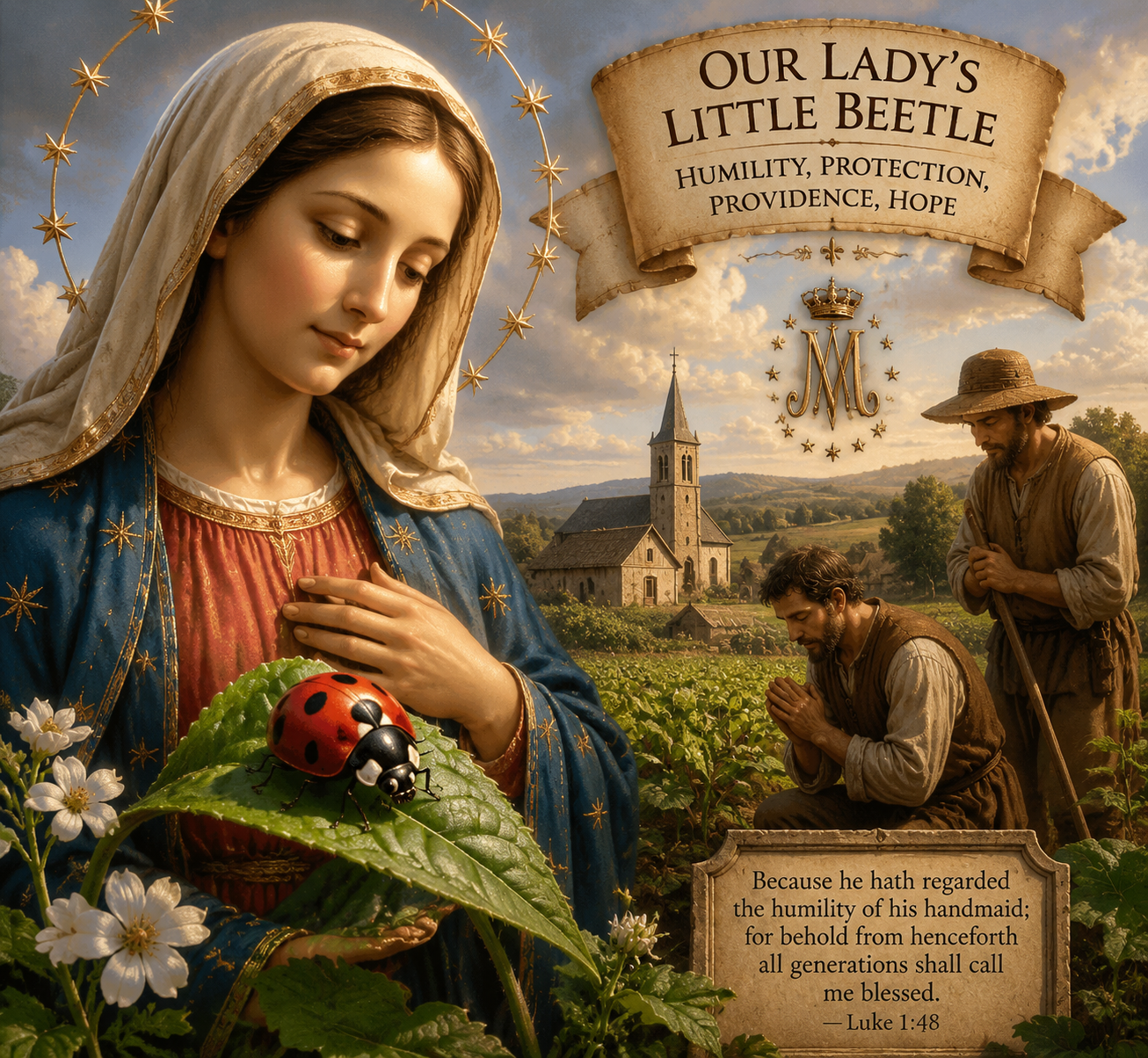
The ladybug is one of the smallest and most familiar creatures in nature. Its bright red wings and gentle appearance have delighted children and gardeners for generations. Yet behind its common name lies an old Catholic tradition connecting this humble insect with the Blessed Virgin Mary.
According to a story passed down in medieval Europe, farmers once faced a serious infestation of insects that threatened to destroy their crops. Their fields were being consumed, and ordinary efforts could not stop the damage. Fearing the loss of their harvest and livelihood, the farmers turned to the Blessed Virgin Mary in prayer and asked for her intercession.
Soon afterward, small red beetles appeared in the fields. These beetles fed upon the aphids and other harmful insects that were attacking the crops. As the pests disappeared, the plants recovered and the harvest was saved.
The grateful farmers saw this deliverance as an answer to their prayers. They began calling the helpful insects “Our Lady’s beetles” or “Our Lady’s birds.” In English, these expressions eventually gave rise to the names “ladybird” and “ladybug,” with the word “Lady” referring not merely to a noblewoman, but traditionally to Our Lady, the Blessed Virgin Mary.
This Marian association can also be found in other European languages. In German, for example, the ladybug is called Marienkäfer, which means “Mary’s beetle.” Such names preserve the memory of a Christian culture in which everyday life, agriculture, nature, and devotion were closely united.
The Ladybug as a Marian Symbol
Over time, Christians began to see spiritual symbolism in the appearance of the ladybug. Its red wings were sometimes associated with the red cloak often worn by the Virgin Mary in Christian art. The dark spots on its wings were also given devotional meanings.
The common seven-spotted ladybug was sometimes connected with the Seven Joys of Mary or the Seven Sorrows of Mary. The Seven Sorrows include the prophecy of Simeon, the flight into Egypt, the loss of the Child Jesus in the Temple, Mary’s meeting with Jesus on the road to Calvary, the Crucifixion, the taking down of Christ’s body from the Cross, and His burial.
These interpretations belong to Catholic folklore and popular devotion. They are not official doctrines of the Church, nor is the story of the farmers considered an authenticated Marian apparition. Nevertheless, such traditions can still carry a beautiful spiritual meaning when they are understood properly.
God Works Through the Small and Humble
The story of the ladybug teaches that God often chooses small and seemingly insignificant things to accomplish great purposes. A tiny beetle, easily overlooked, can protect an entire field by consuming the pests that threaten it.
This reflects a pattern found throughout Sacred Scripture. God chose the young David rather than his stronger brothers. He fed a multitude with five loaves and two fishes. He compared the kingdom of heaven to a mustard seed, one of the smallest seeds known to His listeners. Again and again, God reveals His power through what the world considers weak or unimportant.
The Blessed Virgin Mary herself is the greatest example of holy humility. She did not seek worldly power or recognition. She called herself the handmaid of the Lord and gave herself completely to God’s will. In her Magnificat, she proclaimed:
“Because he hath regarded the humility of his handmaid; for behold from henceforth all generations shall call me blessed.”
—Luke 1:48, Douay-Rheims
Mary’s greatness came not from pride or earthly status, but from her humility, obedience, and complete openness to grace. God exalted her because she humbled herself before Him.
A Sign of Providence and Maternal Care
For Catholics, the ladybug may serve as a simple reminder of divine providence. God cares for His creation, and His wisdom extends even to the smallest creature. Nothing is useless in His design.
The traditional Marian story also recalls the maternal care of Our Lady. Catholics do not worship Mary, for worship belongs to God alone. Rather, they honor her as the Mother of Jesus Christ and ask for her prayers, just as Christians ask one another to pray for them.
When the medieval farmers prayed to Mary, they were asking her to intercede for them before her divine Son. The appearance of the helpful beetles became, in their eyes, a sign of God’s mercy received through prayer.
Whether one encounters the ladybug in a garden, resting upon a leaf, or crawling gently across a hand, it can become an occasion for gratitude. Its smallness reminds us that humble instruments can perform great works. Its usefulness reminds us that every creature has a place in God’s providential order. Its traditional connection with Mary recalls the loving care of the Mother of Christ.
The ladybug is therefore more than a charming insect within Catholic folklore. It is a quiet symbol of humility, protection, providence, and hope. It reminds us that God can answer great needs through the smallest of His creatures, and that no act of faith, no prayer, and no humble servant is insignificant in His sight.