

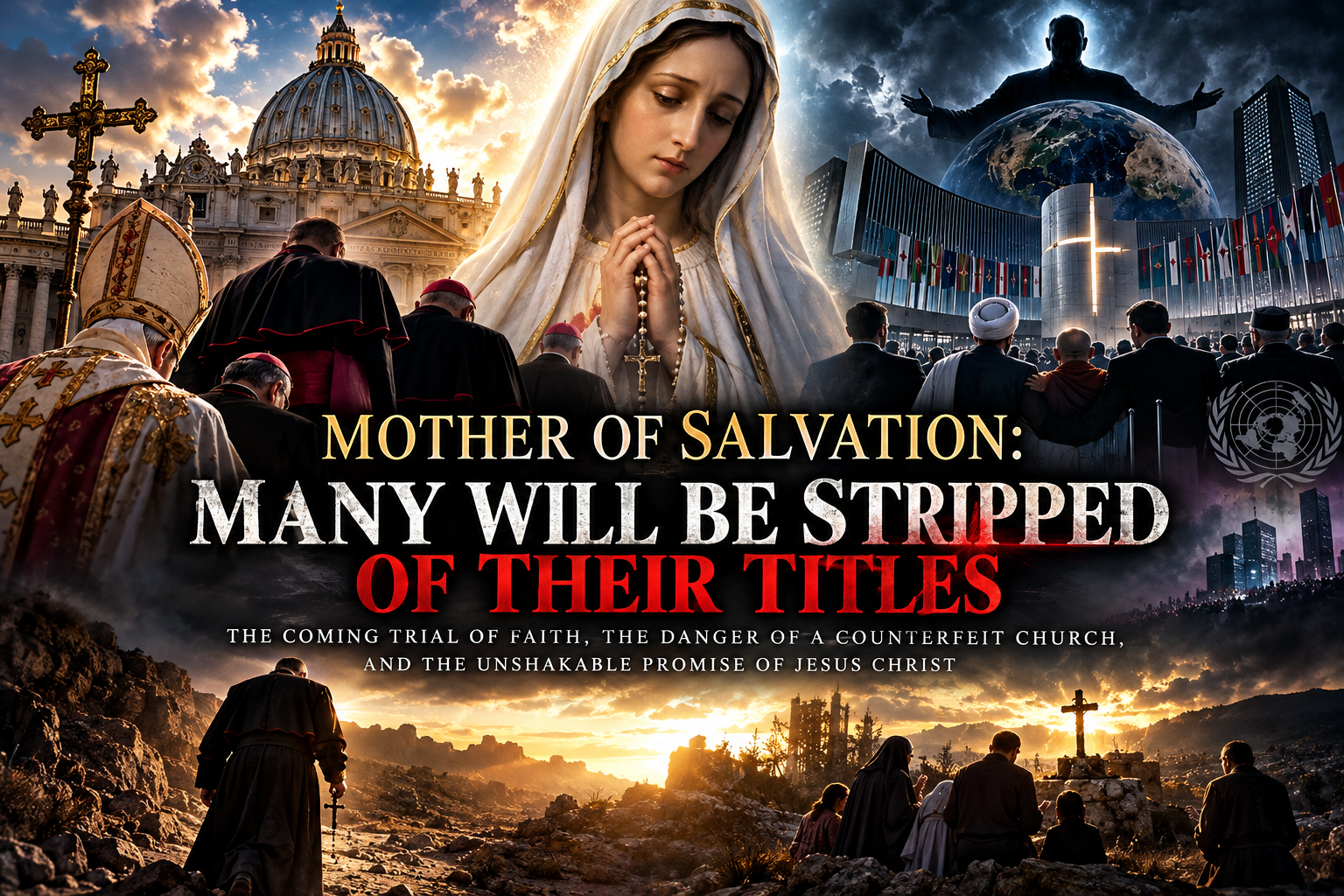
The Coming Trial of Faith, the Danger of a Counterfeit Church, and the Unshakable Promise of Jesus Christ
Faith • Prophecy • Discernment • Catholic Truth
Introduction: When the Church Faces the Test of Fidelity
What happens when religious authority becomes separated from fidelity to Jesus Christ? What happens when the language of compassion is used to excuse sin, when popularity becomes the measure of truth, and when the Church is pressured to accommodate the changing values of the world?
These questions lie at the heart of a message dated October 17, 2014, entitled “Mother of Salvation: Many Will Be Stripped of Their Titles,” published in The Book of Truth, a collection of alleged private revelations associated with Maria Divine Mercy.
The message describes a future period of ecclesiastical upheaval, the humiliation of faithful clergy, the emergence of a new global religious structure, and the perseverance of a smaller community committed to Jesus Christ.
Its imagery is striking. Its warnings are severe. And its principal themes invite examination alongside the Church’s established teaching on apostasy, persecution, false religious promises, and the final trial of the faithful.
However, an essential distinction must be established at the outset.
The Catholic Church has not authenticated these messages as revelations from the Blessed Virgin Mary. On April 16, 2014, Archbishop Diarmuid Martin of Dublin stated that the alleged visions and messages associated with Maria Divine Mercy had no ecclesiastical approval, that many texts contradicted Catholic theology, and that the messages should not be promoted within Catholic Church associations.
Therefore, the following reflection examines the October 17 message as an alleged revelation, not as an established prophecy or an authoritative expression of Catholic doctrine.
The standard by which its claims must be evaluated is not fear, speculation, or apparent agreement with current events. It is the definitive Revelation entrusted to the Church through Sacred Scripture and Sacred Tradition.
The Message of October 17, 2014
MOTHER OF SALVATION: MANY WILL BE STRIPPED OF THEIR TITLES
Friday, October 17, 2014 at 15:30
My dear children, please pray for my Son’s loyal sacred servants as future events take place. Many will be stripped of their titles and sent out into the wilderness, in disgrace. Turmoil and confusion will spread within my Son’s Church, but the traitors will rise in great numbers and many will follow them. Other Christian churches will become close to the newly adapted church and then all will be set in place for a new global religion to rise up. This new form of church will, at first, seem to be a breath of fresh air for many who desire change. Then, it will become clear that it serves only those who want the Laws of God changed in order to suit their sinful lives. This church will lose the entire Faith. It will have all the appearances of a new, renewed church of God, but any symbols, which are meant to glorify my Son, will be nothing of the sort.
Then, as the time becomes ripe, the new one world church will be announced and it will be seen as a great humanitarian institution. It will be intrinsically linked to the world of politics and business. Then those who never belonged to any creed will join it. How they will rejoice, because every sin will be excused and so many people will be relieved, because they will be able to live their lives as they choose. No longer will they have to worry about offending God, because they will not regard sin as something to worry about.
The new church, in order to exude a sense of worthiness, will promote humanitarian works and charities and the whole world will applaud it. Soon afterwards, there will be no distinction made between it and global political alliances and business organisations, dedicated to philanthropy.
Meanwhile, my Son’s True Church, as it was built by Him, will remain alive but weakened. Small in numbers, the Remnant Church will never give up, even when the antichrist takes over.
Pray, pray, pray that my Son’s sacred servants will overcome their fear and stand up to proclaim the Truth, even when their voices are drowned out by those who betray my Son.
Your beloved Mother
Mother of Salvation
Source: The Book of Truth, October 17, 2014, as reproduced by JTM Global.
Attribution Notice: Catholicg33k acknowledges JTM Global (Jesus To Mankind) as the source of the message reproduced above. The accompanying theological commentary and analysis are independently presented by Catholicg33k. Reproduction does not imply affiliation with or endorsement by JTM Global.
1. “Many Will Be Stripped of Their Titles”: The Cost of Fidelity
The opening statement raises a question that has accompanied Christianity since the age of the Apostles: What does it mean to remain faithful when fidelity becomes costly?
The Church’s history contains numerous examples of Christians who suffered imprisonment, exile, the loss of their offices, or martyrdom for refusing to abandon the faith.
Saint Athanasius, the fourth-century Bishop of Alexandria, endured repeated exile amid the Arian controversy, which concerned the divinity of Jesus Christ.
Saint John Fisher, Bishop of Rochester, was executed in AD 1535 after refusing to accept claims of royal supremacy over the Church in England that contradicted his understanding of Catholic faith and ecclesiastical authority.
Such examples demonstrate a foundational Christian principle: the authority of truth does not depend upon worldly recognition.
Saint Paul charged Timothy:
“Preach the word: be instant in season, out of season: reprove, entreat, rebuke in all patience and doctrine.”
— 2 Timothy 4:2, Douay-Rheims
A priest’s vocation is not primarily to achieve public approval. His vocation is to preach Christ, administer the sacraments, care for souls, and faithfully teach what the Church has received.
Yet another distinction is necessary. Not every cleric who loses an ecclesiastical position is a persecuted defender of the faith. Legitimate disciplinary action, including removal from an office, can be necessary to protect the faithful and uphold justice.
Consequently, the removal of a title is not, by itself, evidence of either martyrdom or betrayal.
The fundamental question is whether the person is acting in conformity with divine revelation, Catholic doctrine, justice, and authentic ecclesiastical communion.
Titles may be lost. Human reputations may be destroyed. But the truth of Jesus Christ is not established or overturned by either honor or disgrace.
2. Turmoil Within the Church: Can the Faith Be Changed?
The message describes confusion spreading through the Church and associates that confusion with attempts to change God’s laws.
The concern that Christian teaching might be distorted is not new.
Saint Paul warned that a time would come when people would reject sound doctrine and seek teachers who would accommodate their desires (2 Timothy 4:3–4).
The same Apostle cautioned the Galatians against accepting a different gospel, even if it were proclaimed by a seemingly impressive messenger (Galatians 1:8).
These warnings establish an enduring principle: Christianity is a revealed religion, not a doctrine invented by successive generations.
The Church can deepen her understanding of Revelation, refine theological explanations, reform pastoral practices, and address changing historical circumstances. But she cannot legitimately contradict the definitive Gospel entrusted to her.
The Catechism teaches that public Revelation was completed in Jesus Christ and that no new public revelation is expected before His glorious return (CCC 66).
This does not mean that every discipline, administrative structure, or pastoral method must remain unchanged.
A distinction must be made between authentic development, which preserves and more fully articulates revealed truth, and doctrinal corruption, which denies it.
A genuine renewal of Catholic life should produce a deeper conversion to Christ, greater reverence for the sacraments, clearer teaching, stronger Christian families, and a more faithful practice of charity.
A renewal that denies essential truths about God, the moral law, or the nature of salvation would not be a legitimate development of Catholic doctrine.
The Church must continually reform the lives of her members. She cannot reform Christ into someone other than the Lord revealed in Scripture.
3. The Warning About a “New Global Religion”
One of the most dramatic claims in the message concerns the emergence of a new worldwide religious institution associated with political power, business organizations, and humanitarian initiatives.
Catholic theology does recognize the possibility of religious deception on a profound scale.
The Catechism states:
“Before Christ’s second coming the Church must pass through a final trial that will shake the faith of many believers.”
— Catechism of the Catholic Church, 675
The same paragraph describes an ultimate religious deception offering humanity an apparent solution to its problems at the cost of abandoning the truth.
This teaching deserves serious attention.
It describes the temptation to replace salvation through Jesus Christ with an earthly program that promises human fulfillment apart from God.
Nevertheless, the Catechism does not identify a particular contemporary organization, ecumenical initiative, political movement, or proposed global institution as the Antichrist’s religion.
Nor does Catholic teaching permit the conclusion that every attempt at international cooperation or Christian unity is evidence of apostasy.
The Second Vatican Council explicitly encouraged authentic efforts toward Christian unity in Unitatis Redintegratio, while insisting that the entire Catholic faith must be presented without distortion (UR 11).
Genuine ecumenism seeks unity in truth. Religious indifferentism, by contrast, treats essential doctrinal differences as ultimately unimportant.
Those are not the same thing.
Catholics should be capable of welcoming sincere dialogue and cooperation while rejecting any proposal that requires the denial of Christ’s divinity, His unique saving mission, or the truths of the Catholic faith.
The danger is not cooperation itself.
The danger is any supposed unity that demands the sacrifice of revealed truth.
4. When Humanitarianism Becomes a Substitute for Salvation
Perhaps the most thought-provoking section of the message is its description of a religious institution receiving worldwide applause for its charitable and humanitarian activities.
This raises a significant theological issue: Can human goodness become separated from its ultimate supernatural purpose?
The Church does not regard humanitarian works as suspicious merely because they are publicly praised or conducted in cooperation with secular organizations.
On the contrary, the corporal and spiritual works of mercy are essential expressions of Christian charity.
The Catechism identifies feeding the hungry, sheltering the homeless, clothing the naked, visiting the sick and imprisoned, and caring for those in need as genuine works of mercy (CCC 2447).
Jesus Himself teaches the importance of serving the hungry, the stranger, the sick, and the imprisoned in Matthew 25:31–46.
Therefore, charity is not a distraction from the Christian faith.
It is one of its necessary fruits.
Yet Catholic theology also distinguishes between merely earthly objectives and humanity’s supernatural destiny.
The Church does not exist simply to improve society, administer charitable programs, or make the world more comfortable.
Her fundamental mission is to proclaim Jesus Christ and lead souls toward eternal communion with God.
Political, economic, and humanitarian cooperation can legitimately advance the common good. But none of those activities can replace the Gospel, the sacraments, repentance, sanctifying grace, or the worship owed to God.
The Second Vatican Council teaches that the Church is not identified with any political community or bound to any political system (Gaudium et Spes, 76).
The Church can cooperate with civil institutions without surrendering her supernatural identity.
The proper Catholic response is not to distrust charitable activity. It is to ensure that concern for material suffering does not become an excuse to neglect spiritual suffering.
A hungry person needs bread. A sinner needs reconciliation. A suffering soul needs consolation. Humanity needs justice, mercy, and above all Jesus Christ.
Authentic Christianity never forces us to choose between serving our neighbor and remaining faithful to God.
5. A World in Which Sin Is No Longer Taken Seriously
The message portrays a supposed religious system in which people are told they no longer need to fear offending God.
This theme touches a real and permanent danger in Christian spiritual life: the temptation to separate God’s mercy from conversion.
The Gospel does not proclaim that sin is harmless.
It proclaims that sinners can be forgiven, healed, and transformed through the saving grace of Jesus Christ.
Consider the encounter between Jesus and the woman accused of adultery.
Christ does not abandon her to condemnation. Yet His words are also a call to a new life:
“Neither will I condemn thee. Go, and now sin no more.”
— John 8:11, Douay-Rheims
The two parts of this statement belong together.
Mercy without the invitation to conversion would fail to recognize the seriousness of sin. Moral correction without mercy would fail to reflect the compassionate heart of the Redeemer.
The Catholic Church teaches both the reality of sin and the abundance of divine forgiveness.
Through the Sacrament of Penance, Christ continues His ministry of reconciliation to sinners who repent (CCC 1422–1498).
Saint Paul expresses the relationship between truth and love with remarkable clarity:
“Rejoiceth not in iniquity, but rejoiceth with the truth.”
— 1 Corinthians 13:6, Douay-Rheims
True charity does not celebrate what harms the human soul.
At the same time, the Christian duty to speak truth must never become a pretext for cruelty, contempt, or self-righteousness.
The Church is called to announce both divine justice and divine mercy.
A religious community that denies the reality of sin would betray the Gospel. So would a community that announces condemnation while forgetting Christ’s invitation to repentance and forgiveness.
The mercy of God is not permission to remain enslaved to sin. It is grace offered so that we may be set free.
6. The Remnant Church: A Biblical Reality and a Necessary Caution
The message speaks of a small community of believers persevering amid widespread confusion.
The idea of a faithful remnant appears repeatedly in Sacred Scripture.
In the Old Testament, God preserves His covenant people through periods of infidelity and judgment.
Saint Paul speaks of a remnant according to the election of grace (Romans 11:5).
The New Testament also teaches that Christians must endure persecution and remain faithful through suffering.
But Catholic ecclesiology requires careful distinctions when applying this imagery to the Church.
Jesus promised Saint Peter:
“Upon this rock I will build my church, and the gates of hell shall not prevail against it.”
— Matthew 16:18, Douay-Rheims
This promise is foundational.
The Church may suffer persecution, scandal, internal corruption, and periods of grave disorder. Her members, including members of the clergy, can sin and fall away.
Yet Christ will not permit His Church to be utterly destroyed or to cease being the Church He founded.
This is the doctrine of the Church’s indefectibility.
It would therefore be mistaken to interpret the language of a remnant as proof that the Catholic Church can disappear and be replaced by an independent association of self-designated faithful believers.
Catholic fidelity includes continuity with the apostolic faith, the sacraments, and legitimate ecclesiastical communion.
The Church’s unity with the successor of Saint Peter and the bishops in communion with him is not a disposable administrative arrangement (CCC 815, 837, 882).
Furthermore, no Catholic should assume that membership in a self-described remnant automatically establishes personal holiness or doctrinal correctness.
A person can sincerely believe that he is defending the truth while misunderstanding it.
For this reason, accusations of betrayal against particular bishops, priests, or other Catholics require genuine evidence and careful judgment.
The faithful are called to discernment, not indiscriminate suspicion.
The true measure of Christian fidelity is not how isolated we feel, but how faithfully we remain united to Jesus Christ and the Church He established.
7. The Antichrist and the Church’s Final Trial
The message concludes its account of the remnant with a reference to the Antichrist.
Unlike the particular predictions about titles and worldwide institutions, the Church’s teaching concerning a final trial and the Antichrist belongs to established Catholic doctrine.
In 2 Thessalonians 2:3–12, Saint Paul describes a great rebellion and the manifestation of the man of sin.
The First Epistle of Saint John also discusses the spirit of antichrist and the reality of those who oppose the truth concerning Jesus Christ (1 John 2:18–22; 4:1–3).
The Catechism explains in paragraphs 675–677 that the final trial will involve a religious deception that substitutes human self-glorification for the worship of God.
This is the central theological issue.
The Antichrist’s deception is not merely political power, technological progress, international organization, or social change.
At its heart is a counterfeit claim to salvation.
It is the substitution of something created for the Creator.
Humanity is invited to trust in an apparent earthly deliverance rather than in Jesus Christ, the crucified and risen Savior.
Yet Catholics must also respect the limits of what Revelation makes known.
The Church has not supplied a detailed timetable for the final trial. She has not authorized the faithful to identify every political development or ecclesiastical controversy as its definitive fulfillment.
Christ Himself warns against false prophets and false messianic claims (Matthew 24:23–26).
Thus, proper vigilance involves more than watching external events.
It demands personal holiness, sound doctrine, repentance, prayer, and perseverance.
The final victory belongs not to human ingenuity or to a secretive community with privileged predictions, but to Jesus Christ.
The Church’s ultimate hope is not that she will escape every suffering.
It is that the risen Lord will remain faithful to His promises and bring His people to eternal glory.
8. The Blessed Virgin Mary and the Discernment of Alleged Messages
Because the October 17 text claims to speak in the voice of the Mother of Salvation, particular care is necessary.
Catholics rightly honor the Blessed Virgin Mary as Mother of God and spiritual mother of Christ’s faithful.
At Cana, her direction to the servants captures the essential character of authentic Marian devotion:
“Whatsoever he shall say to you, do ye.”
— John 2:5, Douay-Rheims
Mary always leads souls toward her divine Son.
Her genuine maternal concern cannot be separated from His Gospel, His commandments, His Church, and His saving mission.
This provides an important standard for evaluating claims of Marian messages.
Do they faithfully reflect Catholic doctrine? Do they draw believers toward the sacraments and deeper communion with the Church? Do they encourage humility, hope, prayer, and charity? Or do they promote doctrinal error, fear, division, or hostility toward legitimate ecclesiastical authority?
Saint John commands Christians to test spiritual claims rather than accept them without examination (1 John 4:1).
The Church has an established responsibility to discern alleged supernatural phenomena.
The Dicastery for the Doctrine of the Faith’s 2024 norms emphasize attention to doctrinal accuracy, spiritual fruits, manipulation, and possible harm to ecclesial unity.
The 2014 warning from the Archdiocese of Dublin concerning the wider Book of Truth collection must therefore be taken seriously.
Even if a particular passage addresses subjects found in Scripture or the Catechism, that similarity does not establish its supernatural origin.
A text can contain recognizable Christian themes while also making unsupported predictions or expressing questionable theological conclusions.
No Catholic is obliged to believe these alleged revelations.
Indeed, the appropriate Catholic approach is to judge them by the Church’s public Revelation and authoritative teaching, rather than judging the Church by the alleged revelations.
9. What Should Faithful Catholics Actually Do?
The most important question is not whether every event described in the October 17 message will occur.
It is how Catholics should respond to the real spiritual challenges already identified by Scripture and the Church.
First, Catholics should pray for priests and bishops, asking that they teach faithfully, govern justly, protect the vulnerable, and remain courageous in the face of genuine pressure.
Second, Catholics should study the faith deeply. Sacred Scripture, the Catechism, and the Church’s doctrinal tradition provide a firmer foundation than rumors, speculative interpretations, and claims of hidden prophetic knowledge.
Third, Catholics should frequent the sacraments, especially the Holy Eucharist and the Sacrament of Penance, while cultivating a serious life of prayer.
Fourth, Catholics should practice both truth and charity. Fidelity to doctrine must not become contempt for others. Concern for the poor must not become indifference to sin. Both errors fail to reflect the fullness of Christian discipleship.
Fifth, Catholics should remain vigilant without surrendering to fear. A Christian who becomes obsessed with identifying enemies may lose sight of the Lord he is called to serve.
These are not emergency measures reserved for an imagined future crisis.
They are the ordinary responsibilities of Catholic life.
And they are precisely the disciplines that prepare the soul for extraordinary difficulties, should such difficulties arise.
10. The Greatest Danger Is Forgetting Who the Church Belongs To
The October 17 message presents dramatic images of disgrace, institutional change, apparent religious success, and a community struggling to persevere.
But the deepest Catholic reflection on those themes must return to a much more fundamental truth.
The Church belongs to Jesus Christ.
She was not founded by a committee, a government, a charitable corporation, or a political movement.
Her mission was not invented by public opinion.
She received her life from the saving work of Christ and the outpouring of the Holy Spirit.
The Church exists to glorify the Blessed Trinity, proclaim the Gospel, celebrate the sacraments, and lead humanity toward eternal salvation.
No popularity can replace this mission.
No suffering can erase it.
And no prediction of future upheaval can nullify the promises of the Lord.
Catholics need not deny the seriousness of ecclesiastical crises to remain confident in the Church’s divine foundation.
Nor must they accept unapproved revelations to take seriously the biblical warnings about false teaching, apostasy, and persecution.
The Gospel already provides the foundation for vigilance.
The Catechism already teaches the reality of the Church’s final trial.
The saints already demonstrate the sacrifices that fidelity can demand.
What is needed is not an endless search for hidden signs, but a deeper and more courageous commitment to the faith already revealed.
Conclusion: Faithful to Christ, Whatever May Come
Whether the future brings peace, persecution, confusion, reform, or extraordinary suffering, the Catholic response remains fundamentally the same.
Remain faithful to Jesus Christ.
Love His Blessed Mother.
Pray for His priests.
Defend the truths of the Gospel.
Practice mercy without denying sin.
Seek unity without sacrificing doctrine.
Serve the poor without forgetting their eternal dignity.
Remain in authentic communion with the Church.
And above all, never forget that Christ has already conquered sin and death.
The Church’s hope does not rest on the accuracy of a modern prophecy.
It rests on the Resurrection.
The greatest assurance given to the faithful is not that they will understand every crisis before it arrives.
It is that Jesus Christ remains Lord through every crisis.
The world can strip away honors. History can shake institutions. Human beings can betray their responsibilities. But no earthly power can overturn the final victory of Jesus Christ.
A Prayer for the Faithfulness of the Church
O Blessed Virgin Mary, Mother of God and Mother of the Church, intercede for your children before the throne of your divine Son.
Pray for the Holy Father, for bishops, for priests, for deacons, and for all who are entrusted with the care of souls.
Obtain for them courage in proclaiming the Gospel, humility in exercising authority, purity of heart, fidelity to Catholic doctrine, and perseverance in times of suffering.
Protect the faithful from confusion, false teaching, spiritual pride, hatred, and despair.
Teach us to love the truth without losing charity, to defend the faith without abandoning humility, and to remain obedient to Jesus Christ in every circumstance.
May the Holy Spirit guide the Church through every trial, strengthen those who suffer for righteousness, and preserve us in faith, hope, and love.
Through your maternal intercession, lead us always to Jesus, who lives and reigns forever and ever.
Amen.
Catholic Sources and References
I. Sacred Scripture — Douay-Rheims Bible
- Matthew 16:18 — Christ’s promise that the gates of hell shall not prevail against His Church.
- Matthew 24:23–26 — The warning against false Christs and false prophets.
- Matthew 25:31–46 — Christ’s teaching on the works of mercy and the Last Judgment.
- John 2:5 — The Blessed Virgin Mary’s instruction to obey Jesus Christ.
- John 8:11 — Divine mercy and the command to abandon sin.
- Romans 11:5 — The remnant according to the election of grace.
- Galatians 1:8–9 — Saint Paul’s warning against a different gospel.
- 1 Corinthians 13:4–7 — The relationship between charity and truth.
- 2 Thessalonians 2:3–12 — The rebellion, the man of sin, and the deception of those who reject the truth.
- 2 Timothy 4:2–5 — The obligation to preach sound doctrine in season and out of season.
- 1 John 2:18–22 — The teaching concerning antichrist and the denial of Christ.
- 1 John 4:1–3 — The command to test the spirits.
- Apocalypse 12:17 — The dragon’s war against those who keep God’s commandments and hold the testimony of Jesus Christ.
- Apocalypse 13:1–18 — The beast, religious deception, and the persecution of the saints.
- Apocalypse 21:1–4 — The new heaven and the new earth, and the final victory of God.
II. Catechism of the Catholic Church
- CCC 66–67 — The completion of public Revelation and the proper place of private revelations.
- CCC 675 — The final trial of the Church and the religious deception associated with the Antichrist.
- CCC 676 — False messianism and the rejection of attempts to realize the final Kingdom of God through merely historical or political means.
- CCC 677 — The Church’s final Passover and the ultimate victory of God.
- CCC 815–816 — The unity of the Church and its foundation in Jesus Christ.
- CCC 837 — The bonds of full communion within the Catholic Church.
- CCC 882 — The office of the Roman Pontiff as successor of Saint Peter.
- CCC 1422–1498 — The Sacrament of Penance and Reconciliation.
- CCC 2447 — The corporal and spiritual works of mercy.
III. Ecumenical Councils and Magisterial Documents
Second Vatican Council, Lumen Gentium (November 21, 1964)
Paragraphs 8 and 14 address the visible and spiritual reality of the Church and the necessity of persevering in ecclesiastical communion.
Second Vatican Council, Dei Verbum (November 18, 1965)
Paragraphs 4 and 10 explain the definitive character of God’s Revelation in Jesus Christ and the Church’s responsibility to guard and authentically interpret the deposit of faith.
Second Vatican Council, Unitatis Redintegratio (November 21, 1964)
Paragraph 11 addresses the proper presentation of Catholic doctrine within authentic ecumenical dialogue.
Second Vatican Council, Gaudium et Spes (December 7, 1965)
Paragraph 76 distinguishes the Church’s mission from political authority while recognizing legitimate cooperation for the common good.
Pope Saint John Paul II, Veritatis Splendor (August 6, 1993)
Paragraphs 32–35 address the relationship between freedom, truth, conscience, and the moral law. Paragraphs 84–87 discuss moral truth and the Church’s witness amid contemporary challenges.
Pope Benedict XVI, Deus Caritas Est (December 25, 2005)
Paragraphs 25–29 explain why charitable service belongs to the Church’s essential mission while remaining distinct from the proper responsibilities of political society.
IV. Ecclesiastical Guidance on Alleged Revelations
Archdiocese of Dublin, Statement Concerning the Alleged Visionary “Maria Divine Mercy,” April 16, 2014.
Archbishop Diarmuid Martin stated that the alleged messages and visions had no ecclesiastical approval, that many texts contradicted Catholic theology, and that the messages should not be promoted or used within Catholic Church associations.
Dicastery for the Doctrine of the Faith, Norms for Proceeding in the Discernment of Alleged Supernatural Phenomena, May 17, 2024.
These norms establish procedures for ecclesiastical examination of alleged apparitions, visions, and messages, including evaluation of doctrinal consistency, spiritual fruits, and risks to the faithful.
V. Message Examined
The Book of Truth, attributed to Maria Divine Mercy.
“Mother of Salvation: Many Will Be Stripped of Their Titles.”
October 17, 2014, 15:30.
Text reproduced as supplied from JTM Global.
This alleged message is discussed for theological examination and comparison with Catholic teaching. Its reproduction does not constitute ecclesiastical approval or affirmation of supernatural origin.
Final Editorial Reflection from Catholicg33k
The Catholic Church has never promised that her earthly pilgrimage would be free from suffering, deception, scandal, or persecution.
What she has received is something infinitely greater: the promise that Jesus Christ will remain with His Church and that the powers of hell will never finally overcome her.
Our responsibility is not to surrender to fear or to seek certainty in every alleged prophecy.
Our responsibility is to know the faith, live the faith, defend the faith with charity, and entrust ourselves completely to Jesus Christ.
Be vigilant in faith. Courageous in truth. Steadfast in charity. Faithful to Christ.
Catholicg33k — Exploring Catholic Faith, Scripture, Tradition, and the Questions That Matter for Eternity.
Ad Majorem Dei Gloriam — For the Greater Glory of God.
Sources:
Original October 17, 2014 message
Archdiocese of Dublin’s official statement