

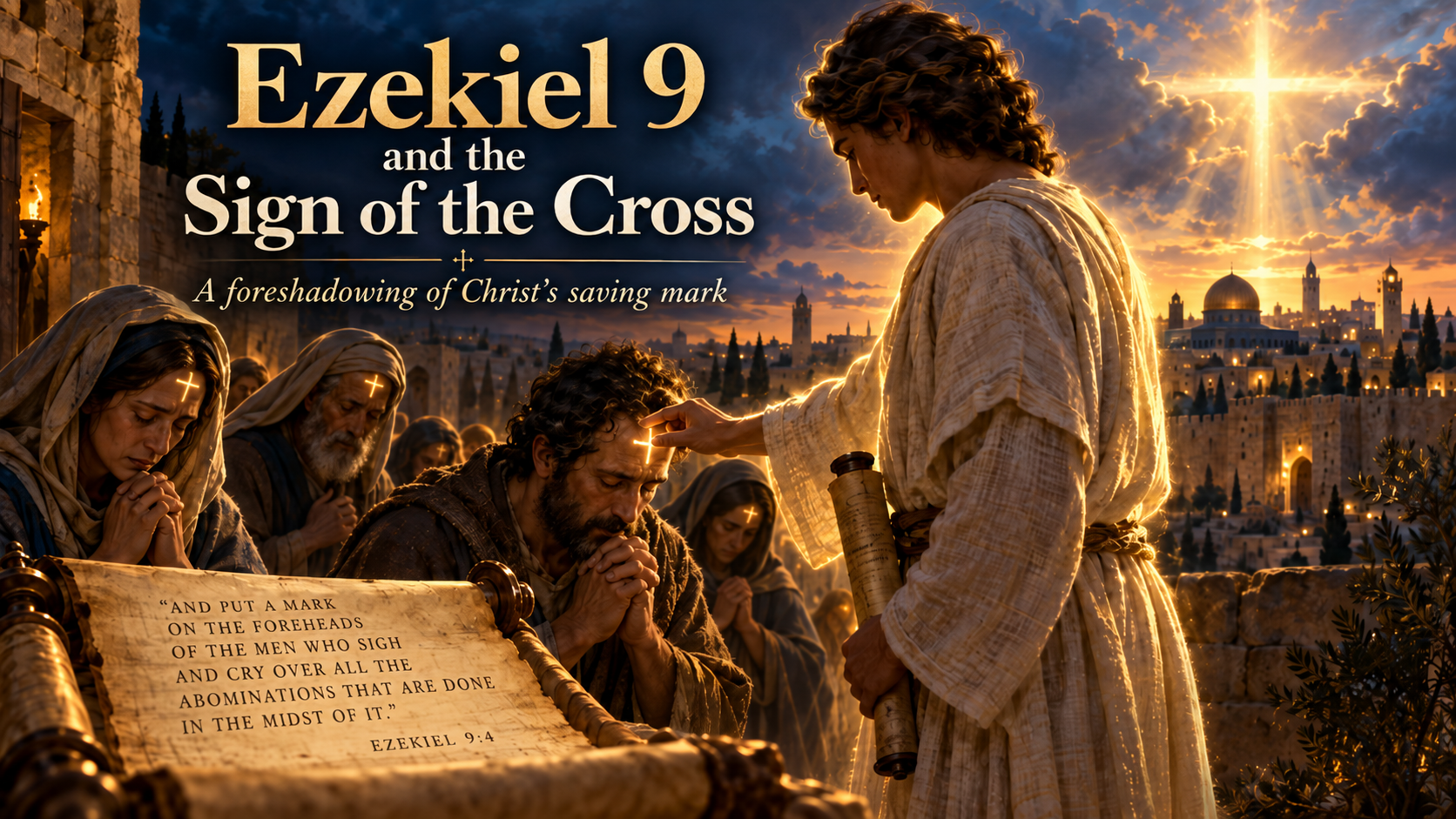
There is a mysterious scene in Ezekiel that Christians have been reflecting on for centuries.
Before judgment falls upon Jerusalem, God commands the man clothed in linen:
“Go through the midst of the city, through the midst of Jerusalem: and mark Thau upon the foreheads of the men that sigh, and mourn for all the abominations that are committed in the midst thereof.”
—
That little word “Thau” is incredibly interesting.
The Hebrew word is tav (ת), the final letter of the Hebrew alphabet. In the ancient Hebrew script used centuries before the modern square Hebrew letters became standard, tav could be written in a cross-like form, something resembling + or ×.
So God tells His messenger to place a tav upon the foreheads of those who belong to Him—those who mourn over sin—and those bearing the mark are spared from the coming judgment.
For Christians, it was difficult not to see something deeper here.
The Early Christians Saw the Cross
Around AD 200, Tertullian explicitly connected Ezekiel’s Tau/Tav with the Cross of Christ. Discussing Ezekiel 9, he pointed to the Greek letter Tau (Τ) and described it as having the form of the Cross that Christians traced upon their foreheads.
— Tertullian, Against Marcion, Book III, chapter 22
The Church was not claiming that Ezekiel understood the entire mystery of Calvary centuries beforehand.
Rather, Christians read Ezekiel in the light of Christ.
What appeared first as a mysterious saving mark becomes striking after Jesus:
a sign placed upon the forehead,
a people separated from sin,
judgment passing over those who bear the sign,
and a cross-shaped letter associated with their preservation.
And then the New Testament gives us another remarkable image.
In Revelation, God’s servants are marked upon their foreheads before judgment:
“Hurt not the earth, nor the sea, nor the trees, till we sign the servants of our God in their foreheads.”
— Apocalypse 7:3
Later, St. John sees the Lamb with His people:
“Having his name, and the name of his Father, written on their foreheads.”
— Apocalypse 14:1
Ezekiel’s mark begins to look like part of a much larger biblical pattern.
And Then Comes Baptism
At Baptism, the Church does something beautiful.
Before the newly baptized belongs visibly to the sacramental life of Christ, he is marked with the Sign of the Cross.
The Catechism explains:
“The sign of the cross, on the threshold of the celebration, marks with the imprint of Christ the one who is going to belong to him.”
— Catechism of the Catholic Church, §1235
Think about that.
Ezekiel: God’s servants are marked on their foreheads.
Revelation: God’s servants are sealed on their foreheads.
Baptism: the Christian is marked with the Cross of Christ.
What was shadow becomes clearer in Christ.
The Cross Is Not Just Decoration
This makes me think differently about something Catholics do almost automatically:
“In the name of the Father, and of the Son, and of the Holy Ghost. Amen.”
We touch our forehead.
We trace the Cross over ourselves.
Sometimes we do it so quickly that we barely notice what we are saying with our bodies.
But the Sign of the Cross is a confession.
It says:
I belong to Jesus Christ.
The Cross that once represented shame and execution has become the sign of our salvation.
Christ took the instrument of death and made it the Tree of Life.
So when I make the Sign of the Cross, I should remember that I am not performing some random Catholic gesture.
I am placing myself beneath the mystery by which I was redeemed.
I am reminding myself whose name I bear.
I am remembering the seal placed upon me in Baptism.
And I am declaring that when the world tells me to compromise, I want to remain among those who “sigh and mourn” over sin rather than make peace with it.
Ezekiel 9 ultimately challenges me with a question:
If God’s people are marked as belonging to Him, does my life actually look like I belong to Him?
The Cross on my forehead means very little if I refuse the Cross in my life.
To bear Christ’s mark means learning to die to sin, choosing holiness when nobody sees, repenting when I fall, carrying suffering faithfully, and refusing to be ashamed of Jesus Christ.
The Catechism says:
“The Christian begins his day, his prayers, and his activities with the Sign of the Cross… The sign of the cross strengthens us in temptations and difficulties.”
— CCC §2157
So make it slowly.
Make it intentionally.
In the name of the Father,
and of the Son,
and of the Holy Ghost.
Amen.
Remember the mark.
Remember your Baptism.
Remember whose you are.
And above all—
remember the Cross.
— Catholicg33k
Sources:
Ezechiel 9:4, Douay-Rheims
Apocalypse 7:3; 14:1, Douay-Rheims
Tertullian, Adversus Marcionem (Against Marcion), III.22
Catechism of the Catholic Church, §§1235, 2157