

When Jesus taught His disciples to pray, He gave them the words:
“Give us this day our supersubstantial bread.”
—Matthew 6:11, Douay-Rheims
Many Christians understand this petition as a simple request for ordinary food and daily necessities. That interpretation is certainly correct. Jesus teaches us to depend upon our heavenly Father for everything we need, one day at a time.
However, it does not follow that Matthew 6:11 has nothing to do with Holy Communion. From the earliest centuries of Christianity, Catholics have recognized that this petition has both a material meaning and a deeper Eucharistic meaning.
It is not a matter of choosing between daily food and the Eucharist. The petition embraces both.
Dependence on God for Every Need
The Lord’s Prayer teaches complete reliance upon God.
We do not pray for a lifetime supply of bread. We pray for bread “this day.” Christ teaches us to trust the Father continually rather than placing our ultimate confidence in wealth, possessions, or our own abilities.
This agrees with the rest of the Sermon on the Mount. Jesus tells His disciples not to be anxious about food, drink, or clothing because their heavenly Father knows what they need.
“Be not solicitous therefore, saying: What shall we eat: or what shall we drink, or wherewith shall we be clothed? … For your Father knoweth that you have need of all these things.”
—Matthew 6:31–32
Catholics fully affirm this meaning. The Catechism explains that the petition concerns the earthly nourishment necessary for everyone’s subsistence and also calls Christians to share with those in need.
“Daily bread” includes food, shelter, health, work, peace, and every other good that comes from God’s providence.
But the meaning does not stop there.
The Mystery of Epiousios
The Greek word translated as “daily” is epiousios. It is an unusual word, appearing in the New Testament only in the Lord’s Prayer in Matthew 6:11 and Luke 11:3.
Because the word is so rare, its exact meaning has long been discussed. It may indicate bread necessary for the day, bread for the coming day, or bread that is above ordinary substance.
St. Jerome, when translating the Gospel of Matthew into Latin, rendered the phrase as panem nostrum supersubstantialem—“our supersubstantial bread.”
That translation points beyond ordinary food. It suggests heavenly bread, spiritual nourishment, and ultimately the Eucharist.
The Douay-Rheims Bible preserves this traditional rendering:
“Give us this day our supersubstantial bread.”
—Matthew 6:11
The word “supersubstantial” does not deny the literal meaning of daily food. Rather, it opens the petition to its fullest Christian meaning. We ask God for the bread that sustains the body and for the heavenly Bread that sustains the soul.
Jesus Is the Bread from Heaven
The Eucharistic meaning of Matthew 6:11 becomes clearer when the passage is read in light of John 6.
After multiplying the loaves, Jesus warns the crowd not to seek only material food:
“Labour not for the meat which perisheth, but for that which endureth unto life everlasting, which the Son of man will give you.”
—John 6:27
Jesus then identifies Himself as the true Bread from heaven:
“I am the bread of life: he that cometh to me shall not hunger.”
—John 6:35
He speaks even more plainly:
“I am the living bread which came down from heaven. If any man eat of this bread, he shall live for ever: and the bread that I will give, is my flesh, for the life of the world.”
—John 6:51–52
Christ does not merely give bread. He is the Bread of Life. The bread He gives is His flesh.
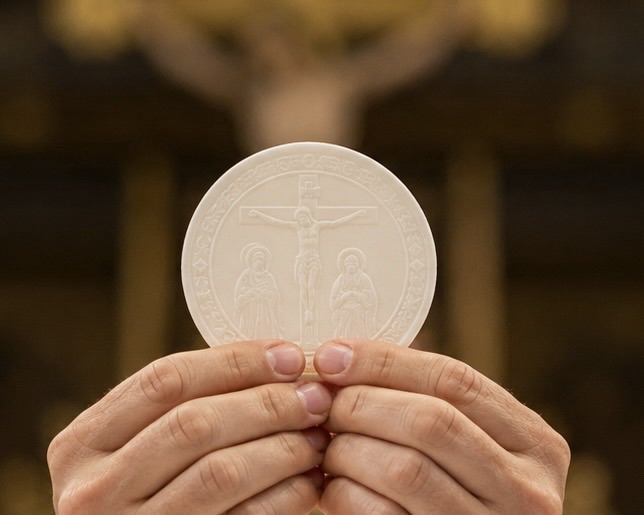
For this reason, Christians have historically understood “daily bread” as including the Eucharist. When the Church prays the Our Father during the Mass, shortly before Holy Communion, the petition takes on an especially powerful meaning. The faithful ask the Father to give them the Bread of Heaven: the Body, Blood, Soul, and Divinity of Jesus Christ.
The Witness of the Early Church
The Eucharistic interpretation of the Lord’s Prayer is not a later Catholic invention.
St. Cyprian of Carthage, writing in the third century, taught that Christ is our Bread because He is the Bread of Life. He connected the petition directly with receiving Christ’s Body in the Eucharist:
“Christ is the bread of life; and this bread does not belong to all men, but it is ours.”
—St. Cyprian, On the Lord’s Prayer, 18
St. Cyril of Jerusalem also understood the petition sacramentally. In his catechetical teaching, he explained that ordinary bread is not “supersubstantial,” while the holy Bread of the Eucharist is appointed for the substance of the soul.
St. Augustine likewise recognized that “daily bread” may refer both to the necessities of this life and to the sacramental Bread received by Christians.
The Fathers did not believe that one meaning excluded the other. They saw Scripture as rich enough to contain multiple complementary senses under the inspiration of the Holy Ghost.
The Teaching of the Catechism
The Catechism of the Catholic Church gathers these meanings together.
It teaches that “our bread” refers first to the earthly nourishment necessary for life. Yet it also presents the deeper Christian meaning of the petition:
“Taken literally, epiousios means ‘super-essential,’ and refers directly to the Bread of Life, the Body of Christ, the ‘medicine of immortality,’ without which we have no life within us.”
—Catechism of the Catholic Church, 2837
The Catechism therefore does not force us to choose between ordinary bread and the Eucharist.
The petition includes:
- the food needed for bodily life,
- the Word of God that nourishes faith,
- and the Eucharistic Bread that communicates eternal life.
This is the fullness of Catholic interpretation.
Not Either-Or, but Both-And
A common mistake in biblical interpretation is assuming that a passage can have only one meaning.
Matthew 6:11 certainly teaches us to rely on God for our daily needs. But that truth does not eliminate its Eucharistic meaning.
Catholic interpretation is often both-and rather than either-or.
We ask for daily bread because we are dependent creatures.
We ask for the Word of God because “not in bread alone doth man live, but in every word that proceedeth from the mouth of God” (Matthew 4:4).
We ask for the Eucharist because Christ is the living Bread that came down from heaven.
Material food preserves natural life for a time. The Eucharist nourishes the supernatural life of grace and prepares us for eternal life.
The Greatest Bread God Gives
Every good gift comes from the Father. The food on our tables, the work of our hands, the strength of our bodies, and the help we receive each day are all expressions of His providence.
But the greatest gift the Father gives is His Son.
In the Eucharist, Jesus does not give us a symbol of Himself or a mere reminder of the Last Supper. He gives us Himself substantially under the appearances of bread and wine.
That is why “Give us this day our daily bread” can be prayed with Eucharistic longing.
We are asking:
Father, provide what we need for today.
Feed the hungry.
Strengthen the weak.
Give us Your Word.
Preserve us in grace.
And above all, give us Jesus Christ, the true Bread from heaven.
Matthew 6:11 is therefore not less about trusting God when it is understood Eucharistically. It is more fully about trusting God, because it recognizes that we depend upon Him not only for the life of the body, but also for the life of the soul.
The petition is not about ordinary bread instead of Communion.
It is about every bread that comes from God—with the Holy Eucharist as the highest and most perfect Bread He gives.
Sources and Further Reading
Sacred Scripture
- Matthew 4:4; 6:11, 25–34
- Luke 11:3
- John 6:27, 32–35, 48–58
- 1 Corinthians 10:16–17; 11:23–29
Scripture quotations are from the Douay-Rheims Bible.
Catechism of the Catholic Church
- CCC 2828–2837 — “Give Us This Day Our Daily Bread”
- CCC 2835 — The hunger for the Word of God
- CCC 2837 — Epiousios, the “super-essential” Bread of Life and the Body of Christ
- CCC 1324–1327 — The Eucharist as the source and summit of the Christian life
- CCC 1374 — Christ’s substantial presence in the Holy Eucharist
Fathers of the Church
- St. Cyprian of Carthage, On the Lord’s Prayer, 18
- St. Cyril of Jerusalem, Mystagogical Catechesis V, 15, also numbered Catechetical Lecture XXIII, 15
- St. Augustine of Hippo, Our Lord’s Sermon on the Mount, Book II, chapter 7, paragraph 25
- Tertullian, On Prayer, 6
- St. John Cassian, Conferences, IX, 21
- St. John Damascene, An Exact Exposition of the Orthodox Faith, Book IV, chapter 13
Biblical and Liturgical Texts
- St. Jerome, Latin Vulgate, Matthew 6:11: Panem nostrum supersubstantialem da nobis hodie
- Roman Missal, Order of Mass: the Lord’s Prayer and the rites immediately preceding Holy Communion
Recommended Citation
Catechism of the Catholic Church, 2nd ed. Washington, DC: United States Conference of Catholic Bishops, 2000, paragraphs 2828–2837.
St. Cyprian of Carthage. On the Lord’s Prayer, 18.
St. Cyril of Jerusalem. Mystagogical Catechesis V, 15.
St. Augustine of Hippo. Our Lord’s Sermon on the Mount, II.7.25.
St. Jerome. Biblia Sacra Vulgata, Matthew 6:11.