

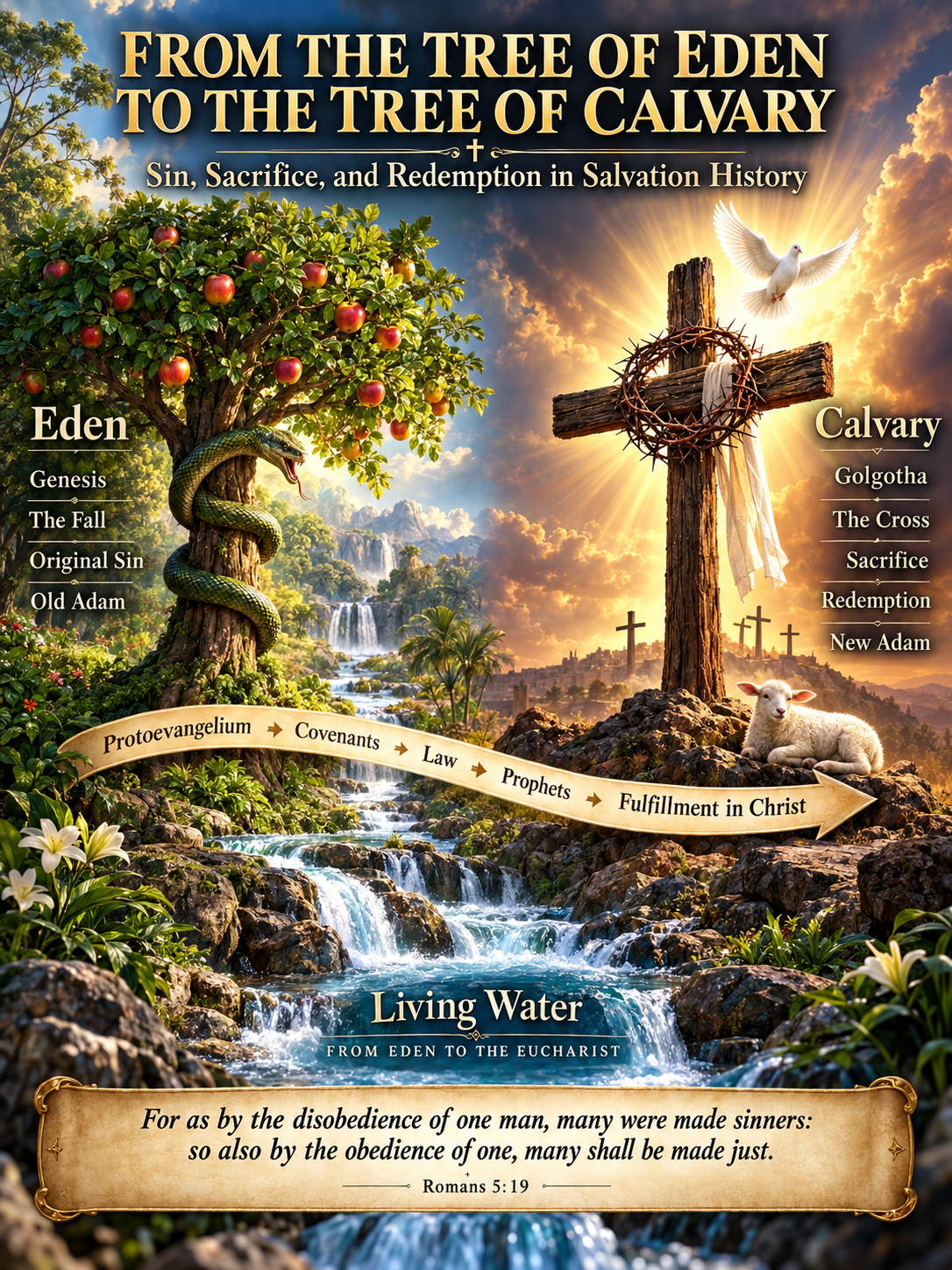
The Divine Mystery of Sin, Sacrifice, and Redemption
How the disobedience of the first Adam was overcome by the perfect obedience of Jesus Christ, the New Adam—and how the Cross became the Tree of Eternal Life.
“For as by the disobedience of one man, many were made sinners: so also by the obedience of one, many shall be made just.”
The entire history of salvation can be contemplated through the mystery of two trees: the tree associated with humanity’s fall in the Garden of Eden and the wood of the Holy Cross upon which Jesus Christ accomplished our redemption.
Between these two trees unfolds the greatest drama in human history:
Creation and rebellion.
Judgment and mercy.
Covenant and sacrifice.
Death and resurrection.
And ultimately, the restoration of humanity through the infinite love of God.
Sacred Scripture is not simply a collection of ancient religious writings, moral teachings, historical accounts, and prophetic announcements. It is one unified divine revelation, progressively unfolding the eternal plan of God to bring humanity into communion with Himself through His beloved Son, Jesus Christ.
From Genesis to the Apocalypse, one magnificent truth illuminates the whole of salvation history:
God created humanity for communion with Himself, and when humanity fell through sin, He freely chose to redeem us through the Incarnation, Passion, Death, and Resurrection of His only-begotten Son.
The Catechism of the Catholic Church expresses this beautifully:
“The whole of divine Scripture is but one book, and this one book is Christ.”
— CCC 134
To understand the astonishing depths of Calvary, we must first return to the beginning—to the garden where humanity first experienced the terrible consequences of disobedience.
1. Eden: When Humanity Turned Away From Divine Love
In the beginning, God created the heavens and the earth.
Among His visible creatures, He fashioned man in His own image and likeness, giving humanity the extraordinary dignity of an intellect capable of knowing truth and a free will capable of choosing the good.
Man was not created for misery.
He was not created for corruption.
He was not created for separation from God.
Humanity was created to know God, love Him, serve Him, and enjoy eternal communion with Him.
Adam and Eve originally lived in a state of original holiness and justice. They possessed sanctifying grace and enjoyed harmony with God, within themselves, with one another, and with creation.
The Church teaches that this original harmony included freedom from the suffering and death associated with fallen humanity.
See CCC 374–379.
Within Eden stood two particularly significant trees:
the Tree of Life and the Tree of the Knowledge of Good and Evil.
Genesis 2:9
This distinction matters.
The Tree of Life represented the divine gift of life.
The prohibition concerning the Tree of the Knowledge of Good and Evil represented a genuine test of humanity’s free obedience to God.
God had given Adam and Eve extraordinary freedom. Yet He also established a boundary reminding them of a fundamental truth:
They were creatures, and He was the Creator.
The command was not an arbitrary restriction imposed by a jealous deity.
It expressed the truth that human happiness comes from receiving goodness from God—not attempting to define good and evil independently of Him.
Then came the serpent.
He introduced the ancient lie that continues to haunt humanity:
Obedience to God prevents you from becoming truly free.
Adam and Eve accepted the deception.
Their sin was deeper than simply eating forbidden fruit.
At its heart was the preference of the creature’s will over the will of the Creator.
The Catechism explains:
“Man, tempted by the devil, let his trust in his Creator die in his heart and, abusing his freedom, disobeyed God’s command.”
— CCC 397
That is the tragedy of original sin.
Humanity attempted to seize through pride what could only be received through grace.
And everything changed.
2. The Catastrophe of Original Sin
The original harmony was shattered.
Sanctifying grace was lost.
The intellect became darkened.
The will became weakened.
Human nature became wounded.
Suffering entered human experience.
Death entered the human condition.
Saint Paul writes:
“Wherefore as by one man sin entered into this world, and by sin death; and so death passed upon all men, in whom all have sinned.”
— Romans 5:12
Original sin must be properly understood.
The Catholic Church does not teach that every newborn child personally committed Adam’s sin.
Original sin is instead the inherited deprivation of original holiness and justice.
See CCC 404–405.
Humanity had been wounded at its source.
Yet precisely when mankind appeared to have lost everything, God revealed the first promise of redemption.
3. The Protoevangelium: The First Gospel
After the Fall, God spoke these mysterious words to the serpent:
“I will put enmities between thee and the woman, and thy seed and her seed: she shall crush thy head, and thou shalt lie in wait for her heel.”
Catholic tradition recognizes this passage as the Protoevangelium—the “First Gospel.”
It is the first announcement of the victory that would ultimately be accomplished through Jesus Christ.
The Catechism identifies this passage with the coming of the New Adam whose obedience would overcome Adam’s disobedience.
See CCC 410–411.
And here, almost immediately after the Fall, we begin to see the great pattern of salvation history.
Adam and Christ.
Eve and Mary.
The serpent and the Redeemer.
The tree of disobedience and the Tree of the Cross.
4. Mary: The New Eve
Saint Irenaeus of Lyons famously taught that the knot created by Eve’s disobedience was untied through Mary’s obedience.
Where Eve listened to the serpent and turned away from God, Mary listened to the angel and surrendered herself completely to God.
At the Annunciation she proclaimed:
“Behold the handmaid of the Lord; be it done to me according to thy word.”
— Luke 1:38
Through Eve’s disobedience, humanity’s fall entered history.
Through Mary’s faithful fiat, the eternal Son of God entered human history as our Redeemer.
Mary does not redeem mankind independently of Christ.
Jesus Christ alone is the divine Redeemer.
Mary’s participation in salvation history depends entirely upon the grace and merits of her Son.
See CCC 970.
Yet the contrast remains magnificent:
Eve said no. Mary said yes.
And through Mary’s yes, the New Adam entered the world.
5. The Old Testament Was Preparing the World for Christ
After the Fall, God did not abandon humanity.
Across centuries, He progressively revealed His saving plan through covenants, sacrifices, prophecies, kings, priests, temples, and sacred institutions.
With Noah came the covenant preserving creation.
With Abraham came the promise that the nations would be blessed through his descendants.
With Moses came the Law and the formation of Israel as a covenant people.
With David came the promise of an everlasting kingdom.
None of these events existed in isolation.
They formed one unfolding divine plan.
Everything was moving toward Christ.
6. The Passover Lamb Points Toward Calvary
The Passover is one of the clearest examples.
The Israelites were commanded to sacrifice a lamb.
Its blood marked their homes.
Through that sign, they were spared from death and liberated from slavery.
Centuries later Saint Paul would proclaim:
“For Christ our pasch is sacrificed.”
— 1 Corinthians 5:7
The Passover lamb was a shadow.
Christ is the fulfillment.
The blood of the lamb delivered Israel from temporal slavery.
The Precious Blood of Jesus delivers humanity from the slavery of sin.
The sacrifices of the Mosaic covenant likewise prepared mankind to understand the meaning of Christ’s sacrifice.
Hebrews teaches that repeated animal sacrifices could not accomplish the definitive removal of sin.
Christ offered something infinitely greater.
He offered Himself.
7. Isaias Saw the Suffering Messiah
Centuries before Calvary, the prophet Isaias proclaimed:
“But he was wounded for our iniquities, he was bruised for our sins: the chastisement of our peace was upon him, and by his bruises we are healed.”
— Isaias 53:5
The suffering servant finds his supreme fulfillment in Jesus Christ.
The Old Testament therefore prepares the New Testament.
The Law reveals the holiness of God.
The prophets announce judgment and restoration.
The sacrifices prefigure Christ.
The Davidic kingdom anticipates His eternal kingship.
Israel’s entire sacred history prepares the world for the Incarnation.
As Dei Verbum teaches, the Old Testament prepares for and prophetically announces the coming of Christ.
See Dei Verbum 15–16.
The Old Testament is not discarded by Jesus Christ. It is fulfilled in Him.
8. Adam and Christ: The Two Heads of Humanity
Saint Paul gives us one of Christianity’s deepest theological insights:
“For as in Adam all die, so also in Christ all shall be made alive.”
— 1 Corinthians 15:22
Adam stands at the head of fallen humanity.
Christ stands at the head of redeemed humanity.
Adam received life.
Christ gives life.
Adam disobeyed in a garden.
Christ accepted the Father’s will in Gethsemani.
Adam succumbed to temptation.
Christ defeated the tempter.
Adam’s sin brought death.
Christ’s obedience brings eternal life.
Saint Paul writes:
“Therefore, as by the offence of one, unto all men to condemnation; so also by the justice of one, unto all men to justification of life.”
— Romans 5:18
And again:
“For as by the disobedience of one man, many were made sinners: so also by the obedience of one, many shall be made just.”
— Romans 5:19
This is the great reversal.
What Adam destroyed through disobedience, Christ restores through obedience.
9. Calvary: The New Tree of Life
Now we arrive at the center of salvation history.
Golgotha.
Calvary.
The Cross.
Saint Peter writes:
“Who his own self bore our sins in his body upon the tree: that we, being dead to sins, should live to justice: by whose stripes you were healed.”
— 1 Peter 2:24
Christian tradition therefore sees the Cross as the new Tree of Life.
This does not mean that the Cross was literally constructed from Eden’s Tree of Life.
The connection is theological and typological.
But the symbolism is breathtaking.
At the first tree, humanity reached out in disobedience.
At the Cross, Christ stretched out His arms in obedience.
At Eden, pride brought death.
At Calvary, humility opened the way to life.
At Eden, Satan whispered that humanity could become like God by rejecting Him.
At Calvary, God Himself revealed that true greatness is found in perfect self-giving love.
Saint Paul writes of Christ:
“He humbled himself, becoming obedient unto death, even to the death of the cross.”
— Philippians 2:8
The Cross is therefore not merely the tragic execution of an innocent man.
It is the voluntary sacrificial self-offering of the incarnate Son of God.
10. Justice and Mercy Meet at the Cross
The Cross reveals two realities simultaneously:
The horrifying seriousness of sin and the unfathomable greatness of divine mercy.
Sin is not simply psychological weakness.
It is a moral offense against God.
Mortal sin destroys charity within the soul when committed with grave matter, full knowledge, and deliberate consent.
See CCC 1855–1861.
Humanity cannot redeem itself.
No collection of human achievements can erase the wound of sin.
We needed a Redeemer.
And because Jesus Christ is both true God and true man, His human sacrifice possesses an incomparable saving value.
Saint Thomas Aquinas explains that the Passion of Christ saves us through merit, satisfaction, sacrifice, redemption, and efficient causality.
See Summa Theologiae, III, q. 48.
But Calvary must never be portrayed as though an angry Father were punishing an unwilling Son.
The Father loves.
The Son freely offers Himself.
The Holy Spirit is inseparably present in the one saving work of God.
The Cross reveals the love of the Most Holy Trinity.
“For God so loved the world, as to give his only begotten Son.”
— John 3:16
11. Blood and Water: The Sacramental Life of the Church
After Jesus died, Saint John records:
“But one of the soldiers with a spear opened his side, and immediately there came out blood and water.”
— John 19:34
The Church has always contemplated the sacramental significance of this mystery.
The Catechism teaches:
“The blood and water that flowed from the pierced side of the crucified Jesus are types of Baptism and the Eucharist, the sacraments of new life.”
— CCC 1225
From the side of the New Adam flows the sacramental life of the Church.
Baptism communicates new life.
The Eucharist nourishes that life.
Here the imagery of the Tree of Life becomes even more profound.
Humanity had been expelled from Eden and denied access to the Tree of Life.
But Christ now gives Himself as heavenly food.
Jesus declares:
“He that eateth my flesh, and drinketh my blood, hath everlasting life: and I will raise him up in the last day.”
— John 6:55
The Eucharist is not merely a symbol reminding us of Jesus.
The Catholic Church professes that Christ is truly present—Body, Blood, Soul, and Divinity.
See CCC 1374.
The fruit taken in disobedience brought death.
The Eucharistic gift received from Christ nourishes supernatural life.
12. The Mass Makes Calvary Sacramentally Present
The Mass does not crucify Jesus again.
Calvary happened once.
Christ’s sacrifice is perfect and definitive.
Yet that one sacrifice becomes sacramentally present upon the altar.
The Catechism teaches:
“The sacrifice of Christ and the sacrifice of the Eucharist are one single sacrifice.”
— CCC 1367
At every Mass, Catholics are not merely remembering Calvary as a distant historical event.
Through the mystery of the Eucharist, the one eternal sacrifice of Christ is sacramentally made present.
This is why the Holy Mass stands at the center of Catholic life.
13. Resurrection: Death Does Not Get the Final Word
The story does not end on Good Friday.
Jesus Christ rose from the dead.
Saint Paul makes the stakes unmistakably clear:
“And if Christ be not risen again, your faith is vain, for you are yet in your sins.”
— 1 Corinthians 15:17
The Resurrection is not merely a metaphor that Christ’s ideas survived.
It is the real victory of Jesus Christ over death.
Through His Resurrection, Christ inaugurates the new creation.
Through His Ascension, He enters heavenly glory.
At Pentecost, the Holy Spirit is poured upon the Church.
Redemption moves from Calvary toward sanctification.
14. The Holy Spirit Makes Us Temples of God
Saint Paul writes:
“Know you not, that you are the temple of God, and that the Spirit of God dwelleth in you?”
— 1 Corinthians 3:16
Through sanctifying grace, the Christian receives a real participation in the divine life.
The Catechism explains:
“Grace is a participation in the life of God.”
— CCC 1997
Think about that.
Original sin deprived humanity of original holiness.
Christ restores communion.
The Holy Spirit dwells within the justified soul.
The supernatural life lost through Adam is restored through the grace of Jesus Christ.
15. Mary at the Foot of the Cross
At Calvary stands the Blessed Virgin Mary.
“Now there stood by the cross of Jesus, his mother…”
— John 19:25
Again we encounter the contrast between Eve and Mary.
The first Eve participates in the drama of humanity’s disobedience.
The New Eve stands faithfully beside the New Adam.
Jesus says:
“Woman, behold thy son.”
Then to the beloved disciple:
“Behold thy mother.”
— John 19:26–27
Mary does not replace Christ.
She does not possess a separate source of redemption.
Her entire role depends upon Christ.
Yet she stands uniquely united with the Redeemer in faith, hope, obedience, and maternal love.
See Lumen Gentium 58–62.
16. Revelation Brings Us Back to the Tree of Life
The Bible begins with a tree.
And astonishingly, it ends with one.
In Genesis, humanity loses access to the Tree of Life.
In the Apocalypse, the Tree of Life appears again in the heavenly Jerusalem.
Saint John writes:
“And he shewed me a river of water of life, clear as crystal, proceeding from the throne of God and of the Lamb.”
— Apocalypse 22:1
Then appears the Tree of Life:
Apocalypse 22:2
The biblical story has come full circle.
Genesis gives us creation, Fall, exile, and lost access to life.
The Gospels give us Jesus Christ crucified and risen.
The Apocalypse gives us the final restoration—the heavenly Jerusalem, the river of life, the Tree of Life, and God dwelling eternally with His people.
What began in a garden ends in glory.
17. The Cross Must Change How We Live
These mysteries are not merely theological curiosities.
They demand conversion.
If Christ died for our sins, then sin cannot be treated casually.
If His Precious Blood purchased our redemption, grace cannot be treated cheaply.
If the Cross reveals the immeasurable love of God, then worldly success, pleasure, wealth, influence, and popularity cannot become our ultimate purpose.
Jesus tells us:
“If any man will come after me, let him deny himself, and take up his cross daily, and follow me.”
— Luke 9:23
That means repentance.
Confession.
Prayer.
Eucharistic devotion.
Resistance to temptation.
Charity.
Humility.
Perseverance.
And above all:
Never despair.
No living sinner should ever conclude that God’s mercy is beyond reach.
The Cross proves otherwise.
18. Where Sin Abounded, Grace Abounded More
Saint Paul writes:
“And where sin abounded, grace did more abound.”
— Romans 5:20
Sin itself is never good.
But God is so powerful, wise, and merciful that He can bring a greater good even from humanity’s rebellion.
The Easter Exsultet gives us the unforgettable phrase:
“O happy fault, that earned so great, so glorious a Redeemer!”
This does not praise sin.
It praises the astonishing mercy of God.
Adam fell.
Christ came.
Death entered.
Life conquered.
The serpent deceived.
Christ triumphed.
Eden was lost.
Heaven was opened.
The Two Trees Tell One Story
The first Adam turned away from God through disobedience.
The New Adam offered perfect obedience to the Father.
The serpent brought deception into Eden.
Christ defeated the devil.
Sin brought death.
Christ conquered death.
The tree associated with mankind’s Fall reveals the catastrophe of rebellion.
The Tree of Calvary reveals the magnitude of divine mercy.
And the Tree of Life in the heavenly Jerusalem reveals the destiny awaiting those who persevere in Christ.
This is the story of salvation.
From Eden…
to Bethlehem…
to Calvary…
to the empty tomb…
to Pentecost…
to the altar…
and finally to the heavenly Jerusalem.
The Cross is not the end of the story.
It is the instrument of our redemption and the doorway to eternal life.
A Prayer Before the Tree of Life
O Lord Jesus Christ, eternal Son of the living God, New Adam and Redeemer of mankind, we adore Thee and bless Thee, because by Thy Holy Cross Thou hast redeemed the world.
Where our first parents disobeyed, Thou didst obey.
Where pride wounded humanity, Thy humility brought healing.
Where sin introduced death, Thy sacrifice opened the fountain of eternal life.
O Jesus, crucified for love of us, grant that we may never regard Thy Passion with indifference.
May Thy Precious Blood cleanse us from our sins.
May Thy Sacred Heart inflame our hearts with divine charity.
May the waters of holy Baptism remind us of the supernatural life Thou hast bestowed upon us.
May the Most Holy Eucharist nourish our souls and strengthen our union with Thee.
Send forth Thy Holy Spirit to enlighten our minds, purify our desires, strengthen our wills, and lead us along the path of holiness.
Through the maternal intercession of the Blessed Virgin Mary, the New Eve, teach us to remain faithful beside Thy Cross and to rejoice always in Thy glorious Resurrection.
And when our earthly pilgrimage reaches its end, receive us, through Thy infinite mercy, into Thy heavenly kingdom, where the redeemed shall behold the face of God and enjoy eternal life.
For Thou livest and reignest with the Father, in the unity of the Holy Spirit, God, world without end.
Amen.
CatholicG33k Closing Callout
From the tree of disobedience to the Tree of the Cross, the entire story of salvation proclaims one truth: sin does not have the final word. Jesus Christ does.
Christ has died. Christ is risen. Christ will come again.
AMEN. ALLELUIA.
Sources & Further Reading
Sacred Scripture — Douay-Rheims Bible: Genesis 2–3; Genesis 9:8–17; Genesis 12:1–3; Genesis 17:1–8; Exodus 12:1–14; Exodus 19:5–6; 2 Kings 7:12–16; Isaias 53; Luke 1:26–38; Luke 9:23; John 3:16; John 6:51–58; John 19:25–34; Romans 5:12–21; 1 Corinthians 5:7; 1 Corinthians 15; Philippians 2:5–11; Hebrews 9–10; 1 Peter 2:24; Apocalypse 21–22.
Catechism of the Catholic Church: CCC 374–421; 456–483; 595–623; 638–655; 963–970; 1213–1284; 1322–1419; 1987–2029; 1023–1029.
Tradition and Magisterium: Saint Irenaeus, Against Heresies, III, 22, 4; Saint Thomas Aquinas, Summa Theologiae, III, qq. 46–49; Second Vatican Council, Dei Verbum 15–16; Lumen Gentium 58–62; Exsultet, Easter Proclamation.