

“Every kingdom divided against itself shall be made desolate.” — Matthew 12:25 (Douay-Rheims)
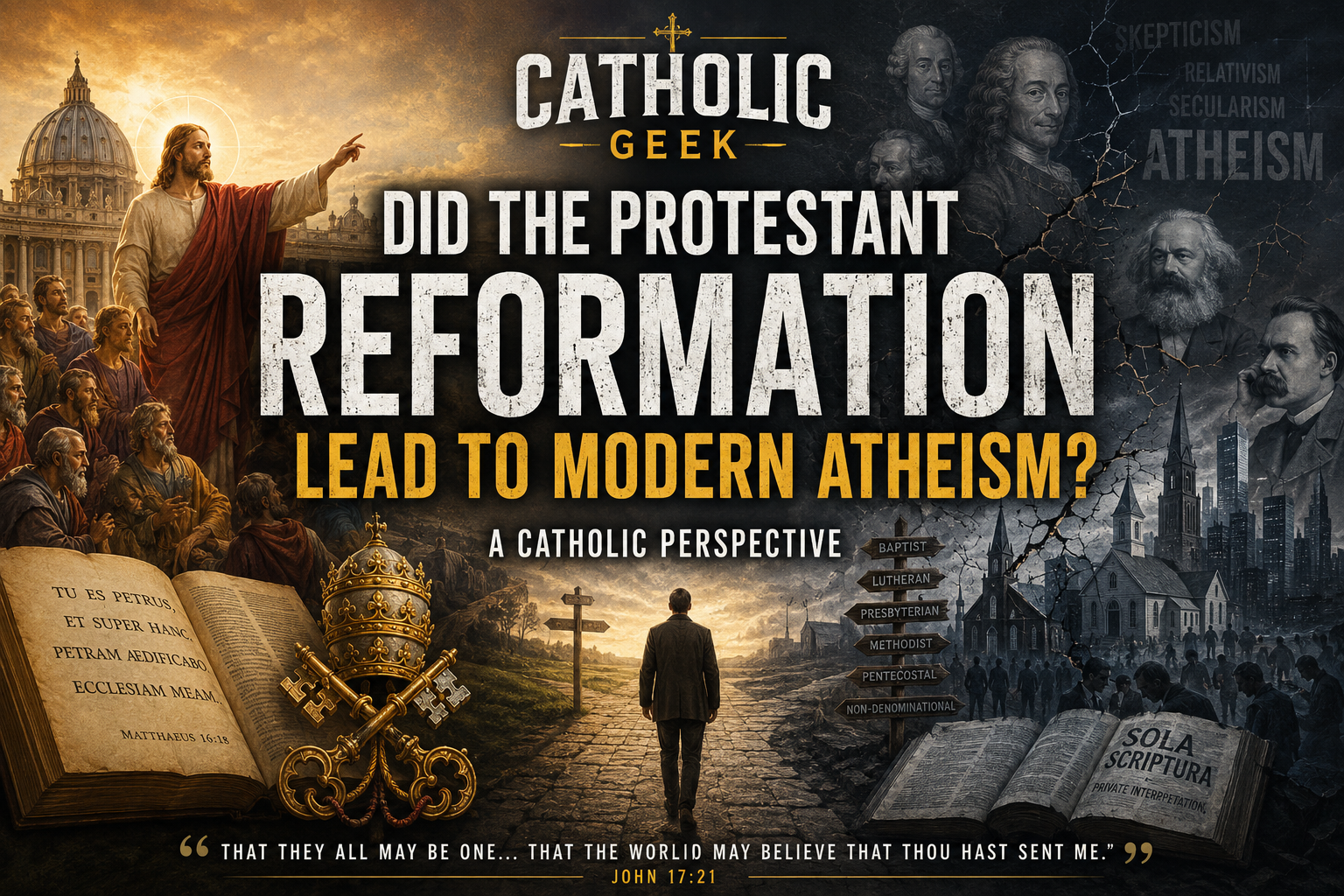
The Protestant Reformation was one of the most significant events in Christian history. It reshaped Western civilization, fractured the visible unity of Christendom, and forever altered the relationship between Scripture, authority, and tradition. Yet one question is rarely asked:
Did the Reformation unintentionally prepare the way for modern atheism?
Many Protestants would immediately answer, “Of course not. The Reformers believed in God.”
And they would be right.
Martin Luther, John Calvin, Huldrych Zwingli, and the other Reformers were not atheists. They sincerely desired to reform what they believed were abuses within the Church. Their goal was never to eliminate Christianity but to restore what they understood to be biblical Christianity.
Yet history often reveals that ideas have consequences beyond the intentions of those who first propose them.
The Catholic argument is not that the Reformers intended atheism. Rather, it is that certain theological principles introduced during the Reformation gradually undermined the very foundations upon which belief in divine revelation rests. The result was a cultural and intellectual trajectory that eventually culminated in skepticism, secularism, and widespread unbelief.
Christ Founded a Visible Church—Not a Book Alone
Before discussing the Reformation, we must first ask a more fundamental question:
How did Christ intend His truth to be preserved?
Christ never commanded His Apostles to write the New Testament.
Instead, He established a visible Church.
He said to St. Peter:
“And I say to thee: That thou art Peter; and upon this rock I will build my church… And I will give to thee the keys of the kingdom of heaven.” (Matthew 16:18–19)
He told the Apostles:
“He that heareth you, heareth me.” (Luke 10:16)
And after His Resurrection:
“Feed my lambs… Feed my sheep.” (John 21:15–17)
The Church existed for decades before a single book of the New Testament had been completed. Christians received the Gospel through apostolic preaching, sacred tradition, and the teaching authority Christ entrusted to His Church.
As the Catechism of the Catholic Church teaches:
“The task of giving an authentic interpretation of the Word of God… has been entrusted to the living teaching office of the Church alone.” (CCC 85)
Scripture, Tradition, and the Magisterium are not competing authorities but gifts that Christ established to safeguard the Deposit of Faith.
The Reformation Changed the Principle of Authority
The central issue of the Reformation was not indulgences.
Nor was it justification.
The deepest issue was authority.
Who possesses the authority to determine the authentic meaning of divine revelation?
For over fifteen centuries, Christians recognized the Church as the final authority in doctrinal disputes.
The Reformers proposed a different principle: Scripture alone (sola scriptura) is the supreme rule of faith.
At first glance this sounds pious.
After all, Catholics revere Sacred Scripture as the inspired Word of God.
But the question is not whether Scripture is inspired.
The question is:
Who has the authority to interpret it authentically?
Once the Church’s teaching office was rejected, every believer necessarily became the final interpreter of Scripture.
This principle became known as private judgment.
Ironically, while sola scriptura was proposed to preserve doctrinal purity, it removed the very institution Christ established to preserve unity.
Fragmentation Was Not an Accident
The consequences appeared almost immediately.
Within Luther’s own lifetime, Protestants divided among themselves over:
- Baptism
- The Eucharist
- Predestination
- Church government
- Salvation
- The nature of grace
- The canon of Scripture
- Worship
- The Lord’s Supper
Luther and Zwingli famously failed to reach agreement regarding Christ’s Real Presence in the Eucharist at the Marburg Colloquy in 1529.
Both appealed to Scripture.
Both claimed the guidance of the Holy Spirit.
Yet they reached incompatible conclusions.
This pattern has continued for centuries.
Today there are thousands of Protestant ecclesial communities throughout the world, often differing on essential doctrines while each appealing to the Bible as the final authority.
The issue is not simply that disagreement exists.
The issue is that once no visible authority exists to resolve doctrinal disputes, disagreement becomes permanent.
From Private Judgment to Religious Skepticism
Ideas possess an internal logic.
If every Christian may ultimately determine doctrine for himself, then an obvious question eventually arises:
Why stop with interpreting Scripture?
Why not question Scripture itself?
Once private judgment becomes the highest authority, Scripture itself becomes subject to human evaluation.
The same principle that rejected the authority of the Church gradually came to judge the authority of the Bible.
Then reason became judge over revelation.
Then science became judge over miracles.
Then history became judge over Christ.
Finally, man became judge over God.
The principle had simply reached its logical conclusion.
As St. John Henry Newman observed, private judgment has no natural stopping point. Once one rejects the authority Christ established in His Church, there is no principled reason why one’s own judgment cannot eventually reject Scripture itself.
The Enlightenment Did Not Arise in a Vacuum
The Enlightenment did not suddenly invent religious skepticism.
Rather, it inherited a Europe already fractured by competing claims to biblical authority.
Thinkers such as Baruch Spinoza, David Hume, Voltaire, Jean-Jacques Rousseau, Immanuel Kant, Ludwig Feuerbach, Karl Marx, Friedrich Nietzsche, and others increasingly questioned not merely the Catholic Church but Christianity itself.
Their arguments differed.
Their conclusions differed.
Yet they shared one assumption:
Human reason alone would determine religious truth.
This was a profound shift from the classical Christian understanding in which reason serves revelation rather than replacing it.
Pope Benedict XVI frequently warned that once faith is severed from objective truth, reason itself eventually loses its proper foundation and degenerates into relativism.
The Catholic Church Predicted This Outcome
Long before modern secularism reached its present form, the Church warned of the dangers of rejecting her teaching authority.
Pope Leo XIII wrote in Satis Cognitum (1896):
“Jesus Christ instituted in the Church a living, authoritative, and permanent Magisterium… Whoever rejects this authority necessarily destroys the unity established by Christ.”
Likewise, the First Vatican Council solemnly taught that Christ established a perpetual teaching office to preserve the Church from doctrinal error.
This was never about institutional power.
It was about preserving truth.
Without a living authority, every disagreement becomes permanent because no final court of appeal remains.
Did the Reformation Cause Atheism?
The answer is both no and yes, depending on what is meant.
No, if one means that Luther or Calvin intended to create atheists.
They certainly did not.
No, if one imagines that atheism has only one historical cause.
Modern unbelief also developed through political revolutions, materialism, scientism, higher biblical criticism, moral rebellion, industrialization, and the philosophical currents of the Enlightenment.
But the answer is also yes in a qualified historical and philosophical sense.
By rejecting the visible teaching authority established by Christ and replacing it with private interpretation, the Reformation unintentionally weakened confidence in objective religious authority.
Once the Church could be rejected, Scripture itself could be questioned.
Once Scripture could be questioned, revelation became optional.
Once revelation became optional, God Himself became optional.
The movement was gradual.
It unfolded over centuries.
Yet the intellectual progression is difficult to ignore.
Unity Is the Answer
Before His Passion, Christ prayed:
“That they all may be one… that the world may believe that thou hast sent me.” (John 17:21)
Notice the connection.
Unity is not merely desirable.
It is evangelical.
Visible unity bears witness to the truth of Christ.
Division obscures that witness.
The Catholic Church does not rejoice over the divisions that followed the Reformation. She prays and works for the restoration of full communion among all Christians. As the Second Vatican Council teaches in Unitatis Redintegratio, many elements of sanctification and truth are found outside the visible boundaries of the Catholic Church, and separated brethren are to be treated with charity and respect.
Yet authentic charity also requires honesty.
History demonstrates that when Christ’s visible teaching authority is rejected, doctrinal fragmentation follows. Fragmentation breeds skepticism. Skepticism prepares the way for secularism. And secularism, carried to its logical end, leaves a culture in which God is no longer regarded as the source of truth but as an optional hypothesis.
The lesson is not that Protestants are responsible for atheism.
The lesson is that ideas have consequences.
Christ founded one Church, entrusted it with His authority, and promised that “the gates of hell shall not prevail against it” (Matthew 16:18). The unity of that Church is not an accidental feature of Christianity—it is part of Christ’s saving plan for the world.
When the Church’s authority is preserved, the faith remains anchored in the apostolic deposit. When that authority is abandoned, every generation must reinvent Christianity for itself.
History suggests that this road does not end in greater certainty.
Too often, it ends in unbelief.
Further Reading
- Sacred Scripture (Douay-Rheims): Matthew 16:18–19; Luke 10:16; John 17:20–23; John 21:15–17; 1 Timothy 3:15; 2 Thessalonians 2:14.
- Catechism of the Catholic Church: §§74–100, 80–87, 888–892.
- First Vatican Council, Pastor Aeternus.
- Pope Leo XIII, Satis Cognitum (1896).
- Second Vatican Council, Unitatis Redintegratio.
- St. John Henry Newman, An Essay on the Development of Christian Doctrine; Apologia Pro Vita Sua.
- Joseph Ratzinger (Pope Benedict XVI), Introduction to Christianity; Truth and Tolerance.