

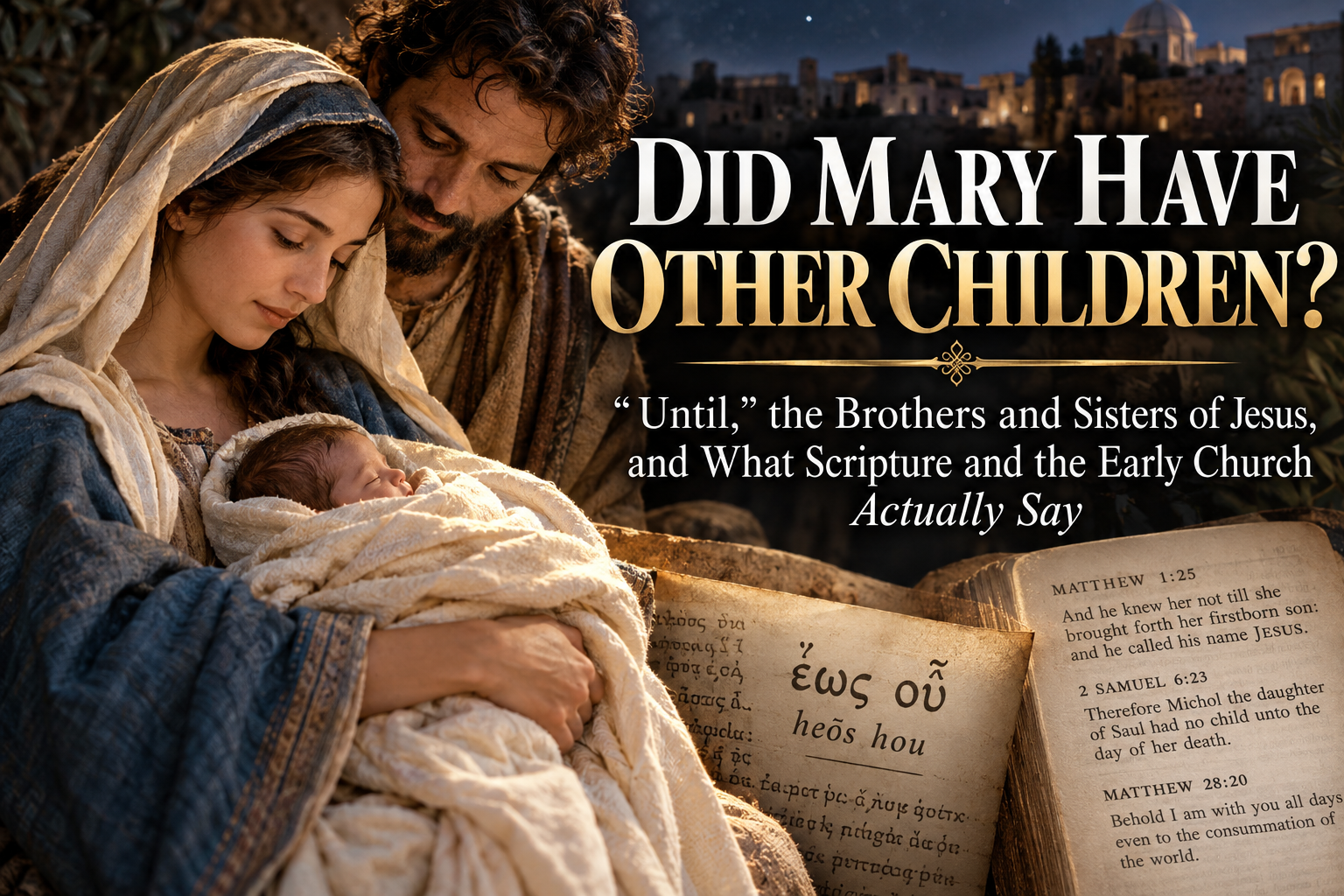
Until,” the Brothers and Sisters of Jesus, and What Scripture and the Early Church Actually Say
Few Marian questions generate as much confusion as the perpetual virginity of the Blessed Virgin Mary.
A common objection sounds simple:
“Matthew says Joseph did not know Mary until Jesus was born. Then Scripture calls James, Joseph, Simon, and Jude His brothers, and even mentions His sisters. Obviously Mary and Joseph had children afterward.”
At first hearing, that conclusion can sound straightforward.
But once the biblical language is examined carefully, it becomes much less straightforward.
The Catholic claim is not that Scripture never calls certain people Jesus’ brothers and sisters. It plainly does.
The question is different:
Does Scripture actually say that these people were children born from Mary?
It never does.
And does Matthew’s use of the word “until” tell us that Joseph began having marital relations with Mary after Christ’s birth?
Again, it does not.
This distinction matters.
Catholic doctrine does not require us to pretend that the biblical words “brother,” “sister,” “firstborn,” or “until” are absent. Instead, we have to determine how Scripture itself uses those words.
1. What the Catholic Church Actually Teaches
The Catholic Church teaches that Mary remained a virgin before, during, and after the birth of Christ.
The Catechism of the Catholic Church states:
“The deepening of faith in the virginal motherhood led the Church to confess Mary’s real and perpetual virginity.”
— Catechism of the Catholic Church, 499.
Concerning the biblical references to Jesus’ brothers and sisters, the Catechism continues:
“The Church has always understood these passages as not referring to other children of the Virgin Mary.”
— CCC 500.
This doctrine was not invented in the Middle Ages.
Mary was already being called Aeiparthenos — “Ever-Virgin” in the ancient Church.
St. Athanasius, writing in the fourth century while defending the true humanity of Christ, refers naturally to Christ taking true human flesh from Mary Ever-Virgin.
That matters because Athanasius does not stop to introduce the idea as something new. He uses the title as though his Christian audience already understands it.
The Lateran Synod of AD 649 later stated explicitly that Mary conceived without seed, gave birth while remaining virginal, and remained a virgin afterward.
But before looking further at the Fathers, we should begin where the objection itself begins:
Scripture.
2. “Joseph Knew Her Not Till She Brought Forth Her Son”
Matthew records:
“And he knew her not till she brought forth her firstborn son: and he called his name JESUS.”
— Matthew 1:25, Douay-Rheims
The argument usually goes:
Joseph did not “know” Mary until Jesus was born; therefore he did know her sexually afterward.
The first part is correct.
In biblical language, “to know” one’s wife can be a euphemism for sexual relations.
The mistake comes from assuming that “until” necessarily means that the previous condition reversed afterward.
It does not.
“Until” tells us what was true up to a particular point. Whether the situation changes afterward must be determined from context.
Matthew’s concern is the virginal conception and birth of Christ.
He has just told us:
“Before they came together, she was found with child, of the Holy Ghost.”
— Matthew 1:18.
The angel tells Joseph:
“For that which is conceived in her, is of the Holy Ghost.”
— Matthew 1:20.
Matthew then applies Isaiah:
“Behold a virgin shall be with child, and bring forth a son.”
— Matthew 1:23; cf. Isaiah 7:14.
Matthew 1:25 therefore emphasizes one particular fact:
Joseph was not responsible for Jesus’ conception.
Nothing in the verse requires Matthew to be commenting on the couple’s marital behavior years afterward.
3. “Until” Does Not Automatically Mean “And Then the Opposite Happened”
Scripture repeatedly uses expressions equivalent to “until” without intending the reader to conclude that the situation reversed afterward.
One famous example concerns Michol, daughter of Saul:
“Therefore Michol the daughter of Saul had no child unto the day of her death.”
— 2 Samuel 6:23.
The statement obviously does not mean:
“She had no children until she died, and then afterward she had children.”
The expression establishes what remained true through the stated boundary.
Christ similarly tells His disciples:
“Behold I am with you all days, even to the consummation of the world.”
— Matthew 28:20.
Christ is not saying:
“I will remain with you until the end of the world and then abandon you.”
The expression establishes His presence through the period being discussed without requiring its opposite afterward.
That is the central grammatical point.
A statement describing what is true until a certain point does not automatically tell us what happens after that point.
4. But Matthew Uses Heōs Hou
A more sophisticated objection notes that Matthew 1:25 uses the Greek construction:
ἕως οὗ — heōs hou
rather than merely a single word translated “until.”
That observation deserves to be taken seriously.
But the conclusion still does not follow.
The construction itself does not function as a grammatical rule saying:
“Whatever was true before this point must become false afterward.”
For example, Acts 25:21 describes Paul being kept in custody:
“I commanded him to be kept, till I might send him to Caesar.”
The Greek uses heōs hou.
Yet Paul’s custody did not simply cease because he was sent toward Caesar.
Acts continues by describing Paul traveling under Roman custody and eventually living in Rome under guard.
So even the exact construction used in Matthew 1:25 does not require a reversal afterward.
That means Matthew’s words cannot legitimately be forced into saying:
“Joseph abstained from relations with Mary until Jesus was born, and then afterward they began having relations.”
That second statement is not in the verse.
It is being supplied by the interpreter.
Matthew 1:25 proves abstinence before Christ’s birth. Grammatically, it neither proves nor disproves relations afterward. The doctrine of perpetual virginity therefore rests on the whole biblical and apostolic witness, not on forcing the word “until” to bear a meaning it does not necessarily have.
5. St. John Chrysostom Already Answered the “Until” Argument
This is not a recently invented Catholic response.
Around AD 390, St. John Chrysostom preached directly on Matthew 1:25.
He explains that Matthew uses “till” in order to emphasize that Mary was untouched by man before Christ’s birth, not in order to tell us that Joseph knew her afterward.
Chrysostom then points out that Scripture frequently uses “until” language without establishing a later reversal.
See St. John Chrysostom, Homilies on Matthew, Homily 5.
That is historically important.
Christians reading Matthew in Greek more than sixteen centuries ago already recognized that:
“Until” does not automatically mean “and afterward the opposite happened.”
6. What About “Firstborn”?
Another objection comes from Luke:
“And she brought forth her firstborn son.”
— Luke 2:7.
Some people read “firstborn” as though it necessarily means:
“the first child among several children.”
But in biblical law, firstborn is a legal designation.
God commands:
“Sanctify unto me every firstborn that openeth the womb among the children of Israel.”
— Exodus 13:2.
The child becomes the firstborn by opening the womb.
His status does not depend upon whether his mother eventually has another child.
No Israelite family had to wait several years to discover whether their first son qualified as the firstborn.
He was the firstborn immediately.
Therefore Luke calling Jesus Mary’s “firstborn” does not mean:
“Mary later had a second-born child.”
That conclusion is simply not contained in the word.
7. Then Who Are the “Brothers” of Jesus?
Now we reach what many regard as the strongest objection.
Nazareth’s inhabitants say:
“Is not this the carpenter’s son? Is not his mother called Mary, and his brethren James, and Joseph, and Simon, and Jude:
And his sisters, are they not all with us?”
— Matthew 13:55–56.
Mark similarly records:
“Is not this the carpenter, the son of Mary, the brother of James, and Joseph, and Jude, and Simon? are not also his sisters here with us?”
— Mark 6:3.
These passages are real.
Catholics should never pretend they are not there.
The question is:
Does the word “brother” necessarily mean another biological child born from Mary?
Biblical usage demonstrates that it does not.
8. Scripture Uses “Brother” for Relatives Who Are Not Literal Brothers
Consider Abraham and Lot.
Genesis establishes Lot’s actual relationship to Abraham.
Lot is the son of Abraham’s brother Haran.
In ordinary modern English terminology, Lot is Abraham’s nephew.
Nevertheless Abraham says to Lot:
“Let there be no quarrel, I beseech thee, between me and thee… for we are brethren.”
— Genesis 13:8.
Genesis 14:16 similarly uses brother-language concerning Lot.
Another example appears with Jacob and Laban.
Jacob is Laban’s sister’s son.
He is Laban’s nephew.
Yet Laban says:
“Because thou art my brother, shalt thou serve me without wages?”
— Genesis 29:15.
This establishes an important biblical principle.
Family language in Scripture can be broader than the modern English use of “biological brother.”
So the existence of the word “brother” by itself cannot settle the exact biological relationship.
9. “But Greek Has a Word for Cousin”
This is a better objection and deserves an accurate answer.
The New Testament does possess a Greek word capable of meaning cousin:
anepsios.
St. Paul uses it in Colossians 4:10 concerning Mark’s relationship to Barnabas.
Therefore Catholics should not claim:
“Greek had absolutely no word for cousin.”
That is too simplistic.
But the opposite claim is also false:
“Because Greek has a word for cousin, adelphos can only mean a literal biological brother from the same mother.”
The New Testament is deeply shaped by Jewish and biblical patterns of speech.
The Greek Old Testament repeatedly uses brother-language where a wider family relationship is intended.
The New Testament itself also uses adelphoi for fellow Israelites and fellow Christians who obviously were not all biological siblings.
So a dictionary alone cannot solve the question.
The proper relationship must be determined by context, biblical usage, Jewish kinship language, and the identities of the people involved.
And that last point becomes extremely important.
10. Scripture Gives Us Another Mary Who Is Mother of James and Joseph
Among the men explicitly called Jesus’ brothers are:
James and Joseph/Joses.
Matthew 13:55 names:
James, Joseph, Simon, and Jude.
Now go to the Crucifixion.
Matthew says that among the women present was:
“Mary the mother of James and Joseph.”
— Matthew 27:56.
Mark likewise speaks of:
“Mary the mother of James the less and of Joseph.”
— Mark 15:40.
Matthew subsequently refers to this woman as:
“the other Mary.”
— Matthew 28:1.
This is extremely important.
The Gospel writers identify another Mary as the mother of men named James and Joseph/Joses, two of the very names appearing among Jesus’ “brothers.”
The Catechism of the Catholic Church points directly to this fact when explaining the brothers of Jesus.
John’s Passion narrative also mentions:
“His mother’s sister, Mary of Cleophas.”
— John 19:25.
St. Jerome drew these Passion accounts together and argued that the “brothers” were close relatives of Jesus rather than other sons born from the Virgin Mary.
See St. Jerome, The Perpetual Virginity of Blessed Mary Against Helvidius.
We should still be careful.
Reconstructing every Mary and determining every precise family connection in these Gospel passages is difficult.
The Catholic doctrine does not require us to prove that every person called Jesus’ brother was exactly a first cousin.
The more important point is this:
Scripture never identifies the brothers of Jesus as sons born from the Blessed Virgin Mary.
11. Notice How Scripture Refers to Mary
This is often overlooked.
Jesus is explicitly identified as Mary’s Son.
At Nazareth He is:
“the son of Mary.”
— Mark 6:3.
But nowhere does Scripture say:
“James, another son of Mary the mother of Jesus.”
“Jude, son of Mary the mother of Jesus.”
“Simon, son of Mary the mother of Jesus.”
or:
“the other children Mary later bore to Joseph.”
Those sentences do not exist.
That silence by itself does not prove perpetual virginity.
But it becomes significant when combined with the fact that another Mary is explicitly identified as the mother of James and Joseph.
12. The Cross Creates Another Difficulty for the “Mary Had Other Sons” Interpretation
At the Crucifixion Jesus sees His mother and St. John.
He tells Mary:
“Woman, behold thy son.”
Then He tells John:
“Behold thy mother.”
And Scripture continues:
“And from that hour, the disciple took her to his own.”
— John 19:26–27.
If Mary had several other biological sons, this scene becomes striking.
Why does Jesus solemnly entrust His mother to John?
Why not James?
Why not Joseph?
Why not Simon?
Why not Jude?
This is not absolute proof by itself. Someone can always propose additional hypothetical circumstances.
But it fits very naturally with the ancient Christian understanding that Jesus was the only child born of Mary.
St. Hilary of Poitiers used this argument in antiquity.
St. John Chrysostom also recognized the importance of Christ entrusting Mary to John.
13. There Were Two Major Ancient Explanations of the Brothers
Catholics should make an important distinction here.
The Church teaches as doctrine that:
Mary remained perpetually virgin.
But the Church does not require Catholics to affirm one single reconstruction of exactly how every “brother” of Jesus was related to Him.
Two major ancient explanations developed.
Close Relatives
St. Jerome argued strongly that the brothers were relatives such as cousins.
His famous treatise Against Helvidius, written around AD 383, addresses almost the exact objections heard today:
- “until,”
- “firstborn,”
- and “brothers.”
Jerome’s argument became especially influential in the West.
Children of Joseph From an Earlier Marriage
Another ancient tradition, especially prominent in the East, held that Joseph had children from an earlier marriage before being entrusted with Mary.
On this reading, the brothers of Jesus would be His legal stepbrothers through Joseph.
They still would not be children of the Virgin Mary.
The Church does not require Catholics to choose between these two explanations as dogma.
The dogmatic point is simpler:
The brothers and sisters of Jesus were not additional children born from Mary.
14. The Protoevangelium of James
The Protoevangelium of James, usually dated to the second century, presents Joseph as an older man who already had children when Mary was entrusted to his care.
Joseph says:
“I have children, and I am an old man, and she is a young girl.”
— Protoevangelium of James, 9.
The Protoevangelium of James is not Scripture.
It is not part of the biblical canon.
Catholics do not treat every detail in it as historically certain.
Its importance here is historical.
It shows that very early Christians were already aware of traditions explaining the brothers of Jesus without concluding that Mary later gave birth to them.
This means perpetual virginity was not invented centuries later because Christians somehow forgot that Scripture mentions Jesus’ brothers.
Those passages were already known.
The question was always how to understand them.
15. Origen
In the third century, Origen discusses the brothers of Jesus in his Commentary on Matthew.
He is familiar with the tradition that they were sons of Joseph from an earlier marriage.
More importantly, Origen speaks approvingly of the conviction that Mary remained a virgin.
See Origen, Commentary on Matthew, Book X, 17.
That is significant because Origen lived approximately a century before Jerome’s dispute with Helvidius.
So Jerome did not invent the doctrine.
His specific explanation of the brothers differed from another older tradition, but the conviction that Mary remained virgin was already present.
16. St. Athanasius
By the fourth century, St. Athanasius simply calls her:
Mary Ever-Virgin.
See St. Athanasius, Discourses Against the Arians, II.70.
Athanasius is particularly important because he is not writing a treatise primarily about Mary.
He is defending orthodox teaching about Christ.
Yet he can refer to Mary as Ever-Virgin naturally, without acting as though he is introducing some novelty.
That suggests the title was already well established within Christian thought.
17. St. Hilary, St. Epiphanius, St. Ambrose, St. Jerome, and St. John Chrysostom
By the fourth century, the historical evidence becomes extensive.
St. Hilary of Poitiers defends Mary’s continuing virginity and appeals to Christ entrusting her to John.
St. Epiphanius of Salamis strongly defends Mary as Ever-Virgin and understands the brothers as children of Joseph from an earlier marriage.
St. Ambrose of Milan explicitly defends perpetual virginity and recognizes that the word “brother” is capable of broader family usage.
St. Jerome writes an entire treatise against Helvidius and examines “until,” “firstborn,” and “brothers.”
St. John Chrysostom, himself a Greek-speaking Father, explains that Matthew’s “until” does not mean Joseph began having relations with Mary afterward.
This matters.
The perpetual virginity of Mary is not an obscure medieval Western doctrine.
It is an ancient Christian belief found across both East and West.
18. What About Helvidius?
Around AD 383, a Christian writer named Helvidius argued that Mary and Joseph had normal marital relations after the birth of Jesus and that the brothers of Jesus were later children of Mary.
St. Jerome responded with Against Helvidius.
This historical fact is worth emphasizing.
Catholics do not need to pretend that nobody in antiquity ever held the position common among many Protestants today.
Someone did.
Helvidius did.
But his position caused controversy precisely because influential Christians regarded it as contrary to the received understanding of Mary.
Jerome treats Helvidius not as someone recovering an obvious biblical truth that all earlier Christians had believed, but as someone challenging an already established Christian conviction.
19. The Biblical Case Is Cumulative
No responsible Catholic defense of perpetual virginity should depend upon one verse.
The case is cumulative.
Matthew 1:25 says Joseph did not know Mary “until” Christ’s birth, but “until” does not require the opposite afterward.
Luke 2:7 calls Jesus Mary’s “firstborn,” but firstborn is a biblical legal status and does not require later children.
Matthew 13:55 and Mark 6:3 call James, Joseph/Joses, Simon, Jude, and unnamed women Jesus’ brothers and sisters, but biblical brother-language can include wider relatives.
The Passion narratives identify another Mary as mother of James and Joseph/Joses, two of the names appearing among Jesus’ brothers.
The New Testament never calls any of those brothers sons of Mary the Mother of Jesus.
At the Cross, Christ entrusts Mary to John rather than to one of the supposed natural brothers.
And ancient Christian writers repeatedly defend or assume Mary’s continuing virginity long before the medieval period.
None of these facts in isolation forces the doctrine.
Taken together, however, they show that the statement—
“The Bible clearly says Mary had other children”
—is much stronger than the text itself allows.
The Bible does not clearly say that.
20. An Important Catholic Distinction
Catholics should distinguish three levels of certainty.
Dogma
Mary remained perpetually virgin.
Biblical Fact
Scripture calls certain people Jesus’ brothers and sisters, but nowhere explicitly identifies them as children born from the Blessed Virgin Mary.
Historical Reconstruction
Exactly how each brother was related to Jesus is not defined with the same level of certainty.
Some ancient Christians favored the stepbrother explanation through Joseph.
St. Jerome favored a close-relative or cousin interpretation.
Catholic doctrine does not depend upon proving one exact genealogy.
That distinction allows Catholics to defend the doctrine without forcing Scripture beyond what Scripture actually reveals.
21. Joseph’s Role Becomes More Beautiful, Not Less
Perpetual virginity is sometimes misunderstood as though Catholics believe marital relations are dirty.
That is completely contrary to Catholic theology.
Marriage is holy, and marital union between husband and wife is good.
The question is not:
“Would marital relations between Joseph and Mary have been evil?”
The question is:
“Did God give this particular marriage a unique vocation in salvation history?”
Joseph was entrusted with the Virgin from whom the Word became flesh.
He became the legal father and guardian of the Messiah.
When the angel speaks, Joseph obeys.
When Herod threatens the Child, Joseph protects Him.
When God commands Joseph to flee, Joseph flees.
When God commands him to return, Joseph returns.
Joseph’s greatness is not diminished by the unique character of his marriage.
It is magnified by it.
And Joseph himself demonstrates something important about biblical family terminology.
Joseph is truly called the father of Jesus in a familial and legal sense even though he did not biologically generate Jesus.
Therefore Scripture itself already teaches us that words such as:
father, son, brother, and family
cannot always be reduced to direct biological generation.
Context determines the precise relationship.
22. Mary Is Not Merely a Woman Who Happened to Give Birth to Jesus
At the deepest level, perpetual virginity is connected to Christ.
The Church’s teaching about Mary ultimately protects truths about who Jesus is.
Mary’s womb is the place where the eternal Word truly assumed human flesh.
Her virginal conception proclaims that Christ’s entrance into the world came through divine initiative.
Gabriel tells her:
“The Holy Ghost shall come upon thee, and the power of the most High shall overshadow thee.”
— Luke 1:35.
The Son does not enter the world through the biological generation of a human father.
His conception is miraculous.
The Catechism therefore teaches:
“Mary’s virginity manifests God’s absolute initiative in the Incarnation.”
— CCC 503.
Mary’s virginity points beyond herself.
It points to Christ.
23. What Scripture Actually Allows Us to Say
We should therefore be precise.
We can say:
Scripture says Jesus had people called brothers and sisters.
Correct.
But we cannot automatically jump to:
Therefore the Virgin Mary gave birth to them.
That second statement requires evidence Scripture never explicitly provides.
We can say:
Scripture says Joseph knew Mary not until Jesus was born.
Correct.
But Scripture does not say:
And afterward Joseph knew her sexually.
That sentence is supplied by the interpreter.
We can say:
Scripture calls Jesus Mary’s firstborn.
Correct.
But Scripture never says:
Therefore Mary later had a second-born child.
Again, that conclusion has been added to the text.
This is why the Catholic position is not based on ignoring Scripture.
It is based on refusing to force Scripture to say more than it actually says.
24. The Early Church Matters
There is also a historical question every Christian should consider.
If the New Testament obviously taught that Mary and Joseph later had many biological children, why do ancient Christians who lived much closer to the apostolic age, understood the biblical world, knew the Old Testament patterns behind New Testament language, and in many cases spoke Greek natively repeatedly defend Mary’s perpetual virginity?
Why does Origen know a tradition explaining the brothers without making them Mary’s children?
Why does Athanasius call her Ever-Virgin?
Why does Epiphanius defend her perpetual virginity?
Why does Ambrose defend it?
Why does Jerome write an entire treatise against the opposite interpretation?
Why does Chrysostom, reading Matthew in Greek, explain that “until” does not require later relations?
A Christian may still disagree with those Fathers.
But it is no longer reasonable to say:
“Catholics only believe this because they do not understand what ‘until’ and ‘brothers’ mean.”
The Christians defending this doctrine were reading the same passages more than fifteen hundred years ago.
Some of them were reading those passages in their native Greek.
Conclusion: Read the Whole Biblical Witness
The question is not whether Jesus had people called “brothers.”
Scripture says He did.
The question is what brother means in those passages.
The question is not whether Matthew says Joseph knew Mary not “until” the birth of Christ.
He does.
The question is whether until necessarily means Joseph knew Mary afterward.
It does not.
The question is not whether Jesus is called Mary’s “firstborn.”
He is.
The question is whether firstborn requires Mary to have later children.
It does not.
Then we add the rest of the biblical evidence:
another Mary is identified as the mother of James and Joseph;
no alleged brother is explicitly called another son of the Virgin Mary;
Jesus entrusts His mother to John from the Cross;
biblical kinship language extends beyond modern biological categories;
and ancient Christians across East and West consistently knew the brother passages while continuing to confess Mary as Ever-Virgin.
The Catholic position therefore does not require us to deny Scripture.
It requires us to read Scripture carefully.
Mary is the Mother of Jesus.
Jesus is truly her Son.
But nowhere does Scripture say that James, Joseph, Simon, Jude, or the unnamed sisters were children born from the Blessed Virgin Mary.
That conclusion is often assumed.
It is not actually stated.
And centuries before Catholicism and Protestantism ever divided from one another, Christians were already speaking of the woman from whom Christ took His human flesh as:
Mary, the Mother of God, Ever-Virgin.
The real question is therefore not:
“Can I make the English word ‘until’ sound like Joseph and Mary had relations afterward?”
The deeper question is:
What does Scripture actually say? How does Scripture itself use these words? And how did Christians closest to the ancient biblical world understand them?
Once all three questions are allowed into the discussion, the supposed contradiction between Scripture and Mary’s perpetual virginity largely disappears.
Sources
Sacred Scripture
Douay-Rheims Bible
Genesis 11:27–31; 13:8; 14:16; 29:13–15
Exodus 13:2
2 Samuel 6:23
Isaiah 7:14
Matthew 1:18–25; 12:46–50; 13:55–56; 27:55–56; 28:1, 20
Mark 3:31–35; 6:3; 15:40
Luke 1:26–38; 2:7
John 2:12; 7:3–5; 19:25–27
Acts 1:14; 25:21; 27:1; 28:16
1 Corinthians 9:5
Galatians 1:19
Colossians 4:10
Jude 1
Douay-Rheims Bible:
https://www.drbo.org/
Magisterial Sources
Catechism of the Catholic Church, 496–511, especially 499–503 and 510
https://www.vatican.va/archive/ENG0015/__P1K.HTM
Lateran Synod of AD 649, Canon 3, concerning Mary’s perpetual virginity
Denzinger-Schönmetzer, Enchiridion Symbolorum, DS 503
Early Christian Sources
Protoevangelium of James, especially chapter 9
Early noncanonical Christian writing; cited as historical evidence, not inspired Scripture
https://www.newadvent.org/fathers/0847.htm
Origen, Commentary on Matthew, Book X, 17
https://www.newadvent.org/fathers/101610.htm
St. Athanasius, Discourses Against the Arians, II.70
https://www.newadvent.org/fathers/28162.htm
St. Hilary of Poitiers, Commentary on Matthew, especially 1.4
St. Epiphanius of Salamis, Panarion, especially 78
St. Ambrose of Milan, De Institutione Virginis
St. Jerome, The Perpetual Virginity of Blessed Mary Against Helvidius
https://www.newadvent.org/fathers/3007.htm
St. John Chrysostom, Homilies on Matthew, Homily 5
https://www.newadvent.org/fathers/200105.htm
St. Augustine, writings concerning the virginal motherhood and perpetual virginity of Mary; see also the formulation cited in CCC 510
Historical and Scholarly Reference
Richard Bauckham, Jude and the Relatives of Jesus in the Early Church
Edinburgh: T&T Clark, 1990.