

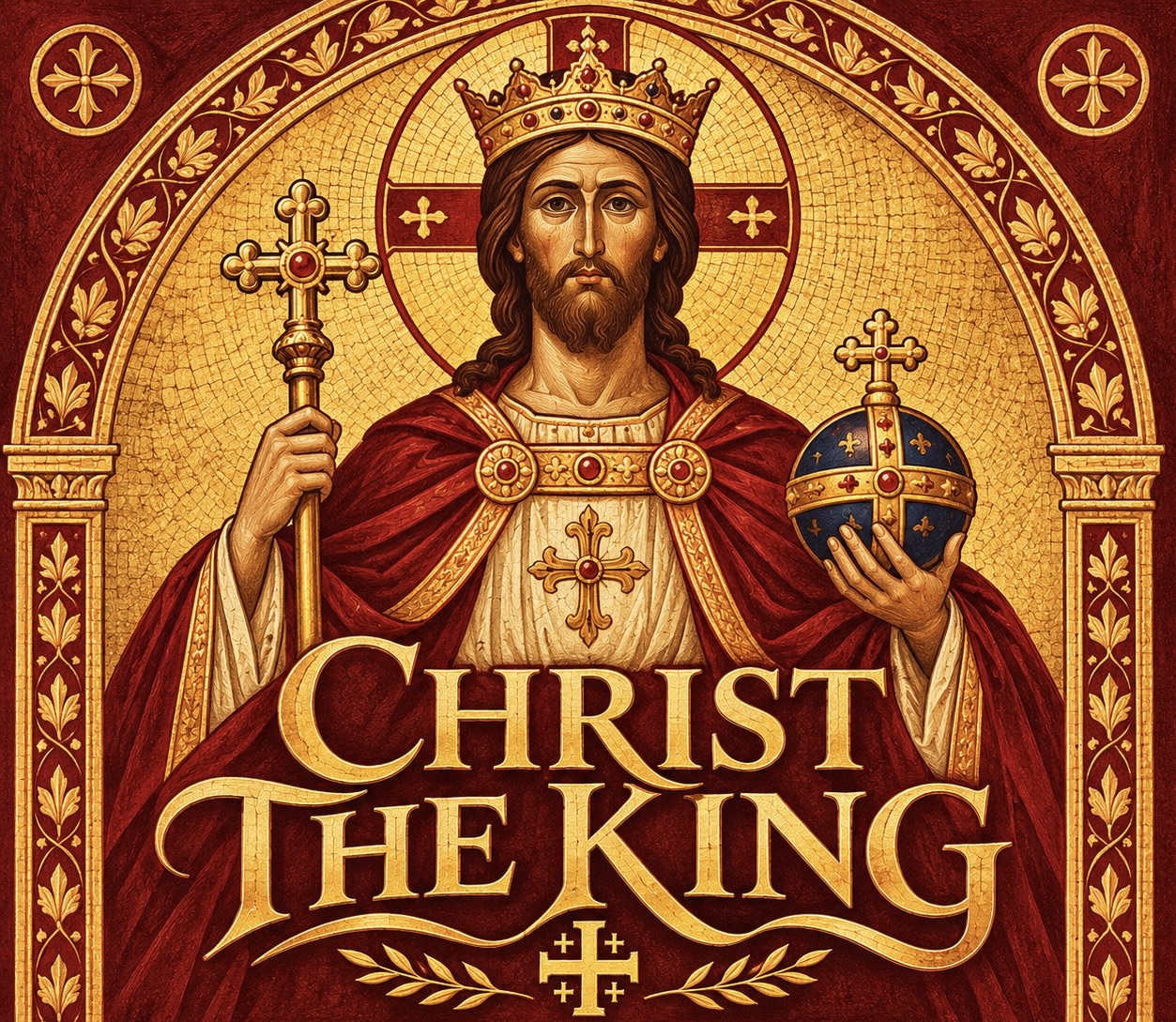
“And he shall reign in the house of Jacob for ever. And of his kingdom there shall be no end.” — Luke 1:32–33 (Douay-Rheims)
A King Whose Kingdom Shall Never End
On the final Sunday of the liturgical year, the Catholic Church celebrates the Solemnity of Our Lord Jesus Christ, King of the Universe, commonly known as the Feast of Christ the King.
This glorious solemnity reminds the faithful of a fundamental truth of the Catholic faith: Jesus Christ is not merely the King of Christians, nor is His authority confined to the Church. He is the sovereign King of all creation, of every nation, of every human heart, and of the entire universe.
Earthly kingdoms rise and fall. Political leaders come and go. Civilizations flourish and eventually fade into history. Yet the kingship of Jesus Christ is eternal, for His authority comes not from earthly power, human elections, or worldly institutions, but from God Himself.
As Sacred Scripture proclaims:
“And he hath on his garment, and on his thigh written: KING OF KINGS, AND LORD OF LORDS.”
— Apocalypse 19:16 (Douay-Rheims)
The Solemnity of Christ the King calls every Catholic to recognize this divine sovereignty and to allow Christ to reign not only in personal prayer and religious devotion, but also in family life, society, and the world.
Why Pope Pius XI Established the Feast
In 1925, Pope Pius XI instituted the Feast of Christ the King through his encyclical Quas primas, issued on December 11 of that year.
The Holy Father recognized that the modern world was increasingly turning away from God. Secularism, atheism, political extremism, and hostility toward Christianity were spreading throughout nations that had once been profoundly shaped by the Catholic faith.
In parts of Europe, Mexico, and Russia, the Church faced growing persecution and efforts to remove Christianity from public life.
Pope Pius XI understood that the rejection of Christ’s authority would have consequences far beyond individual religious belief. When societies reject divine truth and moral law, they risk losing the spiritual and moral foundations upon which authentic peace, justice, and human dignity depend.
In Quas primas, the Pope warned against attempts to exclude Jesus Christ and His teachings from public affairs.
He taught that lasting peace cannot be established merely through political agreements, economic prosperity, or human institutions. True peace must be founded upon justice, charity, truth, and obedience to God’s law.
Christ must reign because only in Him can humanity find its ultimate purpose and lasting peace.
The feast was originally celebrated on the last Sunday of October. Following the reform of the Roman liturgical calendar in 1969, its celebration in the Ordinary Form was transferred to the final Sunday of the liturgical year, emphasizing Christ’s ultimate triumph and the fulfillment of history in His eternal Kingdom.
Jesus Christ Is King by His Divine Nature and His Incarnation
The kingship of Jesus Christ is not merely symbolic or honorary.
It is a theological reality rooted in the mystery of the Incarnation.
The Catholic Church teaches that Jesus Christ is true God and true man: one divine Person possessing both a divine nature and a human nature.
He is the eternal Son of God, the Second Person of the Most Holy Trinity, who assumed human nature in the womb of the Blessed Virgin Mary.
As Saint Paul teaches:
“For in him were all things created in heaven and on earth, visible and invisible.”
— Colossians 1:16 (Douay-Rheims)
Because Jesus Christ is God, He possesses supreme authority over all creation. Because His human nature is united to His divine Person, He also possesses royal authority as the Incarnate Word.
Pope Pius XI explains this truth in Quas primas, no. 13, teaching that Christ’s authority extends over angels and men by reason of the hypostatic union.
Furthermore, Christ’s kingship is manifested through His work of redemption.
Our Lord did not conquer the world through armies, violence, or political domination. He conquered through His Passion, Death, and Resurrection.
His throne was the Cross.
His crown was made of thorns.
His victory was accomplished through perfect obedience to the Father and infinite love for humanity.
By shedding His Precious Blood, Christ redeemed mankind from the slavery of sin and opened the gates of eternal life.
Thus, His kingship reveals both divine authority and sacrificial love.
My Kingdom Is Not of This World
When Jesus stood before Pontius Pilate, He declared:
“My kingdom is not of this world.”
— John 18:36 (Douay-Rheims)
These words do not mean that Christ has no authority over earthly affairs or that His teachings should be excluded from society.
Rather, they mean that His Kingdom does not originate from worldly power, nor is it established by the methods of earthly rulers.
Christ’s Kingdom is supernatural in origin and eternal in destiny.
His reign is one of truth, holiness, grace, justice, love, and peace.
Yet this spiritual Kingdom has real consequences for how human beings live.
If Christ is truly King, then His commandments must influence our decisions, our relationships, our responsibilities, and our treatment of others.
A Catholic cannot sincerely acknowledge Christ as King on Sunday while deliberately rejecting His teachings throughout the rest of the week.
The kingship of Christ must transform the whole of human life.
Christ Must Reign in Our Minds, Hearts, Wills, and Actions
One of the most profound teachings of Quas primas concerns the personal reign of Christ in the soul.
Pope Pius XI explains in no. 33 that Christ must reign in our minds, wills, hearts, and bodies.
This teaching invites every Catholic to examine whether Jesus Christ truly occupies the throne of his or her heart.
Christ must reign in our minds, so that we embrace the truths revealed by God and faithfully taught by His Church.
Christ must reign in our wills, so that we choose obedience to God’s commandments over the passing attractions of sin.
Christ must reign in our hearts, so that we love God above all things and love our neighbors as ourselves.
Christ must reign in our bodies, so that our actions reflect purity, temperance, modesty, charity, and respect for the dignity of human life.
To proclaim Christ as King while refusing to obey His commandments would be a contradiction.
Authentic devotion to Christ the King requires more than words, ceremonies, or external religious practices.
It requires conversion of heart, repentance from sin, participation in the sacramental life of the Church, and continual growth in holiness.
The Kingship of Christ Must Be Acknowledged Publicly
One of the central messages of the Feast of Christ the King is that the Catholic faith cannot be reduced to a purely private matter.
Jesus Christ is Lord of all creation, not merely of church buildings or individual consciences.
Therefore, Catholics are called to bear witness to His truth in the world.
This includes defending the dignity of every human person, protecting the sanctity of human life, strengthening marriage and family life, caring for the poor, practicing justice, and promoting the common good.
It also includes the freedom to worship God, proclaim the Gospel, participate in religious processions, and express religious convictions in public life.
Pope Pius XI specifically encouraged public demonstrations of devotion to Christ the King, including Eucharistic adoration, sermons, and solemn processions (Quas primas, no. 26).
Such public expressions of faith serve as reminders that the world belongs ultimately to God.
At the same time, the Church teaches that religious faith cannot be imposed by coercion. Genuine faith requires a free response to God’s grace, and the human person’s right to religious freedom must be respected (Second Vatican Council, Dignitatis humanae, no. 2).
Acknowledging the kingship of Christ therefore calls Catholics to witness courageously and charitably to the truth, respecting human dignity while refusing to conceal their faith out of fear or social pressure.
Christ the King and the Final Judgment
The Solemnity of Christ the King also directs our attention toward the end of time.
The placement of this feast at the conclusion of the liturgical year reminds us that human history is moving toward its ultimate fulfillment in Jesus Christ.
One day, Christ will return in glory to judge the living and the dead.
In the Gospel of Saint Matthew, Our Lord describes the Son of Man coming in majesty, accompanied by His angels, and sitting upon His throne of glory.
Before Him, all nations will be gathered (Matthew 25:31–32).
No earthly ruler, government, or human institution will escape His judgment.
Christ will reveal the truth of every human life, and His judgment will be perfectly just and merciful.
In this same Gospel passage, Jesus teaches that our treatment of the hungry, thirsty, strangers, the sick, and the imprisoned reveals whether we have truly loved and served Him.
This is an essential lesson of His kingship.
To serve Christ the King is also to recognize and serve Him in our brothers and sisters, especially those who are suffering or in need.
The final triumph of Christ will not simply mark the end of earthly history. It will reveal the fulfillment of God’s eternal plan, when the redeemed will share in the everlasting Kingdom of Heaven.
How Catholics Can Honor Christ the King
The Feast of Christ the King is an invitation to renew our allegiance to Jesus Christ.
We honor Him as King when we participate reverently in the Holy Sacrifice of the Mass, receive the Sacraments worthily, spend time in Eucharistic adoration, pray the Holy Rosary, study Sacred Scripture, and remain faithful to the teachings of the Catholic Church.
We honor Him when we consecrate our families to His Sacred Heart and strive to make our homes places of prayer, forgiveness, and Christian charity.
We honor Him when we resist sin, defend truth, practice the corporal and spiritual works of mercy, and courageously live our Catholic faith in everyday life.
Above all, we honor Christ the King by surrendering ourselves completely to His divine will.
The question each of us must ask is simple:
Does Jesus Christ truly reign in my life?
Is He the King of my thoughts, desires, decisions, relationships, and actions?
Or have I allowed worldly ambitions, personal pride, sinful attachments, and the opinions of others to occupy the throne that belongs to Him alone?
The Solemnity of Christ the King calls us to renew our commitment to place Jesus Christ at the center of everything.
Long Live Christ the King!
Throughout the history of the Church, countless martyrs have given their lives rather than deny the sovereignty of Jesus Christ.
Among them were Catholics persecuted in Mexico during the twentieth century, some of whom went to their deaths proclaiming:
¡Viva Cristo Rey! — Long Live Christ the King!
Their courageous witness reminds us that Christ’s Kingdom is worth more than earthly security, political power, wealth, or even life itself.
As Catholics, we are called to proclaim that same truth, not only with our lips, but through lives of faithfulness, humility, sacrifice, and love.
For Christ is not a king whose reign will someday disappear.
He is the eternal King, whose victory over sin and death has already been accomplished through the Cross and Resurrection.
And when every earthly kingdom has passed away, His Kingdom shall remain forever.
May we therefore open our minds, hearts, homes, and societies to His divine reign.
May we serve Him faithfully in this life so that we may one day rejoice with Him in the glory of His everlasting Kingdom.
Christus vincit! Christus regnat! Christus imperat!
Christ conquers! Christ reigns! Christ commands!
Viva Cristo Rey!
Prayer to Christ the King
O Jesus Christ, King of the Universe, eternal Son of the living God, we adore Thee as our Lord, our Redeemer, and our sovereign King.
Reign in our minds, that we may know Thy truth.
Reign in our hearts, that we may love Thee above all things.
Reign in our wills, that we may faithfully obey Thy commandments.
Reign in our families, that our homes may become sanctuaries of prayer, peace, and holiness.
Reign in our societies, that justice, charity, truth, and respect for human dignity may flourish.
Protect Thy Holy Church, strengthen those who suffer persecution for Thy Name, and bring all souls to the knowledge and love of Thy Sacred Heart.
May we remain faithful to Thee throughout our earthly lives and one day share in the eternal glory of Thy heavenly Kingdom.
Amen.
Our Lord Jesus Christ, King of the Universe, have mercy on us.
Catholic Sources and References
- Pope Pius XI, Quas primas (December 11, 1925), especially nos. 7, 11–15, 24–26, and 33.
- Catechism of the Catholic Church, nos. 436–440: Christ as Messiah and King; nos. 464–469: The Incarnation; nos. 668–682: Christ’s reign and His glorious return.
- Sacred Scripture (Douay-Rheims Bible): Luke 1:32–33; John 18:33–37; Colossians 1:15–20; Philippians 2:5–11; Matthew 25:31–46; Apocalypse 19:16.
- Second Vatican Council, Dignitatis humanae (December 7, 1965), no. 2, on religious freedom.
- Second Vatican Council, Lumen gentium (November 21, 1964), no. 36, on the participation of the laity in Christ’s kingly office.
Leave a Reply