

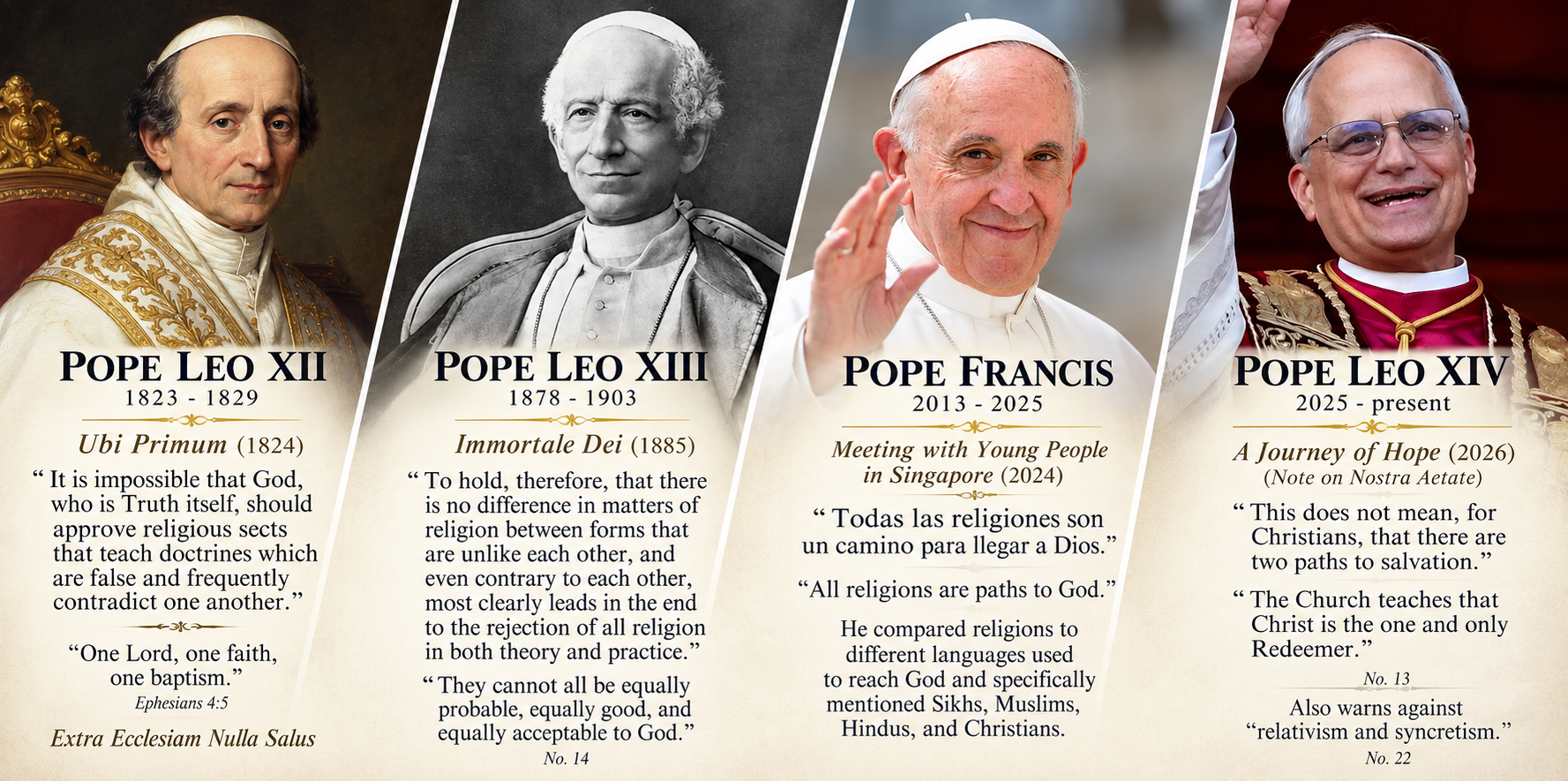
Francis, Leo XII, Leo XIII, and the Catholic Distinction We Keep Missing
When Pope Francis said in Singapore in 2024 that “all religions are paths to God,” Catholics understandably began debating what exactly he meant.
Some reacted as though Francis had formally declared every religion equally true and equally salvific. Others reacted in the opposite direction and seemed determined to explain away words that he plainly said.
Neither approach is necessary.
Francis really did say it.
Speaking spontaneously in Spanish at an interreligious meeting with young people on September 13, 2024, he said:
“Todas las religiones son un camino para llegar a Dios.”
The Holy See’s English translation rendered it:
“All religions are paths to God.”
Francis went on to compare religions to different languages used in approaching God and specifically mentioned Sikhs, Muslims, Hindus, and Christians.
So the question is not whether Francis said it.
He did.
The real question is:
What can a Catholic mean by calling another religion a “path to God”?
That becomes clearer once we distinguish between two very different propositions:
religious indifferentism, which the Church has repeatedly condemned,
and
the possibility that God can draw a sincere seeker toward Himself even while that person remains within an incomplete or erroneous religious framework.
Those are not the same thing.
Leo XII: God Cannot Approve Contradictory Falsehoods
Long before Vatican II or modern interreligious dialogue, Pope Leo XII addressed religious indifferentism directly.
In his 1824 encyclical Ubi Primum, Leo XII rejected the idea that God simply approves all religious sects regardless of what they teach.
His reasoning is direct: God is Truth itself. Therefore contradictory religious claims cannot all receive divine approval merely because they are sincerely held.
Leo XII writes that it is impossible for God, who is “Truth Itself,” to approve sects that profess false and mutually contradictory teachings. He immediately grounds this in the Christian confession of “one Lord, one faith, one baptism” and in the unique saving name of Jesus Christ. He concludes:
“This is why we profess that there is no salvation outside the Church.”
—Leo XII, Ubi Primum (1824).
That gives us an important boundary.
Catholicism cannot mean that every religion is equally true.
It cannot mean that mutually contradictory doctrines are all revelations from God.
And it cannot mean that religions possess independent saving power alongside Jesus Christ.
That would be religious indifferentism.
But rejecting indifferentism does not require us to deny that God may already be working in someone who presently holds religious error.
That is the distinction.
Leo XIII: Contrary Religions Cannot All Be Equally Acceptable to God
Pope Leo XIII makes the same principle unmistakable in Immortale Dei.
He writes:
“To hold, therefore, that there is no difference in matters of religion between forms that are unlike each other, and even contrary to each other, most clearly leads in the end to the rejection of all religion in both theory and practice.”
He then adds that conflicting forms of worship:
“cannot all be equally probable, equally good, and equally acceptable to God.”
—Leo XIII, Immortale Dei (1885), no. 14.
Again, the point is simple.
Christianity teaches that Jesus Christ is God incarnate.
Islam denies His divinity.
Christianity confesses the Most Holy Trinity.
Other religions deny it.
Christianity teaches Christ’s death and bodily resurrection.
Other religious systems reject or reinterpret those claims.
Contradictions cannot all be true in the same sense.
So whatever Francis meant by “paths to God,” a Catholic interpretation cannot mean that all religions are equally true or equally revealed.
But a Path Is Not Necessarily the Destination
This is where much of the controversy becomes confused.
A path can begin in darkness.
A path can contain wrong turns.
A path can include partial understanding.
A path can lead someone beyond the place where he started.
To say that a person is on a path that may ultimately lead him toward God is not necessarily to say that every belief he currently holds is true.
Consider someone raised Muslim who sincerely desires to know and obey God.
He may hold serious errors concerning the Trinity and the Incarnation.
But his desire to know God can still be sincere.
Consider a Hindu who recognizes that material things cannot satisfy the deepest longing of the human heart.
His metaphysical framework may contain serious errors.
But the longing for transcendence is not therefore meaningless.
Consider a Protestant who genuinely loves Jesus Christ while lacking the fullness of Catholic faith and sacramental communion.
The incompleteness remains.
But the love of Christ is real.
The presence of error does not make every movement toward truth worthless.
God can work with what is already present and draw the person further.
That is not indifferentism.
That is grace.
Vatican II Did Not Teach That All Religions Are Equal
Nostra Aetate is often invoked in this discussion, but the Council’s actual language is carefully balanced.
It says that the Church rejects nothing that is “true and holy” in other religions and recognizes in them elements that can reflect:
“a ray of that Truth which enlightens all men.”
But the very same paragraph immediately says that the Church:
“ever must proclaim Christ ‘the way, the truth, and the life.’”
—Second Vatican Council, Nostra Aetate, no. 2.
The Council does not call every religion equally true.
It recognizes real elements of truth while locating the fullness of truth in Jesus Christ.
That distinction is essential.
Francis Was Speaking About Religious Seeking
Francis’ Singapore remarks were spontaneous pastoral comments in the context of interreligious dialogue.
They were not a dogmatic definition.
But neither should Catholics pretend he did not say what he said.
He did.
The question is how those words are to be understood within Catholic faith.
One possible Catholic reading is that Francis was speaking about the human search for God.
People within different religions may genuinely be seeking the transcendent.
They may already possess fragments of truth.
They may recognize moral goods.
They may hunger for God without yet knowing Him fully.
But none of that means the religion itself becomes an independent source of salvation.
A pathway may contain truth without containing the fullness of truth.
A pathway may awaken the desire for God without possessing the fullness of revelation.
A pathway may prepare someone for Christ without replacing Christ.
And ultimately, if anyone is saved, he is saved through Jesus Christ.
For Christ says:
“I am the way, and the truth, and the life. No man cometh to the Father, but by me.”
—John 14:6, Douay-Rheims.
John Paul II Gives Us the Bridge
Saint John Paul II is particularly helpful because he refused both extremes.
He strongly reaffirmed the missionary mandate of the Church while also teaching that the grace of Christ can reach people who do not yet explicitly know Him.
That grace does not create another savior.
It remains the grace of Christ.
And it does not eliminate the need for evangelization.
This is the Catholic balance:
Christ may already be working in a person before that person consciously recognizes Him.
But wherever salvation occurs, Christ is its source.
Benedict XVI: Dialogue Cannot Abandon Truth
Pope Benedict XVI repeatedly warned against turning ecumenical or interreligious dialogue into relativism.
Addressing the Congregation for the Doctrine of the Faith in 2012, he warned against:
“the risk of a false irenism and of indifferentism.”
He also stated:
“Knowing the truth is a right of the conversation partner in every true dialogue.”
—Benedict XVI, Address to the Plenary Meeting of the Congregation for the Doctrine of the Faith, January 27, 2012.
That is a crucial principle.
Charity does not require us to pretend disagreements do not exist.
If I truly love another person, I should desire that he know the fullness of truth.
Authentic dialogue respects the person.
Authentic evangelization proposes Christ.
The two are not enemies.
Leo XIV: Travelling Companions on the Path of Truth
Pope Leo XIV has continued the Church’s emphasis on dialogue while also making the language of truth explicit.
At his General Audience on October 29, 2025, reflecting on Nostra Aetate, Leo XIV said that the document teaches Catholics to meet followers of other religions:
“not as outsiders, but as travelling companions on the path of truth.”
He added that Christians should discern in sincere religious searching “a reflection of the one divine Mystery that embraces all creation.”
That language is highly relevant to the Francis controversy.
Leo XIV does not say that every religion is equally true.
He speaks of people as travelling companions on the path of truth.
That is a very different claim.
The person can be moving.
The person can be seeking.
The person can be encountering reflections of truth.
And yet the fullness of truth remains something toward which the journey is directed.
The 2026 Note Approved by Leo XIV Makes the Boundary Explicit
The 2026 doctrinal note A Journey of Hope: Sixty Years of Interreligious Dialogue and Fraternity in the Light of the Conciliar Declaration Nostra Aetate was issued by the relevant dicasteries and formally approved by Pope Leo XIV, who ordered its publication.
The note makes an important clarification.
Discussing Judaism, it states that recognizing God’s continuing work does not mean:
“that there are two paths to salvation.”
It then says plainly:
“The Church teaches that Christ is the one and only Redeemer.”
The document also warns against relativism and syncretism while continuing to affirm authentic interreligious dialogue.
That is precisely the distinction needed here.
The Church can recognize truth, goodness, sincere searching, and even the mysterious work of grace outside visible Catholic communion.
But she does not therefore affirm multiple independent redeemers or parallel salvific systems.
Christ remains the one Redeemer.
What About Extra Ecclesiam Nulla Salus?
“Outside the Church there is no salvation” remains Catholic doctrine.
But it must be understood as the Church understands it.
The Catechism states:
“All salvation comes from Christ the Head through the Church which is his Body.”
—Catechism of the Catholic Church, no. 846.
That sentence is crucial.
All salvation comes from Christ.
All saving grace is related to His Church.
But this does not mean that every person lacking visible canonical membership in the Catholic Church is automatically damned.
The Catechism teaches that those who, through no fault of their own, do not know Christ and His Church but sincerely seek God and strive to follow His will according to the grace given them may attain salvation.
—CCC 847.
Yet the Catechism immediately affirms the Church’s obligation to evangelize.
—CCC 848.
And that tells us something important.
If every religion were already equally salvific in itself, evangelization would make little sense.
The Church evangelizes because Jesus Christ is not merely one religious option among many.
He is the Savior.
God Can Meet Someone Where He Is Without Intending That He Remain There
This may be the simplest way to state the entire issue.
God can meet a person where he is without intending that he remain there.
A Muslim may begin with a genuine belief in one Creator.
A Hindu may begin with a recognition that created things cannot satisfy the soul.
A Buddhist may begin with a serious recognition of the destructive power of disordered attachment.
An agnostic may begin by asking whether the intelligibility of the universe points beyond itself.
These are not the fullness of Christian revelation.
But they can become starting points.
Grace can awaken questions.
Grace can purify motives.
Grace can dismantle error.
Grace can lead someone beyond the religious framework he inherited.
The fact that God can use a beginning does not mean He endorses every error attached to that beginning.
Our Job Is Not to Extinguish the Search
The Catholic response to someone sincerely seeking God should never be:
“Everything you already believe is equally true.”
But neither should it be:
“Nothing in your search matters until you already understand everything Catholics believe.”
Instead, we recognize whatever is true.
We encourage whatever is genuinely good.
We correct what is false.
We answer questions.
We bear witness.
We proclaim Jesus Christ without embarrassment.
And then we allow grace to do what argument alone cannot.
We educate.
God gives the increase.
The Catholic Answer Is Both/And
Leo XII was right: God, who is Truth itself, cannot approve contradictory falsehoods as though they were equally true.
Leo XIII was right: conflicting religions cannot all be equally probable, equally good, and equally acceptable to God.
Vatican II was right to recognize rays of truth and holiness outside visible Catholic communion.
John Paul II was right to teach that Christ’s grace can reach those who do not yet explicitly know Him.
Benedict XVI was right that dialogue becomes false when it abandons truth.
Francis was speaking to a genuine human reality: people within different religious traditions can sincerely be seeking God.
And Leo XIV has now spoken of those same people as “travelling companions on the path of truth,” while a doctrinal note approved by him explicitly reaffirms that there are not parallel ways of salvation and that Christ remains the one Redeemer.
These truths do not have to contradict one another.
The key is understanding what we mean by path.
There are not many saviors.
There is one Savior.
There are not many equally true revelations.
There is one fullness of divine revelation in Jesus Christ.
There are not many independent religions capable of saving man by their own power.
There is one source of salvation: Jesus Christ.
But there are countless human beings walking through inherited traditions, partial truths, misunderstandings, spiritual hunger, unanswered questions, and sincere longing for something higher than themselves.
God can meet them there.
He can use whatever truth they already possess.
He can deepen the search.
He can correct the error.
He can lead them further.
And every authentic movement toward truth ultimately finds its fulfillment in the One who said:
“I am the way, and the truth, and the life. No man cometh to the Father, but by me.”
—John 14:6, Douay-Rheims.
A person may begin his search from many different places.
But if that search reaches its ultimate fulfillment, it reaches Jesus Christ.
Our job is to help people recognize Him when He calls.
Leave a Reply