

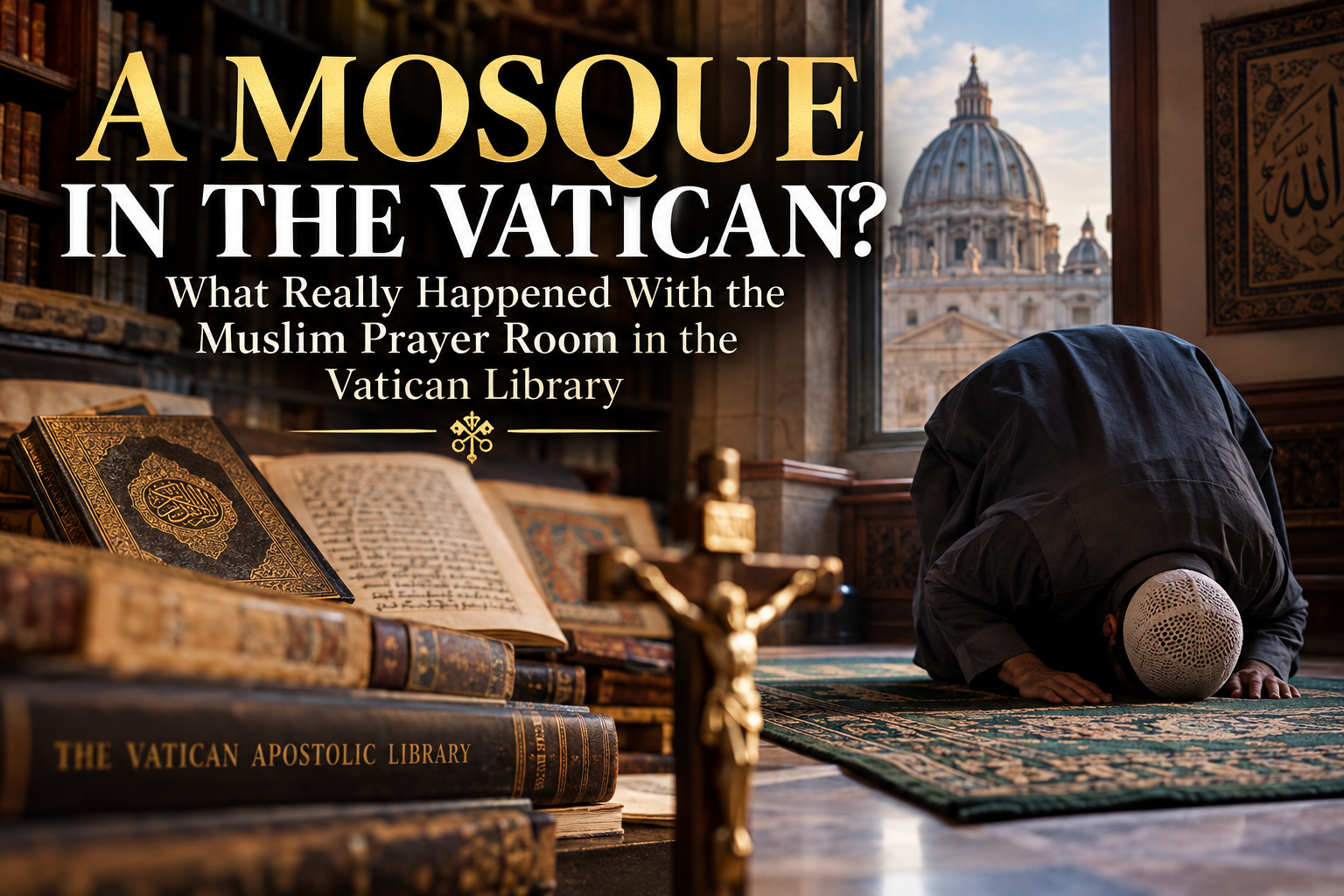
Sometimes a headline tells the truth and still leaves the reader with a false impression.
That appears to be what happened when reports began circulating that the Vatican had opened a “Muslim prayer room” inside the Vatican Apostolic Library.
The reaction was immediate.
Some Catholics saw the story and concluded that Islam had been given a foothold in the heart of the Church.
Others described it as capitulation.
Still others treated it as proof that the Vatican no longer believed Christianity to be uniquely true.
But before Catholics become angry, there is a basic obligation we should remember:
Find out what actually happened.
Because the reality is considerably less dramatic than the headline.
Yes, Muslim Scholars Were Given a Place to Pray
We should begin by admitting the fact rather than trying to explain it away.
Muslim scholars conducting research at the Vatican Apostolic Library asked whether they could have a room with a carpet in which to perform their prayers.
They were given one.
Father Giacomo Cardinali, vice-prefect of the Vatican Apostolic Library, explained that the library regularly receives scholars from different religious and cultural backgrounds and possesses significant Arabic, Jewish, Ethiopian, Chinese, and Islamic collections.
When asked about scholars belonging to other religions, he explained that some Muslim researchers had requested a place to pray and that the library accommodated the request.
The room has been described simply as “a room with a carpet.”
That is the fact.
But facts require context.
The Vatican did not establish a mosque.
It did not transform a consecrated Catholic chapel into an Islamic worship space.
It did not create a public Muslim prayer center for the Islamic population of Rome.
And the room was not apparently created as part of some grand program to introduce Islamic worship into the Vatican.
It arose from a practical request by visiting Muslim scholars who were already inside the library conducting academic research. Catholic World Report
That distinction changes the story considerably.
The Vatican Library Is Not St. Peter’s Basilica
This is perhaps the most important distinction.
A library is not a church.
A research room is not a sanctuary.
A carpeted room is not a consecrated Catholic chapel.
Catholic sacred space has a particular theological meaning.
A church is dedicated to divine worship.
A chapel containing the Blessed Sacrament is ordered toward Catholic prayer and Eucharistic worship.
For precisely that reason, Catholic guidance has historically distinguished between Catholic sacred spaces and ordinary shared or non-sacred spaces where people of different religions may be accommodated.
A Vatican document discussing interreligious facilities made the distinction very clearly: a Christian chapel should retain its Christian character, especially where the Blessed Sacrament is reserved, while non-sacred settings may permit shared or separate areas for prayer without confusing the religions themselves. Vatican
That distinction matters tremendously here.
Nothing indicates that Muslims were invited to perform Islamic prayer before the tabernacle.
Nothing indicates that a Catholic chapel was converted for Islamic use.
Nothing indicates that the Vatican declared Islamic worship equivalent to the Holy Sacrifice of the Mass.
A library room was made available to scholars.
Those are not remotely the same theological act.
What Is the Vatican Apostolic Library Actually For?
The Apostolic Library is one of the great repositories of human learning.
Its mission extends well beyond storing modern Catholic books.
Its collections preserve manuscripts and artifacts belonging to civilizations, languages, religions, and intellectual traditions from across the world.
That includes Christian manuscripts, certainly.
But it also includes Arabic materials, Hebrew manuscripts, ancient Qurans, Ethiopian collections, Asian documents, classical texts, scientific materials, maps, and an extraordinary range of historical documents.
This is why the library welcomes serious scholars from institutions around the world.
Father Cardinali described it as a “universal library.”
That word matters.
“Universal” does not mean:
Every religion is equally true.
It means the library preserves and makes available an extraordinary portion of humanity’s intellectual inheritance.
Pope Leo XIV has more recently described the Vatican Apostolic Library as more than a warehouse of books: it is a place of relationships, intellectual exchange, and shared study. Vatican News
And that raises an interesting Catholic question.
Should we really be frightened when a Muslim scholar walks into a Vatican library to study?
Or should we recognize the opportunity?
Imagine What That Muslim Scholar Encounters
Think about the situation.
A Muslim academic enters the Vatican.
He comes because the Church has preserved manuscripts he needs for his research.
He encounters a civilization shaped by Christianity.
He meets priests, religious, Catholic academics, archivists, historians, and scholars.
He encounters manuscripts preserved through centuries of Catholic intellectual labor.
He may handle texts written by Christians long before either of us were born.
He sees what the Catholic Church has safeguarded.
He discovers that Catholics are not afraid to preserve Islamic manuscripts alongside Christian ones.
He asks for somewhere to perform his prayers.
And instead of being treated with suspicion or contempt, he receives hospitality.
Does any of that prove he will become Catholic?
Of course not.
Grace is not mechanical.
But neither should Catholics underestimate what genuine Christian hospitality can accomplish.
Sometimes the door to evangelization is opened through an argument.
Sometimes through beauty.
Sometimes through scholarship.
Sometimes through friendship.
Sometimes because someone encounters a Catholic who treats him with dignity when he expected hostility.
The Church does not evangelize only from pulpits.
She evangelizes through the entire life of Christians.
Hospitality Does Not Mean Religious Indifference
This is where some Catholics become understandably nervous.
If we accommodate Muslim prayer, are we saying Islam and Christianity are basically the same?
No.
Catholic teaching allows no such conclusion.
The Second Vatican Council states clearly:
The Church “ever must proclaim Christ ‘the way, the truth, and the life.’”
— Nostra Aetate, 2
In the very same document, however, the Church exhorts Catholics to engage followers of other religions through:
“dialogue and collaboration… carried out with prudence and love and in witness to the Christian faith and life.”
That sentence contains both halves of the Catholic approach.
Dialogue.
And:
Witness.
Not dialogue without Christ.
Not witness without charity.
The Catholic Church can show kindness to a Muslim precisely because Catholicism is secure enough to know what it believes.
We do not have to insult Islam in order to confess Christ.
And we do not have to pretend Islam is Christianity in order to love Muslims.
Catholics Should Know What the Church Actually Says About Muslims
The Church does not teach that Islam possesses the fullness of revealed truth.
Muslims do not confess the Most Holy Trinity.
They do not confess Jesus Christ as God the Son incarnate.
They do not accept the Crucifixion and Resurrection in the Christian sense.
They do not receive the Eucharist.
They do not accept the Church Christ founded.
Those differences are enormous.
But Catholic theology also does not require us to pretend Muslims are incapable of sincerely seeking God.
Nostra Aetate notes that Muslims profess belief in the one Creator, honor Abraham, revere Jesus as a prophet rather than God, honor the Virgin Mary, and practice prayer, fasting, and almsgiving.
The Council immediately places this recognition alongside the Church’s unchanging obligation to proclaim Christ. Vatican
That is not indifferentism.
It is Catholic realism.
We can recognize truth wherever it appears while still knowing that the fullness of truth is found in Jesus Christ.
The Goal of Dialogue Is Not to Hide Jesus
This is crucial.
Interreligious dialogue becomes defective if Christians enter it embarrassed about Christianity.
If dialogue means:
“Let us never mention Jesus because someone might be offended,”
then we have lost the plot.
Catholic dialogue should make Christians more capable of witnessing to Christ, not less.
St. John Paul II told the Pontifical Council for Interreligious Dialogue that Christian communities living among people of other religions should bear witness to the Good News of Jesus Christ while building bridges of fellowship and cooperation. Vatican
The Church does not see dialogue and mission as enemies.
Properly understood, dialogue can prepare the ground upon which truthful witness becomes possible.
You cannot explain Christ to someone you refuse to meet.
You cannot answer a Muslim’s questions if you never allow him close enough to ask them.
You cannot correct misunderstandings about Catholicism while remaining sealed behind a wall.
The Library Can Be a Place of Encounter
The Catholic intellectual tradition has always taken study seriously.
Christianity is not afraid of books.
It is not afraid of manuscripts.
It is not afraid of languages.
It is not afraid of history.
It is not afraid of difficult questions.
The Vatican Library itself stands as evidence of that confidence.
And a library is particularly suited to encounter because study creates a peculiar kind of humility.
When two scholars sit before a manuscript that is eight hundred years old, neither of them created it.
Both must listen to the evidence.
Both must submit themselves to something received rather than invented.
There is something profoundly Catholic about that posture.
Truth exists before us.
Our task is to discover it.
And ultimately, for the Catholic, truth is not merely an abstraction.
Truth has a face.
“I am the way, and the truth, and the life.”
— John 14:6, Douay-Rheims
If intellectual encounter is honest enough and deep enough, the Catholic need not fear where truth ultimately leads.
But What About Islamic Prayer?
Some Catholics will still object:
“Why allow false worship anywhere inside Vatican territory?”
That is a serious theological concern and should not simply be mocked.
Catholics are right to guard against religious indifferentism.
Catholics are right to insist that Christian worship is unique.
Catholics are right to defend the sacred character of Catholic churches and chapels.
Catholics are right to reject the idea that all religions are equally pleasing to God.
But we must distinguish between allowing another person freedom to exercise his religion and endorsing the truth of that religion.
Those are not the same act.
If a Catholic employer allows a Muslim employee time to pray, the Catholic has not converted to Islam.
If a hospital provides a quiet room where a Muslim patient may pray, the hospital has not declared Muhammad a prophet.
If a Catholic university permits a Muslim student to pray somewhere on campus, the Eucharist has not ceased to be the Body of Christ.
Likewise, giving a Muslim researcher a private room while he studies ancient manuscripts does not constitute a Catholic profession of Islamic faith.
It is an act of accommodation.
Whether one thinks that accommodation was prudentially wise is a legitimate question.
But calling it apostasy requires far more than the facts currently establish.
Prudential Decisions Can Be Debated
This is another distinction Catholics need.
Not every Vatican administrative decision is a dogma.
Not every decision made by a Vatican employee is necessarily the best possible decision.
Catholics are allowed to ask prudential questions.
Would a neutral quiet room available to all researchers have been preferable?
Would it have avoided confusion?
Could the arrangement have been communicated more clearly?
Could scandal have been prevented by emphasizing that the room is neither sacred nor a mosque?
Those are fair questions.
But a prudential disagreement is different from accusing the Church of abandoning Christ.
We must not inflate every administrative accommodation into an ecclesial apostasy.
Catholic criticism should itself be Catholic.
That means truth, proportion, charity, and reason.
We Should Be More Concerned About Losing Catholics Than Hosting Scholars
There is something ironic about the controversy.
Some Catholics appear terrified that a Muslim might pray inside a room in the Vatican Library.
But how terrified are we that baptized Catholics no longer pray at all?
How worried are we that Catholics no longer believe in the Real Presence?
How concerned are we that Catholic children grow up without knowing the Creed?
How much outrage do we have when Catholics abandon Sunday Mass?
A Muslim scholar kneeling in prayer five times a day should not make us admire Islam as though it possessed the fullness of revelation.
But it might shame us into remembering that Christians should pray.
Pope Leo XIV recently lamented that prayer is increasingly treated as pointless or trivial in societies dominated by efficiency, technology, and consumerism. Vatican
Perhaps the stranger praying in the library should make the Catholic ask:
When did I last kneel before the Blessed Sacrament?
That is a more spiritually fruitful question than social-media outrage.
Muslim Devotion Can Become an Opening for Christian Witness
Pope Benedict XVI observed that Christians living alongside Muslims have sometimes allowed themselves to be challenged by Muslim devotion and piety while continuing to witness to Gospel truth. Vatican
That does not mean Islam is therefore true.
It means God can use encounters with others to expose our own spiritual laziness.
A Muslim who fasts may remind a Catholic that Friday penance exists.
A Muslim who stops to pray may remind a Catholic that the Angelus exists.
A Muslim who speaks confidently about God may remind a Catholic who has become embarrassed about faith that God should not be hidden.
And then the Catholic must go further.
We have something Islam does not have.
Not merely a command to submit to God.
We have God made flesh.
We have Jesus Christ.
We have the Cross.
We have the Resurrection.
We have the Eucharist.
We have sacramental union with Christ.
We have the Most Holy Trinity revealed.
We have the Church.
That is what we should want our Muslim neighbor eventually to discover.
Do We Really Believe Grace Can Work Through Encounter?
This may be the deeper issue.
Sometimes Catholics speak as though the only safe Muslim is one kept as far away from Catholic institutions as possible.
But Christianity spread precisely because Christians encountered people who did not yet believe.
St. Paul walked into pagan cities.
Missionaries entered cultures that worshipped other gods.
The early Church conversed with philosophers.
Catholic missionaries learned languages, translated texts, established schools, debated scholars, and engaged civilizations very different from their own.
Why?
Because Christ commanded:
“Going therefore, teach ye all nations.”
— Matthew 28:19, Douay-Rheims
You cannot teach nations you refuse to encounter.
You cannot evangelize people you treat only as threats.
A Muslim Scholar in the Vatican Library Is Not the Defeat of Christianity
Look at the image differently.
A Muslim scholar enters an institution created and sustained by the Catholic Church.
He studies books preserved by Catholic civilization.
He encounters Christians.
He experiences hospitality.
He sees the intellectual seriousness of the Church.
He learns that Catholicism is not afraid of his questions.
Perhaps he leaves unchanged.
Perhaps a conversation begins.
Perhaps a misunderstanding disappears.
Perhaps he asks about Christ.
Perhaps he asks why Catholics believe Jesus is more than a prophet.
Perhaps he encounters the Gospel in a way he never had before.
We cannot manufacture conversion.
Only grace converts the heart.
But we can make encounter possible.
And we can be ready when the question comes.
St. Peter tells us:
“Being ready always to satisfy every one that asketh you a reason of that hope which is in you.”
— 1 Peter 3:15, Douay-Rheims
The key phrase is:
when they ask.
Sometimes hospitality is what makes a person willing to ask.
The Vatican Should Never Be Ashamed of Christ
None of this means Catholics should stop being vigilant.
Interreligious dialogue must never become relativism.
Catholic institutions should unmistakably remain Catholic.
Christ must remain at the center.
The Cross should never be hidden because someone might object.
The Eucharist must never be treated as one religious symbol among many.
There is one Savior:
Jesus Christ.
There is one Church founded by Him in the fullness intended by Christ.
And every authentic Catholic encounter with another religion should ultimately be ordered toward truth, charity, and the salvation of souls.
But confidence in Christ should make us less frightened, not more.
If Jesus Christ is truly Lord, then a Muslim scholar entering a Catholic library does not threaten Him.
The real question is whether the Catholics he encounters there are prepared to witness to Him.
The Story We Should Have Heard
So what actually happened?
Not:
“The Vatican opened a mosque.”
Not:
“Islamic worship has replaced Catholicism inside the Vatican.”
Not:
“The Catholic Church has declared Islam equal to Christianity.”
What happened was far simpler:
Muslim scholars were using the Vatican Apostolic Library for research.
They requested somewhere to pray.
They were given an ordinary room with a carpet.
That accommodation can certainly be discussed prudentially.
But it should be discussed based on what actually happened.
And perhaps the larger story should make Catholics think beyond controversy.
The Vatican possesses ancient Qurans because Catholic scholarship has spent centuries preserving the intellectual history of civilizations beyond its own.
Muslim scholars come to the Vatican because those collections matter.
They enter a Catholic institution because the Church preserved what scholars need.
And when they arrive, they meet Catholics.
That is not necessarily a defeat.
It can be an opportunity.
Hospitality Is Not Surrender
A secure Catholic faith does not need to choose between truth and charity.
We can say:
Islam is not the fullness of revelation.
And:
Muslims should be treated with dignity.
We can say:
Jesus Christ is God incarnate and the only Savior of mankind.
And:
A Muslim scholar may be treated as a guest rather than an enemy.
We can say:
Catholic sacred spaces must remain Catholic.
And:
An ordinary library room is not a consecrated chapel.
We can reject indifferentism without rejecting hospitality.
Indeed, Christian hospitality may sometimes be the very thing that makes someone willing to listen when we speak about Christ.
The question Catholics should ask is therefore not merely:
“Why did they give Muslims a room?”
Perhaps we should also ask:
“When those Muslims enter our institutions, encounter our scholarship, experience our hospitality, and begin asking questions—are we ready to tell them who Jesus Christ really is?”
Because the ultimate purpose of Catholic engagement with the world is not simply peaceful coexistence.
It is love.
And authentic Christian love always desires the highest good of the other.
That highest good has a name Jesus Christ.
Sources & Further Reading
Second Vatican Council, Nostra Aetate, §§2–3 — On relations with non-Christian religions, dialogue with Muslims, and the Church’s continuing obligation to proclaim Christ as “the way, the truth, and the life.”
St. John Paul II, Address to the Pontifical Council for Interreligious Dialogue, October 30, 1998 — On dialogue, prayer, cooperation, and Christian witness to the Gospel.
Pope Benedict XVI, Ecclesia in Medio Oriente, §§23–24 — On Christian-Muslim relations, Muslim prayer and piety, and continued Christian witness to the Gospel.
International Theological Commission, Christianity and the World Religions (1997), §§111–112 — On prayer, dialogue, the search for truth, and Christian witness in interreligious encounter.
Catholic News Agency / EWTN News, Fact Check: “Did the Vatican Library Open a Prayer Room for Muslims?” — Documents the original remarks of Vatican Apostolic Library vice-prefect Fr. Giacomo Cardinali and clarifies that Muslim scholars were given an ordinary room with a carpet while conducting research rather than a public mosque or Islamic worship center. Catholic World Report
Vatican News, Pope Leo XIV on the Vatican Apostolic Library, September 2026 — Describes the Library not simply as a repository of books but as a place of study, relationships, exchange, and sharing ideas. Vatican News