

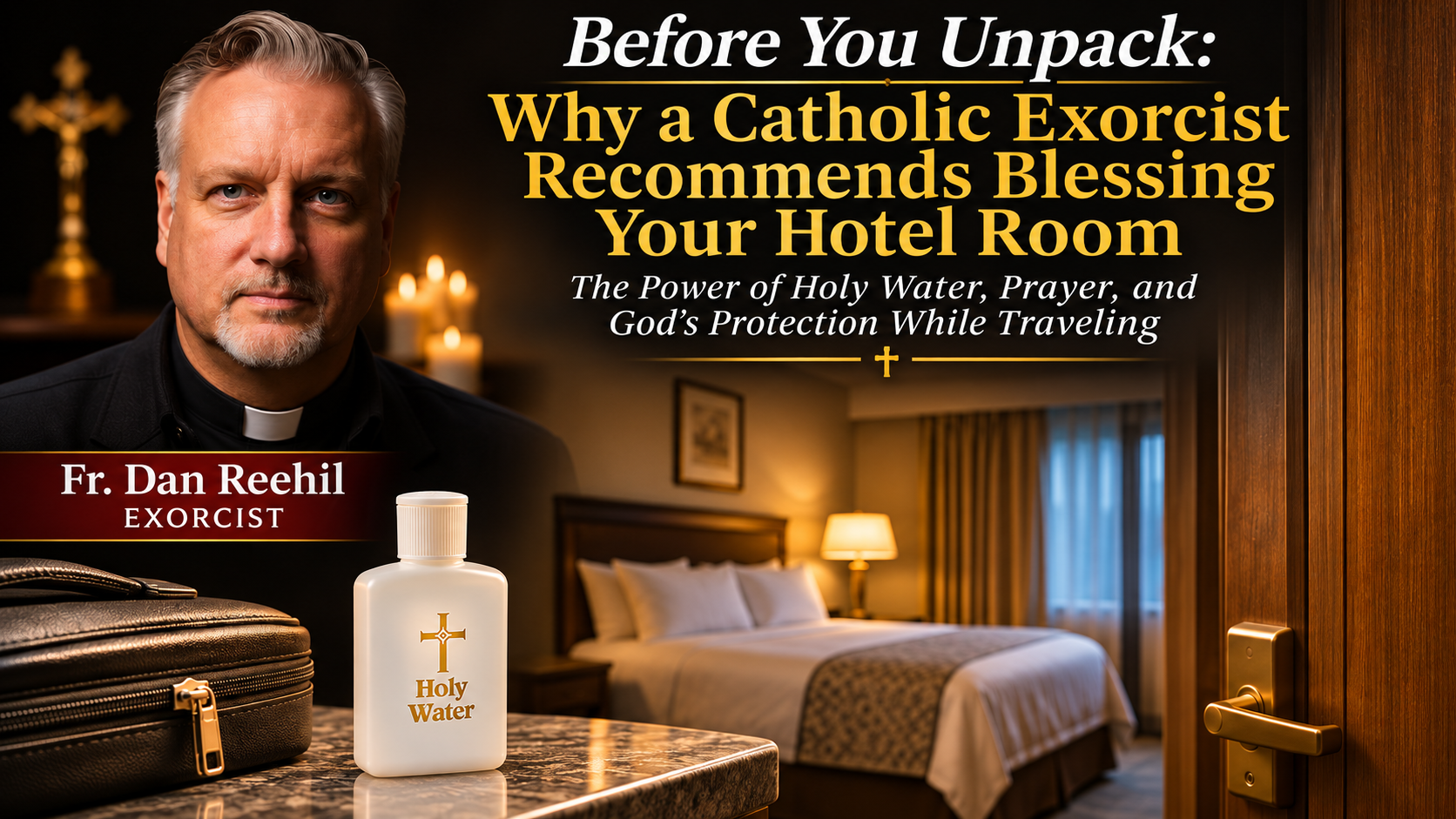
The spiritual meaning of holy water, the unseen battle between good and evil, and a simple Catholic prayer for God’s protection wherever you travel.
“For our wrestling is not against flesh and blood; but against principalities and powers, against the rulers of the world of this darkness, against the spirits of wickedness in the high places.” — Ephesians 6:12 (Douay-Rheims)
Every day, millions of people enter hotel rooms without giving a second thought to what might have happened there before their arrival.
They unlock the door, set their luggage on the floor, turn on the television, inspect the bathroom, and prepare for another night away from home.
For most travelers, the experience is entirely ordinary.
Yet a simple recommendation attributed to Father Dan Reehil, a Catholic priest and exorcist of the Diocese of Nashville, invites us to consider something deeper: the importance of bringing prayer, faith, and the blessing of God into the unfamiliar places where we temporarily dwell.
His advice is remarkably simple.
Bring holy water when you travel. Pray over your hotel room. Entrust yourself and your loved ones to the protection of Jesus Christ.
This is not an invitation to become frightened of hotel rooms, to suspect evil everywhere, or to imagine that every unfamiliar space conceals a supernatural danger.
Rather, it offers an opportunity to rediscover something Catholics have practiced for centuries: sanctifying ordinary life through prayer and the sacramentals of the Church.
The deeper question is not simply whether we should bless our hotel rooms.
It is whether we remember to invite God into every part of our lives.
A Disturbing Experience and an Exorcist’s Advice
An account circulating online describes a caller who contacted Father Reehil’s Catholic radio program to discuss an unsettling experience from 2006.
According to the story, the man had traveled to Las Vegas for an Army reunion.
After arriving at his hotel, he decided to lie down for a nap.
What followed, he said, was terrifying.
He awoke unable to move his body. Near the ceiling, in a corner of the room, he perceived a dark, bat-like figure with glowing yellow eyes.
Overwhelmed by fear, he called upon the Precious Blood of Jesus Christ.
He then experienced an intense burning sensation throughout his body.
The man reportedly continued to struggle with the memory and suffering associated with that night.
Father Reehil’s response, as quoted in the circulated account, was not merely a warning about spiritual danger.
It was an invitation to bring suffering to Christ:
“Unite your suffering to the Cross and ask Jesus to convert it to grace to save souls.”
He also reportedly encouraged travelers to carry holy water and bless their hotel rooms upon arrival.
Editorial note: The details and direct quotations above come from the account supplied for this article. The original radio recording or transcript has not been independently verified. The experience is therefore presented as a reported personal testimony, not as an established case of demonic activity.
That distinction matters.
A person may experience something profoundly frightening without its cause being supernatural. In fact, waking while unable to move, sometimes accompanied by vivid images or a threatening presence, is a recognized medical phenomenon called sleep paralysis.
Recognizing this possibility does not diminish the person’s fear or the value of prayer. It simply reminds us that Catholics are called to exercise both faith and prudence.
But the account raises a worthwhile spiritual question.
Why should Catholics bring holy water into the places where they sleep?
To understand the answer, we must first understand what holy water really is.
1. Holy Water: A Sacred Reminder of Our Baptism
Holy water is one of the most familiar sacramentals in Catholic life.
We encounter it when entering a church, when receiving certain blessings, and when participating in various liturgical celebrations.
Yet its meaning can easily be overlooked.
The Catechism of the Catholic Church teaches that sacramentals are sacred signs instituted by the Church that prepare the faithful to receive grace and sanctify the different circumstances of Christian life.
Catechism of the Catholic Church, 1667–1670
Holy water is not ordinary water regarded as having magical properties.
It is water blessed through the prayer of the Church and used as a sacred sign of God’s sanctifying work.
Its use recalls Baptism, through which we are cleansed from sin, reborn in Christ, and welcomed into the family of God.
When we bless ourselves with holy water, we are reminded of who we are and to whom we belong.
We belong to Jesus Christ.
Through Baptism, we have been marked with His grace and called to live as children of God.
Saint Paul reminds us:
“For as many of you as have been baptized in Christ, have put on Christ.” — Galatians 3:27
This is why making the Sign of the Cross with holy water can be such a meaningful act.
We are not simply performing a religious gesture.
We are remembering the saving mystery of Christ’s Death and Resurrection and renewing our desire to live faithfully in His grace.
When a Catholic sprinkles holy water while praying in a hotel room, the gesture can express a simple intention:
Lord, I belong to You. May this place where I rest tonight be entrusted to Your care.
The important thing is not the amount of water used.
It is the faith, reverence, and prayer with which it is used.
2. Why the Catholic Church Blesses Places
The Catholic Church has a long tradition of blessing not only people but also the places and objects connected with daily life.
Homes, workplaces, schools, fields, religious objects, and other places may receive appropriate blessings.
Why?
Because the Christian life is not confined to the walls of a church.
God is Lord of every aspect of human existence.
The Catechism explains:
“Among sacramentals blessings (of persons, meals, objects, and places) come first.” — CCC 1671
The Church’s blessings praise God and ask Him to bestow His gifts upon His people.
This reveals a beautiful truth.
A house can become a place of prayer.
A family meal can become an occasion of thanksgiving.
A journey can become an act of trust in Divine Providence.
And a hotel room, however temporary, can become a place where someone prays, rests, reads Sacred Scripture, and remembers the presence of God.
Blessing the place where we sleep is therefore not an attempt to discover what previous guests may have done.
It is a way of consciously placing our present circumstances under God’s loving care.
A Catholic should never assume that an unfamiliar room is spiritually contaminated simply because other people have occupied it.
The sins of previous occupants do not automatically make a room dangerous.
The purpose of prayer is not to cultivate suspicion toward strangers.
It is to cultivate confidence in Christ.
3. The Spiritual Battle Is Real, but Christ Has Already Won the Victory
Catholic teaching does not deny the existence of the devil.
Sacred Scripture speaks clearly about Satan, temptation, fallen angels, and the spiritual struggle experienced by the faithful.
Saint Peter warns:
“Be sober and watch: because your adversary the devil, as a roaring lion, goeth about seeking whom he may devour.” — 1 Peter 5:8
This is a serious warning.
Christians should not treat evil as imaginary or assume that spiritual vigilance is unnecessary.
At the same time, we must understand an equally important teaching.
The devil is not equal to God.
Satan is a creature.
His power is limited, and he remains subject to Divine Providence.
The Catechism explicitly teaches this in paragraph 395.
Jesus Christ, through His Passion, Death, and Resurrection, has defeated sin and the powers of darkness.
The Book of the Apocalypse declares:
“And they overcame him by the blood of the Lamb, and by the word of the testimony.” — Apocalypse 12:11
The Precious Blood of Jesus is the sign of our redemption, accomplished through the sacrifice of the Cross.
When Catholics invoke the Precious Blood of Christ, they are expressing confidence in the saving power of their Redeemer.
They are not employing a magical formula.
They are calling upon the Lord who died and rose again for their salvation.
Our Lord Himself tells His disciples:
“In the world you shall have distress: but have confidence, I have overcome the world.” — John 16:33
Notice that Jesus does not promise a life without suffering.
He promises that we can have confidence in Him.
For the Catholic traveler, therefore, blessing a hotel room should arise from faith rather than panic.
We do not need to spend the night imagining invisible enemies.
We need to remember the Lord who watches over us.
4. Why Holy Water Must Never Be Treated as Magic
This distinction is essential.
The Catholic Church teaches that sacramentals are sacred and beneficial when used properly.
But they do not operate as automatic mechanisms of supernatural protection.
The Catechism warns against attributing magical efficacy to religious practices apart from the interior dispositions they require.
Catechism of the Catholic Church, 2111
In other words, holy water should never be treated as a lucky charm or an object that guarantees freedom from every danger.
It is not a substitute for repentance.
It does not replace the Sacraments.
It cannot be used to control God.
Its meaning is inseparable from prayer, the faith of the Church, and the saving work of Jesus Christ.
A person who carries holy water but neglects prayer, deliberately persists in grave sin, and refuses to seek reconciliation with God has misunderstood the purpose of the sacramental.
A Catholic who uses holy water reverently should also seek to live in friendship with Christ.
This includes regular prayer, participation in Sunday Mass, reception of the Sacrament of Penance when needed, and worthy reception of the Holy Eucharist.
The strongest foundation of the Christian spiritual life is not a collection of religious objects.
It is communion with Jesus Christ.
Holy water reminds us of that communion and invites us to deepen it.
5. Can Lay Catholics Pray Over Their Hotel Rooms?
Yes.
Every baptized Catholic can pray for God’s blessing upon themselves, their loved ones, and the places where they live or stay.
The Catechism teaches that the baptized share in Christ’s priestly mission and that laypeople may lead certain blessings in accordance with the Church’s norms.
Catechism of the Catholic Church, 1669
However, an important distinction must be made between personal prayers asking God to bless a place and formal liturgical blessings reserved to ordained ministers.
A lay Catholic may reverently sprinkle blessed water and ask Jesus to protect a hotel room.
This is not the same as performing an official priestly blessing or an exorcism.
Solemn exorcism is governed by the authority of the Church and may be performed only by a priest who has received the required permission from the diocesan bishop.
Code of Canon Law, Canon 1172; Catechism of the Catholic Church, 1673
Ordinary Catholics should direct their prayers to God rather than attempting to confront or command supposed evil spirits.
A simple prayer is sufficient.
There is no need for elaborate rituals, dramatic declarations, or attempts to investigate invisible spiritual presences.
The Christian’s task is to pray with humility, entrust the place to the Lord, and rest in His providential care.
6. How to Pray Over Your Hotel Room With Holy Water
This simple devotional practice can take less than a minute.
Before leaving home, obtain some properly blessed holy water from your parish, where it is available.
Place a small amount in a clean, securely closed travel container.
When you arrive at your hotel room, you may take a quiet moment to turn your thoughts toward God.
Make the Sign of the Cross.
Sprinkle a little holy water reverently near the entrance or another suitable area, taking care not to damage hotel furnishings or property.
You do not need to sprinkle every corner or cover the entire room.
Then offer the following prayer.
A Catholic Prayer for Blessing and Protection in a Hotel Room
In the name of the Father, and of the Son, and of the Holy Ghost. Amen.
Heavenly Father,
I thank You for bringing me safely to this place.
Through the Most Precious Blood of Your beloved Son, Our Lord Jesus Christ, I humbly ask You to watch over this room and everyone who will rest here.
Lord Jesus, You are the Light of the World, and no darkness can overcome Your divine power.
May Your holy presence bring peace to this place.
Protect us from every evil, whether seen or unseen, and preserve us from all that may harm our bodies or souls.
Send Your holy angels to watch over us during the night.
Bless our rest, quiet our minds, strengthen our faith, and keep our hearts united to Your Sacred Heart.
Grant that this room may be a place of peace, gratitude, purity, and prayer.
Through the intercession of the Blessed Virgin Mary, Saint Joseph, our Guardian Angels, and Saint Michael the Archangel, may we remain faithful to You in every circumstance.
Lord Jesus, into Your loving hands I entrust this night, this room, my family, and my life.
In the name of the Father, and of the Son, and of the Holy Ghost. Amen.
A Short Prayer When You First Enter
For travelers who prefer something shorter:
In the name of the Father, and of the Son, and of the Holy Spirit. Amen.
Lord Jesus Christ, bless this room and everyone who rests here.
May Your holy angels watch over us, Your peace remain with us, and Your grace protect us from every evil.
Keep us close to Your Sacred Heart, and let nothing separate us from Your love.
Amen.
After praying, unpack your suitcase, enjoy your evening, and rest in peace.
There is no obligation to repeat the prayer out of fear that it was not performed perfectly.
God hears the sincere prayers of His children.
7. Psalm 90: A Powerful Prayer for Travelers and Families
Among the most beautiful passages of Sacred Scripture for those seeking God’s protection is Psalm 90 in the Douay-Rheims Bible, numbered Psalm 91 in many modern English Bibles.
It begins:
“He that dwelleth in the aid of the most High, shall abide under the protection of the God of Jacob.” — Psalm 90:1
Later, the psalm proclaims:
“Thou shalt not be afraid of the terror of the night.” — Psalm 90:5
And it speaks of God’s care through His angels:
“For he hath given his angels charge over thee; to keep thee in all thy ways.” — Psalm 90:11
These words have brought consolation to Christians through generations.
The psalm speaks of trust in the Lord amid danger, adversity, and uncertainty.
However, we must not misunderstand its promises.
God’s protection does not mean that faithful Christians will never become sick, suffer accidents, experience anxiety, or encounter hardship.
In fact, when Satan tempted Jesus in the wilderness, he misused the promises of this very psalm.
Our Lord rejected that temptation, declaring:
“Thou shalt not tempt the Lord thy God.” — Matthew 4:7
The lesson is profound.
We should trust God’s promises without attempting to force Him to act according to our expectations.
When praying Psalm 90 in a hotel room, we are not demanding immunity from every earthly difficulty.
We are placing our lives in the hands of our heavenly Father.
And there is no safer spiritual refuge than His merciful care.
8. What if You Wake Up Unable to Move?
The experience described in the reported radio call raises another important question.
What should a Catholic do after a frightening episode during sleep?
First, remain as calm as possible.
Sleep paralysis occurs when awareness returns while the normal temporary muscle immobility associated with REM sleep has not yet ended.
During an episode, a person may feel awake but unable to move or speak.
Some people also experience vivid dream-like perceptions, including the apparent presence of threatening figures in the room.
Such experiences can seem extraordinarily real.
Yet these symptoms do not, by themselves, demonstrate a supernatural cause.
Medical guidance from Cleveland Clinic and MedlinePlus recognizes sleep paralysis as a known sleep-related condition.
It may be associated with disrupted sleep, irregular schedules, stress, or certain underlying sleep disorders.
If episodes recur, disrupt sleep, or cause considerable distress, a person should speak with a medical professional.
Persistent pain or other unexplained physical symptoms should also receive appropriate medical attention.
The Church herself insists upon prudence in discerning extraordinary spiritual claims.
Catechism of the Catholic Church, 1673
Seeking medical assistance is not a failure of faith.
Prayer and sound medical care are compatible.
A Catholic who is frightened after such an experience can pray the Our Father, invoke the Holy Name of Jesus, and ask God for peace.
But no one should feel compelled to conclude that an episode of sleep paralysis proves the presence of a demon.
The Lord calls His children to trust, not to live in constant fear.
9. Unite Your Suffering to the Cross of Christ
Perhaps the deepest part of the reported exchange with Father Reehil is his counsel concerning suffering.
“Unite your suffering to the Cross and ask Jesus to convert it to grace to save souls.”
This touches one of the most profound mysteries of Catholic spirituality.
Suffering, considered in itself, is an evil or a deprivation that human beings naturally seek to overcome.
Christianity does not teach us to desire suffering for its own sake.
But through His Passion and Death, Jesus Christ has given suffering a new possibility.
When freely united with His Cross in love, our trials can become occasions of prayer, purification, charity, and spiritual fruitfulness.
Saint Paul declares:
“Who now rejoice in my sufferings for you, and fill up those things that are wanting of the sufferings of Christ, in my flesh, for his body, which is the church.” — Colossians 1:24
Saint Paul does not mean that Christ’s saving sacrifice was insufficient.
The Redemption accomplished by Jesus Christ is complete and perfect.
Rather, God allows the members of Christ’s Mystical Body to participate in the fruits of His saving work.
Pope Saint John Paul II explored this mystery in his apostolic letter Salvifici Doloris, particularly paragraphs 19 and 27.
The Christian can offer suffering to God in union with Jesus, praying that the Lord use those sacrifices for the spiritual good of others.
Consider a traveler struggling with anxiety.
A parent worried about a child far from home.
A person enduring illness.
A family grieving the death of someone they love.
None of these people must pretend that suffering is pleasant.
But they can place their burdens before the Cross.
They can pray:
Lord Jesus, I offer You this pain. Unite it to Your perfect sacrifice. Give me strength to endure it faithfully, and use my suffering, according to Your holy will, for the conversion of sinners and the salvation of souls.
This is the meaning of offering up our suffering.
It is an act of love.
It does not eliminate the importance of seeking relief, treatment, help, or consolation.
Rather, it allows even our most difficult experiences to become opportunities for deeper union with Christ.
10. Families, Children, and the Spiritual Responsibility of Parents
For Catholic parents, the practice of praying while traveling can be particularly meaningful.
Children often imitate the habits they observe in their parents.
When a mother or father makes the Sign of the Cross before beginning a journey, offers a prayer before bedtime, or uses holy water reverently, the child learns that faith belongs to everyday life.
These small moments can become powerful lessons.
They teach children that God is present not only at Sunday Mass but also during family vacations, visits to relatives, overnight trips, and ordinary daily routines.
At the same time, parents should be careful not to frighten their children with stories of demonic presences in hotel rooms.
A child should not be led to believe that an unfamiliar bedroom is dangerous simply because the family is traveling.
Instead, parents can explain:
We are going to thank Jesus for watching over us and ask Him to bless our stay.
A family might pray an Our Father, a Hail Mary, or the traditional Guardian Angel prayer before bedtime.
“Angel of God, my guardian dear, to whom God’s love commits me here, ever this day be at my side, to light and guard, to rule and guide. Amen.”
Such practices cultivate confidence, peace, and trust in God’s care.
The most important spiritual lesson a parent can teach is not that evil may exist in the world.
It is that Jesus Christ is greater than evil, infinitely loving, and worthy of our complete trust.
11. Do Not Allow Fear to Become the Center of Your Spiritual Life
There is a danger in becoming overly fascinated with spiritual warfare.
A person may become so concerned about demons, curses, extraordinary manifestations, and hidden influences that Christ gradually disappears from the center of attention.
This is not the purpose of Catholic spirituality.
Our faith is centered upon Jesus Christ, the Incarnate Son of God, who conquered death through His Resurrection.
The devil is real, but he is not the main character of the Christian story.
Jesus is.
A Catholic who practices the faith should certainly reject sin, avoid occult practices, resist temptation, and remain spiritually vigilant.
But vigilance must never become obsessive fear.
Saint Paul writes:
“For God hath not given us the spirit of fear: but of power, and of love, and of sobriety.” — 2 Timothy 1:7
Spiritual maturity includes prudence, peace, and discernment.
We should not interpret every nightmare, unexplained noise, disturbing dream, or uncomfortable feeling as evidence of demonic activity.
The ordinary means of growing in holiness remain essential: prayer, the Sacraments, Sacred Scripture, charity, repentance, and faithful obedience to God’s commandments.
For Catholics who are genuinely distressed by an ongoing spiritual concern, the proper first step is to consult their parish priest rather than attempting elaborate deliverance rituals themselves.
The Church provides pastoral guidance and careful discernment for these situations.
Our security ultimately rests in the mercy and power of God.
12. A Simple Tradition Worth Remembering Before Your Next Journey
The next time you prepare for a journey, you may pack clothes, medications, a phone charger, important documents, and everything else needed for your stay.
Consider placing a small, properly sealed bottle of holy water among your belongings.
Not because every hotel room should be feared.
Not because the Church requires this particular practice.
Not because the water itself guarantees protection from misfortune.
But because carrying holy water can be a beautiful reminder that you belong to Christ wherever you go.
When you reach your destination, pause for a moment of prayer.
Thank God for bringing you safely there.
Ask Him to bless your rest.
Pray for the people traveling with you.
Remember those who are alone, frightened, ill, or far from home.
And entrust the coming night to His care.
One small bottle of holy water. One sincere prayer. One renewed act of trust in Jesus Christ.
Sometimes these simple expressions of faith help us remember what is most important.
That we are never beyond the reach of God’s love.
That no place is too ordinary for prayer.
And that every moment of our lives can be offered to Him.
FINAL PRAYER: FOR GOD’S PROTECTION WHILE TRAVELING
O Lord Jesus Christ,
You are our refuge, our strength, and our salvation.
You accompanied Your disciples upon the roads of Galilee, protected them amid the storms of the sea, and promised to remain with Your Church until the consummation of the world.
Be with us now as we travel.
Bless the roads upon which we journey, the places where we rest, and the people whom we encounter.
Through the merits of Your Most Precious Blood, protect us from sin, temptation, and every evil that may threaten our souls.
Send Your holy angels to watch over our families and loved ones.
When we are anxious, grant us peace.
When we are weary, grant us rest.
When we are afraid, strengthen our faith.
When we suffer, help us unite our crosses to Yours.
May the Blessed Virgin Mary, our loving Mother, intercede for us.
May Saint Joseph, protector of the Holy Family, pray for us.
May Saint Michael the Archangel defend us through God’s power.
May our Guardian Angels faithfully guide us along the path of salvation.
And when our earthly journeys are complete, bring us safely to our eternal home, where no darkness remains and where we shall rejoice forever in the light of Your divine presence.
For You live and reign with the Father and the Holy Spirit, God, forever and ever.
Amen.
Most Sacred Heart of Jesus, have mercy on us.
Immaculate Heart of Mary, pray for us.
Saint Michael the Archangel, pray for us.
Holy Guardian Angels, watch over us.
A Final Thought
Before your suitcase touches the floor of your next hotel room, take a moment to remember the Lord.
It costs nothing to pray.
It takes only a few seconds to make the Sign of the Cross.
And a small bottle of holy water can serve as a reverent reminder of the promises of your Baptism.
But above all, remember this:
Our greatest protection is not found in a bottle of holy water. It is found in Jesus Christ, whose grace sustains us, whose Precious Blood has redeemed us, and whose love can never be defeated by the powers of darkness.
Travel with prudence.
Pray with confidence.
Rest without unnecessary fear.
And wherever you go, remain close to the Sacred Heart of Jesus.
“The Lord is my light and my salvation, whom shall I fear?” — Psalm 26:1 (Douay-Rheims)
Catholic Scripture and Doctrinal References
Sacred Scripture — Douay-Rheims Bible
- Psalm 26:1 — The Lord is our light and salvation.
- Psalm 90:1–16 — God’s protection and the ministry of His angels.
- Matthew 4:5–7 — Christ rejects the temptation to put God to the test.
- John 16:33 — Christ has overcome the world.
- Ephesians 6:10–18 — The spiritual armor of God.
- Colossians 1:24 — Suffering united to Christ.
- 2 Timothy 1:7 — The spirit of power, love, and sobriety.
- 1 Peter 5:8–9 — Spiritual vigilance.
- Apocalypse 12:11 — Victory through the Blood of the Lamb.
Catechism of the Catholic Church
- CCC 391–395 — The reality and limitations of Satan’s power.
- CCC 1667–1672 — Sacramentals, holy water, and blessings.
- CCC 1673 — Exorcism and the importance of discernment.
- CCC 2111 — The sin of superstition.
Other Church Documents
- Sacrosanctum Concilium, 60–61 — The nature and purpose of sacramentals.
- Salvifici Doloris, 19 and 27 — Pope Saint John Paul II on Christian suffering and participation in Christ’s redemptive work.
- Code of Canon Law, Canons 1166–1172 — Sacramentals, blessings, and exorcism.
- Book of Blessings — The Church’s liturgical blessing of persons, places, and things.
Medical Reference
- Cleveland Clinic, Sleep Paralysis: What It Is, Causes, Symptoms & Treatment — Clinical explanation of sleep paralysis and associated perceptions.
This article is intended for Catholic spiritual education and encouragement. Personal prayer with holy water is not a formal exorcism, and distressing sleep experiences should not automatically be interpreted as supernatural.