

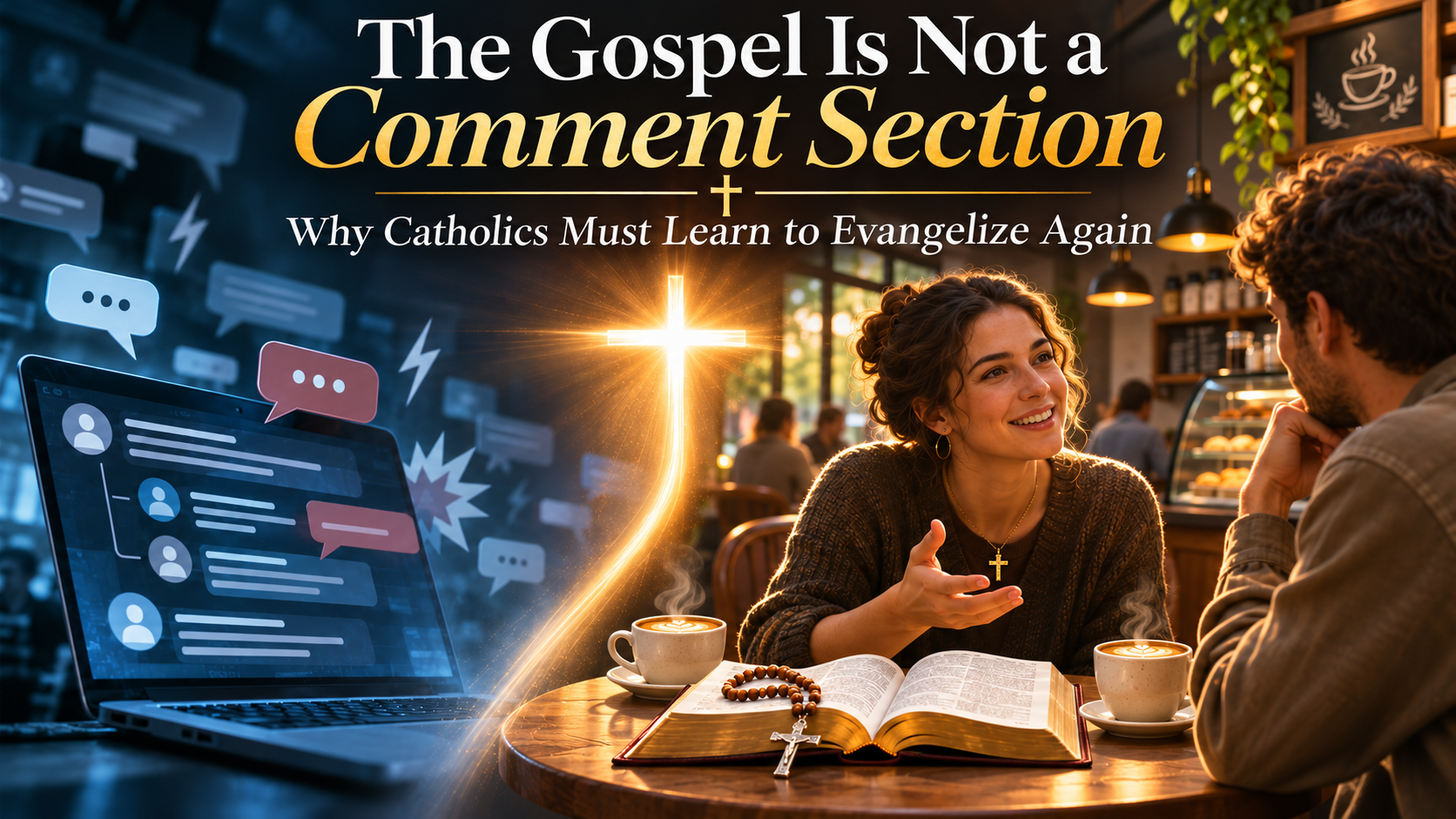
We have more Catholic content, more apologetics, and more access to Church teaching than ever before. But are we actually making disciples of Jesus Christ?
There is something deeply ironic about the modern Catholic world.
We live in an age when nearly the entire intellectual and spiritual inheritance of the Church is available at our fingertips.
The writings of St. Augustine can be accessed in seconds. St. Thomas Aquinas can be studied without entering a monastery or university. The Catechism of the Catholic Church is searchable online. Papal encyclicals, Church councils, biblical commentaries, and the writings of the saints are available to anyone with an internet connection.
We can listen to lectures about the Holy Trinity while driving to work. We can watch debates about the Eucharist during lunch. We can participate in theological discussions with Catholics on the other side of the world.
And yet, despite this extraordinary access to the riches of Catholicism, one uncomfortable question remains.
Are we becoming better at talking about the Catholic faith than we are at actually living and sharing it?
It is possible to know the arguments for the Real Presence and still rarely approach the Blessed Sacrament with reverence.
It is possible to defend the Sacrament of Confession online while avoiding the confessional ourselves.
It is possible to explain the Church Fathers, refute historical misconceptions, and quote the Catechism while neglecting prayer, charity, humility, and the conversion of our own hearts.
We can even become so consumed with defending Christianity that we forget why Christianity exists in the first place.
The Catholic faith is not ultimately a collection of arguments to be won, an identity to be protected, or a civilization to be admired from a distance.
It is the revelation of the living God, who became man in Jesus Christ to redeem humanity from sin and reconcile us to Himself.
And that revelation demands something far greater than intellectual agreement.
It demands conversion.
It demands discipleship.
It demands holiness.
And it demands that we share the Gospel with the world.
1. We Have Confused Defending the Faith with Sharing the Faith
Let us begin with a distinction that modern Catholic apologetics sometimes overlooks.
Apologetics and evangelization are closely related, but they are not identical.
Apologetics concerns the rational defense and explanation of the faith. It addresses objections, resolves misunderstandings, and demonstrates that Catholic belief is intellectually defensible.
Evangelization announces the saving truth of Jesus Christ and invites people into communion with Him.
Apologetics can serve evangelization, but it cannot replace it.
Consider a conversation between a Catholic and someone who has left Christianity.
The former Christian raises objections to the papacy, the Eucharist, or the authority of Sacred Tradition.
The Catholic offers historical evidence, biblical arguments, and theological explanations. Perhaps the objections are answered convincingly.
That is valuable.
But suppose the conversation ends with the Catholic feeling victorious and the other person feeling humiliated, dismissed, or even more distant from Christ.
What has actually been accomplished?
An argument may have been won.
A relationship may have been damaged.
And the Gospel may never have been meaningfully proclaimed.
This does not mean Catholics should avoid difficult arguments. Sacred Scripture itself demonstrates the importance of defending the truth.
St. Peter commands Christians to be prepared to explain the reason for their hope, but he also requires that this be done with modesty, reverence, and a good conscience (1 Peter 3:15–16).
The defense of Christian truth is inseparable from the Christian manner in which that defense is offered.
St. Paul expresses an equally important principle:
“If I should have all faith, so that I could remove mountains, and have not charity, I am nothing.” (1 Corinthians 13:2, Douay-Rheims)
This should trouble every Catholic apologist, writer, commentator, and online evangelist.
Because we can become experts in the intellectual content of the faith while remaining spiritual beginners in the practice of charity.
And when that happens, our knowledge ceases to serve the purpose for which it was given.
The purpose of apologetics is not to demonstrate that we are superior to those who disagree with us. It is to remove obstacles that prevent people from recognizing the truth of Jesus Christ.
If we forget that, apologetics can become another expression of the pride Christianity was given to overcome.
2. You Cannot Introduce Someone to a Christ You Barely Know
Imagine someone enthusiastically recommending that you develop a friendship with a person he has never actually met.
He knows the person’s biography.
He has studied his writings.
He can explain his philosophy, recount the important events of his life, and defend his reputation against criticism.
But he has never spoken to him.
He has never spent time with him.
He has never developed an actual relationship with him.
Would you find his invitation convincing?
This illustrates a danger within religious life.
We can know a tremendous amount about Jesus Christ without developing the interior life through which we come to know Him personally.
Catholicism certainly does not separate knowledge from faith. Theology is sacred precisely because its subject is God.
But theological knowledge must serve communion with the One whom theology studies.
Jesus Himself declares:
“Abide in me, and I in you.” (John 15:4, Douay-Rheims)
Notice what Christ does not say.
He does not simply command His disciples to collect accurate information about Him.
He calls them to remain united to Him.
This communion is cultivated through prayer, fidelity to His commandments, participation in the sacramental life of the Church, and cooperation with divine grace.
The Eucharist occupies a unique place in this relationship.
The Catechism teaches that the Eucharist is the source and summit of the Christian life (CCC 1324).
That means the deepest center of Catholic life is not an argument, podcast, political movement, or theological debate.
It is Jesus Christ Himself, truly present under the sacramental appearances of bread and wine.
Consider the implications.
We may spend hours arguing online about whether John 6 teaches the Real Presence.
But when was the last time we spent an hour in Eucharistic adoration?
We may defend the necessity of sacramental confession.
But do we regularly examine our consciences and seek God’s mercy?
We may passionately explain why the saints matter.
But are we trying to imitate their holiness?
These are not arguments against theological study.
They are reminders of its proper purpose.
The credibility of Catholic evangelization begins with the willingness of Catholics themselves to be converted.
Before we ask how to convince the world that Christ is Lord, we should ask whether we have truly allowed Him to become Lord of our own lives.
3. The Gospel Is a Historical Announcement, Not a Self-Improvement Program
One of the most serious problems facing modern Christianity is the reduction of the Gospel to moral advice.
Christianity is frequently presented as a system for becoming kinder, more disciplined, more charitable, or more emotionally fulfilled.
These are worthwhile goals.
But none of them adequately explains Christianity.
The Gospel is not simply the announcement that human beings should try harder to behave morally.
It is the proclamation that something extraordinary has happened in human history.
God became man.
Jesus Christ suffered and died for our sins.
He rose bodily from the dead.
Through His Passion, Death, and Resurrection, humanity has been offered reconciliation with God.
St. Paul places this announcement at the center of the Christian faith (1 Corinthians 15:3–4).
And the significance of that announcement cannot be understood apart from the history of salvation.
God created the world good.
Humanity fell into sin.
God called Abraham and formed Israel as His covenant people.
Through the Law, the prophets, the temple, and the promises made to David, God prepared His people for the coming of the Messiah.
That promise reached its fulfillment in Jesus Christ.
After His Resurrection, Jesus explained to His disciples the Scriptures concerning Himself, beginning with Moses and the prophets (Luke 24:27).
This is crucial.
Christianity does not begin with our search for meaning. It begins with God’s action to save a fallen world.
When we detach Jesus from the history of Israel, He becomes easy to misunderstand.
He can be reduced to an inspirational teacher, a revolutionary political figure, a religious philosopher, or an example of unusually compassionate living.
But Jesus claimed far more.
He came to accomplish what humanity could not accomplish for itself.
He came to reconcile sinners to God.
He came to establish His kingdom.
And He founded His Church to continue His saving mission throughout history.
This is why an authentic Catholic proclamation must include the reality of sin.
If sin is merely a social inconvenience, then Christ becomes a moral adviser.
If sin is a genuine rupture in humanity’s relationship with God, then we begin to understand why the Cross was necessary.
We do not need Jesus merely to tell us how to improve ourselves.
We need Jesus because we cannot redeem ourselves.
And that is precisely what makes the Gospel good news.
4. We Must Understand the World Without Surrendering to It
There is a temptation among religious people to view contemporary culture exclusively as an enemy.
Certainly, modern society contains serious moral and spiritual dangers.
Relativism, consumerism, pornography, the rejection of objective moral truth, and an increasingly fragmented understanding of human identity present genuine challenges to Christian life.
But if our entire approach to culture consists of condemnation, we risk misunderstanding how evangelization works.
St. Paul provides an instructive example in Acts 17.
When he arrives in Athens, he encounters a deeply religious but predominantly pagan society.
He does not pretend that pagan worship is equivalent to the revelation of the true God.
Nor does he begin by simply insulting his audience.
Instead, he recognizes their religious searching and uses it as a starting point to proclaim the God they do not yet know.
He then announces repentance, divine judgment, and the Resurrection of Jesus Christ.
Some reject his message.
Others become interested.
Some believe.
Paul neither compromises the Gospel nor refuses to engage the people before him.
This is the balance Catholics must recover.
We need to understand the questions people are actually asking.
Why are so many young people anxious about the future?
Why do people increasingly search for identity through politics, sexuality, ideology, and online communities?
Why does a society with extraordinary material conveniences so often struggle with loneliness and a sense of meaninglessness?
Why do people long for belonging while resisting the obligations that genuine community requires?
These questions are not distractions from evangelization.
They can become opportunities to introduce people to the Christian understanding of the human person.
Catholicism teaches that human beings are created in the image and likeness of God (Genesis 1:26–27; CCC 1700).
Our dignity does not depend upon wealth, achievement, popularity, usefulness, or the approval of others.
It comes from our Creator.
That truth has enormous implications for contemporary life.
The answer to the crisis of human identity is not simply another ideology.
It is the recognition that humanity has been created for communion with God.
But we cannot communicate this effectively if we refuse to understand the world in which people actually live.
The Christian mission is not to imitate the world, nor to flee every encounter with it, but to bring the light of Christ into its darkness.
5. The Internet Is a Mission Field, Not a Battlefield for Our Egos
This is where the mission becomes particularly relevant to CatholicG33K.
The internet has transformed the way human beings encounter information, build relationships, form opinions, and discover religious ideas.
A Catholic no longer needs a television network, publishing company, or radio station to reach an audience.
A thoughtful article can travel across continents.
A conversation can introduce someone to the Catechism.
A short video can answer a question that someone has quietly struggled with for years.
A podcast can accompany a person who has not entered a church in decades.
These are extraordinary opportunities.
But they come with extraordinary temptations.
Social media platforms often reward outrage, conflict, speed, and emotional intensity.
A carefully reasoned theological explanation may attract little attention.
An angry accusation can receive thousands of reactions.
A charitable correction may go unnoticed.
An insulting response may become viral.
And the Christian who enters this environment without spiritual discipline can gradually begin to mistake engagement for evangelization.
We start measuring success through views, shares, followers, and arguments won.
We become preoccupied with what our opponents are saying.
We learn to anticipate controversy before it even begins.
Eventually, it becomes possible to spend an entire day discussing God without once remembering to pray.
This is not a small spiritual danger.
It is a distortion of priorities.
There is nothing inherently wrong with public debate. Error should be challenged, and the faith deserves serious intellectual defense.
But a Catholic account should not become a place where contempt is cultivated under the appearance of religious zeal.
We should ask ourselves whether our words make the truth more understandable or merely make our audience more angry.
Are we correcting misinformation, or are we enjoying the humiliation of another person?
Are we defending the dignity of the Church, or defending our own reputation?
Are we trying to reach those who disagree with us, or merely entertaining those who already agree?
These questions matter because the internet does not exempt Christians from the moral law.
The commandment to love our neighbor does not disappear when our neighbor becomes a username.
And charity does not become optional because someone has expressed an objectionable opinion.
The Catechism reminds Christians that the duty to bear witness to the Gospel belongs to the baptized (CCC 1270, 2472).
For Catholic content creators, this means that publishing religious material is not enough.
We must also consider the moral character of our communication.
Every Catholic platform should ask not only whether it is spreading information about the faith, but whether it is actually serving the mission of the Church.
That is the challenge.
And it is one Catholic digital communities cannot afford to ignore.
6. Charity Does Not Require Us to Compromise the Truth
At this point, an important objection naturally arises.
Does emphasizing kindness and dialogue mean Catholics should soften unpopular doctrines?
Absolutely not.
The Gospel is not ours to reinvent.
The Church cannot discard revealed truth simply because contemporary society finds it uncomfortable.
Jesus Christ did not promise that His teachings would always be popular.
He called His disciples to faithfulness, including when faithfulness would bring opposition.
The Catholic Church must continue to proclaim the dignity of every human life, the sanctity of marriage, the reality of sin, the necessity of repentance, the truth of the sacraments, and the universal saving mission of Jesus Christ.
But proclaiming difficult truths does not give us permission to abandon charity.
St. Paul calls Christians to hold to the truth in charity (Ephesians 4:15).
The two virtues are not enemies.
Charity without truth can become sentimentality.
Truth proclaimed without charity can become a weapon of personal pride.
Neither is an adequate expression of Christian discipleship.
Consider how Jesus encounters the Samaritan woman in John 4.
He does not begin by pretending that her life is morally ordered.
He speaks truthfully about her circumstances.
But He also engages her as a person capable of receiving divine grace.
He does not reduce her to her failures.
He reveals the living water that only He can provide.
Similarly, when Catholics engage people who reject Christian moral teaching, the goal should not be to disguise the truth.
It should be to help them understand why that truth matters.
A person struggling with a particular teaching does not need a dishonest presentation of Catholicism.
But neither does that person need to be treated as though his entire identity can be reduced to one moral disagreement.
Evangelization requires the ability to speak clearly without becoming cruel.
It requires patience without doctrinal surrender.
And it requires remembering that the person before us is someone for whom Jesus Christ died.
The Church does not become more faithful by becoming less charitable. Nor does she become more loving by becoming less truthful.
7. The Church Is Not an Optional Addition to Jesus Christ
A recurring problem in contemporary religious discussion is the tendency to separate Jesus Christ from the Church He founded.
People often claim to admire Jesus while rejecting organized religion.
They may appreciate His moral teachings, compassion, and concern for the poor, while regarding the Church as an unnecessary human institution.
Catholics should acknowledge that scandals, hypocrisy, and the sins of Christians have sometimes contributed to this perception.
The Church’s members are not without sin.
But the failures of Christians do not erase the divine purpose of the Church.
Jesus did not simply leave behind a collection of inspiring teachings for individuals to interpret in isolation.
He gathered Apostles.
He entrusted authority to them.
He instituted the sacraments.
He commanded the making and baptizing of disciples.
And He promised to remain with His Church (Matthew 28:19–20).
The Acts of the Apostles presents the earliest Christian community persevering in apostolic teaching, fellowship, the breaking of bread, and prayer (Acts 2:42).
Christianity was ecclesial from its beginning.
This is why Catholic evangelization cannot be satisfied with encouraging someone to develop a vague admiration for Jesus.
We want people to encounter Christ in the fullness of the life He gave His Church.
That includes Sacred Scripture.
It includes prayer and moral conversion.
It includes the sacraments.
It includes the Holy Sacrifice of the Mass.
It includes the communion of saints and the spiritual riches of Catholic Tradition.
And it includes the responsibility to live as members of Christ’s Body.
The Catechism teaches that the Church is missionary by her very nature (CCC 849).
Her mission is not an occasional institutional activity.
It belongs to her identity.
A Catholic who shares the faith should therefore be willing to invite others beyond the screen and into the life of the Church.
An article may introduce someone to Catholic teaching.
A conversation may resolve a misunderstanding.
A video may inspire someone to read the Gospels.
But those encounters should ultimately point beyond themselves.
They should open a path toward the worship of God and communion with His people.
The goal is not to create permanent consumers of Catholic content.
The goal is to help people become disciples of Jesus Christ.
8. Not Every Conversation Requires a Debate
Sometimes the most effective act of evangelization is an explanation.
Sometimes it is a direct challenge.
Sometimes it is a personal testimony.
And sometimes it is simply listening.
Not every individual approaches Christianity with the same questions, experiences, or wounds.
A person who has never encountered Catholic theology may need patient instruction.
Someone who believes Catholics worship Mary may need a careful explanation of the distinction between adoration and veneration.
A former Catholic wounded by a serious betrayal may need to be heard before being presented with another argument.
A person intellectually convinced of Christianity may still struggle with the fear of changing his life.
And someone who is curious about the faith may simply need an invitation to attend Mass.
The method must be appropriate to the person.
This is not relativism.
It is prudence.
St. Paul describes adapting his approach to the people he encounters in order to bring them the Gospel (1 Corinthians 9:19–23).
The truth does not change.
But the way we communicate it can and should account for the circumstances of those receiving it.
This is particularly important in online Catholic discourse, where people are often reduced to theological labels.
Protestant.
Atheist.
Agnostic.
Traditionalist.
Progressive.
Convert.
Cradle Catholic.
These terms may describe real differences, but they do not tell us the whole story of a human soul.
Behind every argument is a person with experiences, hopes, fears, and responsibilities we may know very little about.
We should therefore avoid assuming that every disagreement is an expression of bad faith.
Some people genuinely misunderstand Catholic teaching.
Some have never heard it explained accurately.
Others know the teaching but struggle with its implications.
And some reject it despite understanding what the Church proposes.
These situations require different responses.
The Catholic evangelist must learn when to speak, when to explain, when to challenge, and when to remain silent.
Evangelization is not about delivering the same speech to everyone. It is about serving the same truth while recognizing the person in front of us.
Evangelization May Begin With a Cup of Coffee
Imagine two friends sitting across from one another in a coffee shop.
One is a practicing Catholic. The other has not attended Mass in years.
The conversation begins with an ordinary question:
“Why do you still believe in the Catholic Church?”
The Catholic could immediately begin explaining apostolic succession, papal authority, the historical reliability of the Gospels, or the philosophical arguments for God’s existence.
There may eventually be a place for all these things.
But perhaps the better first response is another question:
“What made you stop believing?”
And then, instead of preparing a rebuttal, the Catholic listens.
Perhaps the friend has experienced suffering. Perhaps he was scandalized by the failures of Church leaders. Perhaps he has never understood what Catholics believe about the Eucharist.
That conversation may become an opportunity to explain the faith, acknowledge real wounds, and testify to the mercy of Jesus Christ.
The Catholic does not need to win the conversation.
He needs to speak the truth with charity and allow room for the Holy Ghost to work.
Saint Peter teaches us to be ready to give a reason for our hope, but to do so with modesty and reverence (1 Peter 3:15–16).
Sometimes the first step toward conversion is not a brilliant theological argument.
It is the discovery that someone genuinely cares enough to listen.
A Catholic may spend years debating strangers online without leading anyone closer to Christ.
Yet one sincere conversation, one invitation to Mass, or one act of Christian friendship may become the beginning of someone’s journey home to the Church.
The Gospel is not merely something we post. It is something we proclaim, embody, and share with the people God places before us.
9. We Must Recover the Beauty of Catholicism
There is another dimension of evangelization that modern Catholics sometimes underestimate.
Beauty.
The Catholic faith possesses an extraordinary inheritance of sacred art, architecture, music, literature, philosophy, and liturgical tradition.
These are not merely cultural decorations surrounding the Gospel.
At their best, they help direct the human person toward the truth and goodness of God.
A Gothic cathedral can inspire questions about transcendence.
Gregorian chant can introduce someone to the spiritual atmosphere of Catholic worship.
The paintings of Michelangelo and the poetry of Dante can awaken an interest in the Christian understanding of humanity, sin, judgment, and redemption.
The lives of the saints can reveal what holiness looks like when lived in the world.
And the writings of great Catholic thinkers can demonstrate that faith and reason are not enemies.
None of these things can replace divine grace or the proclamation of Christ.
But they can help prepare the human heart to receive the truth.
This matters because human beings are not purely intellectual creatures.
We encounter reality through reason, imagination, memory, emotion, and the senses.
God created us this way.
The beauty of Catholicism should therefore be neither hidden nor treated as an embarrassment.
We should share it confidently.
But we should also remember that beauty serves a higher purpose.
The most beautiful cathedral in the world is not an end in itself.
It is meant to direct worship toward God.
The most moving sacred music is not merely a performance.
It is ordered toward the glorification of God and the sanctification of the faithful.
And the most brilliant Catholic theological work is not ultimately about the brilliance of its author.
It is meant to help us contemplate divine truth.
Catholic beauty becomes genuinely evangelical when it leads the soul beyond admiration toward worship.
10. Evangelization Begins Much Closer to Home Than We Imagine
When Catholics hear the word evangelization, they sometimes imagine extraordinary missionary journeys.
We picture distant countries, public preaching, dramatic conversions, or major apostolic movements.
These forms of missionary activity are important.
But the responsibility to witness to Christ begins in ordinary life.
It begins with the people God has already placed before us.
Our spouses.
Our children.
Our parents.
Our neighbors.
Our coworkers.
Our friends.
The person who asks why we go to Mass every Sunday.
The relative who has drifted away from the Church.
The colleague who wonders why Catholics practice fasting.
The friend who is suffering and asks whether prayer actually matters.
These encounters may appear insignificant.
But they can become moments of profound spiritual importance.
The Second Vatican Council teaches that the laity have a particular responsibility to bear witness to Christ within the ordinary circumstances of the world (Lumen Gentium, 31, 33).
We do not need to become priests, professors, or professional apologists to participate in the mission of the Church.
We need to become faithful Catholics.
That faithfulness includes learning our religion.
We should know what the Church teaches and why.
We should read Sacred Scripture.
We should study the Catechism.
We should learn from the saints.
But we must also cultivate the habits that make our witness credible.
Honesty.
Patience.
Humility.
Generosity.
Self-control.
Mercy.
Fidelity to our duties.
A Catholic parent who teaches the faith while practicing forgiveness is evangelizing.
A Catholic professional who refuses to participate in dishonesty is bearing witness.
A Catholic who lovingly accompanies a suffering neighbor is making the charity of Christ visible.
These actions do not eliminate the need to proclaim the Gospel explicitly.
Words remain necessary.
But our conduct should not contradict the truth our words announce.
The Catechism teaches that Christians are called to be witnesses to Christ through both their words and their deeds (CCC 2044, 2472).
The question is not whether ordinary Catholics have opportunities to evangelize.
The opportunities are everywhere.
The question is whether we recognize them.
11. We Cannot Give What We Refuse to Receive
There is a deeper spiritual problem beneath many failures of Catholic evangelization.
We often want to change the world without first allowing God to change us.
We want society to recognize Christian moral truth.
But we resist examining our own sins.
We want other people to submit to the authority of Christ.
But we negotiate with Him when His commandments become personally demanding.
We want the Church to be respected.
But we neglect the spiritual responsibilities of belonging to her.
This contradiction weakens our witness.
The call to evangelization cannot be separated from the universal call to holiness.
The Second Vatican Council teaches that all the faithful are called to the fullness of Christian life and the perfection of charity (Lumen Gentium, 40).
Holiness is not reserved for a small religious elite.
It is the vocation of every baptized Christian.
And holiness matters for evangelization because the Christian life itself is meant to become a sign of God’s transforming grace.
We should not misunderstand this.
A Catholic does not have to attain perfect holiness before sharing the faith.
If that were the standard, almost nobody could evangelize.
The Apostles themselves were weak men who depended upon God’s mercy.
St. Peter denied Christ.
St. Paul had persecuted the Church.
Yet divine grace transformed them into extraordinary witnesses.
Their weakness did not prevent God from acting.
But their mission required repentance, humility, and obedience.
The same is true for us.
We need not pretend to possess every answer.
We need not conceal the fact that we struggle.
We need not present ourselves as spiritually superior to the people we hope to reach.
Sometimes a simple admission is more powerful than a polished argument:
I am a sinner. I need God’s mercy. I believe Jesus Christ is the Savior who offers that mercy, and I am trying to follow Him faithfully.
Such a testimony does not replace doctrine.
It makes clear that doctrine concerns real life.
The Catholic faith becomes more credible when those proclaiming it demonstrate that they, too, are living under its demands.
12. The Mission Is Too Important to Leave to Professionals
The modern world has created a strange division between those who produce religious content and those who consume it.
We have Catholic speakers, writers, scholars, podcasters, priests, influencers, and professional apologists.
Their work can be enormously valuable.
But the mission of the Church was never intended to become the exclusive responsibility of specialists.
Jesus Christ entrusted the proclamation of the Gospel to His Church.
Through Baptism and Confirmation, the faithful are called to participate in her witness and apostolic mission (CCC 1270, 1303).
Every Catholic has a responsibility appropriate to his state in life.
A father may evangelize through the spiritual leadership of his family.
A mother may evangelize through the formation of her children.
A student may evangelize through friendship and courageous fidelity to the truth.
A writer may evangelize through careful explanations of Catholic teaching.
A software developer may create tools that help people study Scripture and the Catechism.
A musician may compose works that awaken a longing for God.
And a Catholic who feels incapable of public speaking may evangelize through prayer, sacrifice, kindness, and personal conversation.
The gifts differ.
The mission remains the same.
The Church does not need every Catholic to become an internet personality.
She needs Catholics willing to live and share the faith faithfully.
There is a place for public apologetics.
There is a place for theological debate.
There is a place for Catholic media.
But none of these activities should become substitutes for the spiritual responsibilities already entrusted to us.
A person may reach thousands of followers while neglecting the needs of his own family.
He may become famous for defending Catholic doctrine while failing to practice ordinary Christian charity.
And he may spend years building a religious platform without cultivating the interior life necessary to sustain an authentic apostolate.
This is why missionary work must remain rooted in prayer and the sacraments.
The Church’s mission does not originate in our creativity, technology, or rhetorical talent.
It originates in Jesus Christ.
We are instruments.
He is the Savior.
13. What CatholicG33K Should Stand For
If Catholic digital media is going to serve the Church effectively, it needs more than compelling headlines and strong arguments.
It needs a clear understanding of its mission.
For CatholicG33K, that mission should be rooted in a simple conviction:
Technology should serve the truth, and the truth should lead people to Jesus Christ.
That conviction should shape what we publish, how we communicate, and how we engage those who disagree with us.
We should be willing to defend difficult Catholic teachings without apology.
We should also be willing to admit when an argument is weak, a historical claim is inaccurate, or an explanation needs correction.
Truth does not benefit from exaggeration.
The Catholic faith does not need fabricated evidence, sensational claims, or misleading presentations to remain credible.
We should resist the temptation to turn every theological disagreement into a personal conflict.
We should distinguish legitimate criticism of religious ideas from hostility toward the human beings who hold them.
We should recognize that rejecting error does not require despising the person who is mistaken.
And we should remember that a Christian audience does not automatically make Christian communication virtuous.
Our content should be intellectually serious, historically responsible, unmistakably Catholic, and animated by genuine concern for souls.
That means explaining the Catholic faith in its fullness.
Not only its most controversial teachings.
Not only its historical achievements.
Not only its philosophical defenses.
But also its spiritual life.
Prayer.
Repentance.
The sacraments.
The virtues.
The saints.
The Cross.
The Resurrection.
The Eucharist.
The hope of eternal life.
The world needs to encounter more than Catholics who can argue.
It needs to encounter Catholics who believe that Jesus Christ is truly Lord and live accordingly.
Conclusion: The World Does Not Need Another Religious Argument Without Love
We should never underestimate the importance of truth.
Christianity makes definite historical, theological, and moral claims.
Those claims deserve to be explained, defended, and proclaimed.
The Church cannot remain silent about Jesus Christ without betraying her mission.
But neither can we reduce that mission to argumentation.
The ultimate purpose of Catholic evangelization is not to increase our intellectual influence, accumulate followers, or demonstrate that our religious community possesses better arguments than its opponents.
It is to bring human beings into communion with the living God.
The same Jesus Christ who called the Apostles by the Sea of Galilee continues to call men and women today.
The same Gospel that transformed the Roman world still possesses the power to transform human hearts.
The same Church that preserved the faith through persecution, controversy, war, and cultural upheaval continues to proclaim the saving truth entrusted to her.
And the same divine grace that transformed sinners into saints remains available to us.
Our responsibility is not to invent a new Gospel.
It is to proclaim the Gospel we have received.
To study it faithfully.
To defend it courageously.
To live it humbly.
And to share it with charity.
That mission will sometimes require serious debate.
Sometimes it will require public correction.
Sometimes it will require the courage to speak an unpopular truth.
And sometimes it will require the humility to close the laptop, put down the phone, and listen to a person who desperately needs someone to care.
Not every conversation will end in conversion.
Not every objection will be resolved.
Not everyone will accept the Gospel.
Even St. Paul encountered rejection.
But the fruitfulness of our mission ultimately depends upon God’s grace, not our ability to control another person’s response.
We are called to be faithful witnesses.
We are not the authors of salvation.
And perhaps this is the most important lesson Catholics must recover in the digital age:
The Gospel is not content to be consumed. It is the good news of salvation to be believed, lived, and proclaimed.
The Church does not exist to win the internet.
She exists to glorify God and announce Jesus Christ to the nations.
Our articles should serve that mission.
Our conversations should serve that mission.
Our technology should serve that mission.
And our lives should bear witness to that mission.
Because when our time on earth is finished, the measure of our Christian life will not be the number of arguments we won, the followers we accumulated, or the controversies in which we participated.
What will matter is whether we answered God’s call with faith, hope, and charity.
So study the faith.
Defend the truth.
Challenge error.
Use technology wisely.
But above all, seek holiness, love your neighbor, and proclaim Jesus Christ.
The goal is not to win an argument and lose a soul.
The goal is to make Christ known.
Scripture and Catholic Sources
Sacred Scripture: Matthew 28:18–20; Luke 24:27; John 4:1–42; John 15:1–11; Acts 2:42; Acts 17:16–34; Romans 10:14–17; 1 Corinthians 9:19–23; 1 Corinthians 13:1–13; 1 Corinthians 15:3–4; Ephesians 4:15; 1 Peter 3:15–16.
Catechism of the Catholic Church: §§849–856 (the missionary mandate), 905 (the lay apostolate), 1270 (Baptism and apostolic responsibility), 1303 (Confirmation), 1324 (the Eucharist), 2044 (the witness of Christian life), and 2472 (Christian witness).
Second Vatican Council: Lumen Gentium, §§31, 33, 40; Ad Gentes, §§2, 11.
Further Reading: Bishop Robert Barron, How to Share Your Faith (Word on Fire Catholic Ministries, 2016).
Editorial note: This is an original CatholicG33K reflection developed after reviewing Bishop Barron’s work. It builds on the shared concerns of Catholic evangelization and missionary discipleship while offering independent analysis, organization, language, examples, and applications to contemporary digital Catholic culture.