

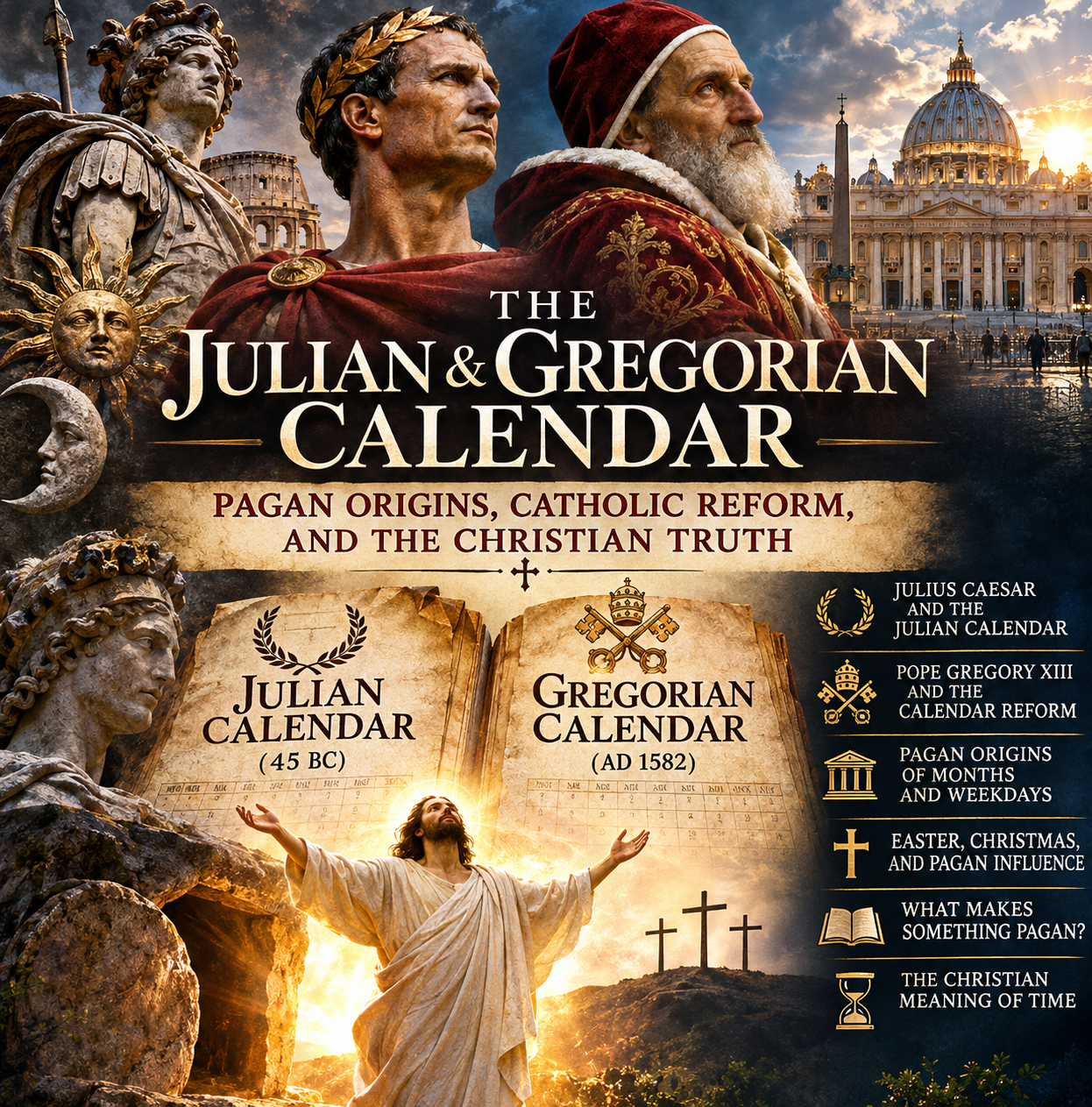
From the gods of ancient Rome to the reforms of a Catholic pope: a journey through history, astronomy, paganism, and the Christian understanding of sacred time.
The calendar hanging on our wall carries a history far older than most people realize. Its months preserve the names of ancient gods and Roman emperors. Its weekdays echo religious traditions that existed long before Christianity reached northern Europe. Yet the calendar used by most of the world today was reformed by a Catholic pope, partly to preserve the proper celebration of the Resurrection of Jesus Christ.
How can these things all be true?
To understand the answer, we must journey backward through more than two thousand years of history, into an ancient world where religion, astronomy, politics, and the measurement of time were deeply intertwined.
Along the way, we encounter Julius Caesar, pagan Roman priests, the earliest Christians, the Council of Nicaea, Pope Gregory XIII, and a question that deserves serious theological reflection:
Does something become pagan because of where it originated, or because of what we believe and practice when we use it?
The distinction matters enormously.
Because if we confuse the historical origins of a custom with its present religious meaning, we risk misunderstanding not only history but the very nature of Christian worship.
1. Before Rome, Before Caesar, Before Every Calendar, There Was God
The Christian understanding of time begins not with Julius Caesar or Pope Gregory XIII, but with the opening pages of Sacred Scripture.
Genesis 1:14 declares:
“Let there be lights made in the firmament of heaven, to divide the day and the night, and let them be for signs, and for seasons, and for days and years.”
Before humanity invented calendars, days and seasons already existed within the created order.
The rising and setting of the sun, the changing phases of the moon, and the recurring seasons provided the natural foundations for measuring time.
Humanity did not create these realities.
We discovered them.
This distinction is fundamental.
A calendar is a human attempt to measure an order already established in creation.
Whether Egyptian, Babylonian, Hebrew, Roman, Julian, or Gregorian, every calendar represents an effort to organize the passage of time according to observable cycles or inherited conventions.
A calendar can be more or less accurate. It can be associated with particular religious traditions. It can even incorporate names inherited from ancient mythology.
But the existence of a calendar does not determine the identity of the God whom someone worships.
The sun belongs to God, not to the pagan civilizations that worshipped it.
The moon belongs to God, not to the astrologers who attempted to divine human destiny from its movements.
And time itself belongs to the Creator, regardless of the names civilizations assign to its passing days.
The error of ancient paganism was not recognizing that the heavens are magnificent.
It was treating created things as divine.
As Saint Paul teaches in Romans 1:25, the fundamental distortion of idolatry is to serve the creature rather than the Creator.
This distinction will become essential when we consider the calendars inherited by Christian civilization.
2. The Julian Calendar: A Pagan Emperor’s Reform of Roman Time
In the first century BC, Rome faced a serious problem.
Its traditional civil calendar had become increasingly unreliable.
The Roman Republic used a calendar that required periodic adjustments to keep the months aligned with the seasons. These adjustments were administered under the authority of Roman religious officials, creating opportunities for confusion and political manipulation.
Julius Caesar sought to reform the system.
After consulting astronomical expertise traditionally associated with Sosigenes of Alexandria, Caesar introduced the calendar that took effect in 45 BC.
It became known as the Julian calendar.
The reform established a relatively simple arrangement: a common year of 365 days, with an additional day approximately every fourth year.
This produced an average year of 365.25 days.
For its time, the system was a remarkable achievement.
It provided the Roman world with a more stable means of organizing agricultural activity, government administration, commerce, and religious observances.
Yet we must remember something important.
Julius Caesar was not a Christian.
Christianity did not yet exist.
Caesar operated within the religious and political world of pagan Rome. He had also held the position of pontifex maximus, the chief priest of the Roman state religion.
The Julian calendar therefore emerged from a civilization whose public religious life included the worship of many gods.
Does that make the Julian calendar a pagan religious ritual?
Not necessarily.
Its historical setting was pagan, but its basic purpose was chronological and administrative.
The calendar measured the year. It did not, merely by counting days, require its users to sacrifice to Jupiter, worship Mars, or honor the emperor as divine.
This becomes particularly significant when we consider what happened after Christianity spread throughout the Roman Empire.
Christians continued using the Julian calendar for centuries.
They used it to record events, organize daily life, and eventually calculate the dates of Christian feasts.
They did not thereby become worshippers of Julius Caesar.
Rather, a practical system inherited from an earlier civilization became part of the ordinary life of a Christian society.
A tool created within a pagan civilization does not necessarily remain an instrument of pagan worship.
That is the first historical distinction we must understand.
3. The Pagan Gods Hidden in the Names of Our Months
Although the Julian calendar was principally a reform of timekeeping, the names of the months reveal how deeply Roman religious and political history remains embedded in modern civilization.
Consider the calendar we use every day.
January derives its name from Janus, the Roman god associated with beginnings, gateways, and transitions.
February is associated with the Latin februa, referring to purification rites.
March takes its name from Mars, the Roman god of war.
April’s precise etymology remains disputed. One traditional explanation connects it to the Latin word for opening, associated with the coming of spring.
May is commonly connected with Maia, a goddess associated with growth, although other ancient explanations exist.
June is traditionally associated with Juno, the Roman goddess connected with marriage and the protection of women, though its etymology has also been debated.
July honors Julius Caesar.
August honors Augustus Caesar, Rome’s first emperor.
The remaining names preserve an older numerical sequence:
September comes from septem, meaning seven.
October comes from octo, meaning eight.
November comes from novem, meaning nine.
December comes from decem, meaning ten.
These names reflect an earlier Roman calendar tradition in which March was the beginning of the monthly sequence.
This explains why September, despite being our ninth month, retains a name originally associated with the number seven.
What an extraordinary historical inheritance.
Every time we say January, March, or July, we use words shaped by religious or political traditions that predate Christianity.
But here we must ask a serious question.
When a Catholic says, “I will attend Mass in January,” is he invoking Janus?
When someone schedules a baptism in March, is that person honoring Mars?
When a family celebrates a wedding in June, have they offered worship to Juno?
Of course not.
The historical etymology of a word does not automatically determine the religious intention of the person using it.
Languages preserve the memories of civilizations long after their religious systems have disappeared.
A name can survive without the worship once associated with it surviving alongside it.
That does not mean historical origins are unimportant.
It means they must be interpreted honestly.
4. Sunday, Saturn, and the Pagan Names of the Week
The names of the weekdays offer another fascinating example.
The Roman planetary system associated the seven days with the sun, moon, and five planets visible to the unaided eye, which were also associated with ancient deities.
As this system spread into Germanic-speaking cultures, several Roman divine names were replaced with names drawn from local mythology.
Our English weekdays preserve that inheritance.
Sunday is named after the sun.
Monday refers to the moon.
Tuesday preserves the name of Tiw or Tyr, a Germanic god associated with war.
Wednesday comes from Woden.
Thursday recalls Thor, the thunder god.
Friday is associated with the Germanic goddess Frigg.
Saturday preserves the name of Saturn, the Roman deity.
These associations are historical facts.
But does saying “Thursday” constitute devotion to Thor?
Does speaking of Saturday mean that we worship Saturn?
And most importantly, does Sunday worship become pagan simply because the English name refers to the sun?
The earliest Christian testimony gives us a decisive answer.
Around the middle of the second century AD, Saint Justin Martyr described Christian worship in his First Apology, chapter 67.
He explained that Christians gathered on the day commonly called Sunday to hear Scripture, pray, and celebrate the Eucharist.
He also explained why.
It was the day associated with creation and, above all, the day on which Jesus Christ rose from the dead.
This testimony is extraordinary.
Saint Justin acknowledged the ordinary Roman name of the day, yet explained the distinctly Christian reason for its observance.
The Christians were not assembling to worship the sun.
They were assembling to worship the risen Christ.
Centuries later, Pope Saint John Paul II addressed this history directly in his apostolic letter Dies Domini, paragraph 27.
He explained how Christians understood Sunday, the Roman day of the sun, through the mystery of Christ, the true light of the world.
The Church did not need to worship the sun in order to use a day carrying an ancient solar name.
Instead, the day was understood through the Resurrection.
The distinction is not a clever excuse invented by modern Christians.
It is documented within the earliest centuries of Christian history.
5. The Gregorian Calendar: Why a Catholic Pope Changed the Dates
By the sixteenth century AD, the Julian calendar had developed a significant astronomical problem.
Its average year of 365.25 days was slightly longer than the actual cycle of the seasons, approximately 365.2422 days.
The difference amounted to only about eleven minutes per year.
That sounds insignificant.
But small errors become substantial when repeated over centuries.
The Julian calendar slowly drifted relative to the seasonal year.
By the sixteenth century, the astronomical spring equinox was occurring approximately ten days earlier on the Julian calendar than the March 21 date used in the Church’s traditional Easter calculations.
Why did this matter?
Because the date of Easter was connected to the relationship between the spring equinox and the lunar cycle.
Christianity’s most important annual celebration was being calculated using a calendar whose relationship to the seasons had gradually shifted.
The issue was not simply scientific convenience.
It concerned the Church’s desire to preserve the traditional calculation of the annual celebration of Christ’s Resurrection.
Pope Gregory XIII therefore promulgated a calendar reform through the papal bull Inter gravissimas, dated February 24, AD 1582.
The reform drew heavily upon the work of the astronomer Aloysius Lilius and was explained and defended by the Jesuit mathematician Christopher Clavius.
Its essential changes included a correction to the leap-year system and a one-time adjustment of ten calendar dates.
Under the Gregorian calendar, most years divisible by four are leap years.
However, century years are exceptions unless divisible by 400.
Thus, AD 2000 was a leap year, but AD 1900 was not, and AD 2100 will not be.
This produces an average calendar year of 365.2425 days, significantly closer to the seasonal year than the Julian system.
In countries adopting the reform immediately, Thursday, October 4, AD 1582, was followed by Friday, October 15.
Ten date numbers disappeared from the civil calendar.
But ten actual days did not disappear from creation.
The sun continued rising.
Human beings continued living.
The sequence of weekdays remained uninterrupted.
Only the numbering system changed.
Other countries adopted the reform later.
Great Britain and its colonies, for example, adopted the new system in AD 1752, when September 2 was followed by September 14.
Today, the Julian calendar runs thirteen days behind the Gregorian calendar for dates in the present period.
Here is the essential historical truth:
The Gregorian calendar was not introduced to replace Christianity with paganism. It was introduced by a Catholic pope, principally to correct the calendar and preserve the Church’s traditional calculation of Easter.
Its months and many inherited conventions remained Roman because the reform sought greater accuracy, not the invention of an entirely new vocabulary for time.
6. The Council of Nicaea and the Question of Easter
To understand why the Gregorian reform mattered, we must travel back to the fourth century.
The First Council of Nicaea met in AD 325.
Among the questions confronting the early Church was the proper celebration of Easter.
Christ’s Passion and Resurrection occurred in the historical context of the Jewish Passover.
The earliest Christians understood His saving death through the mystery of the Passover lamb.
Saint Paul declares in 1 Corinthians 5:7:
“For Christ our pasch is sacrificed.”
The Christian celebration of the Resurrection is therefore connected to Israel’s sacred history.
Its theological origins are not found in the worship of Roman gods or Germanic fertility deities.
They are found in the death and Resurrection of Jesus Christ, understood through the fulfillment of the Passover.
The Council of Nicaea sought greater unity in the annual celebration of Easter.
Over time, the Church’s traditional calculation came to use March 21 as a fixed ecclesiastical equinox and the Sunday following the relevant ecclesiastical Paschal full moon.
These are calculated dates, not simply direct astronomical observations.
The Gregorian reform sought to restore the relationship between the calendar and this established method of calculating Easter.
This explains why differences remain between Western and Eastern Christian celebrations.
Many Eastern Orthodox churches continue to calculate Pascha according to the older Julian Paschal system, even where another calendar is used for civil life or certain fixed feasts.
The disagreement concerns inherited calendrical methods and ecclesiastical traditions.
It does not mean that Catholics worship one God while Orthodox Christians worship another because they sometimes celebrate the Resurrection on different dates.
A date is a means of identifying when a feast is celebrated.
The object of Christian worship remains Jesus Christ.
7. Is Easter Really a Pagan Festival?
Few claims are repeated as confidently, or as carelessly, as the assertion that Easter is simply a pagan fertility festival renamed by Christians.
This argument usually begins with the English word Easter.
The eighth-century monk Saint Bede, in De Temporum Ratione, associated the old English seasonal name with a goddess called Eostre.
His testimony has generated considerable historical debate.
The independent evidence for the supposed goddess and the details of her worship are limited, and scholars have disagreed over the exact history of the name.
But even granting a connection between the English word and a pre-Christian seasonal tradition, this does not establish that the Christian feast of the Resurrection originated in the worship of that goddess.
Why?
Because the Christian Paschal celebration predates the use of the English name.
The early Christians used the term Pascha, derived from the language of the Jewish Passover.
In Spanish, the feast is Pascua.
In Italian, Pasqua.
In French, Pâques.
In many other languages, the name likewise preserves its Passover connection.
The English word is therefore not the universal Christian name for the celebration.
It belongs to a particular linguistic history.
Confusing the etymology of one language with the origin of an ancient religious feast is a serious historical mistake.
Christianity did not need a Germanic spring goddess to discover the Resurrection.
The Resurrection was the central proclamation of the Apostles centuries before Bede wrote about the English language.
8. Christmas, December 25, and the Worship of the Sun
The question of pagan influence becomes even more complicated when we examine Christmas.
Ancient Rome possessed traditions of solar worship, and December 25 became associated with the birth of the Unconquered Sun in surviving Roman calendrical evidence.
Because Christians also came to celebrate the Nativity on December 25, some writers argue that Christmas was deliberately placed on that date to replace an existing pagan festival.
This is a historical possibility that scholars have investigated.
But it is not the only explanation supported by historical research.
Another important explanation emerges from early Christian calculations concerning the dates of Christ’s conception, Passion, and birth.
Some Christian writers connected Christ’s conception with March 25.
Counting nine months from that date produces December 25.
Scholar C. Philipp E. Nothaft has examined early Christian chronological traditions supporting this calculation theory.
Other scholars have argued for various forms of pagan influence or interaction between Christian and Roman religious traditions.
The precise historical reasons for the adoption of December 25 remain debated.
We should therefore avoid two equally careless conclusions.
The first is that Christmas is certainly a stolen pagan festival and therefore cannot be Christian.
The second is that no pagan traditions or cultural circumstances could possibly have influenced the development of Christmas celebrations.
Historical honesty requires distinguishing established evidence from uncertain reconstruction.
But there is a deeper theological point.
Even if Christians selected a date that also carried pagan religious associations, this would not mean that they worshipped the pagan deity associated with that date.
The content of the celebration matters.
The Catholic Church does not celebrate Christmas to honor Sol Invictus.
It celebrates the Incarnation and birth of Jesus Christ.
The sun is a created heavenly body.
Christ is the eternal Son of God through whom all things were made.
To confuse those two realities is not to uncover Christianity’s hidden paganism.
It is to overlook Christianity’s central theological distinction between Creator and creation.
9. What Actually Makes Something Pagan?
This is where the historical investigation becomes a question of moral theology.
The Catechism of the Catholic Church, paragraph 2113, identifies idolatry with the act of treating something other than God as divine.
It is not limited to the ancient worship of statues or mythological deities.
Money, power, pleasure, or any created reality can become an idol when given the devotion that belongs to God alone.
The Church also explicitly rejects divination and astrology in paragraph 2116.
This distinction is important.
Astronomy studies the heavenly bodies as part of the created universe.
Astrology, when it claims to reveal destiny or hidden knowledge through celestial influences in a divinatory manner, falls under the practices rejected by the Catechism.
Measuring the movement of the sun to establish a calendar is not the same as worshipping the sun.
Observing the moon to calculate the date of Easter is not the same as asking the moon to determine one’s destiny.
Using the word Thursday is not an act of devotion to Thor.
And consulting a Gregorian calendar does not make a Christian a participant in ancient Roman religion.
The moral character of an action cannot always be determined by investigating the distant origins of the words associated with it.
We must also consider what the person is actually doing, what the action signifies, and whether it involves worship, superstition, idolatry, or another moral wrong.
At the same time, not everything inherited from pagan culture can simply be declared harmless.
A genuinely idolatrous ceremony does not become Christian merely because someone adds Christian language to it.
The Church must distinguish what can legitimately be received from a culture and what must be rejected.
The Catechism addresses this principle in paragraphs 1204–1206.
The Gospel can enter different cultures, receiving what is good and transforming what is compatible with Christian faith, while requiring the abandonment of customs that contradict it.
This is not surrender to paganism.
It is the application of Christian discernment.
The Church does not teach that everything once touched by pagan civilization must be destroyed. She teaches that whatever is contrary to the worship of the true God must be rejected.
10. Can a Calendar Become an Idol?
There is another danger, one that deserves attention from Christians who are sincerely concerned about pagan influences.
We can become so preoccupied with proving that one calendar is more sacred than another that we forget what the calendar is supposed to serve.
The Julian calendar is not divine.
The Gregorian calendar is not divine.
Neither system was revealed to Moses on Mount Sinai.
Neither was instituted by Jesus Christ as an immutable requirement for every Christian civilization.
Both are human systems for organizing time, although they have played important roles in Christian liturgical history.
A Christian may properly appreciate the antiquity of the Julian calendar.
Another may recognize the greater astronomical accuracy of the Gregorian reform.
Different Christian communities may preserve legitimate traditions for calculating their liturgical observances.
But it would be a profound mistake to treat either calendar as though its mathematical rules possess divine authority simply by existing.
Saint Paul reminds believers in Romans 14:5–6 that the religious observance of particular days must be approached in relation to the Lord.
His teaching does not erase the Church’s liturgical obligations or deny the importance of holy days.
It reminds us that Christian religious observance must be directed toward God rather than becoming an end in itself.
We should also remember that an obsession with identifying supposed pagan contamination in every inherited custom can become spiritually unbalanced.
The Christian response to idolatry is not endless fear of words, dates, and historical associations.
It is faithful worship of the true God, informed by reason and sound doctrine.
A calendar should help us order our days.
It should never become the master of our faith.
11. The Church Did Not Merely Inherit Time. She Sanctified It.
There is something profoundly beautiful about the Christian liturgical year.
The Church takes the ordinary progression of days and organizes its worship around the mysteries of salvation.
Advent prepares us for the coming of Christ.
Christmas celebrates His Nativity.
Lent calls us to penance and conversion.
Holy Week brings us into the mystery of His Passion.
Easter proclaims His victory over death.
Pentecost celebrates the descent of the Holy Ghost.
Throughout the year, the Church also commemorates the Blessed Virgin Mary, the Apostles, martyrs, confessors, and countless saints who witnessed to Christ.
The purpose is not to assign magical powers to particular dates.
It is to bring the mysteries of Christ before the faithful through the recurring rhythm of worship.
The Catechism, paragraph 1166, teaches that the Church’s celebration of Sunday originates in the apostolic remembrance of Christ’s Resurrection.
Pope Saint John Paul II, in Dies Domini, emphasizes the same truth.
The Christian understanding of Sunday is founded upon the risen Lord.
This reveals a beautiful distinction between the pagan and Christian understandings of time.
In ancient pagan religion, heavenly bodies could be treated as gods ruling over human existence.
In Christianity, heavenly bodies are creatures.
They have their place within the universe, but they do not govern the ultimate destiny of the human soul.
Christ stands above them.
As Saint Paul teaches in Colossians 1:16–17, all things were created through Christ and for Christ, and all things hold together in Him.
The sun does not give divinity to Christ.
Christ gives existence to the sun.
The moon does not control the Church.
The Church observes the lunar cycle as part of an inherited method of determining when to celebrate the saving mysteries of Christ.
The stars do not write our eternal destiny.
Our salvation rests upon the grace of God and our response to Him.
Christianity does not deny the beauty of the heavens.
It places that beauty in proper relationship to its Creator.
12. The Great Irony: We Debate Pagan Names While Worshipping Modern Idols
Perhaps the most uncomfortable truth lies beyond calendars entirely.
A Christian may spend countless hours worrying that January bears the name of Janus or that Thursday recalls Thor.
Yet the same person may scarcely notice when money, status, personal ambition, or worldly success begins to take the place of God.
The ancient Romans worshipped many gods.
Modern humanity has not necessarily abandoned idolatry.
We have often changed its appearance.
The Catechism’s teaching on idolatry in paragraph 2113 makes this especially clear.
The worship of false gods is not restricted to kneeling before an ancient statue.
Anything that receives the absolute allegiance owed to God can become an idol.
We should therefore ask ourselves a more demanding question than whether the month of March was named after Mars.
What actually governs our lives?
Is it Christ?
Or is it the pursuit of power, wealth, comfort, and approval?
We may reject the gods of Rome while surrendering our hearts to the idols of the modern world.
We may carefully avoid language associated with ancient paganism while allowing vanity or greed to dominate our decisions.
We may know the correct calculation of Easter while failing to live as people transformed by the Resurrection.
This is the spiritual danger of confusing external historical associations with the deeper realities of worship.
The greatest threat to Christian faith is not that a month was named after a pagan god two thousand years ago. It is that the human heart can still place something other than God upon the throne that belongs to Him.
13. Time Is a Gift, and Every Day Moves Us Toward Eternity
There is one final truth that rises above the Julian calendar, the Gregorian calendar, and the civilizations that produced them.
Humanity measures time, but humanity does not own it.
Kings and emperors have risen and fallen.
The ancient Roman priesthood disappeared.
The empire that produced the Julian calendar passed into history.
Centuries later, a Catholic pope corrected its mathematical deficiencies.
Nations adopted the new calendar at different times.
The dates changed.
The civilizations changed.
But the passage of time continued.
And through all these centuries, the Christian proclamation has remained centered upon the same mystery.
The eternal Son of God entered human history.
He was born of the Blessed Virgin Mary.
He suffered under Pontius Pilate.
He was crucified, died, was buried, and rose again.
His Resurrection was not created by the calendar used to commemorate it.
The calendar merely helps the Church remember and celebrate what Christians profess happened in history.
This distinction brings us to the heart of the matter.
The Incarnation reveals that time is not meaningless.
History is not merely an endless series of days numbered by human inventions.
Human existence unfolds beneath the providence of God.
Every year gives us opportunities for repentance.
Every season reminds us of our dependence upon creation.
Every Sunday calls Christians to remember the Resurrection.
And every passing day reminds us that our earthly life is temporary.
The calendar can tell us how many years we have lived.
It cannot tell us whether we have lived those years well.
It can identify the date of Christmas.
It cannot make us welcome Christ into our hearts.
It can calculate Easter.
It cannot make us believe in the Resurrection.
It can measure the passing of centuries.
It cannot grant eternal life.
Only God can give what no calendar can provide.
Conclusion: The Calendar Belongs to History. Time Belongs to God.
The Julian calendar emerged from pagan Rome.
The Gregorian calendar arose from a Catholic reform intended to improve the measurement of time and the calculation of Christian feasts.
Many names inherited from ancient religions remain embedded in our months and weekdays.
These are historical truths.
But history must not be confused with theology.
A pagan origin does not automatically make every later use of a word, instrument, or convention an act of pagan worship.
Nor does a Christian name automatically sanctify every custom or practice.
What matters is truth, the nature of the act, the object of worship, and fidelity to God.
The Church is right to reject idolatry, superstition, divination, and every attempt to give created things the honor due to the Creator.
She is also right to recognize that human knowledge, including astronomy and mathematics, can serve legitimate purposes regardless of the civilization in which that knowledge developed.
We do not become pagans by using the Gregorian calendar.
Nor do we become holier merely by using the Julian calendar.
Holiness comes through the grace of Jesus Christ, received in faith and lived through charity, repentance, obedience, and the sacramental life.
And perhaps this is the greatest lesson hidden within the history of the calendar.
For more than two thousand years, humanity has argued about how to measure time. Yet the most important question has never been which calendar we use. It is what we do with the time God has given us.
The pagans named days after their gods.
The Romans organized years according to the needs of an empire.
The Church ordered her liturgical year around the saving mysteries of Jesus Christ.
And every human being, regardless of calendar, continues moving toward the moment when earthly time will give way to eternity.
The calendar may tell us what day it is. Only God can tell us what our days are ultimately for.
Historical and Theological References
Sacred Scripture — Douay–Rheims Bible
- Genesis 1:14–19 — The creation of the heavenly lights and the measurement of time.
- Romans 1:21–25 — The error of worshipping created things rather than the Creator.
- Romans 14:5–6 — The observance of particular days in relation to the Lord.
- 1 Corinthians 5:7–8 — Christ our Pasch.
- Colossians 1:15–17 — Christ as Creator and Lord of all creation.
Catholic Magisterium
- Catechism of the Catholic Church, §§1163–1173, 1200–1206, 2112–2117.
- Pope Gregory XIII, Inter gravissimas, February 24, AD 1582.
- Pope Saint John Paul II, Dies Domini, May 31, AD 1998, especially §§21–28.
- Second Vatican Council, Sacrosanctum Concilium, §§102–111.
Early Christian Sources
- Saint Justin Martyr, First Apology, chapter 67.
- Saint Bede the Venerable, De Temporum Ratione, chapter 15.
Historical and Astronomical Scholarship
- The Vatican Observatory, Astronomy, Calendars and Religion.
- Explanatory Supplement to the Astronomical Almanac, third edition, chapter 15, on calendar systems and Gregorian reform.
- C. Philipp E. Nothaft, Early Christian Chronology and the Origins of the Christmas Date: In Defense of the Calculation Theory, Questions Liturgiques, vol. 94 (2013), pp. 247–265.
- Carole Cusack, From Easter to Ostara: The Reinvention of a Pagan Goddess?, Time and Mind (2008).