

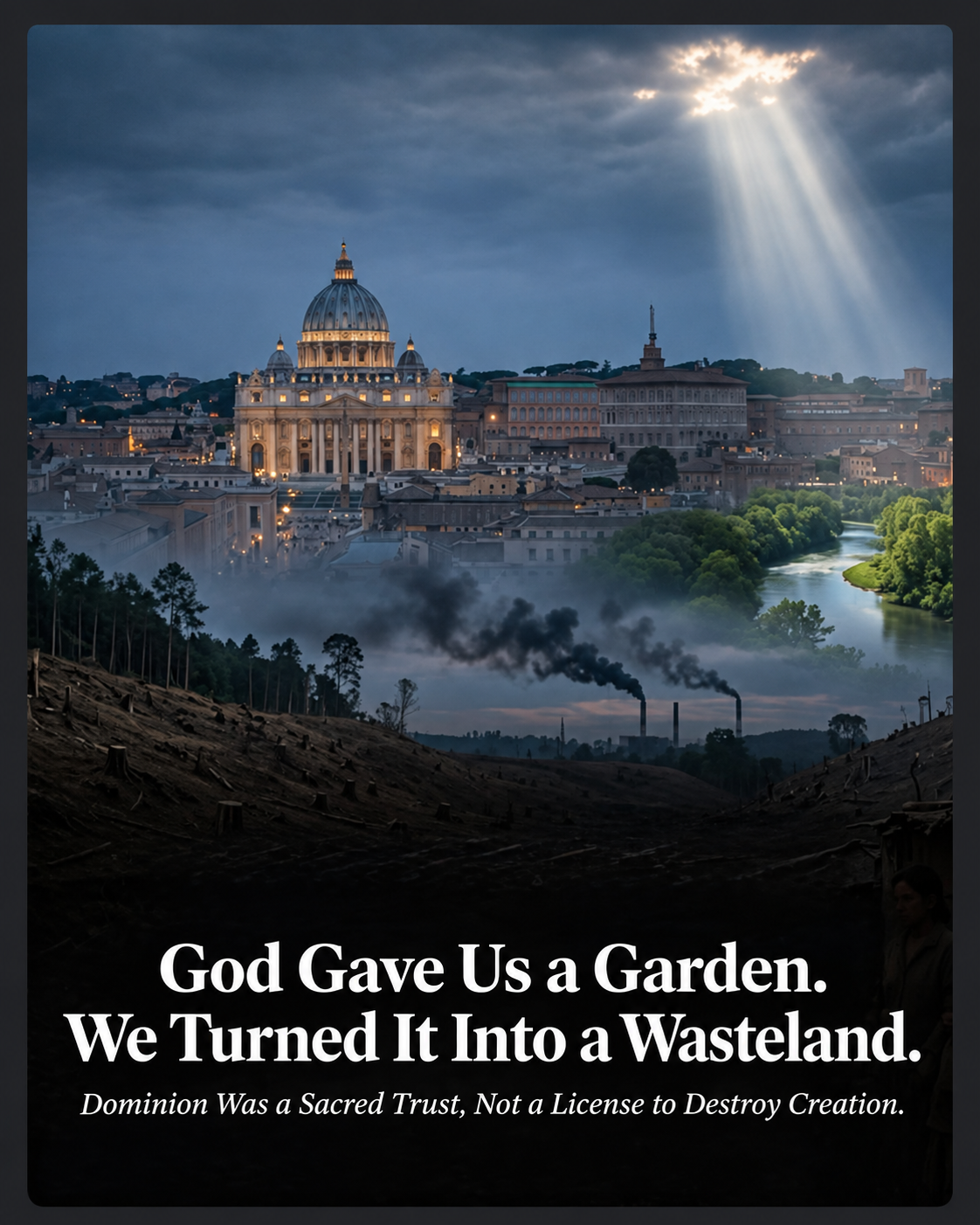
The forgotten responsibility of humanity, the sin against creation, and the day we must answer to the Creator.
God created a world of extraordinary beauty, placed humanity within it, and entrusted us with its care. And somewhere along the way, we confused dominion with ownership, stewardship with exploitation, and progress with the unrestricted consumption of everything placed before us.
We were given a garden, and too often we have treated it like a wilderness to be conquered, a warehouse to be emptied, and a possession to be exhausted.
Perhaps the greatest tragedy is not simply what humanity has done to the earth. It is that we have done so while forgetting whose earth it is.
In Genesis 1:28, God gives humanity an extraordinary commission:
“Increase and multiply, and fill the earth, and subdue it, and rule over the fishes of the sea, and the fowls of the air, and all living creatures that move upon the earth.”
For centuries, human beings have emphasized the words subdue and rule. But we have not always given equal attention to the responsibility those words carry.
God did not surrender His ownership of creation to humanity. He entrusted creation to beings made in His image and likeness, expecting us to exercise authority in a manner consistent with His wisdom, goodness, and justice.
Genesis 2:15 makes this responsibility unmistakable:
“And the Lord God took man, and put him into the paradise of pleasure, to dress it, and to keep it.”
To dress it. To keep it.
Not to devastate it. Not to poison it. Not to consume its riches without considering those who would come after us.
The first responsibility entrusted to humanity was not exploitation. It was cultivation and care.
And that distinction changes everything.
The Earth Was Never Ours to Destroy
There is a profound difference between possessing authority and possessing absolute ownership.
A king may govern a kingdom, but his authority does not make injustice righteous. A father may lead his household, but his authority does not give him permission to abuse his children.
Likewise, humanity’s dominion over creation does not grant us permission to destroy whatever we find useful, inconvenient, or profitable.
The earth belongs first and ultimately to God.
The Scriptures proclaim in Psalm 23:1:
“The earth is the Lord’s and the fulness thereof: the world, and all they that dwell therein.”
Every forest, river, mountain, ocean, and living creature exists because God willed creation into existence.
The natural world is not divine. It is not something to worship. But it is the work of the One whom we worship.
That is precisely why its destruction deserves serious moral reflection.
When we carelessly destroy what another has entrusted to us, we demonstrate something about the value we place upon the giver.
How much more serious is that question when the giver is God?
The Terrible Cost of Human Pride
Human ingenuity is extraordinary.
We have learned to cultivate the earth, build great cities, harness energy, develop medicine, and transform the material world in ways previous generations could scarcely imagine.
These achievements can be expressions of our God-given intelligence and legitimate dominion.
But human power becomes dangerous when separated from moral wisdom.
We have also polluted rivers, devastated habitats, exhausted resources, destroyed forests, and treated countless living creatures as disposable.
Too often, economic gain has become an excuse for environmental destruction, while the people who benefit least from that destruction bear some of its greatest consequences.
And beneath these failures lies a temptation as old as Eden itself.
The temptation to believe that we may determine good and evil according to our own desires.
The temptation to act as though our power makes us sovereign.
The temptation to forget that we are creatures, not the Creator.
This is why environmental destruction cannot be understood merely as a technical problem. At its deepest level, deliberate and unjust destruction of creation can reveal a disorder within the human soul.
When greed becomes greater than gratitude, consumption greater than restraint, and profit greater than justice, our treatment of creation begins to reveal the condition of our hearts.
We have developed astonishing powers over the natural world without always developing the corresponding virtues necessary to exercise those powers rightly.
We learned how to take more.
But have we learned when to stop?
We learned how to produce more.
But have we learned what is enough?
We learned how to dominate much of the natural world.
But have we learned how to govern ourselves?
Perhaps this is the question our civilization most urgently needs to confront.
A Sin Against Creation and the Creator
In August 2026, the International Theological Commission published Caring for Our Common Home: A Responsible and Fraternal Response to the Triune God.
Its central theological argument deserves far greater attention than a passing news headline.
In paragraph 97, the Commission proposes understanding serious wrongdoing against our common home as a sin against both creation and the Creator.
This is not an invention of a new commandment. It is a deeper application of moral obligations already rooted in Scripture and Catholic teaching.
The Catechism of the Catholic Church, paragraph 2415, teaches that human dominion over living and nonliving things is not absolute. It must respect moral obligations, the welfare of our neighbors, future generations, and the integrity of creation.
Pope Francis had already emphasized in Laudato Si’, particularly paragraphs 66–67, that the divine command to exercise dominion must never be interpreted as permission for unrestricted exploitation.
Now the theological question is being stated with renewed force.
When human beings knowingly and freely destroy God’s creation through grave irresponsibility, greed, or disregard for others, that destruction can become a moral offense against God Himself.
Of course, not every environmental mistake is a grave sin. Moral responsibility depends upon the nature of the act, the harm involved, knowledge, freedom, intention, and circumstances.
But neither can we pretend that knowingly devastating a community’s water, poisoning its surroundings, or sacrificing the well-being of future generations for selfish gain is morally indifferent.
Sin does not cease to be sin because it produces a financial return.
And injustice does not become justice because it can be described as economic development.
The Poor Inherit What the Powerful Destroy
One of the most troubling dimensions of environmental destruction is that its consequences are not shared equally.
Those with wealth may have the means to relocate, acquire clean water, obtain medical care, or protect themselves against environmental dangers.
The poor frequently possess no such alternatives.
When water becomes contaminated, when agricultural land is degraded, when communities suffer from destructive practices imposed upon them, the burden often falls upon people who had little influence over the decisions that caused the harm.
The consequences also reach beyond those presently living.
Children not yet born will inherit the consequences of decisions they never made.
The Catholic understanding of justice therefore requires us to ask not merely what benefits our generation, but what responsibilities we owe to those who will follow us.
A society cannot claim to love its children while knowingly destroying the conditions necessary for their flourishing.
Nor can Christians separate love of neighbor from a serious concern for the environments upon which human life depends.
We cannot claim to honor the Creator while treating His gifts with contempt, or claim to love our neighbors while remaining indifferent to preventable harms imposed upon them.
Creation Is Not Disposable Because Human Life Is Not Disposable
Catholic teaching does not place a tree, an animal, or a river on the same moral level as a human person.
Human beings possess a unique dignity because they are created in the image and likeness of God.
But human dignity does not diminish our responsibility toward the rest of creation. It increases it.
Our intelligence should make us more capable of care, not more ingenious in destruction.
Our freedom should make us more responsible, not more reckless.
Our authority should make us guardians, not tyrants.
Nature is not more important than humanity. Yet humanity cannot flourish while recklessly destroying the natural conditions upon which life depends.
We have a legitimate right to cultivate land, harvest resources, build homes, develop industries, and improve the lives of our families.
The moral question is whether we accomplish those things with justice, prudence, moderation, and respect for God’s purposes.
True dominion is not the absence of restraint.
It is the responsible exercise of power under the authority of God.
Creation Groans, but Redemption Calls Us to Hope
Saint Paul describes the condition of creation in Romans 8:19–22, portraying the created world as awaiting liberation and sharing in the consequences of humanity’s fallen condition.
This is a profound Christian mystery.
Sin does not damage only the individual soul. Human wrongdoing also wounds relationships, societies, and the world entrusted to our care.
But Christianity is not a religion of despair.
The same faith that teaches us to acknowledge our sins also proclaims the possibility of conversion, redemption, and renewal through Jesus Christ.
An authentic Christian response to environmental wrongdoing therefore requires more than fear, anger, or political argument.
It requires repentance.
It requires humility sufficient to recognize that everything we possess has first been received.
It requires gratitude for the beauty and abundance of God’s creation.
It requires temperance in the use of resources, justice toward the poor, wisdom in the development of technology, and responsibility toward those who will inherit the earth after us.
And it requires the courage to recognize that some forms of material progress are not progress at all when their achievement depends upon serious injustice and destruction.
The answer is not to reject human development. It is to restore human development to its proper moral purpose.
We are called to make the world more fruitful, more habitable, and more worthy of the dignity of human life.
One Day, the Steward Must Answer to the Owner
There is a final question that should trouble the conscience of every believer.
What will we say to God about the world He entrusted to us?
What will we say about the rivers we allowed to be poisoned, the forests we destroyed unnecessarily, the creatures we treated cruelly, or the communities whose suffering we ignored?
What will we say about the blessings we consumed without gratitude, the resources we wasted without thought, and the generations whose future we treated as less important than our present desires?
These questions do not mean humanity is incapable of good. There are countless people working to restore damaged landscapes, protect communities, develop cleaner technologies, and use natural resources responsibly.
Such efforts show that our freedom can be directed toward restoration rather than destruction.
And that is where hope begins.
God did not command us to abandon the earth.
He commanded us to exercise dominion over it.
But the highest expression of that dominion is not our ability to destroy.
It is our ability to govern wisely, cultivate generously, protect responsibly, and give thanks humbly.
We should remember that the first pages of Scripture describe humanity receiving a garden to cultivate and keep. The final pages reveal God’s promise of a renewed creation, with the river of life and the tree of life appearing in the heavenly Jerusalem (Apocalypse 22:1–2).
The biblical story begins with a gift and leads toward fulfillment in God.
We are not its authors. We are participants entrusted with a sacred responsibility.
God gave humanity dominion over the earth. He never gave us permission to forget that it belongs to Him.
And perhaps the measure of our civilization will not ultimately be how much of the earth we managed to conquer, but how faithfully we cared for what we were given.
For the most important question is not simply whether humanity has the power to change the world.
It is whether we possess the wisdom, humility, and love to change it without destroying the gifts that make life possible.
We were entrusted with a garden. May we not leave our children a wasteland and call it progress.
Scriptural and doctrinal foundations: Genesis 1:26–31; Genesis 2:15; Psalm 23:1; Romans 8:19–22; Apocalypse 22:1–2 (Douay–Rheims Bible); Catechism of the Catholic Church, §§339, 2415–2418; Pope Francis, Laudato Si’, §§66–68, 116–117; International Theological Commission, Caring for Our Common Home (2026), §§77–79, 93–97, 110, 144–146.
Leave a Reply