

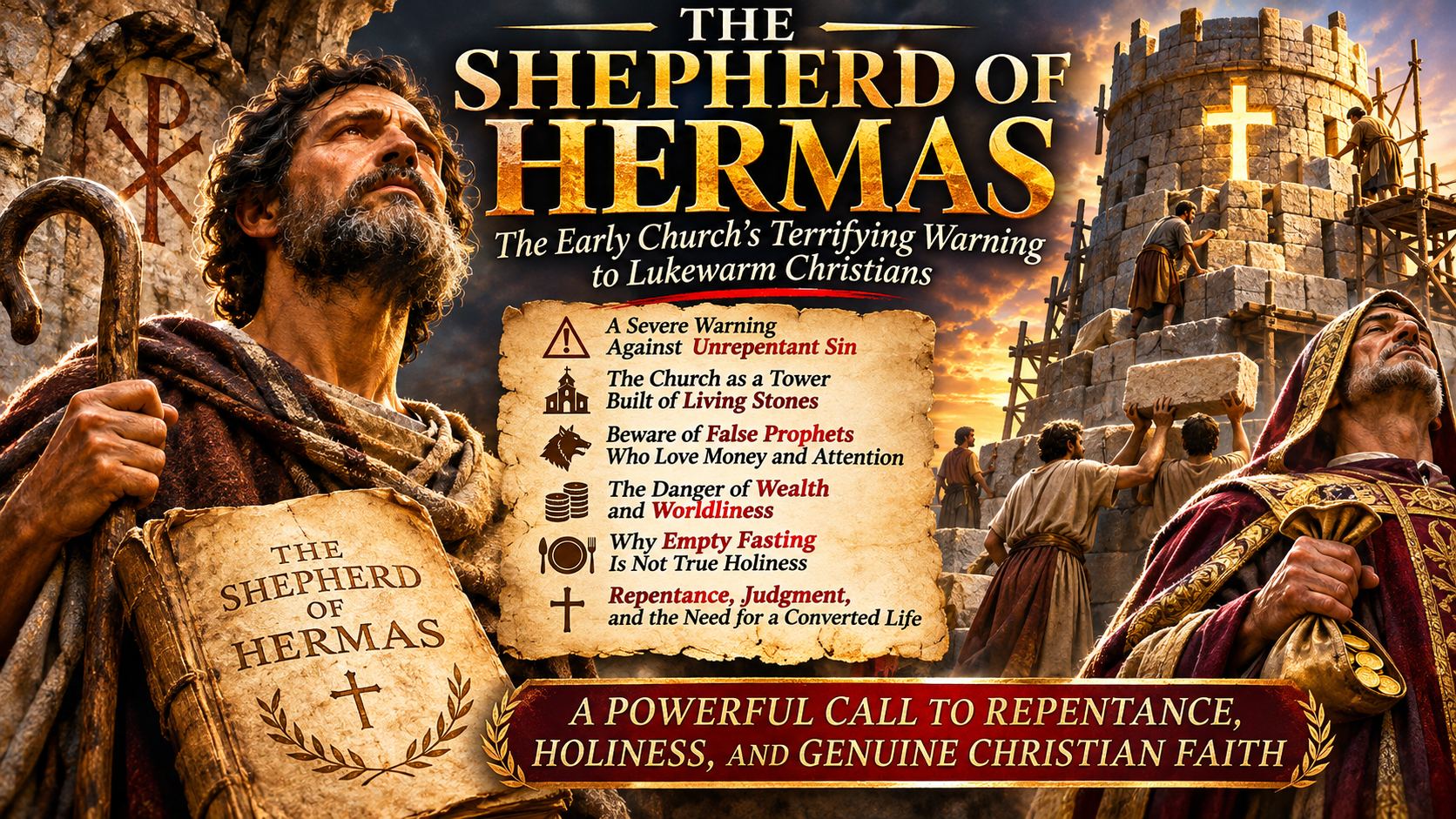
An Ancient Christian Writing That Confronts Sin, False Prophets, Corruption, Worldliness, and the Judgment of God
What if Christians living nearly 1,900 years ago could walk into our churches today? Would they recognize the faith they practiced—or would they warn us that we have grown dangerously comfortable with sin?
Long before Christianity became the religion of emperors, long before magnificent cathedrals rose across Europe, and long before the great theological councils of the fourth century, Christians were reading an extraordinary work called The Shepherd of Hermas.
Its message was not designed to entertain.
It was intended to awaken consciences.
It confronted Christians who professed faith while neglecting holiness. It warned about religious leaders corrupted by pride, believers consumed by wealth, and people who continually postponed repentance.
It described the Church as a tower under construction, with stones representing believers whose lives would be examined.
Some stones were welcomed.
Others were rejected.
And some that appeared suitable were discovered to be deeply defective.
The warning was unmistakable: belonging outwardly to the Christian community was no excuse for refusing genuine conversion.
But who wrote this remarkable work? Why did the earliest Christians take it so seriously? And why is it not in the Catholic Bible?
The answers reveal a fascinating chapter of early Christian history.
1. What Is the Shepherd of Hermas?
The Shepherd of Hermas is an early Christian writing generally associated with Rome during the first half or middle of the second century AD.
Its author identifies himself as Hermas, a man who had formerly been enslaved and who presents himself as a Christian struggling with the moral failures of his household and his own past conduct.
The work combines visions, moral commandments, and symbolic parables.
Traditionally, it is divided into three major sections:
- Five Visions: Revelations concerning repentance, the Church, persecution, and judgment.
- Twelve Commandments or Mandates: Instructions about faith, purity, truthfulness, anger, charity, and discernment.
- Ten Similitudes or Parables: Symbolic lessons about salvation, wealth, repentance, and the final examination of believers.
The shepherd who gives the work its name is presented as an angel associated with repentance.
The book is not a Gospel, nor does it claim to be another account of the earthly ministry of Jesus Christ.
Instead, it offers a window into the moral concerns, spiritual expectations, and disciplinary struggles of early Christian communities.
And those concerns sound remarkably familiar today.
2. Was Hermas the Brother of a Pope?
One of the most intriguing historical claims about this work comes from the Muratorian Fragment, an early witness to the development of the biblical canon.
According to this document, Hermas wrote The Shepherd in Rome while his brother, Pius, occupied the episcopal chair.
This would associate its composition with Pope St. Pius I, whose pontificate is commonly placed around AD 140–155.
If the identification is correct, the work emerged from the Christian community of Rome during a period in which the Church still lived under pagan imperial rule.
However, historians debate the precise dating, stages of composition, and authorship. Some material may be earlier, and the claim of a familial connection to Pope Pius I cannot be independently established with certainty.
Even with those qualifications, one fact remains important:
The Shepherd of Hermas belongs to the formative centuries of Christianity, centuries before the Council of Nicaea in AD 325.
Its moral teachings provide valuable evidence of the concerns that occupied many early Christians.
3. The Book That Some Christians Read Alongside Scripture
The historical reception of The Shepherd is extraordinary.
St. Irenaeus of Lyons referred to it with scriptural authority in Against Heresies (IV, 20, 2).
Clement of Alexandria made use of it.
Origen considered it valuable, although he acknowledged that its authority was disputed.
The fourth-century Codex Sinaiticus, one of the earliest substantial manuscripts of the Christian Bible, contains The Shepherd of Hermas after the New Testament writings.
This does not establish that the book belongs to the biblical canon. Rather, it demonstrates how highly some early Christian communities regarded it.
Indeed, the Muratorian Fragment recommended that The Shepherd be read but distinguished it from writings that could be proclaimed publicly as apostolic Scripture.
In AD 367, St. Athanasius of Alexandria likewise identified The Shepherd as a work useful for religious instruction but not included in the canon.
(Festal Letter 39, §7)
The Catholic Church does not recognize The Shepherd of Hermas as inspired Sacred Scripture.
It should therefore never be placed on the same level of authority as the Gospels, apostolic writings, or other canonical books.
Nor is it a suppressed or secretly removed book of the Bible.
Its significance is historical and spiritual: it helps us understand how some ancient Christians approached repentance, discipline, and holiness.
And its warnings are difficult to ignore.
THE HARDEST-HITTING WARNINGS FROM THE SHEPHERD OF HERMAS
4. You Cannot Follow Christ While Entertaining Sin in Your Heart
The Shepherd of Hermas, Vision I, Chapter 1
The opening vision does not begin with a spectacular prediction about the end of the world.
It begins with a man’s conscience.
Hermas remembers being attracted to a woman named Rhoda. Although he does not describe committing an external act of adultery, the vision confronts the desire that arose within his heart.
The message is a penetrating reminder that Christianity concerns more than outward behavior.
The Shepherd insists that the thoughts of a righteous person should themselves be righteous.
Consider how challenging this was to a Christian living in the second century.
And consider its relevance today.
A person may appear outwardly religious while willingly cultivating lust, hatred, envy, resentment, or fantasies of revenge.
Others may never see those interior struggles.
But God sees the heart.
The teaching recalls the words of Jesus Christ concerning lust and adultery in Matthew 5:27–28.
It must be understood carefully: an unwanted temptation or involuntary thought is not itself a mortal sin. Moral guilt requires the relevant degree of knowledge and consent.
Nevertheless, knowingly nourishing evil desires endangers the soul.
Christian holiness cannot be reduced to avoiding public scandal while privately consenting to evil.
The battle for holiness begins within.
5. The Church Is Not a Hiding Place for Unrepentant Sin
The Shepherd of Hermas, Vision III, Chapters 2–7
One of the most striking images in the entire work is the construction of a magnificent tower.
The tower represents the Church.
Its stones represent people associated with the Christian community.
Some stones are polished, strong, and fitted together so perfectly that the tower appears almost to be made of one piece.
Others are cracked, damaged, rough, or unsuitable.
Some are thrown aside.
The symbolism is direct.
The visible community contains people at different stages of faithfulness, including those whose lives require serious repentance.
The imagery is not an invitation to declare ourselves judges of other people’s souls.
It is an invitation to examine our own.
Are we living stones strengthened by faith and charity—or are we trying to appear part of God’s building while resisting His work within us?
St. Paul similarly describes Christians as members of God’s building in 1 Corinthians 3:9–17.
St. Peter speaks of the faithful as living stones forming a spiritual house in 1 Peter 2:4–5.
The Catholic Church is holy because Christ is her Head and the Holy Spirit sanctifies her.
Yet her members remain sinners in need of conversion.
(Catechism of the Catholic Church, §§823–827)
The lesson is serious:
Being visibly associated with the Church does not make repentance unnecessary.
6. Beware of Religious Leaders Who Love Money and Attention
The Shepherd of Hermas, Commandment XI
This is one of the most powerful passages in the entire work.
The Shepherd instructs Hermas to discern true and false prophets by examining their lives.
He says:
“Try the man who has the Divine Spirit by his life.”
He describes genuine spiritual integrity in terms of humility, peace, restraint, and freedom from worldly vanity.
By contrast, the false prophet is portrayed as someone who seeks prominence, enjoys luxury, flatters people’s desires, and expects payment for his supposed prophetic activity.
Does that sound familiar?
Religious authority can be abused when spiritual leadership becomes an opportunity for personal enrichment, manipulation, or self-promotion.
Not every religious leader with resources is corrupt, and genuine ministry requires legitimate material support.
But a person who exploits faith for personal gain betrays the responsibilities of spiritual leadership.
Jesus Christ warned against false prophets in Matthew 7:15–20.
He taught that they are to be recognized by their fruits.
The Shepherd develops a similar moral test.
Does the teacher seek truth or applause?
Does he lead people toward repentance or merely tell them what they want to hear?
Does he serve the vulnerable or use them?
Does he display humility or demand admiration?
The popularity of a preacher is not proof of holiness.
And a religious title is no substitute for integrity.
7. Your Tongue Can Destroy Your Neighbor
The Shepherd of Hermas, Commandment II
The Shepherd condemns not only slander but also the willingness to participate in it.
He warns that a Christian who willingly accepts and spreads malicious accusations can become a participant in another person’s wrongdoing.
Consider the implications.
How many reputations have been damaged by conversations presented as innocent concern?
How many families have been divided by gossip?
How many Christians condemn sins publicly while participating in detraction privately?
The Catechism teaches that rash judgment, detraction, and calumny offend against truth and charity.
(Catechism of the Catholic Church, §§2477–2479)
The Shepherd’s message is particularly relevant in an age when a rumor can spread to thousands of people within minutes.
You cannot claim to love your neighbor while taking pleasure in destroying his reputation.
The Christian is called to speak truthfully, justly, and charitably.
Even when another person has genuinely committed wrong, our speech must be governed by justice and prudence rather than revenge.
8. Wealth Can Become a Spiritual Prison
The Shepherd of Hermas, Similitudes I–II
The Shepherd warns Christians against becoming so attached to earthly possessions that they forget their true homeland.
Its first similitude portrays believers as strangers dwelling temporarily in a foreign land.
Why devote your entire heart to possessions that cannot accompany you into eternity?
The second similitude presents an image of a vine supported by an elm tree.
It represents the relationship between the rich and the poor.
Those blessed with material wealth are called to assist the needy.
Those who receive such assistance can, in turn, offer prayers of thanksgiving and intercession.
This is not a condemnation of possessing money.
It is a condemnation of allowing wealth to replace God.
The Catholic Church teaches that ownership of property carries responsibilities toward others, particularly the poor.
(Catechism of the Catholic Church, §§2402–2406, 2443–2449)
Our Lord Himself warned:
“You cannot serve God and mammon.”
— Matthew 6:24, Douay-Rheims
The question is not simply how much money a Christian possesses.
It is what governs his heart and how he uses what has been entrusted to him.
What good is a large bank account if your soul is spiritually bankrupt?
9. Empty Fasting Is Not Holiness
The Shepherd of Hermas, Similitude V, Chapter 1
In this passage, Hermas describes his fasting.
The Shepherd challenges him to understand that fasting must involve more than abstaining from food.
True fasting must be accompanied by purification of life, obedience to God’s commandments, and resistance to evil.
This is deeply connected to biblical teaching.
The prophet Isaias condemned fasting performed without justice and charity.
(Isaias 58:3–7)
Jesus warned against making religious practices into displays of public righteousness.
(Matthew 6:16–18)
The Church continues to teach the importance of prayer, fasting, and almsgiving as expressions of interior conversion.
(Catechism of the Catholic Church, §§1430–1434)
Fasting is not useless.
On the contrary, properly practiced, it is spiritually valuable.
But it cannot be separated from the conversion of the heart.
A person can deny himself food while continuing to feed his pride.
A person can observe every outward religious practice while refusing to forgive.
The Shepherd reminds us that God desires more than religious performance.
He desires a converted life.
10. Repentance Is Not Permission to Keep Sinning
The Shepherd of Hermas, Commandment IV, Chapter 3
This passage requires particular care.
Hermas asks about repentance after Baptism.
The Shepherd responds by emphasizing the gravity of post-baptismal sin and presenting a strict discipline concerning repentance.
He speaks of a single opportunity for repentance in a way that reflects serious concerns within the early Church about grave sin after Baptism.
The passage must not be interpreted as if Catholic doctrine teaches that God will forgive a baptized Christian only once.
The Catholic Church does not teach that there is a lifetime limit of one valid sacramental Confession.
Christ instituted the Sacrament of Penance for the reconciliation of baptized Christians who have fallen into sin.
The Church teaches the continuing necessity of conversion and the availability of God’s mercy to those who genuinely repent.
(Catechism of the Catholic Church, §§1425–1429, 1446)
Nevertheless, the Shepherd’s warning against abusing divine mercy remains valuable.
Repentance is not a spiritual loophole.
It is not permission to plan tomorrow’s sin while promising to seek forgiveness afterward.
True repentance involves sorrow for sin, rejection of evil, and a sincere purpose of amendment.
The Lord calls us to conversion today.
And His own words are unmistakable:
“Unless you shall do penance, you shall all likewise perish.”
— Luke 13:3, Douay-Rheims
God’s mercy is greater than our sins.
But His mercy must never become an excuse for deliberate impenitence.
11. Some Christians Have God on Their Lips but Not in Their Hearts
The Shepherd of Hermas, Similitude IX, Chapter 21
This may be the most devastating warning for complacent Christianity.
The Shepherd describes people who outwardly confess the Lord but are inwardly divided.
He declares that:
“Their words alone live, while their works are dead.”
Think about those words.
A person may know the language of Christianity.
He may speak passionately about Scripture.
He may defend religious doctrine in arguments.
He may display religious symbols and identify publicly as a believer.
But what happens when the demands of the Gospel conflict with his desires?
Does he obey Christ?
Or does he choose the world?
This passage recalls the warning of Our Lord in Matthew 7:21:
Not everyone who calls Him Lord will enter the kingdom of heaven, but those who do the will of His Father.
It also recalls St. James, who teaches that faith without works is dead.
(James 2:17)
Good works do not purchase God’s grace or make salvation a human achievement.
Rather, authentic Christian faith is called to become living and fruitful through grace and charity.
(Catechism of the Catholic Church, §§1814–1816, 2008–2011)
A Christian profession that never changes the way we live demands serious examination.
This is not an argument against the importance of sound doctrine.
It is a warning against possessing correct religious vocabulary while refusing the moral obligations of the faith.
12. Even Those Entrusted With Ministry Will Be Accountable
The Shepherd of Hermas, Similitude IX, Chapter 26
The Shepherd describes people entrusted with religious responsibilities who abuse their positions.
Among the sins identified are the exploitation of widows and orphans and the misuse of resources connected to ministry.
This is a remarkable witness to the seriousness with which early Christians regarded the responsibility of caring for the vulnerable.
The warning does not exempt religious leaders from moral accountability.
It intensifies their responsibility.
Anyone who accepts a position of trust within the Church must remember that the faithful are not possessions to be exploited.
The poor are not opportunities for personal enrichment.
The vulnerable are not expendable.
Our Lord said that more would be required of those to whom more had been entrusted.
(Luke 12:48)
This principle remains essential in Catholic teaching about justice, ecclesiastical responsibility, and the obligations of those who exercise authority.
No title, office, vestment, or public reputation can make exploitation holy.
Genuine religious authority exists for service.
13. The Final Inspection: When Every Stone Is Tested
The Shepherd of Hermas, Similitude IX, Chapters 5–9
The image of the tower returns.
Its construction appears impressive.
The stones have been assembled.
The building stands before its master.
But then comes an examination.
The master inspects the stones, testing them to reveal defects previously concealed.
Some stones that appeared acceptable are found to be damaged.
They are removed.
The image gives the Christian reader a solemn reminder of divine judgment.
God sees more than appearances.
The Church teaches that every human being will face the particular judgment after death, receiving the eternal consequences of his life in relation to Christ.
(Catechism of the Catholic Church, §§1021–1022)
The final judgment will reveal the truth of every person’s relationship with God.
(Catechism of the Catholic Church, §§1038–1041)
The Shepherd’s symbolic details are not a technical description of Catholic eschatology, but its central moral warning is consistent with the need for perseverance in grace.
We must not confuse appearing holy with becoming holy.
The ultimate question is not how impressive our outward religious identity appears.
It is whether we have responded faithfully to the grace of Jesus Christ.
14. What the Shepherd of Hermas Reveals About the Early Church
When these passages are considered together, they reveal something important about early Christianity.
The faith was never intended to be merely a system of religious identification.
It demanded conversion.
The early Christians faced difficult moral questions concerning purity, honesty, wealth, marriage, persecution, ecclesiastical leadership, and repentance after Baptism.
They also struggled with hypocrisy, corruption, division, and spiritual complacency.
Those problems are not inventions of the modern age.
They existed among Christians long before the Council of Nicaea.
That fact should encourage humility.
We should not imagine that every Christian in the second century was a saint.
Nor should we romanticize the ancient Church as though its members never sinned.
The very existence of writings such as The Shepherd of Hermas demonstrates that serious moral failures had to be confronted.
But it also demonstrates something beautiful.
The call to repentance was already central to Christian life.
The early Church understood that becoming a Christian was not the end of conversion.
It was the beginning of a life that demanded continual faithfulness to Christ.
15. Why Catholics Must Read This Ancient Work Carefully
Although The Shepherd of Hermas provides valuable testimony to early Christian spirituality, Catholic readers must distinguish its historical significance from the authority of Sacred Scripture.
Its visions and parables are not part of the biblical canon.
Some of its theological expressions and disciplinary positions reflect an early stage of Christian reflection and require careful interpretation.
They should not be treated as though they possess the same authority as the defined teaching of the Church.
For Catholics, Sacred Scripture, Sacred Tradition, and the authentic Magisterium provide the proper framework for interpreting such texts.
(Catechism of the Catholic Church, §§80–87)
This distinction does not diminish the historical value of the work.
It allows us to appreciate it accurately.
The Shepherd is not a secret Gospel.
It is not a newly discovered revelation.
It is not proof that the Church concealed an alternative Christianity.
It is an ancient witness to the seriousness with which many early Christians approached the call to holiness.
And that is precisely why its warnings deserve attention.
16. The Warning Is Not Just for the Ancient Church
It is easy to read about the sins of the early Christians and imagine that the warnings were intended only for them.
But the moral questions remain.
Are we honest?
Are we charitable?
Do we forgive?
Do we care for the poor?
Do we fight against temptation?
Do we resist pride?
Do we examine the integrity of those who claim spiritual authority?
Do we approach the sacraments with reverence and proper preparation?
Do we seek reconciliation when we fall into sin?
Or have we become comfortable with the very sins that the Gospel commands us to abandon?
The answer cannot be found merely in outward religious appearances.
It must be sought through prayer, examination of conscience, repentance, and cooperation with God’s grace.
The Church does not call sinners to despair.
She calls them to Christ.
And Christ offers genuine mercy.
The Sacrament of Confession remains a profound gift to Catholics who have fallen and desire to return to God.
The Eucharist nourishes the life of grace in those who receive Our Lord worthily.
Prayer strengthens our relationship with Him.
Acts of charity form our hearts in love.
The road to holiness is not traveled by human strength alone.
It is traveled with the assistance of divine grace.
CONCLUSION: ARE WE LIVING STONES OR CRUMBLING FOUNDATIONS?
Nearly nineteen centuries have passed since The Shepherd of Hermas first circulated among Christians.
Empires have risen and fallen.
Nations have been converted.
Cathedrals have been built.
Councils have defended the faith.
Saints have suffered martyrdom.
Yet the fundamental call of the Gospel has not changed.
Jesus Christ calls sinners to repentance.
He calls believers to holiness.
He calls His disciples to persevere.
The ancient image of the Church as a tower under construction remains a powerful invitation to examine ourselves.
We are not called to be spectators who admire the building.
We are called to be living stones, transformed by the grace of God and united in Christ.
And we must remember that conversion cannot indefinitely be postponed.
We do not know the hour of our death.
We do not know how many opportunities remain before us.
But we do know that the mercy of Christ calls us today.
The most important question raised by The Shepherd of Hermas is not whether our names appear on a church membership record.
It is whether our lives bear witness to the One whom we profess to follow.
Do we merely speak about Jesus Christ—or are we truly striving to live as His disciples?
For the Catholic, this question should lead not to fear without hope, but to repentance, Confession when needed, renewed faith, and deeper love for Our Lord.
And above every warning stands the promise of the Savior who came to call sinners to repentance.
The Shepherd of Hermas reminds us of the danger.
The Gospel reveals our salvation.
And Jesus Christ remains our hope.
“But he that shall persevere to the end, he shall be saved.”
— Matthew 24:13, Douay-Rheims
The time to repent is now. The time to return to Christ is now. The time to pursue holiness is now.
Primary Sources and Historical References
- The Shepherd of Hermas, Visions I–V, Commandments I–XII, and Similitudes I–X.
- The Muratorian Fragment, lines traditionally numbered 73–80, concerning Hermas and Pope Pius I.
- St. Irenaeus of Lyons, Against Heresies, Book IV, Chapter 20, §2.
- St. Athanasius of Alexandria, Festal Letter 39, §7 (AD 367).
- Eusebius of Caesarea, Ecclesiastical History, Book III, Chapter 3, §6.
- Catholic Encyclopedia, “Hermas,” 1910.
- Catechism of the Catholic Church, §§80–87, 823–827, 1021–1022, 1038–1041, 1425–1429, 1430–1434, 1446, 1814–1816, 2008–2011, 2402–2406, 2443–2449, 2477–2479.
- Holy Bible, Douay-Rheims: Matthew 5:27–28; 6:24; 7:15–21; 24:13; Luke 12:48; 13:3; James 2:17; 1 Peter 2:4–5; 1 Corinthians 3:9–17.
Note: Quotations and references to The Shepherd of Hermas follow the traditional division into Visions, Commandments, and Similitudes. English wording may vary by translation.