

Remember Your Last End — Article 6 of 7
How can Catholics prepare for death in a way that is faithful, practical, sacramental, and full of trust in Christ?
Scripture for Meditation: James 5:14–15; John 6:51–58; John 20:19–23; Luke 23:39–43
The question behind every last hour
Imagine a family gathered around a loved one whose illness has become serious. People may be discussing medications, schedules, hospital care, and practical arrangements. There may be fear, tenderness, exhaustion, and uncertainty. Someone finally asks whether a priest should be called.
That question does not mean the family has abandoned hope. It can be an act of Christian hope itself.
The Church accompanies her children not only at Baptism and marriage, but also through illness, danger, and the passage toward death. Jesus Christ has entrusted sacraments to His Church as effective signs of His grace. They do not eliminate our humanity or guarantee a particular earthly outcome. They give what only Christ can give: sacramental grace ordered toward healing and salvation.
St. Alphonsus Liguori, in his spiritual classic Preparation for Death, exhorts Christians to prepare for their final hour while they are still healthy, rather than presume that serious illness will provide sufficient time for repentance and reconciliation with God. His concern is not to discourage medical care, but to remind us that reconciliation and fidelity belong to the present life. The editor’s foreword identifies final perseverance as one of the graces most precious to the saint.
A holy death should therefore be understood in two connected ways: as the fruit of a life increasingly shaped by grace, and as an occasion for the Church’s tender sacramental care.
What is a holy death?
A holy death is not necessarily painless, quiet, or outwardly beautiful. We should never imagine that a person’s eternal destiny can be read from facial expression, medical circumstances, or how calmly an illness unfolds.
The Gospel itself forbids shallow judgments. Jesus dies through public violence and physical agony; nevertheless His death is the supreme saving sacrifice. The penitent thief turns toward Christ at the end of his life and receives a promise of paradise (Luke 23:39–43).
We should seek the grace to die in friendship with God. That is the essential concern. Final perseverance is the grace of remaining united to Christ to the end. We cannot guarantee it through good intentions or possess it as a human achievement. We ask for it and cooperate with God’s grace through faithful living.
The Catechism encourages preparation for the hour of death, prayers for perseverance, and entrusting ourselves to Mary, the Mother of God (CCC 1014). The Hail Mary itself contains this petition: pray for us sinners, now and at the hour of our death.
Preparation begins long before the final illness by a life of repentance, sacramental participation, charity, and obedience to Christ.
Confession: the mercy that reconciles
We may be tempted to delay the Sacrament of Penance out of embarrassment or the belief that we must first become worthy to return. Yet Confession is Christ’s medicine for sinners, not a prize for the flawless.
After His Resurrection, Jesus entrusts to the Apostles the ministry of forgiving sins (John 20:19–23). Through the Sacrament of Penance, a penitent who is properly disposed receives absolution and reconciliation with God and the Church (CCC 1422–1498).
For someone conscious of grave sin, sacramental Confession is ordinarily necessary according to the Church’s discipline. The sacrament is not merely a psychological exercise of naming faults. It is a real encounter with Christ’s forgiveness through a sacramental act.
The ordinary practice of frequent examination of conscience and regular Confession forms humility. It helps us become accustomed to telling the truth about our sins before they harden into habits of self-justification.
But the dying person may be unable to confess in the usual way. The Church’s pastoral and sacramental norms provide for differing circumstances, including danger of death. Such cases should be entrusted promptly to a priest, who can administer the sacraments according to the Church’s law. Families should not attempt to replace a priest’s judgment with internet speculation.
Anointing of the Sick: Christ meets the suffering
A persistent misconception is that the Anointing of the Sick should be delayed until the person is only moments away from death. The Church explicitly teaches otherwise.
The sacrament is intended for Catholics who begin to be in danger due to sickness or old age, according to the Church’s discipline (CCC 1514–1515; Code of Canon Law, canons 1004–1005). A sick person may receive it before an operation when the cause is a serious illness, and the sacrament can be received again when appropriate.
James 5:14–15 directs the sick to call the presbyters of the Church for prayer and anointing in the name of the Lord. This apostolic witness provides the biblical foundation of the sacrament.
Through the Anointing of the Sick, Christ offers strengthening, peace, courage, deeper union with His Passion, and forgiveness of sins if the sick person was unable to obtain it through Penance, in the circumstances taught by the Church. If conducive to salvation, the sacrament may also be accompanied by bodily healing (CCC 1520–1523).
These graces should not be described as a guaranteed medical cure. The Church honors medical science and supports appropriate care; sacramental ministry and medical treatment are not rivals.
Calling a priest can be a profound act of love. Waiting until death is unmistakably imminent can deprive the sick person of the conscious comfort and strengthening the sacrament is meant to provide.
Viaticum: the Bread of Life for the final journey
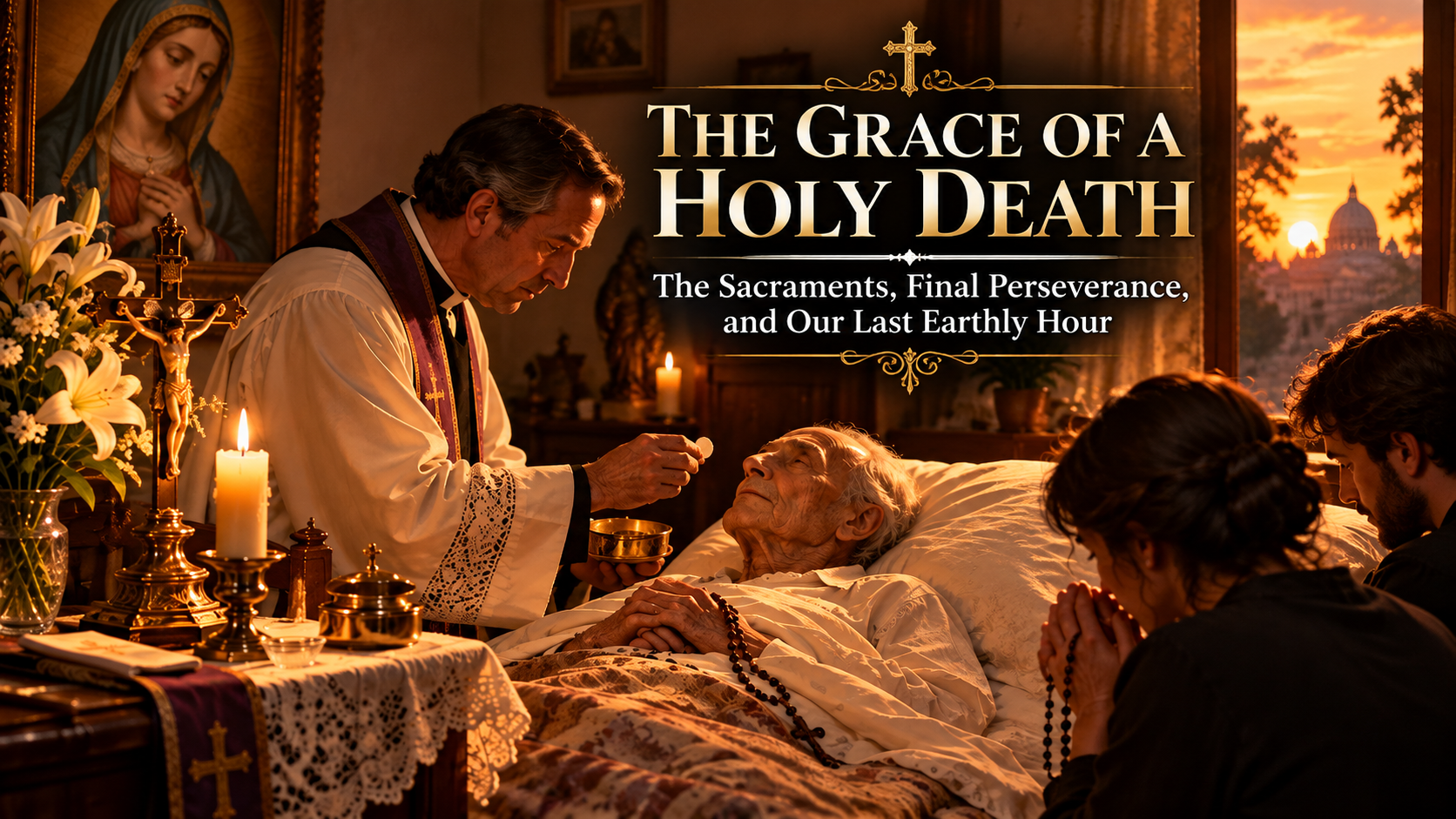
One of the most moving Catholic practices is Holy Communion received as Viaticum—the Eucharist given as nourishment for the passage from this life to the Father.
The Catechism describes Viaticum as a seed of eternal life and the power of resurrection, precisely because it is the Body and Blood of the risen Lord (CCC 1524–1525).
The Eucharist is not merely a symbol of Jesus’ concern. According to Catholic doctrine, Christ is truly, really, and substantially present under the sacramental species (CCC 1374). For a person approaching death and able to receive Communion, Viaticum is therefore an extraordinary encounter with the Savior.
We should distinguish Viaticum from the Anointing of the Sick. Both may be administered in preparation for death, but they are not the same sacrament. The Church provides an appropriate order for celebrating Penance, Anointing, and Viaticum in the last rites, considering the person’s condition and the circumstances.
The family should notify the parish or chaplain promptly, especially where health is declining. A dying person’s spiritual care should not be treated as a minor administrative detail.
What families can do beside the sickbed
Sacramental preparation does not relieve relatives of ordinary compassion. Presence, listening, appropriate physical care, and respect for the person’s dignity are profound works of mercy.
Ask whether the person would like a priest to visit. If the person is conscious, offer an opportunity to pray or simply rest quietly. A short psalm, the Our Father, the Hail Mary, or a decade of the Rosary may be fitting. Avoid turning the bedside into a test of how many devotional formulas can be completed.
Do not pressure the ill person to explain suffering or manufacture reassuring emotions. Sometimes the most loving prayer is brief and gentle. If the person is unable to communicate, the Church’s prayers of commendation can still be offered, and pastoral guidance sought.
Caregivers may need respite. Christian charity includes realistic support for family members and respect for qualified medical professionals. Decisions involving treatment, proportionate care, and end-of-life ethics can be complex; guidance should be sought from trustworthy Catholic clinicians and clergy who understand the particular case (CCC 2276–2279).
A holy death is not achieved by abandoning the sick to spiritual slogans. It is supported through truth, mercy, presence, and proper care.
The meaning of the final hours when sacraments were unavailable
A difficult pastoral question arises when death occurs suddenly or a priest cannot arrive. Families may wonder whether their loved one has been abandoned by Christ.
We must neither dismiss the importance of the sacraments nor presume to know the eternal destiny of someone who lacked an opportunity to receive them. God has bound salvation to the sacraments, but He Himself is not bound by them in the simplistic way that would make His mercy helpless when access is impossible (see CCC 1257, on Baptism; and the Church’s broader teaching on grace and repentance).
Only God knows the soul’s final interior disposition. Families should commend the departed to His justice and mercy, request the Church’s prayers, and avoid judgments based on appearances.
The Christian response to an unexpected death is sorrow joined to hope, not certainty where God has not given it.
St. Joseph and the grace of final perseverance
Catholics traditionally invoke St. Joseph as patron of a happy death. The tradition reflects his unique place in the Holy Family and the hope of dying in friendship with Jesus and Mary.
This devotion does not guarantee that a Catholic will die in an imagined ideal setting. It expresses confidence in the intercession of the saints and dependence upon God’s grace.
The Blessed Virgin Mary is likewise invoked in every Hail Mary at the hour of our death (CCC 2677). The petition is not a magical formula, but a prayer of filial trust rooted in the communion of saints.
The grace most worth requesting is perseverance in Christ. We ask not simply for an absence of pain or uncertainty but that, through whatever circumstances arise, we may remain in His love.
The CatholicG33k Practice: Prepare without panic
This week, make a good examination of conscience and seek Confession if needed.
This month, learn how your parish provides Anointing of the Sick and pastoral care to the homebound or hospitalized. If someone you love is seriously ill, do not delay asking about a priest’s visit.
This year, make prudent arrangements for dependents and important responsibilities. Speak with loved ones about medical and spiritual wishes without treating the conversation as a prediction of imminent death.
Each day, pray one Hail Mary intentionally for the grace of a holy death. Add a brief prayer for those who will die today and for those caring for them.
Above all, do not wait for a final crisis to build a relationship with Jesus Christ.
Questions for reflection
1. Have I mistakenly thought of Anointing of the Sick as a sacrament reserved only for the final minutes of life?
2. Am I preparing for death through regular repentance, Eucharistic faith, and acts of charity?
3. How can my family discuss spiritual care and end-of-life wishes with compassion rather than fear?
Prayer for the sick and the dying
Lord Jesus Christ, compassionate Physician of souls and bodies, look with mercy upon the sick, the dying, and those who care for them. Grant healing according to Your providence, courage amid uncertainty, and the spiritual comfort of Your Church. Help us to seek the Sacrament of Penance with humility, the Anointing of the Sick with faith, and Holy Viaticum with profound love. Through the prayers of the Blessed Virgin Mary, St. Joseph, and St. Alphonsus Liguori, obtain for us final perseverance. At the hour of death, may Your Cross be our confidence and Your Resurrection our hope. Amen.
Conclusion: We do not travel alone
The Church does not promise that death will be easy. She promises neither an exact timetable nor an earthly exemption from suffering. She does, however, bring us the mercy of Jesus Christ through prayer, the sacraments, and the care of the Christian community.
A holy death is prepared for through a life lived in the grace of Christ.
Sources and further reading
Primary spiritual source: St. Alphonsus Liguori, Preparation for Death: Prayers and Consolations for the Final Journey, ed. Norman J. Muckerman, C.Ss.R. (1998), editor’s Foreword and Part I, chapters 1–3.
Sacred Scripture (Douay-Rheims): James 5:14–15; John 6:51–58; John 20:19–23; Luke 23:39–43; 1 Corinthians 15.
Catechism of the Catholic Church: CCC 1014; 1374; 1422–1498; 1514–1525; 2276–2279; 2677.
Canon Law: Code of Canon Law, canons 1004–1005 (Anointing of the Sick).
CatholicG33k — Faith. Truth. Reason.