

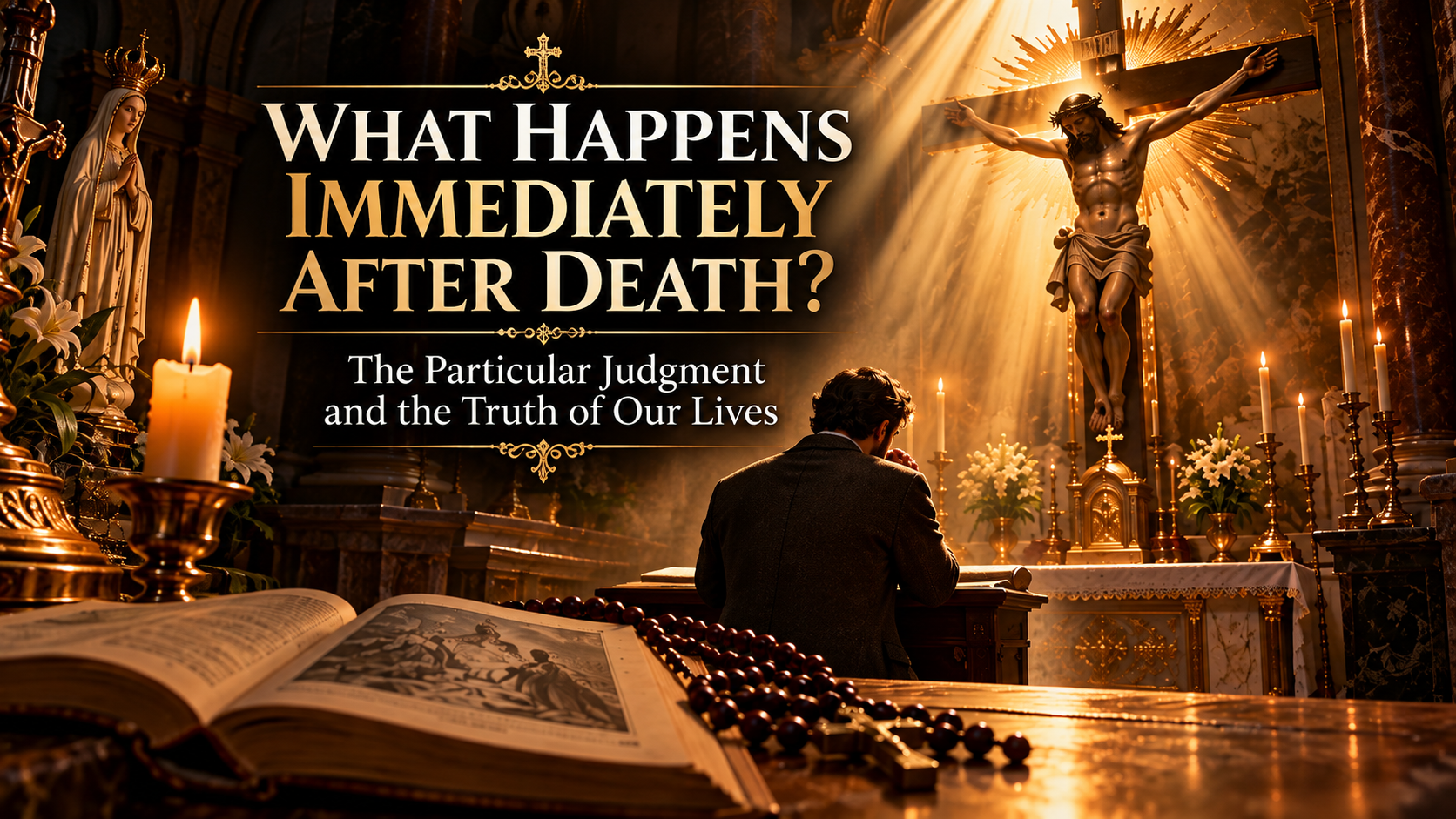
Remember Your Last End — Article 3 of 7
At death, does the soul simply disappear, sleep without awareness, or immediately meet the judgment of Jesus Christ?
Scripture for Meditation: Hebrews 9:27; Luke 16:19–31; Luke 23:39–43; 2 Corinthians 5:6–10
The silence after a final breath
We know the signs by which doctors recognize that earthly life has ended. We may have stood beside a hospital bed or beside a grave. We may have heard prayers of commendation spoken softly as loved ones gathered.
But the Catholic question reaches beyond what physical observation can measure. What becomes of the person? Does love disappear? Is death an interval of meaninglessness? Does the soul immediately receive God’s judgment, or must it wait for the last day?
The Christian answer arises from divine revelation. Human reason can recognize the mortality of the body and reflect upon the soul; the definitive teaching about our destiny comes from Christ and His Church.
In the third chapter of the supplied excerpt of Preparation for Death, St. Alphonsus Liguori turns directly to Hebrews 9:27: after death comes judgment. The saint’s urgency presupposes the gravity of this encounter. The Church gives us a more precise doctrinal account in the Catechism.
Death is the end of the earthly pilgrimage
Death is the separation of soul and body. The human person is not a soul merely wearing a disposable body. We are a unity of body and soul, and death is therefore a genuine rupture, not simply an inconvenience (CCC 362–368; 1005).
Yet the soul does not vanish with bodily death. The Church teaches the continued existence of the spiritual soul and awaits the resurrection of the body. At the final resurrection, God’s saving work will be manifested in the glorification of the whole person, not merely the preservation of an invisible fragment.
We must hold these truths together. Death is real and serious; it is not the annihilation of personal existence. The body matters, and that is why the Catholic faith honors the dead and professes the resurrection of the body.
It is also important not to confuse bodily resurrection with the particular judgment. They are related but distinct truths. The particular judgment concerns the individual immediately after death. The resurrection of the body and the Last Judgment belong to the consummation of history at Christ’s glorious coming.
The particular judgment: an encounter with Christ
The Catechism teaches that each person receives an eternal retribution in the immortal soul at the very moment of death, in a particular judgment that refers the person’s life to Christ (CCC 1021–1022).
This does not imply that God needs to investigate facts He does not know. He knows the human heart perfectly. Judgment manifests the truth of our response to Him: faith or unbelief, charity or persistent refusal of charity, repentance or definitive rejection of grace.
There is no elaborate timetable in these paragraphs, and we should not invent one. The Church teaches the fact of immediate personal judgment; she does not give us license to describe its hidden mechanics as though we had witnessed them.
The doctrine can be frightening when considered without the Gospel. But the Judge is Jesus Christ, whose divine mercy seeks the salvation of sinners. His Passion was not an afterthought to divine justice. Through His Cross and Resurrection, salvation is offered to us as grace.
The question for the present life is therefore not how to outwit judgment. It is how to abide in Christ.
Can a soul change its fundamental choice after death?
During earthly life we receive grace and are called to conversion. We can repent of sins, seek sacramental reconciliation, and grow in charity. Death ends that earthly time of choosing (CCC 1013). The Church does not teach an unlimited period of conversion after death during which a person may reverse a definitive rejection of God.
This is why St. Alphonsus warns against postponement. The point is not to suggest that God’s mercy becomes cruel or capricious. It is to recognize that human freedom has eternal significance and our present choices matter.
We must avoid presumption. No one should deliberately remain in grave sin on the assumption that there will certainly be another opportunity for repentance at the last moment.
We must likewise avoid despair. While we live, God calls us to conversion. We should not conclude that our past sins have placed us beyond His mercy. The Sacrament of Penance exists precisely for sinners who seek reconciliation.
Heaven, purification, and separation from God
The Catechism identifies the possible outcomes of the particular judgment: entrance into the blessedness of heaven immediately or through purification, or immediate and everlasting damnation (CCC 1022). These truths require careful language.
Heaven is perfect communion with the Most Holy Trinity and the blessed. Its center is the beatific vision, the supernatural seeing of God as He is (CCC 1023–1029).
Purgatory is the final purification of those who die in God’s grace and friendship but are still imperfectly purified (CCC 1030–1032). It is not a second opportunity to choose salvation after rejecting God. Those who undergo this purification are assured of heaven.
Hell is the state of definitive self-exclusion from communion with God, the consequence of dying in mortal sin without repentance and accepting God’s merciful love (CCC 1033). God predestines no one to hell (CCC 1037). The Church teaches this possibility seriously without permitting us to claim certain knowledge that named individuals have been damned.
These teachings are not competing mythologies. They express the holiness, freedom, justice, and mercy involved in the human person’s definitive relation to God.
But what of the Last Judgment?
The particular judgment should not be confused with the universal or Last Judgment. Scripture teaches that Christ will come again in glory and that the dead will rise. The Last Judgment will manifest the full truth of God’s justice, including the consequences of human actions in history (Matthew 25:31–46; CCC 1038–1041).
Our hidden acts are not meaningless. The harm we caused may ripple outward; so may the good we quietly performed. The Last Judgment will reveal God’s perfect justice, which our limited viewpoints cannot now comprehend.
But no Catholic should try to calculate the date of Christ’s return. The Gospel calls us to vigilance, not speculation. We prepare by faithfulness in the responsibilities before us.
The hope that prevents judgment from becoming despair
A Christian does not approach the thought of death by insisting that the soul’s destiny is unimportant. Neither should we let fear silence the Gospel. The same Jesus who speaks of judgment offers Himself as the Good Shepherd and the Savior of sinners.
The penitent thief addresses the Crucified Lord and receives a promise of paradise (Luke 23:39–43). The scene displays extraordinary mercy; it does not establish permission to delay conversion deliberately. We are not promised the circumstances of the thief’s final hour.
There is a profound difference between trembling before a mystery and being abandoned by God. Holy fear can awaken repentance. Christian hope anchors repentance in the merits of Christ. The Church’s sacraments, prayer, and moral teaching exist to lead us toward communion with Him.
For people struggling with scrupulosity, this doctrine may require the help of a prudent confessor. Repeated mental attempts to determine one’s final destiny are not the same as trustful conversion.
Praying for the dead without pretending to know their judgment
When a person dies, the Church does not invite us to pronounce judgment upon the soul. She invites us to pray. Catholic funeral rites commend the departed to God’s mercy, and the Eucharistic sacrifice is offered for the living and the dead.
Prayer for the faithful departed is grounded in the Church’s communion and her teaching on purification (2 Machabees 12:46; CCC 1032). We pray because charity is not abolished by death, not because we can manipulate divine judgment.
The family of a deceased person may experience grief, questions, and guilt. We should not deepen their sorrow with speculation. We can entrust the departed to Christ, request Masses for their repose, and live more faithfully ourselves.
The CatholicG33k Practice: Prepare to meet Christ
Read Hebrews 9:27 and 2 Corinthians 5:6–10. Ask not, “What dramatic image can I form of the judgment?” but, “How can I live truthfully before Jesus today?”
Make an examination of conscience that includes both sins and neglected duties of charity. If conscious of grave sin, seek sacramental Confession rather than presuming that time is guaranteed. Pray for one deceased person by name and perform one act of justice or mercy in the person’s memory.
Finally, renew the Creed’s profession of the resurrection of the body and life everlasting. The Christian faith directs our attention beyond the grave without dismissing the goodness of bodily life.
Questions for reflection
1. Do I think of divine judgment mainly as arbitrary punishment, or as the perfect judgment of Jesus Christ, who calls me to conversion?
2. What is the difference between the particular judgment and the final resurrection and Last Judgment?
3. How can I pray for the dead with confidence in God’s mercy while refusing to speculate about another person’s eternal fate?
Prayer before the judgment of Christ
Lord Jesus Christ, You are the just Judge and merciful Savior. You know my life more truthfully than I know it myself. Reveal my sins to me while I can still repent, and keep me from hiding behind excuses or falling into despair. Lead me back to Your sacraments, form my heart in charity, and teach me to trust the merits of Your Cross. For those who have died, I ask Your mercy and the purification they may need. May all my days prepare me not merely to face judgment, but to meet You whom I desire to love forever. Amen.
Conclusion: Live before the face of Christ
What happens immediately after death is not a puzzle to be solved through imagination. The Church teaches that the soul comes before the particular judgment of Christ. This truth best serves us when it reforms our present life. We need not know the hidden details of eternity to know what Christ asks now: repentance, faith, charity, perseverance, and trust in His grace.
The final judgment of our lives makes this day’s choices meaningful.
Sources and further reading
Primary spiritual source: St. Alphonsus Liguori, Preparation for Death: Prayers and Consolations for the Final Journey, ed. Norman J. Muckerman, C.Ss.R. (1998), Part I, chapter 3, “Facing Death.” The detailed account of judgment, purgatory, and the Last Judgment in this article is supplied from Catholic doctrine, not from additional chapters absent from the uploaded excerpt.
Sacred Scripture (Douay-Rheims): Hebrews 9:27; 2 Corinthians 5:6–10; Luke 16:19–31; 23:39–43; Matthew 25:31–46; 2 Machabees 12:46; 1 Corinthians 15.
Catechism of the Catholic Church: CCC 362–368; 1005–1014; 1021–1041.
Magisterium: Second Vatican Council, Lumen Gentium, 48–51.
CatholicG33k — Faith. Truth. Reason.