

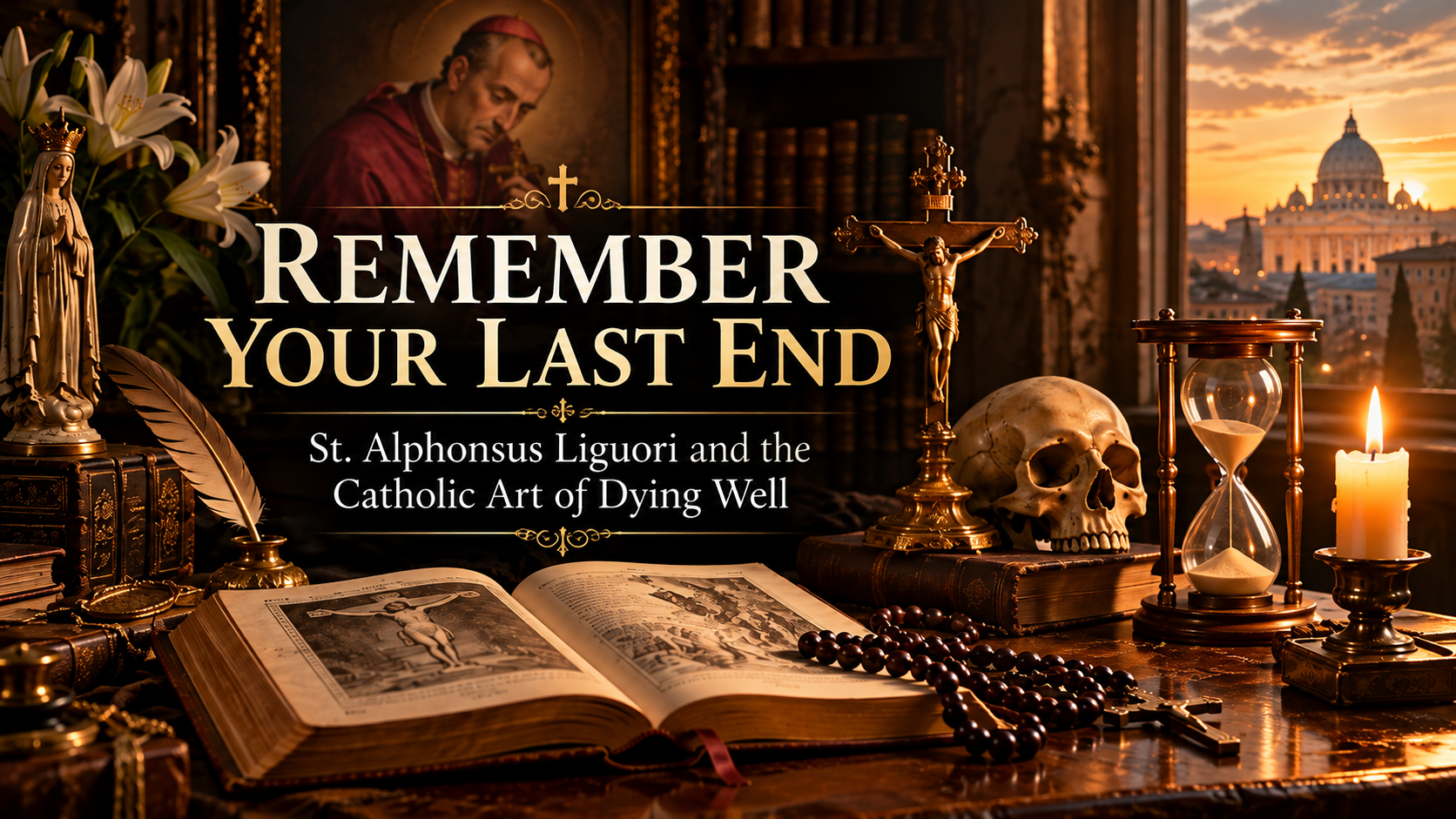
Remember Your Last End — Article 1 of 7
How can remembering death teach us to love God more deeply, repent more honestly, and live with a hope stronger than the grave?
Scripture for Meditation: Ecclesiasticus 7:40; Luke 12:16–21; Hebrews 9:27; John 11:25–26
The appointment that never appears on our calendar
There is a day awaiting each of us for which no ordinary calendar can provide an appointment. We may arrange our careers, save for retirement, schedule important occasions, and imagine where we will live ten years from now. Yet the duration of our earthly pilgrimage remains beyond our control. One day we will take our last breath. Our responsibilities will pass to other hands, our possessions will be distributed, and our earthly choices will have reached their conclusion.
Why does the Church ask us to contemplate this uncomfortable certainty? Not because Christianity despises earthly life. Life is God’s gift, and it deserves our gratitude. Rather, remembrance of death frees us to ask which goods are temporary and which possess eternal importance. The ancient counsel of Ecclesiasticus 7:40—remember your last end—does not tell us to retreat from life. It calls us to live truthfully.
St. Alphonsus Maria de Liguori devoted sustained attention to this question in Preparation for Death. In the abridged edition supplied for this series, the opening chapters are entitled “Certainty of Death,” “Life Is Short,” and “Facing Death.” Their argument is deliberately direct. Death is certain; its timing is uncertain; therefore we should not defer conversion. But the foreword identifies an even deeper aim in the saint’s writings: divine love and the grace of final perseverance. Properly understood, his meditation is not a celebration of fear. It is an invitation to come home to God while there is time.
Mortality unmasks our illusions
Death is an equalizer, though not in a way that abolishes the dignity of our different vocations. Wealth cannot buy exemption. Education cannot repeal mortality. Admirers cannot accompany us into eternity by the power of applause. Even our dearest loved ones can walk beside us only as far as human companionship permits.
St. Alphonsus describes the ordinary continuity of life after a person’s passing. Others return to their duties, inhabit familiar rooms, and attend to the affairs of the household. His descriptions can sound severe. Their purpose, however, is to expose the mistake of constructing our identity upon being indispensable or remembered forever by the world.
None of this means that human relationships are insignificant. Charity remains when worldly prestige vanishes. The tenderness with which a parent raises a child, the hidden fidelity of a spouse, the quiet endurance of a caregiver, and the patient service of a priest are not made meaningless because outsiders forget them. Their value rests ultimately in God’s truth and in the love through which they were performed.
The question is not whether earthly life matters. It matters profoundly. The question is whether we have allowed earthly goods to replace the One for whom we were created. Christ asks in Matthew 16:26 what it profits someone to gain the whole world and lose the soul. It is possible to win an impressive reputation while neglecting the one relationship that gives our entire existence its ultimate meaning.
The danger of postponing the essential
In Luke 12:16–21, the rich man has a successful harvest and plans larger barns. His failure is not agriculture or prudent planning. It is the illusion that his possessions have secured the years ahead. He speaks as though he owns tomorrow. In the parable, his life ends before those plans can guarantee him anything.
How often do we make a spiritual version of the same mistake? We will return to Confession after the next busy season. We will make peace when the other person apologizes. We will pray when the children grow older. We will renounce a habitual sin when its consequences become less convenient. We will pursue holiness when we feel ready.
But readiness does not always arrive before action. A sincere beginning is often how God teaches us to become ready. We do not need to know the hour of death to understand the importance of this present hour.
The Catechism teaches that death ends the time of earthly pilgrimage in which we receive and respond to grace (CCC 1013). It does not teach that every person dies with equal opportunity for final conversations, last-minute reconciliations, or conscious sacramental preparation. The prudent Christian therefore does not gamble upon an imagined future conversion. He responds to grace today.
The fig tree and the mercy of another season
A particularly striking passage in the first chapter of the supplied edition recalls the barren fig tree (Luke 13:6–9). The tree has been given time, yet it has produced no fruit. The gardener asks that it be cultivated once more. God’s patience is visible in the image, but so is a genuine expectation of fruit.
There is a difference between intending to become holy and cooperating with grace. We may admire charity while refusing to practice it. We may praise humility while protecting our pride. We may affirm the importance of forgiveness while repeatedly rehearsing injuries. Fine aspirations can become a substitute for conversion if they never reach our choices.
The barren tree should not make the penitent despair. Indeed, the prayer following Alphonsus’s first chapter turns toward Jesus with confidence in His mercy. That movement reveals the right spiritual sequence: recognize the danger, refuse excuses, and ask God for the grace to change.
The fruit that the Lord desires is not produced without Him. Christ teaches that apart from Him we can do nothing (John 15:5). Grace precedes and sustains every saving response. Yet grace invites our free cooperation. We are not called to save ourselves through willpower, but neither are we called to postpone love indefinitely.
Judgment: when nothing false can remain hidden
Hebrews 9:27 joins death to judgment. The Church teaches that each person receives the particular judgment immediately after death (CCC 1021–1022). Our lives therefore are not morally weightless. Our faith, our acts of charity, our sins, our repentance, and our final state before God matter.
Yet Christians should be precise about the One who judges. The Judge is Jesus Christ: the incarnate Son who received sinners, called them to repentance, suffered for our salvation, and rose in glory. His justice is not arbitrary; His mercy is not indifference toward evil. Both are perfect.
Two temptations distort our understanding. Presumption claims that repentance is unnecessary because God is merciful. Despair concludes that repentance is futile because our sins are too grave. The Gospel rejects both. Christ’s sacrifice is sufficient, and He calls us to respond through faith, repentance, and life in His grace.
A healthy meditation on judgment does not ask us to speculate about the eternal fate of particular people. God alone sees each heart with perfect knowledge. It asks us instead to stop hiding from Him ourselves.
The Cross changes the meaning of death
The Church does not ask us to contemplate mortality apart from the Resurrection. If death were only the final collapse of every hope, spiritual preparation would become an exercise in dread. But Christ entered death and conquered it.
Jesus tells Martha, “I am the resurrection and the life” (John 11:25). This is not merely reassurance that the dead remain affectionately remembered. The Lord’s Resurrection is real; He opens the way to our own resurrection and life with God. Christian hope is founded upon His Paschal Mystery, not upon optimism about human progress.
Death remains a serious event. Our grief over the death of loved ones is real, and the Church never teaches that grief is a lack of faith. But the believer may grieve with hope because the Crucified One lives.
The saint’s urgency and the Church’s hope must be kept together. The purpose of being ready to die is to be ready to meet Christ. To meet Him well, we must seek Him now.
Learning to live with eternity in view
What would change if we truly remembered our last end? Perhaps we would spend less energy defending trivial resentments. Perhaps we would recognize that the people entrusted to our care are not interruptions to a more important life. Perhaps we would repair an injustice, make a neglected confession, or begin a modest practice of prayer.
We would still work, laugh, celebrate, and plan. Catholic faith is not contempt for created goodness. It is learning to love created goods in their proper order, receiving them with gratitude without treating them as gods.
Preparing for death also means exercising ordinary prudence: making appropriate arrangements for dependents, caring for one’s health, seeking medical treatment, and attending to loved ones. Trust in providence does not eliminate responsible stewardship.
Above all, a life prepared for death is a life being formed in charity. The small daily decisions that seem hidden—truthfulness, fidelity, patience, mercy—are precisely the places where cooperation with God’s grace becomes real.
The CatholicG33k Practice: Seven days of readiness
Day 1 — Remember. Read Ecclesiasticus 7:40. In silence, consider what matters most if earthly life is finite.
Day 2 — Examine. Read Luke 12:16–21. Identify one attachment that has displaced your duties toward God or neighbor.
Day 3 — Repent. Read Luke 15:11–32. Examine your conscience and arrange for Confession if needed.
Day 4 — Bear fruit. Read Luke 13:6–9. Perform a specific work of mercy that you have been postponing.
Day 5 — Reconcile. Read Matthew 5:23–24. Take a prudent first step toward making peace or repairing a wrong. Forgiveness never requires remaining in danger.
Day 6 — Remember the departed. Pray for deceased family members and for those who have no one to pray for them.
Day 7 — Hope. Read John 11:17–27. Pray for the grace of final perseverance and thank Christ for His victory over death.
Questions for reflection
1. If my earthly life ended sooner than expected, what spiritual responsibility would I wish I had not postponed?
2. Which temporary good has begun to occupy a place in my heart that belongs to God?
3. What concrete act of repentance or charity can I begin today rather than promising to begin tomorrow?
A prayer for a heart ready to meet Christ
Lord Jesus Christ, You created me for communion with the Father and have redeemed me through Your Cross and Resurrection. Teach me to remember that my days are a gift, not a possession. Free me from the illusion that I can postpone obedience without consequence. Give me sorrow for my sins without despair, trust in Your mercy without presumption, and courage to love faithfully in the duties of this day.
Through the intercession of the Blessed Virgin Mary and St. Alphonsus Liguori, obtain for me the grace of a holy life and final perseverance. May I receive the sacraments with gratitude, love those entrusted to my care, pray for the departed, and await Your coming with Christian hope. At my final hour, let me place my confidence not in myself but in Your saving mercy. Amen.
Conclusion: This day belongs to grace
One day we will leave this world. But today we can turn toward God. We can pray, forgive, repent, serve, return to the sacraments, and renew our hope in Christ. St. Alphonsus’s meditation is severe only because the matter is important: life is brief, eternity is real, and the love of God deserves our whole heart.
Remember your last end—not to become afraid of living, but to learn how to live for eternity.
Sources and further reading
Primary spiritual source: St. Alphonsus Maria de Liguori, Preparation for Death: Prayers and Consolations for the Final Journey, ed. Norman J. Muckerman, C.Ss.R. (Liguori Publications, 1998), Foreword; Part I, chapters 1–3 (“Certainty of Death,” “Life Is Short,” “Facing Death”). The supplied excerpt contains only these opening chapters.
Sacred Scripture (Douay-Rheims): Ecclesiasticus 7:40; Luke 12:16–21; Luke 13:6–9; Luke 15:11–32; Matthew 16:26; John 11:17–27; Hebrews 9:27.
Catechism of the Catholic Church: CCC 1005–1014 (Christian death); 1021–1022 (particular judgment); 1430–1433 (interior conversion); 2008 (grace and merit).
Magisterium: Second Vatican Council, Gaudium et Spes, 18; Lumen Gentium, 48.
CatholicG33k — Faith. Truth. Reason.