

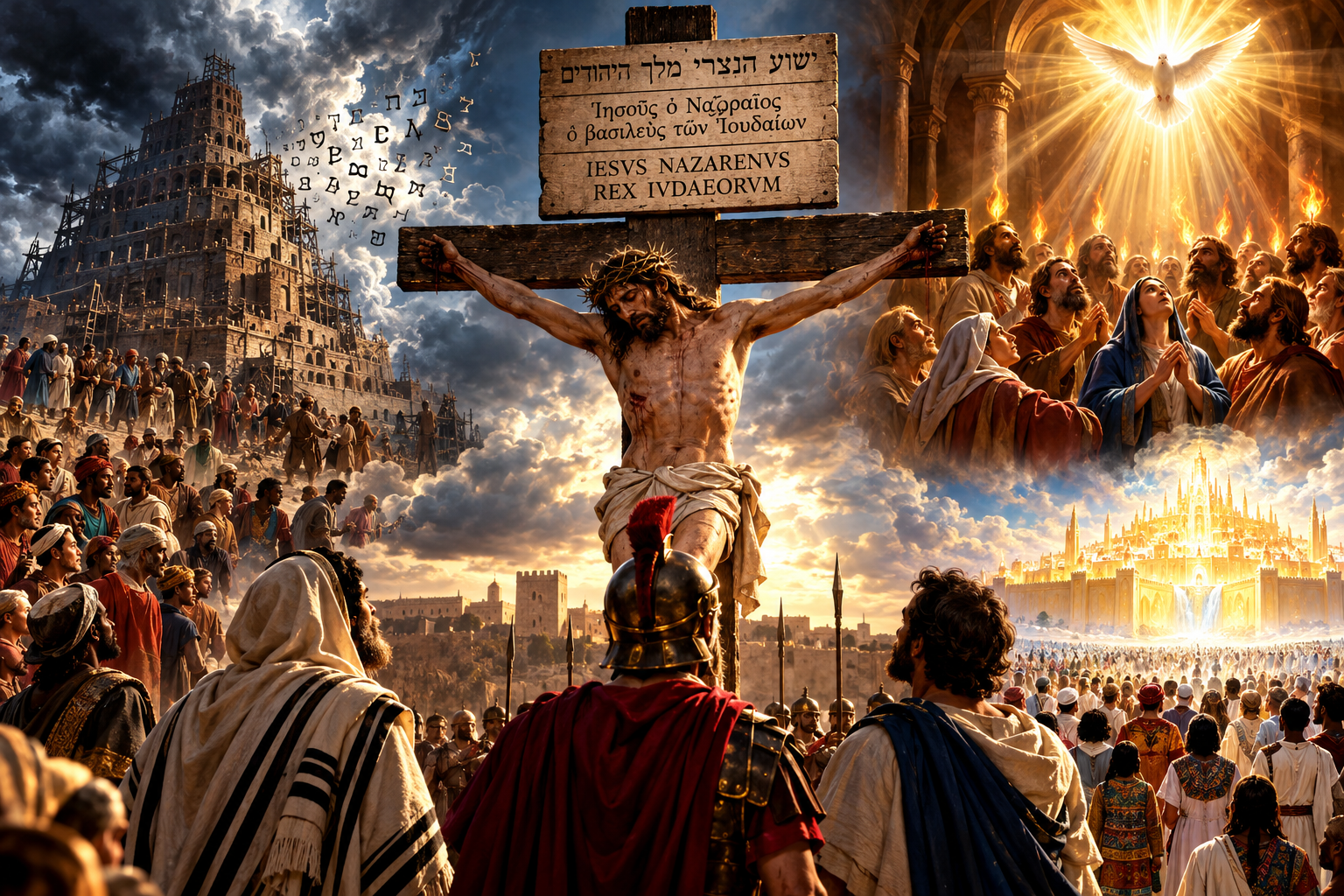
How the inscription above Jesus reveals a profound connection between the nations, the Crucifixion, and God’s plan to reunite humanity in Christ.
CatholicG33k | Biblical Theology • Sacred Scripture • Church Fathers • Catholic Apologetics
Introduction: Was the Inscription Above Jesus More Important Than We Realize?
Above the dying Jesus of Nazareth hung an inscription ordered by Pontius Pilate.
At first glance, it appeared to be a simple Roman declaration identifying the condemned man’s alleged offense.
Yet St. John records a remarkable detail that invites us to look more deeply into the mystery of the Crucifixion.
The inscription was written in three languages.
“This title therefore many of the Jews did read: because the place where Jesus was crucified was nigh to the city: and it was written in Hebrew, in Greek, and in Latin.”
— John 19:20, Douay-Rheims
Why did St. John preserve this detail?
Why was the inscription written in Hebrew, Greek, and Latin?
Why did it identify Jesus as King?
And might this multilingual proclamation illuminate a much older biblical story—the scattering of humanity at the Tower of Babel?
To explore these questions, we must travel through the history of salvation: from Noah and Babel to the covenant with Abraham, from Israel’s promises to Calvary, from the Cross to Pentecost, and finally to the heavenly Jerusalem.
The connection is not that Sacred Scripture explicitly identifies Pilate’s inscription as the fulfillment of Babel. It does not.
Nor does the Catholic Church teach that the three languages correspond directly to the three sons of Noah.
Rather, when these events are contemplated within the unity of God’s saving plan, a profound theological pattern emerges.
At Babel, humanity seeks unity through pride. At Calvary, Christ accomplishes reconciliation through His sacrifice. At Pentecost, the Holy Ghost gathers people of many languages into the unity of His Church. And in the heavenly Jerusalem, that communion reaches its everlasting fulfillment.
The three languages above the Cross are therefore not a secret biblical code. They are a historically meaningful detail within the inspired Gospel, one that fittingly directs our attention toward the universal kingship of Jesus Christ.
The most important question is not merely why Pilate wrote in three languages.
It is why the King of the Jews, crucified beneath that inscription, would become the Savior proclaimed to every nation.
1. The World After Noah: One Human Family, Many Nations
Our investigation begins long before the Crucifixion.
Following the Flood, Sacred Scripture records that Noah and his three sons emerged from the ark.
“And the sons of Noe, who came out of the ark, were Sem, Cham, and Japheth: and Cham is the father of Chanaan.”
— Genesis 9:18, Douay-Rheims
These names are more commonly rendered in modern English as Shem, Ham, and Japheth.
Genesis 10 presents what is traditionally called the Table of Nations.
This chapter describes the peoples associated with Noah’s descendants, organizing them according to families, territories, and languages.
The theological significance is considerable.
Humanity may develop into different nations, cultures, and linguistic communities, but the human race possesses a common origin and a common dignity before God.
No nation exists outside His providence.
No people possesses a superior degree of human dignity because of its ancestry.
The Catechism of the Catholic Church, §§56–58, presents the covenant with Noah within God’s universal concern for humanity.
The story of Noah’s descendants therefore introduces a central biblical truth: the many nations remain members of one human family.
Why Genesis 10 mentions languages before Babel
An attentive reader may notice something unusual.
Genesis 10 already describes nations according to their languages, yet Genesis 11:1 subsequently declares:
“And the earth was of one tongue, and of the same speech.”
— Genesis 11:1
Is this a contradiction?
Not necessarily.
Genesis 10 presents an overview of the nations and their distribution. Genesis 11:1–9 then turns back to explain the theological significance of humanity’s linguistic confusion and scattering.
The chapters need not be interpreted as two events presented in an uninterrupted chronological sequence.
The sacred author first displays the diversity of the nations and then narrates the episode of Babel.
This distinction helps us read Genesis according to its literary arrangement rather than imposing a modern historical format upon the text.
Nimrod and the beginning of Babel
Genesis 10 also introduces Nimrod, describing him as a mighty figure whose kingdom began with Babel in the land of Sennaar, or Shinar (Genesis 10:8–10).
Later Jewish and Christian traditions frequently associate Nimrod with the construction of the Tower of Babel.
However, Genesis 11 does not explicitly identify Nimrod as the tower’s architect.
That distinction is important.
A traditional interpretation may be interesting, ancient, or spiritually suggestive without possessing the authority of a statement explicitly revealed in Sacred Scripture.
Catholic theology must distinguish between what God has revealed and what later interpreters have proposed.
This principle will become especially important when examining the languages above the Cross.
2. Babel: When Humanity Attempts to Build Its Own Way to Heaven
Genesis 11 describes humanity dwelling together with a common language.
The builders settle in the land of Sennaar and undertake an extraordinary construction project.
They propose a city and a tower whose height will reach toward heaven.
Yet the problem is not simply the size of their tower.
It is the spiritual ambition revealed by their words.
“And let us make our name famous before we be scattered abroad into all lands.”
— Genesis 11:4
The builders desire security, greatness, and lasting recognition.
But their unity has become centered upon human self-exaltation.
They seek to establish their own greatness rather than receive their proper place within God’s providence.
The Catechism of the Catholic Church, §57, specifically identifies Babel with the pride of fallen humanity and its attempt to construct unity through a disordered ambition.
Building cities is not inherently sinful.
Cooperation is not sinful.
The pursuit of knowledge, architecture, and civilization is not sinful.
The spiritual disorder occurs when human achievement becomes a substitute for obedience to God.
Babel represents humanity attempting to make itself the ultimate foundation of its own unity and greatness.
The irony of God’s descent
Genesis 11:5 records that God descends to examine the city and tower.
The irony is striking.
Human beings construct something they imagine to be reaching heaven, yet the biblical narrative portrays God as descending to inspect their supposedly magnificent achievement.
The contrast exposes the limitations of human pride.
No matter how impressive human civilization becomes, humanity cannot manufacture communion with God through technological advancement, political control, or collective ambition.
The builders attempt to secure their future through their own power.
Instead, their speech is confused, their cooperation collapses, and they are scattered.
The unity they attempted to establish apart from God proves incapable of sustaining itself.
St. Augustine and the earthly city
In The City of God, Book XVI, chapter 4, St. Augustine discusses Babel in relation to the beginnings of earthly dominion and human pride.
His broader distinction between the earthly city and the City of God illuminates the spiritual problem.
The earthly city is characterized by disordered self-love.
The City of God is founded upon love rightly directed toward God.
The issue is therefore deeper than language.
Babel reveals the danger of seeking a common life without acknowledging the Creator as the ultimate source of truth and goodness.
Humanity desires unity, but its pride produces division.
Yet God does not abandon the nations.
He begins preparing a far greater answer.
3. Abraham: God’s Answer to the Scattering of the Nations
Immediately after the account of Babel, Genesis turns toward the genealogy leading to Abraham.
This literary movement is theologically significant.
The nations have been scattered, but God’s saving plan continues.
Rather than commanding humanity to rebuild the tower, God calls one man and establishes a covenant whose blessings will eventually extend to the nations.
The Lord promises Abraham:
“And in THEE shall all the kindreds of the earth be blessed.”
— Genesis 12:3, Douay-Rheims
This promise provides an essential bridge between Babel and Calvary.
At Babel, humanity attempts to create its own greatness.
Through Abraham, God begins a covenantal history founded upon divine initiative.
The blessing does not originate in human pride.
It comes from God.
The Catechism, §59, explicitly explains that God calls Abraham in order to gather together scattered humanity.
This is one of the most important theological connections in the entire biblical narrative.
The call of Abraham is not an isolated event.
It belongs to God’s universal plan of salvation.
Through Abraham comes the people of Israel.
Through Israel come the covenants, the Law, the prophets, and the promises concerning the Messiah.
And from Israel, according to the flesh, comes Jesus Christ.
St. Matthew begins his Gospel by identifying Jesus as the Son of David and the Son of Abraham (Matthew 1:1).
St. Paul later explains that God’s promise to Abraham finds its fulfillment in Christ and extends to the Gentiles through faith (Galatians 3:8–16, 26–29).
The movement of salvation history is therefore clear:
- Humanity is scattered among the nations.
- God calls Abraham and promises a universal blessing.
- Israel becomes the people through whom the Messiah is prepared.
- Jesus Christ fulfills God’s saving promises.
- Through Christ, the Gospel is proclaimed to every nation.
This does not mean that Israel’s history was meaningless or disposable.
On the contrary, the universal mission of Jesus Christ can only be properly understood within the covenantal history of Israel.
The King of the Jews is also the Savior of the world.
And this truth will be proclaimed, in a remarkable way, above His Cross.
4. Calvary: Three Languages Above One Crucified King
We now arrive at the event that inspired this investigation.
Pontius Pilate orders an inscription to be placed above Jesus as He hangs upon the Cross.
St. John records:
“And Pilate wrote a title also, and he put it upon the cross. And the writing was: JESUS OF NAZARETH, THE KING OF THE JEWS.”
— John 19:19, Douay-Rheims
The Evangelist then tells us that the inscription was written in Hebrew, Greek, and Latin.
These three languages belonged to distinct but overlapping dimensions of the first-century Mediterranean world.
Their presence together above the Crucified Christ deserves careful consideration.
Hebrew: The language of Israel’s sacred inheritance
Hebrew was the language of Israel’s sacred Scriptures and a principal language of Jewish religious identity.
The Greek wording of John’s Gospel may encompass the Semitic speech associated with Jewish life, including Aramaic, which was widely spoken in the region.
Consequently, the precise linguistic form used on the inscription should not be asserted beyond what the Gospel establishes.
Nevertheless, its connection with Israel is unmistakable.
Jesus was born into the Jewish people.
He was descended from David.
He was the fulfillment of God’s promises to Abraham.
His identity as the Messiah cannot be separated from the covenantal history of Israel.
The inscription’s reference to the King of the Jews therefore possesses a meaning that reaches far beyond the immediate Roman legal proceedings.
Greek: The language of communication across nations
Greek was widely used throughout the eastern Mediterranean.
It served as an important language of trade, education, administration, and communication among peoples of different backgrounds.
Greek could reach audiences beyond the immediate Jewish population of Jerusalem.
It would also become the language in which the New Testament writings were composed.
Through Greek, the apostolic proclamation of Jesus Christ would be communicated throughout much of the Mediterranean world.
The presence of Greek above the Cross therefore places the Crucifixion within a broader international setting.
Latin: The language of Roman political authority
Latin represented the power of Rome.
Pontius Pilate governed Judaea under Roman imperial authority, and crucifixion was a Roman form of execution.
The Latin inscription belonged to the administrative and political setting of Christ’s condemnation.
Yet a profound irony emerges.
The earthly empire possesses the authority to execute Jesus, but the inscription publicly identifies the condemned man as a king.
The representative of Caesar orders the execution of the One whose kingdom is not of this world (John 18:36).
St. Augustine’s interpretation of the three languages
St. Augustine directly considers the multilingual inscription in his Tractates on the Gospel of John, Tractate 117, §4.
He associates Hebrew with the Jewish people and their knowledge of God’s Law, Greek with the learning of the Gentile world, and Latin with the political dominion of Rome.
This interpretation establishes that reflection upon the inscription’s three languages is not a modern invention.
The Church Fathers recognized their historical and theological significance.
The three languages represented major dimensions of the world surrounding the Crucifixion.
We should not exaggerate this observation into a claim that they literally represented every language on earth.
Nevertheless, their appearance together above Christ fittingly calls attention to the wider world in which His saving Passion took place.
The King of Israel is crucified at the meeting point of Jewish covenantal history, Greek-speaking civilization, and Roman imperial authority.
The event is particular in its historical circumstances.
Its saving significance is universal.
5. Pilate’s Inscription and the Universal Kingship of Christ
The chief priests object to the inscription.
They do not want Pilate to declare Jesus simply to be King of the Jews.
They request that the inscription instead identify kingship as something Jesus claimed for Himself.
Pilate refuses.
“What I have written, I have written.”
— John 19:22, Douay-Rheims
Historically, the inscription identifies the royal claim associated with the condemned prisoner.
We should not assume that Pilate intended to proclaim the Christian faith.
Sacred Scripture does not establish that Pilate understood Jesus to be the divine Son of God or the Savior of the world.
Nevertheless, St. John’s account permits us to recognize a remarkable irony.
Pilate exercises earthly authority, but he does not control the ultimate meaning of the event unfolding before him.
The inscription identifies Jesus as a king.
And, despite the political intentions surrounding His execution, the declaration is true.
St. Augustine: King of the Jews and of the Gentiles
St. Augustine develops this point further in Tractate 117, §5.
After reflecting upon Pilate’s refusal to change the inscription, Augustine asks whether Christ is King only of the Jews or also of the Gentiles.
His answer is unmistakable.
Christ is King of the Gentiles also.
Augustine turns to Psalm 2, where God promises the nations to His Anointed.
“Ask of me, and I will give thee the Gentiles for thy inheritance.”
— Psalm 2:8, Douay-Rheims
He also appeals to the teaching of Jesus concerning the other sheep who must be gathered into one flock under one Shepherd (John 10:16).
This is a particularly important patristic witness.
St. Augustine does not merely comment upon the historical use of Hebrew, Greek, and Latin.
He proceeds from the inscription to the universal kingship of Christ.
The title identifies Jesus as King of the Jews, yet His dominion extends to the nations.
The Gospel will go forth to the Gentiles, who are called to share in the promises made to Abraham through Christ (Galatians 3:29).
Thus the inscription must not be interpreted as separating Jesus from Israel.
Rather, the Messiah of Israel brings the promised blessing to the nations.
God’s providence does not excuse human wrongdoing
In the same passage, Augustine reflects upon the mysterious operation of divine providence in Pilate’s refusal to alter the inscription.
God can accomplish His saving purposes even through persons who do not fully understand those purposes.
Acts 4:27–28 likewise recognizes the involvement of human authorities in Christ’s Passion while affirming the fulfillment of God’s saving plan.
This does not excuse injustice.
Pilate remains responsible for his actions.
Divine providence does not transform evil into good merely because God is capable of bringing good from it.
Rather, the mystery reveals that human wrongdoing cannot ultimately defeat God’s saving purpose.
The Passion and the Jewish people
An essential Catholic distinction must also be maintained.
The Church rejects the accusation that the Jewish people collectively bear responsibility for the death of Christ.
The Second Vatican Council teaches in Nostra Aetate, §4, that the events of the Passion cannot be charged indiscriminately against all Jews living at that time or against Jewish people today.
The Catechism of the Catholic Church, §§597–598, likewise emphasizes that sinners bear responsibility for the sufferings of Christ.
Jesus freely accepted His Passion out of love for the salvation of humanity.
The Cross cannot be used as a justification for antisemitism, hostility, or collective accusations.
Its message is precisely the opposite.
Christ offers Himself to reconcile sinners to God.
The inscription reveals the kingship of Jesus. His sacrifice reveals the infinite love through which He exercises that kingship for our salvation.
6. Does the Three-Language Inscription Reverse the Tower of Babel?
We now reach the central theological question.
At Babel, humanity’s common language is confused, and the builders are scattered.
At Calvary, three languages proclaim the title of one crucified King.
Could this multilingual inscription foreshadow the reconciliation of the nations?
As a theological contemplation, the connection is meaningful.
As a claim of direct, explicitly revealed fulfillment, it would go beyond what the biblical text establishes.
Sacred Scripture does not say that Pilate selected three languages because Noah had three sons.
Nor does it assign Hebrew, Greek, and Latin individually to Shem, Ham, and Japheth.
The Church has not defined such a numerical correspondence.
We must therefore distinguish between a spiritual analogy that illuminates divine revelation and a doctrine revealed by God.
The Catholic tradition permits the contemplation of biblical types and spiritual senses when these are properly rooted in the literal meaning of Scripture and consistent with the unity of faith.
The Catechism, §§115–119, explains the different senses of Sacred Scripture.
The Second Vatican Council, in Dei Verbum, §12, requires that biblical interpretation respect the sacred authors’ intentions, literary forms, the unity of Scripture, and the living Tradition of the Church.
Consequently, the inscription may fittingly evoke the universal scope of Christ’s mission without our claiming that St. John explicitly established a formal typological relationship with Babel.
Babel’s pride and Christ’s obedience
Consider the contrasting movements.
At Babel, humanity seeks greatness through self-exaltation.
At Calvary, Christ accepts humiliation through obedience to the Father.
At Babel, human beings attempt to establish their own path to heaven.
In the Incarnation, the eternal Son of God descends into human history to save fallen humanity.
At Babel, the human project ends in confusion and scattering.
At Calvary, Christ accomplishes the redemption through which humanity can be reconciled to God.
Babel seeks unity through human pride.
The Cross establishes the foundation of true communion through divine love.
This is not simply a poetic contrast.
Its theological foundation is found in the writings of St. Paul.
Ephesians 2: The Cross reconciles divided humanity
St. Paul’s Letter to the Ephesians provides one of the clearest biblical explanations of reconciliation through the Cross.
Writing about the relationship between Jews and Gentiles in Christ, the Apostle declares:
“And might reconcile both to God in one body by the cross, killing the enmities in himself.”
— Ephesians 2:16, Douay-Rheims
The Apostle is addressing the reconciliation of Jews and Gentiles, who are brought near to God through Jesus Christ.
His teaching is therefore more specific than a general discussion of linguistic diversity.
Yet this reconciliation possesses profound significance for the unity of humanity.
Christ does not merely encourage previously separated peoples to cooperate.
He establishes peace through His sacrificial death.
The divisions overcome in Christ are reconciled within a new communion grounded in His saving work.
And St. Paul continues:
“For by him we have access both in one Spirit to the Father.”
— Ephesians 2:18, Douay-Rheims
Here the theological relationship becomes unmistakable.
Through Christ, reconciliation is accomplished.
In one Spirit, the reconciled receive access to the Father.
The movement from Calvary toward Pentecost is therefore grounded in apostolic teaching.
The Cross is the redemptive foundation of reconciliation. The Holy Ghost gathers believers into the communion established through Christ.
From a human tower to God’s dwelling place
There is another beautiful contrast in Ephesians 2.
The builders of Babel attempted to construct a monument that would establish their greatness.
St. Paul describes Christians as being joined together into a holy temple, with Jesus Christ Himself as the chief cornerstone (Ephesians 2:19–22).
In verse 22, the Apostle teaches that believers are built together into a dwelling place of God in the Spirit.
The contrast is remarkable.
At Babel, humanity attempts to construct greatness for itself.
In Christ, God forms a people in whom He dwells by His Spirit.
The first project seeks human glory.
The second is founded upon divine grace.
This contrast is a theological application of the passages, not a claim that St. Paul explicitly identifies the tower of Babel with his description of the Church.
Nevertheless, it reinforces the broader biblical pattern.
Humanity cannot build its own way into divine communion.
God Himself establishes that communion through Jesus Christ.
And this divine work becomes visibly manifested in the universal mission of the Church.
7. Pentecost: The Holy Ghost Gathers the Scattered Nations
The most explicit biblical and patristic comparison with Babel is found not in the inscription itself, but in Pentecost.
After Christ’s Passion, Resurrection, and Ascension, the Holy Ghost descends upon the disciples gathered in Jerusalem.
The Acts of the Apostles records:
“And they were all filled with the Holy Ghost, and they began to speak with divers tongues, according as the Holy Ghost gave them to speak.”
— Acts 2:4, Douay-Rheims
People from numerous nations hear the Apostles proclaiming the mighty works of God in their own languages (Acts 2:5–11).
The significance is profound.
At Babel, language becomes a barrier to cooperation.
At Pentecost, the Holy Ghost overcomes linguistic barriers so that the Gospel may be proclaimed.
Notice what does not happen.
God does not abolish every language.
He does not require all nations to adopt one earthly tongue.
Instead, through a miraculous gift, He makes the apostolic proclamation accessible across linguistic boundaries.
The unity of Pentecost is not the destruction of diversity.
It is the work of the Holy Ghost gathering diverse peoples into one faith.
St. Augustine: Charity gathers what discord scattered
St. Augustine develops the comparison between Babel and Pentecost in Sermon 271, preached on the feast of Pentecost.
He contrasts the pride associated with Babel with the unity established through the Holy Ghost.
In his interpretation, the languages spoken by the Apostles signify the future universality of the Church.
The nations once divided by linguistic confusion are now called into communion through Christ.
Augustine emphasizes that charity gathers together those whom discord had scattered.
This is an especially important witness because it directly connects Babel, Pentecost, and the unity of Christ’s Mystical Body.
For Augustine, the miracle of tongues is not merely an extraordinary linguistic event.
It reveals the Church’s universal calling.
The Gospel is destined for every nation, and the faithful are gathered under one Head, Jesus Christ.
St. Irenaeus: The Holy Ghost brings distant peoples into unity
An even earlier Christian witness appears in St. Irenaeus of Lyons.
Writing in Against Heresies, Book III, chapter 17, §2, St. Irenaeus reflects upon the descent of the Holy Ghost at Pentecost.
He explains that the Spirit empowers the entrance of the nations into the new covenant and brings distant peoples into unity.
He associates the gift of languages with the nations offering praise to God.
This testimony is extraordinary.
Already in the second century AD, a major Church Father understood Pentecost in terms of the gathering of peoples who had previously been distant from one another.
The Holy Ghost makes the Gospel accessible beyond the boundaries of one nation.
Through the Church, peoples from across the world are called to worship the one true God.
St. Irenaeus therefore strengthens the theological foundation of the article’s central argument.
The unity of the nations in Christ is not a recently invented interpretation.
It is deeply rooted in early Christian reflection upon Pentecost.
Pope Benedict XVI: Unity is not uniformity
Pope Benedict XVI explained this mystery with particular clarity in his Pentecost homily of May 23, 2010.
He contrasted Babel’s false model of unity with the communion created by the Holy Ghost.
At Babel, humanity possesses one language, yet its pride leads toward division.
At Pentecost, the Apostles proclaim the Gospel across different languages, and the Spirit creates understanding.
The distinction is crucial.
The Church’s unity does not require the disappearance of legitimate cultural and linguistic differences.
Instead, the nations are invited into one faith, one sacramental communion, and one life in Christ.
The Catechism, §§813–814, teaches that the Church’s unity originates in the Blessed Trinity and is compatible with a diversity of peoples, traditions, and gifts.
Pope Benedict returned to the Babel-Pentecost comparison in his homily of May 27, 2012.
He explained that the unity humanity truly needs cannot be manufactured by self-centered ambition.
It must be received through the transforming gift of God’s Spirit.
Babel reveals what happens when humanity seeks unity without God. Pentecost reveals what God can accomplish when humanity receives His Spirit.
Why the Cross must come before Pentecost
The sequence of salvation history is essential.
The Holy Ghost does not descend merely to solve a communication problem.
He comes to make Christ known, to sanctify believers, and to gather them into the Church.
The Apostles proclaim Jesus Christ crucified and risen.
Their message is made possible through the saving work of the Redeemer.
Jesus Himself connects the coming gift of the Spirit with His glorification (John 7:37–39).
The Catechism, §§731–732, places Pentecost within the fulfillment of Christ’s Paschal Mystery.
Thus Pentecost cannot be separated from Calvary.
The Spirit does not establish an alternative path to salvation.
He communicates the saving work of the Son and brings believers into communion with the Father through Christ.
This is the magnificent biblical progression:
Babel reveals humanity’s division. Abraham receives the promise of blessing for the nations. Calvary accomplishes redemption. Pentecost gathers peoples into the communion of Christ’s Church.
The inscription’s three languages belong within this wider history.
They do not replace the miracle of Pentecost.
They fittingly anticipate the universal proclamation that will follow the Resurrection.
8. From Babel’s Tower to Christ’s Kingdom: The Great Reversal of Pride
The contrast between Babel and Christ becomes even more profound when we examine the builders’ desire to make a name for themselves.
Their ambition is upward.
They seek exaltation.
They attempt to secure greatness through human achievement.
Now compare this with Philippians 2:5–11.
St. Paul describes the humility of Jesus Christ, who takes the form of a servant and becomes obedient unto death, even death upon the Cross.
Because of this obedience, God exalts Him.
The movement is opposite to the pride of Babel.
Babel attempts self-exaltation.
Christ embraces self-humiliation.
Babel seeks greatness apart from God.
Christ accomplishes salvation through perfect obedience to the Father.
Babel builds upward.
In the Incarnation, the eternal Word descends into our humanity.
The Gospel declares:
“And the Word was made flesh, and dwelt among us.”
— John 1:14, Douay-Rheims
Humanity cannot reach divine life through its own unaided power.
God comes to humanity through the mystery of the Incarnation.
And the incarnate Son offers Himself upon the Cross.
Jesus declares:
“And I, if I be lifted up from the earth, will draw all things to myself.”
— John 12:32, Douay-Rheims
St. John immediately explains that these words signify the manner of Christ’s death (John 12:33).
The contrast is striking.
The tower is raised in the hope of human glory.
The Cross is raised as the instrument of Christ’s redemptive sacrifice.
The builders of Babel seek to establish their own name.
The Apostles proclaim the saving Name of Jesus Christ (Acts 4:12).
The builders fear being scattered.
Christ comes to gather together the scattered children of God (John 11:52).
At Babel, human pride fractures communion.
Through Christ’s sacrifice, divine love establishes the means of reconciliation.
And the kingdom of the crucified and risen Lord extends beyond every earthly empire.
The kingship that earthly power cannot comprehend
Jesus explains to Pilate that His kingdom is not of this world (John 18:36).
This does not mean that Christ has no authority over earthly life.
It means that His kingdom does not originate from worldly power or operate according to the methods of earthly domination.
His kingship is founded upon divine truth.
His victory comes through sacrificial love.
The crown of thorns, the Cross, and the inscription stand as an astonishing contrast to the ambitions of worldly rulers.
The Son of God conquers sin and death not through the pride of Babel, but through perfect obedience and love.
The true King is enthroned upon the Cross.
And the salvation He accomplishes is destined to be proclaimed among the nations.
9. The Book of Jasher: Distinguishing Scripture From Speculation
Some discussions of Babel introduce additional stories involving Nimrod, angels, different groups of builders, and extraordinary punishments.
Such narratives are sometimes drawn from a later work circulated under the title Book of Jasher or Sefer haYashar.
Certain versions contain an expanded account of Babel, including details not found in Genesis 11.
These accounts may be of historical interest for the study of later religious traditions.
However, they must not be confused with inspired Sacred Scripture.
The Old Testament refers to a Book of Jashar in Joshua 10:13 and 2 Kings 1:18 (2 Samuel 1:18 in modern numbering).
These references do not establish that later works circulated under the title Book of Jasher are identical to the ancient source mentioned in Scripture.
The later work is not part of the Catholic biblical canon.
Its additional narratives do not possess the authority of divine revelation.
The importance of the Catholic canon
The Catholic Church receives the inspired books of Sacred Scripture according to the canon solemnly reaffirmed by the Council of Trent, Session IV.
The Catechism of the Catholic Church, §120, presents the canonical books of the Old and New Testaments.
A Catholic must distinguish between:
- Inspired Sacred Scripture.
- Sacred Tradition handed down from the Apostles.
- Authoritative teaching of the Magisterium.
- Interpretations and commentaries of the Church Fathers.
- Later noncanonical religious and historical literature.
These sources do not all possess the same authority.
A tradition about Nimrod may be considered without being presented as certain biblical history.
A symbolic relationship among Noah’s sons and the three languages of the Cross may be explored without being proclaimed as a revealed doctrine.
Theological reflection must remain faithful to the distinction between revelation and speculation.
This is precisely why the Church’s principles of biblical interpretation matter.
Dei Verbum, §12, requires careful attention to the intended meaning of Scripture, its literary forms, its unity, and its interpretation within the living Tradition of the Church.
Authentic Catholic biblical theology should be rich enough to recognize spiritual patterns and disciplined enough not to confuse theological possibilities with revealed certainties.
The connection between Babel, Calvary, and Pentecost does not require an invented numerical code.
It rests upon the far stronger foundation of salvation history, apostolic teaching, and the testimony of the Church Fathers.
10. The Heavenly Jerusalem: Every Nation Before the Lamb
The biblical narrative does not conclude at Pentecost.
The universal mission of the Church points toward the final fulfillment of God’s saving plan.
In the Apocalypse, St. John beholds an immense multitude gathered in heavenly worship.
“After this I saw a great multitude, which no man could number, of all nations, and tribes, and peoples, and tongues, standing before the throne, and in sight of the Lamb.”
— Apocalypse 7:9, Douay-Rheims
Here the universality of redemption is displayed in its final glory.
The multitude is drawn from different nations, tribes, peoples, and languages.
Their diversity has not prevented their common worship.
They stand before the throne and before the Lamb.
The nations are no longer presented as a people seeking to construct their own greatness apart from God.
Their worship is directed toward the Lord.
Their communion comes through the saving work of the Lamb.
This heavenly vision brings the contrast with Babel into sharper focus.
At Babel, the builders seek to establish their own name.
In heaven, the redeemed worship the Name of God.
At Babel, human pride produces scattering.
In the heavenly vision, the redeemed are gathered in worship.
At Babel, unity is sought through earthly construction.
In heaven, communion is the gift of divine redemption.
The nations enter the light of the New Jerusalem
St. John develops the vision further in Apocalypse 21.
Describing the heavenly Jerusalem, he declares:
“And the nations shall walk in the light of it: and the kings of the earth shall bring their glory and honour into it.”
— Apocalypse 21:24, Douay-Rheims
The following verses continue this vision of the nations in relation to the holy city (Apocalypse 21:25–26).
This passage is especially meaningful when read alongside the story of Babel.
In Genesis, humanity attempts to construct a great city for its own exaltation.
In the Apocalypse, the New Jerusalem descends from heaven, from God (Apocalypse 21:2).
The difference is fundamental.
Babel represents the insufficiency of fallen human ambition.
The New Jerusalem manifests the divine gift of final communion.
The ultimate destiny of the redeemed is not a human civilization that has finally succeeded in constructing its own way to heaven.
It is eternal life with God, received through His grace.
Nor does the vision imply that every person is saved automatically, regardless of his or her response to grace.
The Apocalypse describes the final blessedness of those who belong to the Lamb (Apocalypse 21:27).
The Church’s universal mission announces salvation to all peoples and calls them to conversion, faith, and perseverance in Christ.
Four great scenes in salvation history
We may now contemplate four great biblical scenes as one theological progression.
Babel — The scattering of humanity
Human beings attempt to establish unity and greatness through pride.
Their project ends in confusion and scattering.
Calvary — The reconciliation accomplished by Christ
The incarnate Son freely offers His life upon the Cross.
Through His sacrifice, He accomplishes redemption and establishes the foundation of peace.
Pentecost — The gathering of the nations
The Holy Ghost empowers the Apostles to proclaim Christ across linguistic boundaries.
The Gospel goes forth to the nations, and the Church manifests her universal mission.
The Heavenly Jerusalem — The consummation of communion
The redeemed from every nation worship God and the Lamb.
The communion begun through grace reaches its final fulfillment in glory.
This theological progression does not depend upon assigning particular languages to Noah’s descendants.
It depends upon something far more profound.
The whole history of salvation finds its center and fulfillment in Jesus Christ.
11. What the Three Languages Above the Cross Teach Catholics Today
The inscription of the Crucifixion is not merely a detail belonging to ancient history.
It invites serious reflection upon the nature of Christ’s kingship, the unity of the Church, and our own participation in God’s saving work.
First: Christianity cannot be separated from Israel
Jesus is the Son of David, the Son of Abraham, and the promised Messiah.
His kingship fulfills God’s covenantal promises.
The Christian faith does not arise independently of Israel’s sacred history.
It is within that history that God prepares the coming of His Son.
Second: The Gospel is destined for every nation
Christ commands His Apostles to make disciples of all nations (Matthew 28:19–20).
The Church’s catholicity is not a later human invention.
It belongs to the mission entrusted to her by the risen Lord.
The proclamation of Christ is not the possession of one ethnic group, language, or empire.
It is a message of salvation addressed to the whole world.
Third: Worldly power is never ultimate
Pilate possessed political authority.
Yet he did not possess authority over the truth of Christ’s kingship.
The inscription he ordered has outlived the empire under whose authority Jesus was condemned.
The Crucified One remains King.
Earthly powers rise and fall.
The kingdom of Jesus Christ will have no end (Luke 1:33).
Fourth: True unity requires truth and charity
Babel warns against unity established through pride and self-exaltation.
Pentecost reveals communion established by the Holy Ghost.
The Church’s unity is not merely an agreement to coexist.
It is a participation in one faith, one sacramental life, and one communion in Christ.
St. Paul teaches:
“One Lord, one faith, one baptism.”
— Ephesians 4:5, Douay-Rheims
The diversity of peoples and cultures is not inherently opposed to unity.
But authentic Christian unity cannot be separated from the truth revealed by God.
Fifth: Redemption is a gift of grace
Humanity cannot construct its own path into the divine life through its unaided efforts.
Salvation comes through Jesus Christ.
We are called to respond to His grace through faith, repentance, Baptism, perseverance, and charity.
The Lord does not merely offer a better version of Babel.
He establishes an entirely new communion through His Paschal Mystery.
Sixth: The Church must speak to every people
The miracle of Pentecost reminds Catholics that the Gospel must be proclaimed intelligibly and faithfully.
The Church is called to evangelize across languages, cultures, and national boundaries.
This does not require abandoning revealed truth.
It requires communicating that truth with charity, clarity, courage, and fidelity.
The same Holy Ghost who empowered the Apostles continues to sanctify the Church and sustain her mission.
The faithful are therefore called not to build monuments to their own greatness, but to bear witness to Jesus Christ.
Our mission is not to make our own name famous. It is to proclaim the saving Name of the Lord.
Conclusion: The Cross Speaks to the Nations
When Pontius Pilate ordered an inscription above the crucified Jesus, he intended to identify the condemned man and His alleged royal offense.
St. John preserved both the wording and the remarkable fact that it appeared in Hebrew, Greek, and Latin.
St. Augustine recognized the historical significance of these three languages and explained that Christ’s kingship extends beyond the Jewish people to the Gentiles.
St. Paul revealed the deeper foundation of this unity: through the Cross, Christ reconciles those who were divided and grants access to the Father in one Spirit.
St. Irenaeus and St. Augustine understood the miracle of Pentecost as a manifestation of the Church’s universal mission and the gathering of peoples once separated.
And the Apocalypse reveals the final destiny of the redeemed: a multitude from every nation worshiping God and the Lamb.
The great biblical progression becomes clear.
At Babel, humanity attempts to reach heaven through its own pride.
At Calvary, the eternal Son of God, who descended into our humanity, is lifted upon the Cross.
At Pentecost, the Holy Ghost empowers the Apostles to proclaim the crucified and risen Christ across the languages of the nations.
And in the heavenly Jerusalem, the redeemed enter the everlasting communion of God.
The three languages above the Cross are not a hidden formula proving speculative theories about Noah’s descendants.
Nor does Scripture explicitly declare the inscription to be the fulfillment of the Tower of Babel.
But within the unity of God’s saving plan, the inscription offers a fitting sign of the universal proclamation that will follow the Resurrection.
One crucified King is publicly identified in three languages.
Soon His Apostles will proclaim Him in the languages of many nations.
And through His Church, that proclamation will continue until the end of the age.
The deepest mystery is not that Pilate wrote in Hebrew, Greek, and Latin.
It is that the One whom Pilate condemned is the eternal Son of God, whose redemptive sacrifice opens the way to reconciliation.
The King of the Jews is the Savior of the world.
The Crucified One is the risen Lord.
And the Holy Ghost gathers the nations into the communion of His Church.
Babel’s tower was built so that humanity might make a name for itself.
The Cross was raised upon the earth so that humanity might be saved through the Name of Jesus Christ.
At Babel, pride scattered.
At Calvary, divine love redeemed.
At Pentecost, the Holy Ghost gathered.
And in the heavenly Jerusalem, the redeemed shall worship the Lamb forever.
One King. One Cross. One saving Gospel for every nation.
And of His kingdom there shall be no end.
— Luke 1:33
Primary Sources and Further Study
Sacred Scripture — Douay-Rheims Bible
The nations, Babel, and the promise to Abraham
- Genesis 9:18–27 — Noah and his sons.
- Genesis 10:1–32 — The Table of Nations.
- Genesis 11:1–9 — The Tower of Babel.
- Genesis 12:1–3 — God’s promise to Abraham.
- Psalm 2:7–8 — The nations promised to God’s Anointed.
The kingship and sacrifice of Jesus Christ
- Matthew 1:1 — Jesus Christ, Son of David and Son of Abraham.
- Matthew 27:23–37 — The condemnation and Crucifixion.
- Luke 1:32–33 — The everlasting kingdom of Christ.
- Luke 23:3–38 — Jesus before Pilate and the inscription.
- John 10:16 — One flock and one Shepherd.
- John 11:51–52 — The gathering of God’s scattered children.
- John 12:32–33 — Christ lifted up upon the Cross.
- John 18:33–37 — Christ’s kingship before Pilate.
- John 19:19–22 — The inscription in three languages.
- Acts 4:27–28 — Human actions and divine providence.
- Acts 4:12 — Salvation in the Name of Jesus.
- Philippians 2:5–11 — Christ’s humility and exaltation.
- Colossians 1:19–20 — Peace through the blood of the Cross.
The Church and the gathering of the nations
- Matthew 28:19–20 — The mission to all nations.
- John 7:37–39 — The promise of the Holy Ghost.
- Acts 1:14 — The disciples gathered in prayer with Mary.
- Acts 2:1–11 — Pentecost and the gift of languages.
- Galatians 3:8–29 — The promise to Abraham fulfilled in Christ.
- Ephesians 2:11–22 — Reconciliation of Jews and Gentiles through the Cross and one Spirit.
- Ephesians 4:1–6 — The unity of the Church.
- Apocalypse 7:9–10 — The redeemed of every nation before the Lamb.
- Apocalypse 21:1–27 — The New Jerusalem and the nations walking in its light.
Catechism of the Catholic Church
- §§56–58 — The covenant with Noah and the nations.
- §§59–60 — The calling of Abraham and the gathering of scattered humanity.
- §§109–119 — Principles of biblical interpretation and the senses of Scripture.
- §120 — The canon of Sacred Scripture.
- §§597–598 — Responsibility for the Passion of Christ.
- §§599–618 — Christ’s redemptive death within God’s saving plan.
- §§731–732 — Pentecost and the Holy Ghost.
- §§813–815 — The unity and legitimate diversity of the Church.
- §§830–831 — The meaning of the Church’s catholicity.
- §§1202–1204 — Liturgical traditions and cultural diversity.
Church Fathers
St. Irenaeus of Lyons
- Against Heresies, Book III, chapter 17, §2 — The Holy Ghost at Pentecost and the gathering of the nations into unity.
St. Augustine of Hippo
- The City of God, Book XVI, chapter 4 — Babel, earthly dominion, and human pride.
- Tractates on the Gospel of John, Tractate 117, §4 — The significance of Hebrew, Greek, and Latin in the inscription.
- Tractates on the Gospel of John, Tractate 117, §5 — Christ’s kingship over Jews and Gentiles and the providential significance of Pilate’s inscription.
- Sermon 271, On Pentecost — The confusion of Babel and the gathering of the nations through the Holy Ghost.
Magisterial Documents
Second Vatican Council
- Dei Verbum, §12 — The proper interpretation of Sacred Scripture.
- Lumen Gentium, §1 — The Church as a sign and instrument of union with God and the unity of humanity.
- Nostra Aetate, §4 — The Church’s relationship with the Jewish people and the rejection of collective Jewish responsibility for the Passion.
Council of Trent
- Session IV, Decree Concerning the Canonical Scriptures, April 8, 1546 — The canonical books of Sacred Scripture.
Pope Benedict XVI
- Homily for Pentecost, May 23, 2010 — Babel, Pentecost, and unity amid linguistic diversity.
- Homily for Pentecost, May 27, 2012 — Human pride, the Holy Ghost, and the unity of the Church.
Additional Historical Context
- Book of Jasher / Sefer haYashar, particularly later accounts concerning Babel — Noncanonical literature requiring distinction from inspired Scripture.
- Joshua 10:13 and 2 Kings 1:18 (2 Samuel 1:18 in modern numbering) — Biblical references to an ancient Book of Jashar, not proof of identity with later writings bearing that title.
CatholicG33k — Faith . Truth . Reason.