

CatholicG33k | The Rosary, Rediscovered | Article 11 of 12
Scripture to Open: Luke 24:1–53; Acts 1:1–14; Acts 2:1–13; 1 Corinthians 15:12–28
Central Question: If Christ has conquered death, how should we live now?
Christianity Makes an Astonishing Claim
The Resurrection is not simply a poetic image for starting over. Christianity proclaims that Jesus Christ truly rose from the dead, bodily and gloriously. His victory is the foundation of our faith and the pledge of our future resurrection (1 Corinthians 15:14–22; CCC 638–655).
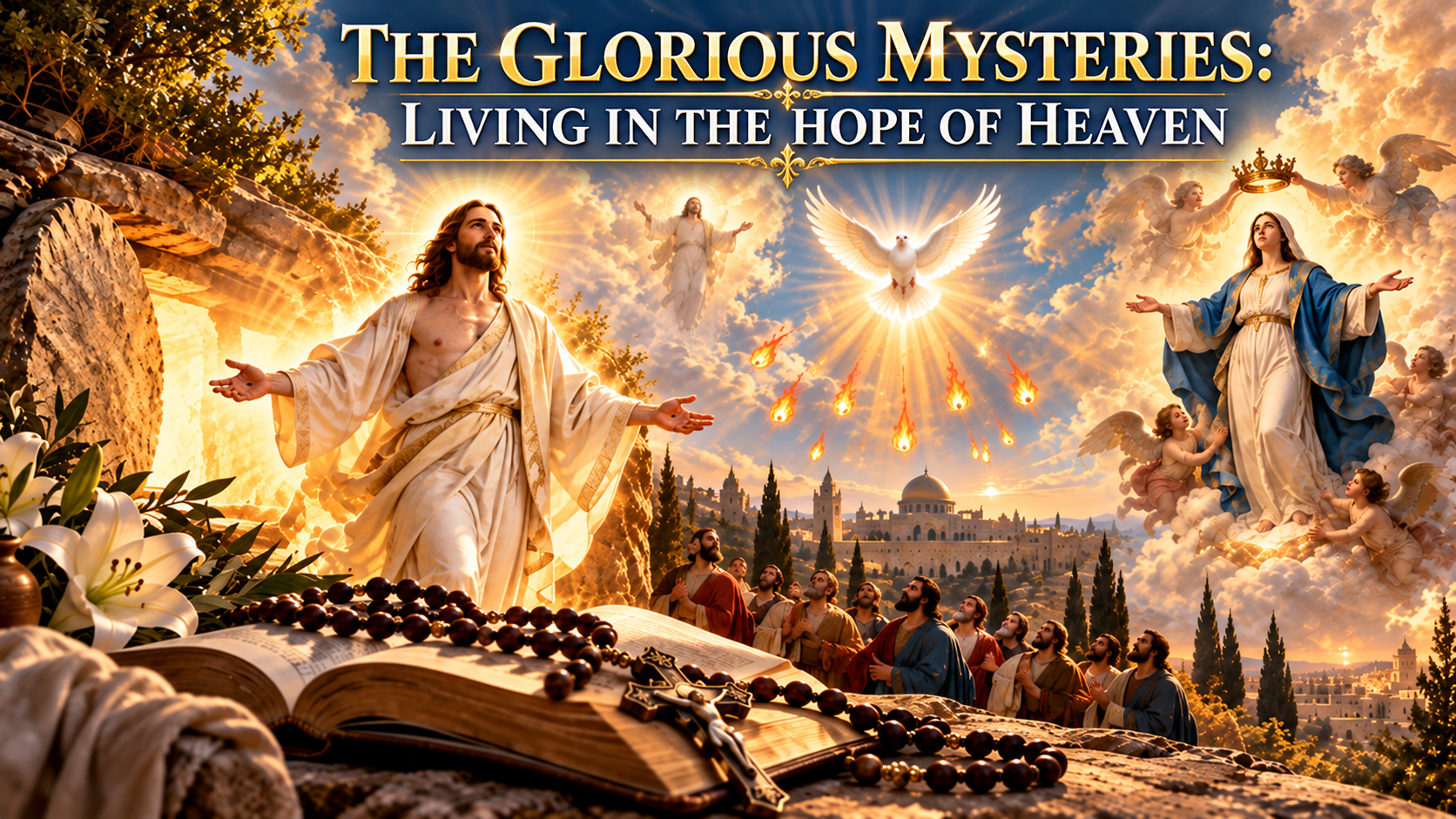
The Glorious Mysteries move from the empty tomb to the exalted Lord, the gift of the Holy Ghost, and the heavenly destiny displayed in Mary. They teach the Church to live between Christ’s victory already accomplished and the final fulfillment still awaited.
Hope in heaven is not an excuse to neglect earth. It makes our earthly choices matter more: love is not wasted, fidelity is not futile, and suffering endured in union with Christ is not meaningless.
The Glorious Mysteries invite us to lift our eyes toward heaven without turning our hearts away from the responsibilities of this life.
They remind us that the Christian life is not merely about surviving the present world. It is about preparing for eternal communion with God.
First Glorious Mystery: The Resurrection
Read: Luke 24:1–12; John 20:1–29
Contemplate: The crucified Jesus truly lives.
Ask For: Faith and hope.
The women come expecting a tomb and receive the announcement of life. The disciples struggle to comprehend what God has done. The risen Christ is not simply a memory cherished by His followers; He encounters them, speaks, and bears the wounds of His Passion.
The Resurrection vindicates Jesus’ identity and inaugurates the new creation. It also changes the meaning of death for those united to Him.
The Catechism teaches that the Resurrection confirms the truth of Christ’s divinity and fulfills the promises of both the Old Testament and Jesus Himself (CCC 651–653).
This is why St. Paul declares that without Christ’s Resurrection, our preaching and faith would be vain (1 Corinthians 15:14).
Christian hope is not vague optimism. It rests upon God’s definitive action in history.
Carry It Into Life: Bring one seemingly hopeless situation before the risen Christ. Ask Him for the grace to persevere, and take one faithful step rather than yielding to despair.
Second Glorious Mystery: The Ascension
Read: Luke 24:50–53; Acts 1:6–11
Contemplate: The exalted Lord reigns and intercedes for His people.
Ask For: Hope of heaven and perseverance in mission.
The Ascension is not Jesus abandoning His disciples or traveling beyond God’s reach. His glorified humanity enters the heavenly glory of the Father.
The One who shares our human nature now reigns as Lord and continues to act for His Church (CCC 659–667).
Christ’s Ascension reveals something extraordinary about our destiny: human nature, united to the divine Person of the Son, has entered heavenly glory.
The angels’ words in Acts call the apostles away from merely staring toward heaven. They have a mission.
The Lord’s exaltation does not bring the Church’s earthly work to an end. It sends His disciples into the world as witnesses of His saving truth.
We are called to live with our hearts directed toward heaven and our hands committed to the work of charity, evangelization, and holiness.
Carry It Into Life: Ask whether your hope of heaven is making you more faithful to your earthly responsibilities, relationships, and duties.
Third Glorious Mystery: The Descent of the Holy Ghost
Read: Acts 2:1–13; John 14:15–26
Contemplate: The risen Christ pours out the Holy Ghost upon His Church.
Ask For: Courage, wisdom, and apostolic charity.
At Pentecost, the fearful community is strengthened for proclamation.
The apostles speak, and people of many nations hear the mighty works of God. What began with a small gathering of disciples becomes the Church’s public proclamation of the Gospel.
The Holy Ghost does not merely produce a private religious feeling. He forms, sanctifies, unites, and sends the Church.
Mary is present among the disciples in prayer before Pentecost (Acts 1:14).
Her presence reveals a beautiful continuity between the Incarnation and the Church’s mission.
The Holy Ghost who overshadowed Mary at the Annunciation now empowers the Church, the Mystical Body of Christ, to bear witness to her divine Head.
The gifts of the Holy Ghost are ordered toward holiness, communion, and service—not spiritual self-display.
The same Spirit who strengthened the apostles continues to work in the Church through grace, the sacraments, and the lives of the faithful (CCC 731–741).
Carry It Into Life: Pray for the gifts of the Holy Ghost. Ask for the courage to share your faith, then offer one sincere word or act of Christian witness.
Fourth Glorious Mystery: The Assumption of the Blessed Virgin Mary
Read: 1 Corinthians 15:20–28, 51–57; Revelation 12:1–6
Contemplate: The grace of Christ points His people toward bodily resurrection and heavenly glory.
Ask For: Hope and holy perseverance.
The Church solemnly teaches that Mary, at the completion of her earthly life, was assumed body and soul into heavenly glory (CCC 966).
Pope Pius XII defined this dogma in Munificentissimus Deus on November 1, 1950.
The New Testament does not give us a direct narrative of Mary’s Assumption in the way the Gospels narrate Christ’s Resurrection.
Rather, the Church understands Mary’s heavenly glorification through Sacred Tradition and Scripture interpreted in the light of the Church’s faith.
Biblical passages concerning victory over death, the promised resurrection, and the woman clothed with the sun contribute to theological reflection on Mary’s glorification. Revelation 12, however, should not be treated as an explicit historical account of the Assumption.
Mary’s Assumption is not equal to Christ’s Ascension.
Christ ascends into heaven by His own divine power. Mary is assumed into heavenly glory by God’s grace, through the saving merits of her Son.
Her Assumption reveals the transforming power of Christ’s redemption and anticipates the resurrection promised to His faithful people.
In Mary, we contemplate the glorious destiny toward which Christ calls His Church (Vatican II, Lumen Gentium, 68).
Carry It Into Life: Treat your body and the bodies of others with reverence and dignity, remembering that Christianity proclaims not merely the immortality of the soul, but the resurrection of the body.
Fifth Glorious Mystery: The Coronation of the Blessed Virgin Mary
Read: Revelation 12:1; Luke 1:32–33, 46–55; 1 Kings 2:19
Contemplate: The Mother of the Messiah shares in His victory as a creature wholly dependent upon divine grace.
Ask For: Perseverance and heavenly joy.
Catholics honor Mary as Queen because she is the Mother of Jesus Christ, the King whose kingdom will have no end.
Her queenship is entirely subordinate to Christ’s universal kingship. It reveals the triumph of His grace in a redeemed human life.
Scriptural images of the queen mother in the Davidic kingdom and the woman clothed with the sun contribute to Catholic reflection on Mary’s queenship.
These connections should be understood through biblical typology and theological interpretation, rather than as verse-by-verse historical descriptions of a heavenly coronation.
Mary’s royal dignity never places her on the same level as God.
Everything she possesses comes from Him.
Pope Pius XII’s encyclical Ad Caeli Reginam (1954) explains the theological foundations of Mary’s queenship, especially her divine motherhood and unique cooperation in the work of redemption.
The Church’s faith in Mary’s heavenly glory directs us toward the communion of saints and the final worship of God.
In heaven, the saints do not compete with Christ for glory. They rejoice eternally in His presence.
Mary’s queenship reminds us that true greatness is found not in worldly domination, but in humble fidelity to God’s will.
Carry It Into Life: Pray for the faithful departed, and ask God to transform your desire for worldly recognition into a sincere longing for holiness.
Heaven Changes the Present
The Glorious Mysteries proclaim that our lives are not closed circles between birth and death.
Christ has risen.
He reigns in glory.
The Holy Ghost animates His Church.
And the grace of God is powerful enough to bring redeemed humanity into eternal glory.
Because heaven is real, works of mercy matter.
Because the body will rise, human dignity matters.
Because Christ is King, our loyalties matter.
Because the Holy Ghost has been poured out upon the Church, we are not left to pursue holiness by our own strength.
And because Christ has conquered death, the Christian can face the future with a hope that transcends even the grave.
This does not mean suffering disappears, that faithful Christians never experience sorrow, or that the path to holiness becomes easy.
It means that suffering and death do not have the final word.
The final word belongs to Jesus Christ, who is risen and who promises eternal life to those who remain united to Him.
The Glorious Mysteries teach us to live for heaven by becoming more faithful to Christ here on earth.
Questions for Personal Reflection
- Do I live as though Christ’s Resurrection is a historical reality that should change my daily decisions?
- How does Mary’s Assumption deepen my understanding of the dignity of the human body and the Christian hope of resurrection?
- What is the Holy Ghost calling me to do for the Church, my family, and the world?
- Is my desire for heaven inspiring greater charity, humility, and perseverance in my present life?
- What earthly attachment might be preventing me from seeking holiness more wholeheartedly?
CatholicG33k Challenge: Live as a Person of the Resurrection
During your next Rosary, contemplate each of the five Glorious Mysteries with one intention:
- The Resurrection: Renew your faith in Christ’s victory over death.
- The Ascension: Offer your earthly responsibilities to the Lord who reigns in heaven.
- Pentecost: Ask the Holy Ghost to strengthen your witness.
- The Assumption: Renew your hope in the resurrection of the body.
- The Coronation: Ask for the humility and perseverance needed to seek eternal life.
At the end of your Rosary, choose one concrete act of charity that reflects the hope you have contemplated.
Let the mysteries become more than subjects of meditation.
Let them shape the way you live.
Closing Prayer
Risen Lord Jesus Christ,
Strengthen my faith in Your victory over sin and death.
Lift my heart toward heaven without withdrawing it from the needs of my neighbor.
Teach me to live with the hope of the Resurrection, the courage of Your apostles, and the humility of Your Blessed Mother.
Through the power of the Holy Ghost, strengthen me in charity, perseverance, and fidelity to Your holy will.
Through the intercession of the Blessed Virgin Mary, help me remain faithful through the trials of this earthly pilgrimage.
May I never lose sight of the eternal life You have promised to those who love You.
Keep me in Your grace until the day I behold You in glory.
Amen.
Our Lady, Queen of Heaven, pray for us.
Sources for Further Study
Sacred Scripture (Douay-Rheims)
- Luke 24:1–53 — The Resurrection and Ascension of Christ
- John 20:1–29 — Appearances of the Risen Lord
- Acts 1:1–14 — The Ascension and the Apostles at Prayer
- Acts 2:1–13 — Pentecost
- 1 Corinthians 15:12–57 — Christ’s Resurrection and Our Future Resurrection
- Revelation 12:1–6 — The Woman Clothed with the Sun
- Luke 1:26–55 — The Annunciation, Visitation, and Magnificat
Catechism of the Catholic Church
- CCC 638–655 — The Resurrection of Jesus Christ
- CCC 659–667 — The Ascension
- CCC 683–747 — The Holy Ghost and the Church
- CCC 966 — The Assumption of the Blessed Virgin Mary
- CCC 971 — Devotion to the Blessed Virgin
- CCC 988–1019 — The Resurrection of the Body and Christian Death
Magisterial Documents
- Pope Pius XII, Munificentissimus Deus (1950)
- Pope Pius XII, Ad Caeli Reginam (1954)
- Second Vatican Council, Lumen Gentium, 59, 68–69
- Pope St. John Paul II, Rosarium Virginis Mariae, 23
CatholicG33k | The Rosary, Rediscovered
Leave a Reply