

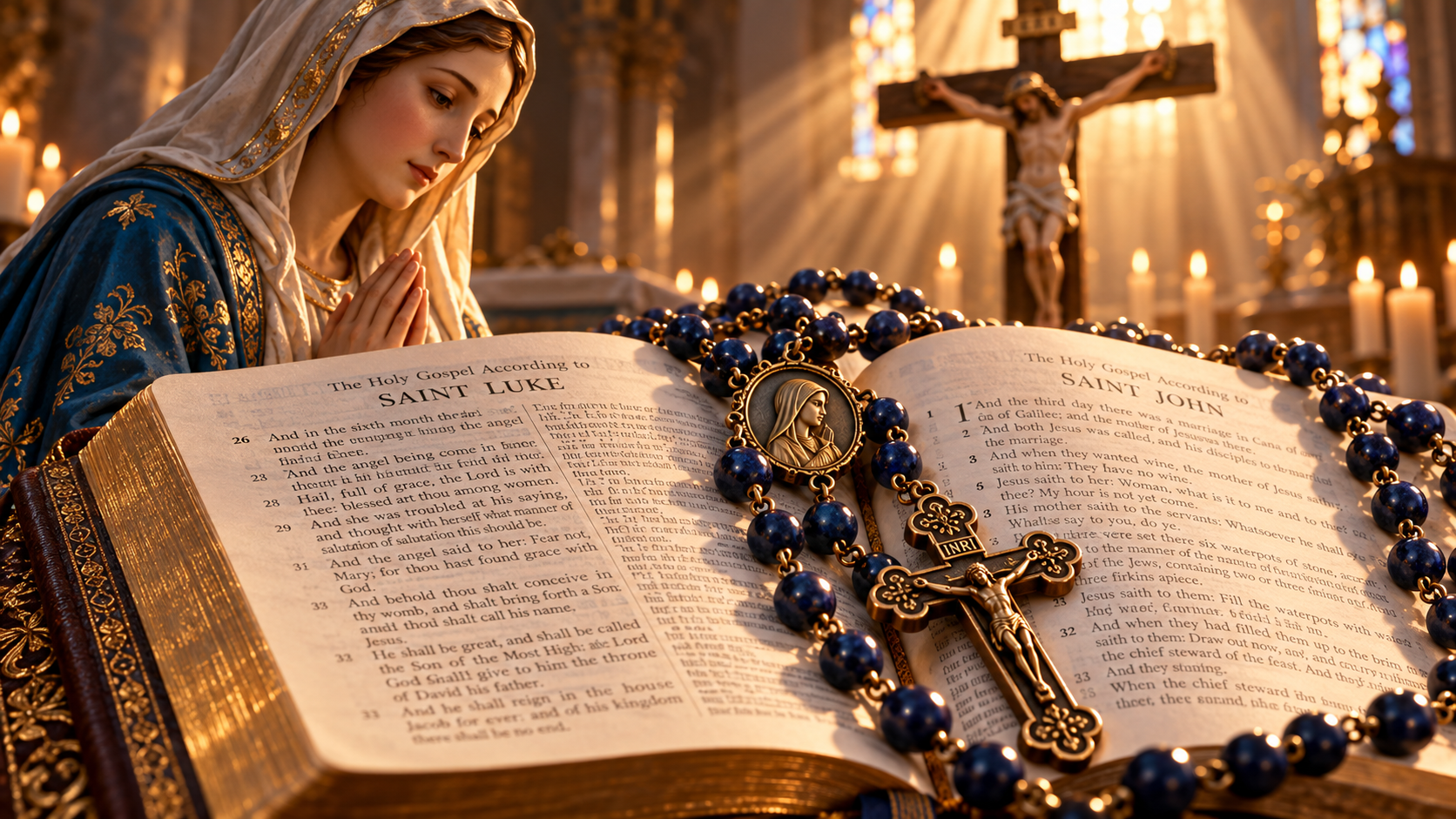
The Rosary, Rediscovered — Article 12 of 12
Discover how to pray the Rosary with Sacred Scripture, meditate upon all twenty mysteries of Jesus Christ, and transform familiar prayers into a deeper encounter with the Word of God through the example and intercession of the Blessed Virgin Mary.
Scripture for Meditation: Luke 2:19; John 2:5; 2 Timothy 3:14–17
What if the Rosary became more than a familiar sequence of prayers?
What if every mystery led us directly into Sacred Scripture, where we could encounter the words and saving deeds of Jesus Christ?
For many Catholics, the Rosary is among the most treasured devotions of the Church.
We know its prayers.
We recognize its beads.
We remember the names of its mysteries.
But familiarity with the Rosary does not always mean that we understand the biblical events upon which its mysteries are founded.
A person might pray the Annunciation for years without carefully reading Luke’s account of Gabriel’s message to Mary.
Another might meditate upon the Institution of the Eucharist without reflecting upon Christ’s words at the Last Supper.
Still another might contemplate the Crucifixion without returning to the Gospel accounts of Calvary.
The Rosary is profoundly rooted in the Gospel.
But its biblical character becomes more apparent when we deliberately place Sacred Scripture at the center of our meditation.
This is the purpose of the Scriptural Rosary.
It is not a new sacrament, a replacement for traditional Catholic prayer, or a complicated technique reserved for spiritually advanced Catholics.
It is a simple way of allowing the inspired Word of God to guide our contemplation of Jesus Christ.
And in doing so, it helps us imitate the Blessed Virgin Mary, who treasured the mysteries of her Son and pondered them in her heart.
A Rosary Shaped by Divine Revelation
The Rosary is often described as a Christ-centered Marian prayer.
That description is important.
Although the Hail Mary is repeated throughout the devotion, the mysteries we contemplate concern the saving life and mission of Jesus Christ.
We meditate upon His Incarnation.
We consider His public ministry.
We accompany Him through His Passion.
We proclaim His Resurrection and Ascension.
We contemplate the coming of the Holy Spirit and the heavenly glory promised to those who remain faithful to Christ.
The Rosary is therefore not meant to distract us from the Gospel.
It is intended to lead us more deeply into it.
Yet this connection can become obscured when the prayers are separated from their biblical foundation.
We may know that the third Joyful Mystery is the Nativity without understanding why the circumstances of Christ’s birth reveal the humility of the Incarnation.
We may know that the fourth Luminous Mystery is the Transfiguration without remembering the Father’s command to listen to His beloved Son.
We may know that the first Sorrowful Mystery is the Agony in the Garden without reflecting upon the obedience of Christ’s human will.
Sacred Scripture restores the substance of these mysteries to our attention.
Instead of relying entirely upon vague recollections or familiar religious imagery, we return to the inspired accounts through which God has revealed His saving work.
St. Paul reminds Timothy of the importance of Scripture:
“All scripture, inspired of God, is profitable to teach, to reprove, to correct, to instruct in justice.”
— 2 Timothy 3:16, Douay-Rheims
Sacred Scripture does more than provide religious information.
Through the grace of God, it teaches, corrects, forms, and directs the believer toward holiness.
When we incorporate Scripture into the Rosary, we allow the Word of God to nourish our meditation.
The goal is not simply to learn more facts about biblical history.
It is to know Jesus Christ more deeply and respond to Him more faithfully.
Mary: The Model of Prayerful Attention to Scripture
The Blessed Virgin Mary provides the perfect human example of receptive attention to the Word of God.
At the Annunciation, she listens to the message of the angel Gabriel.
She asks a question seeking understanding.
Then she responds with faith.
Her consent is an act of obedience to the divine Word.
Later, after the birth of Jesus and the visit of the shepherds, St. Luke records:
“But Mary kept all these words, pondering them in her heart.”
— Luke 2:19, Douay-Rheims
This description reveals something essential about Mary’s spiritual life.
She did not treat the events surrounding Jesus as isolated religious experiences.
She treasured them.
She reflected upon them.
She continued to receive their meaning through faith.
The same pattern appears after the Finding of Jesus in the Temple.
St. Luke again tells us that Mary kept these things in her heart (Luke 2:51).
This is the disposition that the Rosary seeks to cultivate.
We return to the mysteries of Christ because their spiritual significance cannot be exhausted through a single reading or meditation.
The Incarnation remains worthy of contemplation.
The Cross continues to reveal the depths of divine mercy.
The Resurrection remains the foundation of Christian hope.
The more faithfully we return to these truths, the more deeply they can shape our understanding and conduct.
Mary also teaches us that genuine devotion always leads toward obedience to Jesus.
At Cana, she tells the servants:
“Whatsoever he shall say to you, do ye.”
— John 2:5, Douay-Rheims
These words provide a guiding principle for the Scriptural Rosary.
We read the Gospel.
We contemplate Christ.
We listen to His Word.
And we seek the grace to obey Him.
Prayer becomes fruitful when the truth received in contemplation begins to transform the way we live.
Scripture Must Be Read Within the Faith of the Church
A Scriptural Rosary is not simply an exercise in private biblical interpretation.
Catholics receive Sacred Scripture as the inspired Word of God entrusted to the Church.
The Bible must therefore be interpreted according to the faith through which the Church has received and transmitted it.
The Catechism of the Catholic Church provides important principles for understanding Scripture in CCC 111–114.
These include attention to the unity of the whole of Scripture, the living Tradition of the Church, and the analogy of faith.
This matters because individual passages cannot always be understood correctly when isolated from the broader revelation of God.
The Old Testament prepares for the coming of Christ.
The New Testament reveals the fulfillment of God’s promises in Him.
The Church reads the whole of Scripture in the light of Jesus Christ, the definitive revelation of the Father.
This approach is especially important when considering certain Marian mysteries.
The Annunciation, Visitation, Nativity, Presentation, and Finding in the Temple are directly narrated in the Gospels.
The Resurrection, Ascension, and Pentecost are likewise proclaimed in explicit New Testament accounts.
However, the Assumption and Coronation of Mary require a different kind of explanation.
The Church teaches the Assumption as a divinely revealed dogma. Its scriptural foundations are understood within Sacred Tradition and the Church’s authoritative interpretation, rather than through a biblical narrative directly describing the event.
Likewise, Mary’s heavenly queenship is understood in relation to the kingship of Christ and the Church’s theological reflection upon Scripture and Tradition.
A responsible Catholic guide should acknowledge these distinctions.
We should neither reduce Catholic doctrine to isolated proof texts nor pretend that Scripture directly narrates events it does not explicitly describe.
Faithful Catholic interpretation welcomes the full relationship between Scripture, Tradition, and the Church’s teaching authority.
That relationship enriches our understanding rather than diminishing it.
What Is a Scriptural Rosary?
A Scriptural Rosary is a form of Rosary devotion in which passages from Sacred Scripture are incorporated into the meditation.
The simplest approach is to read a short Gospel passage before announcing or beginning each decade.
Some Catholics prefer to read one verse before each Hail Mary.
Others read the full biblical passage connected with a mystery and then pray the decade while reflecting upon what they have read.
These approaches share the same basic purpose.
They place the Word of God before the mind and heart so that the prayers are directed toward the saving mysteries of Christ.
Pope St. John Paul II recommends the proclamation of a suitable biblical passage after the announcement of each mystery in Rosarium Virginis Mariae, paragraph 30.
He explains that this practice helps give a biblical foundation and greater depth to the meditation.
This recommendation is especially useful because it preserves the familiar structure of the Rosary while enriching its contemplative character.
The purpose is not to turn prayer into a biblical examination.
Nor should we feel obligated to master every historical or theological detail before praying.
Scripture is given to nourish faith.
A few verses read attentively may be more fruitful than an entire chapter read without reflection.
The goal is to allow the Word of God to shape our contemplation.
How to Pray a Scriptural Rosary
The Scriptural Rosary does not require an entirely new method of prayer.
Its familiar structure remains intact.
The following approach can be used individually, within a family, or in a parish prayer group.
Before Beginning
Choose one set of five mysteries.
If time is limited, begin with a single mystery and one decade.
Have a Bible available, preferably a Catholic edition.
You may also use a prepared list of Scripture references.
Begin with the Sign of the Cross.
Pray the customary opening prayers, which commonly include the Apostles’ Creed, one Our Father, three Hail Marys, and a Glory Be.
Then proceed to the first mystery.
For Each Decade
1. Announce the Mystery
Clearly name the mystery being contemplated.
For example:
The First Joyful Mystery: The Annunciation of Our Lord.
Allow a moment for the mystery to enter your attention.
2. Read the Corresponding Scripture Passage
Read the selected passage slowly.
Consider what the inspired text reveals about Jesus Christ.
Notice the actions, words, and responses of those involved.
Do not rush immediately into interpretation.
First receive what Scripture actually says.
3. Ask for a Particular Grace
Offer a short petition connected with the mystery.
For the Annunciation, ask for humility and trusting obedience.
For the Crucifixion, ask for repentance and deeper love of Christ.
For Pentecost, ask for courage and openness to the Holy Spirit.
This helps direct meditation toward conversion.
4. Pray the Our Father
Offer the prayer taught by Jesus Christ.
Remember that every Christian prayer ultimately depends upon our relationship with the Father through the Son in the Holy Spirit.
5. Pray Ten Hail Marys
As you pray, return your attention to the Gospel event.
You may recall a particular verse, reflect upon one action of Christ, or meditate upon a truth revealed in the passage.
Allow the name of Jesus to become a point of renewed attention.
When distractions arise, return gently to the mystery.
6. Pray the Glory Be
Conclude the decade by praising the Most Holy Trinity.
Where customary, the Fatima prayer may also be added.
7. Pause for Silent Reflection
Remain silent briefly.
Ask what the mystery teaches you about Christ and how it calls you to respond.
The pause need not be lengthy.
Even thirty seconds of attentive silence can help bring the meditation into daily life.
Concluding the Rosary
After completing the chosen mysteries, conclude with the customary prayers, such as the Hail Holy Queen and the concluding Rosary prayer.
The Scripture readings enrich the devotion.
They do not replace its traditional prayers.
The goal is not to create a more complicated Rosary, but a more attentive one.
A Biblical Guide to All Twenty Mysteries of the Rosary
The following guide provides Scripture references, themes for contemplation, and prayer intentions for all twenty mysteries.
The references are intended to support personal meditation, family prayer, and parish devotion.
For mysteries directly narrated in Sacred Scripture, the corresponding Gospel or New Testament passage is provided.
For mysteries whose doctrinal foundation involves Sacred Tradition and the Church’s authoritative teaching, that distinction is explained.
The Joyful Mysteries
The Joyful Mysteries lead us into the Incarnation and the early life of Jesus Christ.
They reveal how the eternal Son of God entered human history and how faith, obedience, humility, and charity shaped the lives of Mary and Joseph.
1. The Annunciation
Scripture: Luke 1:26–38
Contemplate: The angel Gabriel announces that Mary will conceive the Son of God through the power of the Holy Ghost.
Grace to Seek: Humility and trusting obedience.
God takes the initiative in salvation.
Mary receives His message and freely responds.
Her consent reveals the faith of someone who trusts God’s will without possessing complete knowledge of the future.
The Annunciation invites us to examine whether we are willing to obey God when His will disrupts our plans.
Prayer intention: Lord, grant me the grace to respond faithfully to Your call.
2. The Visitation
Scripture: Luke 1:39–56
Contemplate: Mary carries Christ to Elizabeth and responds to God’s blessings with praise and charity.
Grace to Seek: Love of neighbor and joyful humility.
Mary does not treat her extraordinary vocation as a reason to withdraw from the needs of others.
She goes to Elizabeth.
Her presence brings joy, and her Magnificat directs all praise toward God.
The mystery reminds us that authentic devotion should lead to practical charity.
Prayer intention: Lord, teach me to serve others generously and without seeking recognition.
3. The Nativity
Scripture: Luke 2:1–20
Contemplate: The eternal Son of God enters the world in the humility and vulnerability of human infancy.
Grace to Seek: Poverty of spirit and reverence for human life.
The Savior is born in humble circumstances.
The Creator accepts a true human nature.
The Nativity reveals that the dignity of human life does not depend upon wealth, strength, or social status.
It also teaches us to recognize God’s presence in ordinary circumstances.
Prayer intention: Lord, make my heart humble and grateful for the gift of Your Incarnation.
4. The Presentation in the Temple
Scripture: Luke 2:22–40
Contemplate: Mary and Joseph present Jesus in the Temple, where Simeon recognizes the promised salvation and foretells suffering.
Grace to Seek: Faithfulness and perseverance.
Simeon and Anna embody patient hope.
They have awaited the fulfillment of God’s promises.
The prophecy of suffering reminds us that Christian joy is not separated from the Cross.
The mystery calls us to remain faithful even when God’s plan includes difficulties we do not understand.
Prayer intention: Lord, strengthen my faithfulness in times of joy and sorrow.
5. The Finding of Jesus in the Temple
Scripture: Luke 2:41–52
Contemplate: Jesus reveals His unique relationship with the Father while living within the obedience of family life.
Grace to Seek: Wisdom and perseverance in seeking Christ.
Mary and Joseph search anxiously for Jesus.
They find Him in the Temple, where His words reveal the priority of His Father’s mission.
Yet He returns to Nazareth and remains obedient to them.
The mystery teaches us to seek Christ above all things while faithfully fulfilling our daily responsibilities.
Prayer intention: Lord, help me seek You before every lesser good.
The Luminous Mysteries
The Luminous Mysteries reveal the public ministry of Jesus Christ.
They invite us to contemplate His divine identity, His teaching, His call to repentance, and His sacramental gift of Himself in the Eucharist.
1. The Baptism of Jesus in the Jordan
Scripture: Matthew 3:13–17
Contemplate: The Father reveals His beloved Son as the Holy Spirit descends upon Him.
Grace to Seek: Fidelity to baptismal grace.
Jesus enters the Jordan without needing repentance.
His Baptism marks the beginning of His public ministry and manifests the Trinitarian character of His mission.
Through our own sacramental Baptism, we are united to Christ and called to live as children of God.
Prayer intention: Lord, renew my desire to live according to my baptismal promises.
2. The Wedding at Cana
Scripture: John 2:1–11
Contemplate: Mary intercedes, Christ manifests His glory, and the servants respond with obedience.
Grace to Seek: Trust in Jesus Christ.
Mary recognizes a human need and brings it to Jesus.
She then directs the servants to obey Him.
The miracle reveals Christ’s divine power and calls forth faith in His disciples.
The mystery teaches us that authentic Marian devotion always leads toward obedience to Christ.
Prayer intention: Lord, teach me to trust Your wisdom and obey Your Word.
3. The Proclamation of the Kingdom
Scripture: Mark 1:14–15; Luke 4:16–21
Contemplate: Jesus announces the Kingdom of God and calls sinners to repentance and faith.
Grace to Seek: Conversion of heart.
Christ proclaims the arrival of God’s Kingdom.
His message is both a gift and a summons.
We are called to repent, believe the Gospel, and order our lives according to divine truth.
The mystery challenges us to move beyond merely admiring Jesus toward genuinely following Him.
Prayer intention: Lord, grant me sincere repentance and a deeper love for Your Gospel.
4. The Transfiguration
Scripture: Matthew 17:1–8
Contemplate: Jesus reveals His glory before Peter, James, and John, and the Father commands the disciples to listen to Him.
Grace to Seek: Courage and obedience.
The Transfiguration reveals the glory of Christ and strengthens the disciples for the suffering that lies ahead.
The Father’s command to hear His beloved Son applies to every Christian.
Faithfulness requires listening to Christ even when His teaching challenges our preferences.
Prayer intention: Lord, give me courage to follow You through every difficulty.
5. The Institution of the Eucharist
Scripture: Luke 22:14–20; 1 Corinthians 11:23–29
Contemplate: Jesus gives His Body and Blood under the appearances of bread and wine.
Grace to Seek: Eucharistic faith, reverence, and gratitude.
At the Last Supper, Christ institutes the Holy Eucharist.
The Church confesses His true, real, and substantial presence in this sacrament.
The Eucharist is the source and summit of Christian life (CCC 1324).
The mystery calls us to greater reverence for the Holy Mass, worthy reception of Communion, and sacrificial charity.
Prayer intention: Lord, deepen my love for Your Real Presence in the Holy Eucharist.
The Sorrowful Mysteries
The Sorrowful Mysteries bring us into the Passion and Death of Jesus Christ.
They reveal the seriousness of sin and the greatness of the love through which humanity has been redeemed.
1. The Agony in the Garden
Scripture: Matthew 26:36–46
Contemplate: Christ freely submits His human will to the Father’s saving plan.
Grace to Seek: Trust amid fear and suffering.
Jesus experiences profound anguish in Gethsemane.
He does not pretend that suffering is pleasant.
Yet He freely embraces the Father’s will.
The mystery teaches us that surrender does not require emotional indifference.
We may bring our fears honestly before God while asking for the grace to remain faithful.
Prayer intention: Lord, teach me to trust Your will even when obedience is difficult.
2. The Scourging at the Pillar
Scripture: John 19:1
Contemplate: The innocent Christ suffers human cruelty and violence.
Grace to Seek: Purity of heart and compassion.
The scourging reveals the brutality of human sin.
Christ’s dignity remains undiminished by the violence inflicted upon Him.
The mystery calls us to repentance and greater respect for every human person.
It should also make us attentive to those who suffer injustice or abuse.
Prayer intention: Lord, purify my heart and teach me to defend the dignity of others.
3. The Crowning with Thorns
Scripture: Matthew 27:27–31
Contemplate: The true King is mocked and humiliated.
Grace to Seek: Humility and freedom from pride.
The soldiers ridicule Christ’s kingship.
Yet the mocked prisoner is the eternal Son of God.
His true authority does not depend upon earthly recognition.
The mystery challenges our attachment to status, admiration, and personal prestige.
Prayer intention: Lord, free me from pride and teach me the humility of Your Sacred Heart.
4. The Carrying of the Cross
Scripture: Luke 23:26–32; John 19:16–17
Contemplate: Jesus carries His Cross toward Calvary in sacrificial love.
Grace to Seek: Perseverance and charity.
Christ accepts the suffering involved in His saving mission.
Simon of Cyrene is compelled to help carry the Cross.
The mystery reminds us that discipleship requires sacrifice, but also that we are called to help bear the burdens of others.
Prayer intention: Lord, strengthen me to carry my responsibilities faithfully and to assist those who suffer.
5. The Crucifixion and Death of Our Lord
Scripture: John 19:25–37
Contemplate: Jesus Christ freely offers Himself for the redemption of humanity.
Grace to Seek: Repentance, forgiveness, and love of God.
At Calvary, the Son of God gives His life for sinners.
His sacrifice is unique, complete, and sufficient.
Mary stands faithfully beneath the Cross.
The mystery reveals divine mercy and calls us to respond through repentance, gratitude, forgiveness, and charity.
Prayer intention: Lord, deepen my love for You and grant me the grace of final perseverance.
The Glorious Mysteries
The Glorious Mysteries proclaim Christ’s victory over sin and death and direct our attention toward the eternal life promised to those who remain faithful to Him.
They remind us that the Cross is not the end of the Christian story.
The risen Lord reigns, the Holy Spirit sanctifies His Church, and the faithful are called to share in heavenly glory.
1. The Resurrection of Jesus Christ
Scripture: Luke 24:1–12; John 20:1–29
Contemplate: The crucified Lord has risen from the dead.
Grace to Seek: Faith and hope.
The Resurrection is the foundation of Christian faith.
Christ’s victory is not merely a symbol of optimism or renewal.
He has truly risen.
Death no longer has dominion over Him.
The mystery invites us to live with confidence in His victory and in the promise of our own resurrection.
Prayer intention: Lord, strengthen my faith in Your Resurrection and my hope of eternal life.
2. The Ascension of Our Lord
Scripture: Acts 1:6–11
Contemplate: The risen Christ ascends into heaven and sends His disciples to continue His mission.
Grace to Seek: Desire for heaven and zeal for the Gospel.
The Ascension reveals the exaltation of Christ and the fulfillment of His earthly mission.
He does not abandon His Church.
He continues to reign as Lord and remains present to His people according to His promises.
The mystery reminds us that our ultimate homeland is heaven and that we are called to bear witness to the Gospel.
Prayer intention: Lord, direct my heart toward heaven and strengthen my desire to proclaim Your truth.
3. The Descent of the Holy Spirit at Pentecost
Scripture: Acts 2:1–13
Contemplate: The Holy Spirit descends upon the disciples and empowers the Church for her mission.
Grace to Seek: Courage and openness to the Holy Spirit.
At Pentecost, the Apostles receive the promised gift of the Holy Spirit.
Their fear gives way to bold proclamation.
The Church is empowered to announce Jesus Christ to the nations.
The mystery calls us to cooperate with the gifts of the Holy Spirit and witness faithfully to the Gospel.
Prayer intention: Holy Spirit, strengthen my faith and give me courage to live and proclaim the truth.
4. The Assumption of the Blessed Virgin Mary
Scripture for Theological Meditation: 1 Corinthians 15:20–28, 51–57
Contemplate: Mary’s bodily glorification as a sign of the resurrection promised through Jesus Christ.
Grace to Seek: Perseverance and hope of resurrection.
The Catholic Church teaches that the Blessed Virgin Mary, having completed the course of her earthly life, was assumed body and soul into heavenly glory.
This doctrine was solemnly defined by Pope Pius XII in Munificentissimus Deus (1950).
The Assumption is not directly narrated in Sacred Scripture.
The passage from First Corinthians does not describe Mary’s Assumption.
Rather, it proclaims Christ’s victory over death and the resurrection promised to those who belong to Him.
The Church understands Mary’s Assumption within the fullness of divine revelation transmitted through Scripture and Sacred Tradition.
As the Mother of God, Mary has been glorified through the saving merits of her Son.
Her Assumption is a sign of the destiny promised to the redeemed.
It directs our attention toward Christ’s victory and the hope of bodily resurrection.
The Catechism affirms the doctrine in CCC 966.
Prayer intention: Lord, strengthen my hope in the resurrection of the body and the life of the world to come.
5. The Coronation of Mary as Queen of Heaven and Earth
Scripture for Theological Meditation: Luke 1:32–33; Revelation 12:1
Contemplate: Mary’s heavenly queenship in relation to the eternal kingship of Jesus Christ.
Grace to Seek: Final perseverance and the joy of heaven.
Catholic devotion honors the Blessed Virgin Mary as Queen of Heaven and Earth.
Her queenship is inseparable from that of her Son.
Jesus Christ is the eternal King.
Mary’s dignity and heavenly glory are gifts of divine grace received through His saving work.
The biblical passages associated with this mystery require careful interpretation.
Luke 1:32–33 proclaims the everlasting kingship of Jesus Christ.
Revelation 12:1 presents the great sign of a woman clothed with the sun and crowned with twelve stars.
Within Catholic interpretation, this woman has been understood in relation to Israel, the Church, and the Blessed Virgin Mary.
These passages contribute to the Church’s theological and typological reflection.
They do not directly narrate an event in which Mary is crowned in heaven.
The doctrine of Mary’s heavenly queenship is understood through Scripture as interpreted within Sacred Tradition and the teaching of the Church.
The Catechism describes Mary as exalted by the Lord as Queen over all things (CCC 966).
Her glory does not compete with Christ’s kingship.
It manifests the grace and victory of her Son.
The Coronation directs our attention toward the eternal glory prepared for those who persevere in Christ.
Prayer intention: Lord, grant me final perseverance and lead me into the joy of Your heavenly Kingdom.
An Example: Praying the First Joyful Mystery With Scripture
Having considered the twenty mysteries, we can now bring the method into practice.
The Annunciation provides an excellent starting point because it reveals the relationship between divine grace and the faithful response of Mary.
Mystery: The First Joyful Mystery — The Annunciation
Scripture: Luke 1:26–38
Grace to Seek: Humility and trusting obedience.
Begin by reading the Gospel passage slowly.
Consider the angel Gabriel entering the ordinary circumstances of Mary’s life.
Notice the message, Mary’s question, the angel’s explanation, and her response.
Then ask:
Lord, where are You calling me to greater obedience?
Pray the Our Father.
As you continue through the ten Hail Marys, use the following reflections to keep your attention focused upon the mystery.
These are original meditation prompts inspired by Scripture. They are not additional official prayers and do not replace the words of the Hail Mary.
Ten Reflections for the Ten Hail Marys
First Hail Mary: God’s Initiative
God begins the work of salvation through His grace.
Before Mary responds, the Lord has already acted.
Consider how every movement toward holiness begins with divine grace.
Second Hail Mary: The Humility of Nazareth
The angel comes to an ordinary village.
God chooses a setting far removed from worldly prestige.
Reflect upon how divine grace can transform ordinary circumstances.
Third Hail Mary: A Unique Vocation
Mary is called to become the Mother of the Savior.
Her vocation is extraordinary, but it is received rather than invented.
Ask whether you are attentive to the responsibilities God has entrusted to you.
Fourth Hail Mary: Full of Grace
Gabriel’s greeting reveals the abundance of God’s grace.
Mary’s holiness is entirely dependent upon the saving merits of Jesus Christ.
Thank God for the grace He offers to every believer.
Fifth Hail Mary: Mary’s Question
Mary asks how the angel’s message will be fulfilled.
Her question seeks understanding rather than expressing unbelief.
Ask for the grace to seek truth with humility.
Sixth Hail Mary: The Power of the Holy Spirit
The angel explains that the Holy Ghost will come upon Mary.
The Incarnation is accomplished through divine power.
Remember that salvation is God’s work before it is ours.
Seventh Hail Mary: The Son of God
The Child will be called the Son of God.
The One conceived in Mary’s womb is the eternal Son made man.
Contemplate the mystery of the Incarnation.
Eighth Hail Mary: Nothing Is Impossible with God
The angel points to God’s power and faithfulness.
Human limitations cannot prevent the fulfillment of His divine promises.
Bring one difficult concern before Him.
Ninth Hail Mary: Mary’s Consent
Mary freely accepts God’s will.
Her response is an expression of trusting faith.
Ask for the grace to obey even when the future remains uncertain.
Tenth Hail Mary: The Word Made Flesh
Through Mary’s consent, the divine plan of the Incarnation is fulfilled.
The eternal Son truly enters human history.
Thank God for the gift of Jesus Christ, our Savior.
Concluding the Decade
Pray the Glory Be.
Then remain silent for approximately thirty seconds.
Ask yourself:
Where is God asking for my yes?
Do not leave the answer as an abstract thought.
Choose one concrete act of obedience.
Perhaps it is a neglected responsibility, an apology, a decision to seek Confession, or a charitable action you have postponed.
The purpose of the meditation is not simply to understand Mary’s response.
It is to imitate her faith through cooperation with God’s grace.
From Biblical Meditation to Catholic Life
A Scriptural Rosary should not remain an isolated devotional exercise.
Its purpose is to draw us more deeply into the life of Christ and His Church.
Sacred Scripture reveals the Word of God.
The mysteries of the Rosary invite contemplation.
Prayer opens the heart to divine grace.
And the sacraments nourish and strengthen the Christian life.
These elements belong together.
The Rosary is not a substitute for the Holy Mass.
It does not replace sacramental Confession.
It should not diminish the importance of directly reading and studying Sacred Scripture.
Rather, it should increase our desire for all of them.
Someone who contemplates the Institution of the Eucharist should grow in love for the Holy Mass.
A person who meditates upon Christ’s call to repentance should become more willing to examine conscience and seek reconciliation.
Someone who reflects upon the Visitation should become more generous in serving others.
A person who contemplates the Crucifixion should grow in gratitude for Christ’s saving sacrifice.
And someone who meditates upon the Resurrection should live with greater hope.
Prayer becomes fruitful when the truths contemplated in faith begin to shape our conduct.
The Scriptural Rosary is therefore not merely a way to enrich devotional technique.
It is a means of cooperating more attentively with the grace of God.
Making the Scriptural Rosary Part of Daily Life
The biblical approach to the Rosary is flexible enough to be incorporated into many different circumstances.
A person praying alone may read an entire Gospel passage before each decade.
A family with young children may choose only two or three verses.
A parish prayer group may appoint someone to proclaim the Scripture passage before each mystery.
A person experiencing illness or exhaustion may choose one decade and a brief reading.
The essential point is not the amount of Scripture read.
It is the sincere effort to allow divine revelation to guide contemplation.
For Individuals
Choose the mysteries you intend to pray.
Read the corresponding biblical passages before beginning.
After the Rosary, write one sentence in a prayer journal:
What did this mystery teach me about Jesus Christ, and how should I respond?
This simple practice can help connect meditation with concrete spiritual growth.
For Families
Allow family members to participate.
A child might announce the mystery.
Another family member might read a short passage from the Gospel.
Parents can explain the meaning of the mystery in clear, accessible language.
Avoid turning family prayer into a long theological lecture.
The goal is to help children encounter Christ through the simple and beautiful structure of the Rosary.
Over time, they may begin to understand the biblical foundations of prayers they first learned by memory.
For Parish Prayer Groups
Consider incorporating a short Scripture reading before each decade.
Allow a brief period of silence.
Use accurate Catholic biblical texts and maintain the familiar structure of the devotion.
Avoid overloading the Rosary with excessive commentary.
The purpose is to make room for contemplation, not to replace prayer with a presentation.
For Those Beginning Again
Perhaps you have not prayed the Rosary regularly in many years.
Perhaps you find it difficult to concentrate.
Perhaps you are unfamiliar with several of the mysteries.
Begin simply.
Choose one mystery.
Read its Scripture passage.
Pray one decade attentively.
Ask God for the grace to persevere.
There is no need to become discouraged by imperfect concentration.
The Rosary is learned through faithful practice.
The Lord does not ask us to manufacture holiness through technique.
He asks us to respond to His grace.
The CatholicG33k Practice: A Week With the Word and the Rosary
This Week’s Spiritual Practice: Seven Days of Scriptural Contemplation
Scripture: Luke 1–2; John 2; Matthew 26–28; Acts 1–2
Grace to Seek: A deeper love for Sacred Scripture and a more faithful response to Jesus Christ.
For the next seven days, use the Scriptural Rosary as a practical school of prayer.
Day 1: Begin With the Annunciation
Read Luke 1:26–38.
Pray one decade of the Annunciation.
Ask for the grace of humility and trusting obedience.
Perform one concrete act of obedience.
Day 2: Learn Charity Through the Visitation
Read Luke 1:39–56.
Pray one decade of the Visitation.
Ask for the grace of joyful charity.
Perform a hidden act of service for someone in need.
Day 3: Listen to Christ at Cana
Read John 2:1–11.
Pray one decade of the Wedding at Cana.
Reflect upon Mary’s instruction to obey her Son.
Choose one command of Christ that you need to follow more faithfully.
Day 4: Surrender With Christ in Gethsemane
Read Matthew 26:36–46.
Pray one decade of the Agony in the Garden.
Bring a particular fear before God.
Ask for the grace to trust His providence while fulfilling your responsibilities.
Day 5: Remain Beneath the Cross
Read John 19:25–37.
Pray one decade of the Crucifixion.
Consider the love revealed through Christ’s sacrifice.
Make an act of repentance and gratitude.
Take one step toward forgiveness or reconciliation where appropriate.
Day 6: Rejoice in the Resurrection
Read John 20:1–29.
Pray one decade of the Resurrection.
Ask for the grace of faith and Christian hope.
Bring before God a situation in which you are struggling with discouragement.
Remember that Christ has conquered death.
Day 7: Ask for the Holy Spirit
Read Acts 2:1–13.
Pray one decade of Pentecost.
Ask the Holy Spirit to deepen your faith and strengthen your courage.
Consider one opportunity to witness to Christ through truth, charity, or service.
At the End of the Week
Reflect upon what you have learned.
Which Scripture passage most deeply affected your prayer?
Which mystery helped you understand Christ more clearly?
Did reading the Gospel change the way you contemplated the Rosary?
Did your meditation lead to a concrete act of obedience or charity?
The goal is not simply to finish a seven-day program.
It is to begin a lasting habit of praying with Sacred Scripture.
The Rosary should become a familiar place where we repeatedly encounter the truths of the Gospel and respond to them with faith.
Questions for Reflection
1. Scripture and Contemplation
Have I allowed Sacred Scripture to shape what I believe and imagine about the mysteries of the Rosary?
2. Scripture, Tradition, and Catholic Doctrine
How does understanding the distinction between biblical narrative and the Church’s authoritative doctrinal teaching help me appreciate the fullness of Catholic faith?
3. Prayer and Conversion
Which of the twenty mysteries is calling me to a more deliberate act of faith, repentance, obedience, or charity this week?
These questions invite us to examine whether the Rosary has become a genuine school of Christian discipleship.
The purpose is not simply to know the mysteries.
It is to allow the saving truth they reveal to transform our lives.
A Prayer for a Heart Formed by the Word of God
Heavenly Father,
Your Word is a light for our path and a source of truth for all who seek You.
Open the Scriptures to our understanding through the grace of the Holy Spirit.
Teach us to receive Your divine revelation with faith, humility, and gratitude.
As the Blessed Virgin Mary treasured the words and deeds of Your Son in her heart, grant that we may learn to contemplate the mysteries of Jesus Christ with similar love.
When we pray the Rosary, keep our hearts attentive to the Gospel.
May the Annunciation teach us obedience.
May the Visitation teach us charity.
May the Nativity teach us humility.
May the public ministry of Christ strengthen our faith.
May His Passion lead us to repentance.
May His Resurrection fill us with hope.
And may the coming of the Holy Spirit give us courage to live as faithful disciples.
Guard us against empty routine.
Free us from the temptation to treat prayer merely as a task to complete.
Teach us to seek Jesus Christ in every mystery and to respond to His Word with generous hearts.
Through the intercession of the Blessed Virgin Mary, deepen our love for Sacred Scripture, strengthen our fidelity to the Church, and increase our reverence for the Holy Eucharist.
May every decade of the Rosary lead us more deeply into communion with Your Son.
And may the truths we contemplate in prayer bear fruit in faith, hope, obedience, and charity.
Through the same Jesus Christ our Lord.
Amen.
Conclusion: The Rosary, Rediscovered
Throughout this series, we have explored the Rosary from many different perspectives.
We began by considering the Rosary as a school of love rather than merely a string of beads.
We examined the struggles of distraction and spiritual dryness.
We reflected upon authentic devotion to the Blessed Virgin Mary and its relationship to the glory of Jesus Christ.
We uncovered the biblical and theological richness of the Hail Mary.
We considered Christ’s warning against vain repetition and discovered the difference between empty words and persevering prayer.
We traced the Rosary’s historical development and its relationship with the Church’s living tradition.
We explored the art of contemplation and learned how vocal prayer can lead us toward deeper attention to Christ.
And we entered the Joyful, Luminous, Sorrowful, and Glorious Mysteries, beholding the saving work of Jesus Christ and the eternal hope offered through His victory.
Now we arrive at the central lesson of the entire journey.
The Rosary is meant to lead us to Jesus Christ.
Its prayers are important.
Its structure is valuable.
Its history is worth understanding.
Its mysteries are inexhaustibly rich.
But none of these elements is an end in itself.
They exist to help us contemplate the Savior.
When we pray the Rosary with Sacred Scripture, this purpose becomes especially clear.
The Gospel reveals the mystery.
The familiar prayers provide a rhythm.
The example of Mary teaches us to receive the Word with faith.
And the grace of God invites us to move from contemplation toward conversion.
The Rosary is not a substitute for the Gospel.
It is a way of returning to the Gospel.
It is not a rival to the Holy Eucharist.
It should deepen our desire for sacramental communion with Christ.
It is not a magical formula that guarantees the fulfillment of our personal wishes.
It is an act of faith in the God who knows our needs and calls us to trust His providence.
Nor is it merely a beautiful Catholic custom preserved from earlier centuries.
It is a living devotion capable of forming Christians in the truth of the faith.
The mother caring for her children can pray it.
The father burdened by responsibility can pray it.
The young person seeking direction can pray it.
The elderly Catholic preparing for eternity can pray it.
The grieving can find consolation in its mysteries.
The repentant can find a path toward deeper conversion.
And those seeking to know Jesus Christ more intimately can discover within it a lifetime of contemplation.
The Rosary remains simple enough for a child to learn.
Yet its mysteries lead us into the depths of the Incarnation, Redemption, and eternal glory.
That is its extraordinary spiritual beauty.
Every decade returns us to Jesus.
Every mystery places before us another dimension of His saving love.
And every sincere act of prayer invites us to cooperate more fully with His grace.
We should never allow familiarity to make these mysteries seem ordinary.
The Word became flesh.
The Son of God entered human history.
He proclaimed the Kingdom.
He suffered and died for our salvation.
He rose from the dead.
He ascended into heaven.
He sent the Holy Spirit upon His Church.
And He calls us to share in His eternal life.
This is the Gospel.
This is the faith of the Catholic Church.
And this is the saving mystery that the Rosary continually places before our hearts.
The beads are not the destination.
The prayers are not an end in themselves.
The goal is Jesus Christ.
The One whom Mary bore.
The One whom the Apostles proclaimed.
The One whom the Church worships.
The One who died and rose again.
And the One who calls each of us into communion with Himself.
As we conclude The Rosary, Rediscovered, may we carry forward the lesson that gives meaning to every article in this series.
Pray with faith.
Listen to Sacred Scripture.
Contemplate the mysteries.
Imitate the obedience of Mary.
Remain faithful to the Church.
And allow the grace of Jesus Christ to transform the way you live.
For the Rosary is not simply a prayer we are meant to finish.
It is a prayer through which we learn to follow the Lord.
And the closer it brings us to Jesus Christ, the more fully it accomplishes its purpose.
Pray the Rosary. Contemplate the Gospel. Follow Jesus Christ.
Sources and Further Reading
Sacred Scripture
- Luke 1:26–56 — The Annunciation, Visitation, and Magnificat.
- Luke 2:1–52 — The Nativity, Presentation, and Finding in the Temple.
- Matthew 3:13–17 — The Baptism of Jesus.
- John 2:1–11 — The Wedding at Cana.
- Mark 1:14–15 — The Proclamation of the Kingdom.
- Matthew 17:1–8 — The Transfiguration.
- Luke 22:14–20 — The Institution of the Holy Eucharist.
- Matthew 26–28 — The Passion, Death, and Resurrection of Christ.
- Luke 22–24 — The Passion and Resurrection narratives.
- John 18–20 — The Passion and Resurrection of Our Lord.
- Acts 1–2 — The Ascension and Pentecost.
- 1 Corinthians 11:23–29 — The Holy Eucharist.
- 1 Corinthians 15:20–28, 51–57 — Christ’s victory over death and the resurrection of the body.
- Revelation 12:1 — The woman clothed with the sun.
- 2 Timothy 3:14–17 — The inspiration and spiritual value of Sacred Scripture.
Catechism of the Catholic Church
- CCC 101–141 — Sacred Scripture and its place in divine revelation.
- CCC 111–114 — Principles for interpreting Sacred Scripture.
- CCC 966 — The Assumption and heavenly glory of the Blessed Virgin Mary.
- CCC 1324 — The Eucharist as the source and summit of Christian life.
- CCC 2676–2677 — The biblical and theological meaning of the Hail Mary.
- CCC 2678–2679 — The Rosary and devotion to the Blessed Virgin Mary.
- CCC 2705–2708 — Meditation and the Christian life of prayer.
Papal and Magisterial Teaching
- Pope Pius XII, Munificentissimus Deus (1950) — The solemn definition of the Assumption of the Blessed Virgin Mary.
- Pope Pius XII, Ad Caeli Reginam (1954) — The queenship of the Blessed Virgin Mary.
- Second Vatican Council, Dei Verbum, paragraphs 9–12 — Sacred Scripture, Sacred Tradition, and the authentic interpretation of divine revelation.
- Pope St. John Paul II, Rosarium Virginis Mariae (2002), paragraphs 18–24 — The mysteries of the Rosary.
- Pope St. John Paul II, Rosarium Virginis Mariae, paragraphs 29–38 — Practical guidance for praying the Rosary, including Scripture readings, meditation, silence, and contemplation.
The Rosary, Rediscovered — Article 12 of 12
CatholicG33k — Faith. Truth. Reason.
End of Series: The Rosary, Rediscovered