

The Rosary, Rediscovered — Article 9 of 12
Discover how the five Luminous Mysteries reveal the identity and mission of Jesus Christ, from His Baptism in the Jordan to the Institution of the Holy Eucharist, and how they call every Christian to conversion, obedience, and a deeper life of faith.
Scripture for Meditation: Matthew 3:13–17; John 2:1–11; Mark 1:14–15; Matthew 17:1–8; Luke 22:14–20
What does Jesus Christ reveal about Himself through His public ministry, and what does that revelation demand of those who claim to follow Him?
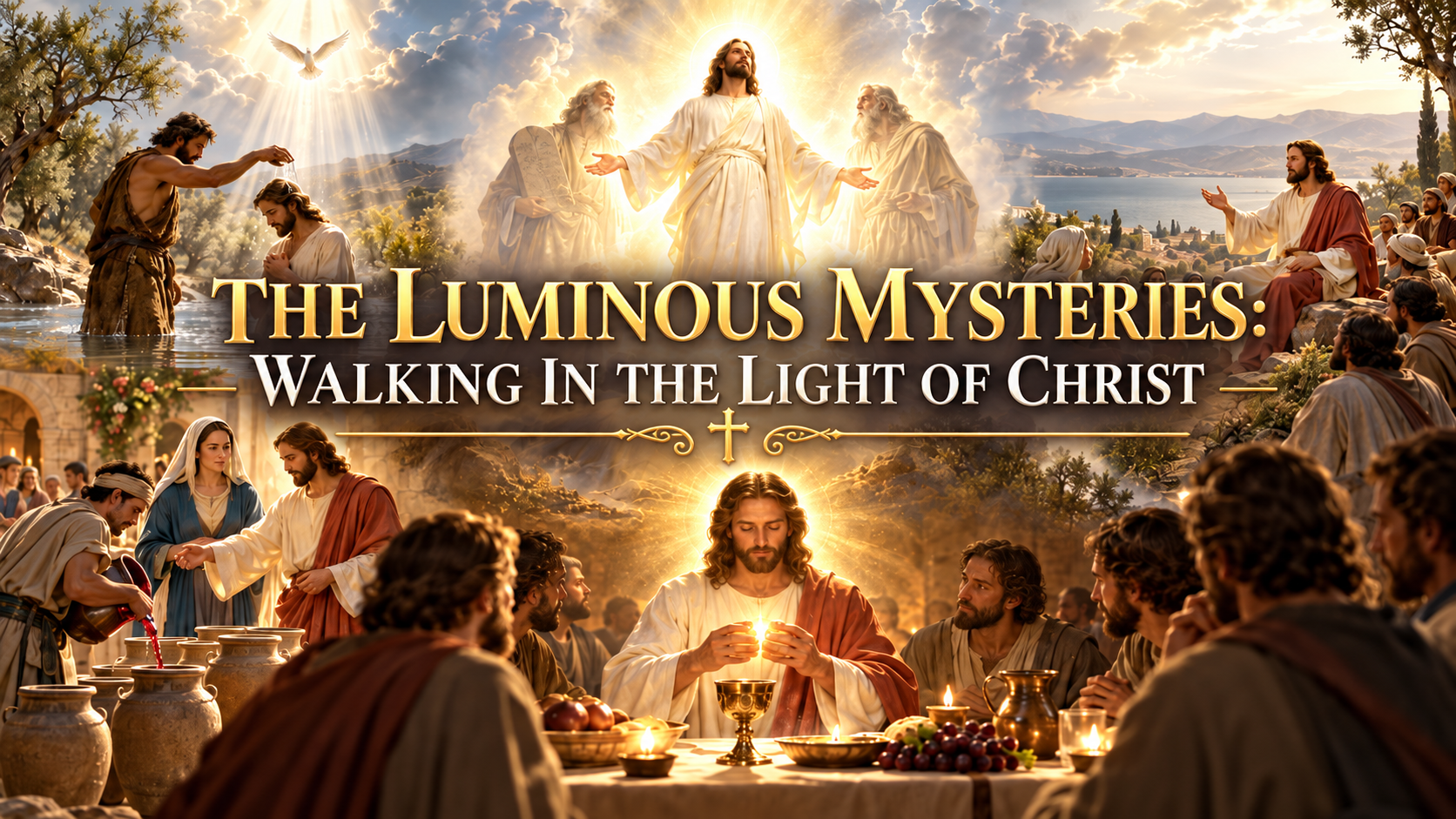
The Luminous Mysteries invite us to contemplate five decisive moments in the earthly life of our Lord.
We stand beside the Jordan as the Father reveals His beloved Son.
We witness the miracle at Cana, where Christ manifests His glory.
We hear His proclamation of the Kingdom of God and His call to repentance.
We behold His divine glory upon the mountain of the Transfiguration.
And finally, we enter the Upper Room, where Jesus gives His Body and Blood in the Holy Eucharist.
These mysteries are not merely episodes from the past.
They reveal who Jesus Christ is, why He came into the world, and what it means to live as His disciple.
The Gospel is not simply a collection of moral instructions.
It is the revelation of the living God in the Person of Jesus Christ.
And the Luminous Mysteries invite us to walk in His light.
The Light Is a Person
Throughout Sacred Scripture, light is associated with the presence, truth, holiness, and saving action of God.
Darkness often represents ignorance, sin, and separation from divine truth.
The Gospel of John brings this symbolism to its fulfillment in Jesus Christ.
Our Lord declares:
“I am the light of the world. He that followeth me, walketh not in darkness, but shall have the light of life.”
— John 8:12, Douay-Rheims
Jesus does not merely claim to possess spiritual wisdom.
He identifies Himself as the light of the world.
This distinction is fundamental.
Christianity is not primarily an ethical system built around the teachings of a remarkable religious leader.
It is the revelation of the eternal Son of God who became man for our salvation.
Christ reveals the Father.
He sends the Holy Spirit.
He calls sinners to repentance.
He establishes His Church.
And He gives Himself as the source of eternal life.
The Luminous Mysteries direct our attention toward this saving mission.
In his apostolic letter Rosarium Virginis Mariae, published in AD 2002, Pope St. John Paul II proposed five additional mysteries focused upon the public ministry of Christ.
He called them the Mysteries of Light.
His purpose was to enrich the Rosary’s contemplation of the Gospel by giving greater attention to the years between Christ’s childhood and His Passion.
The Pope explained that these mysteries reveal the Kingdom of God present in the Person of Jesus Christ (Rosarium Virginis Mariae, 19–21).
They are particularly significant because the public ministry of Jesus is the period in which He openly teaches, performs signs, calls disciples, reveals His divine authority, and prepares for His saving sacrifice.
The Luminous Mysteries remind us that discipleship involves more than admiring Jesus from a distance.
It requires responding to Him.
We must receive His grace.
We must obey His Word.
We must repent of sin.
We must listen to His teaching.
And we must remain united to Him through the sacramental life of the Church.
The light of Christ is not merely something to observe.
It is a light by which we are called to live.
The First Luminous Mystery: The Baptism of Jesus in the Jordan
Scripture: Matthew 3:13–17
Contemplate: The Father reveals His beloved Son as the Holy Spirit descends upon Him.
Grace to Seek: Fidelity to baptismal grace and a deeper awareness of our identity in Christ.
The first Luminous Mystery brings us to the banks of the Jordan River.
John the Baptist is preaching repentance and preparing the people of Israel for the coming of the Messiah.
Those who respond to his preaching enter the waters as a sign of repentance.
Then Jesus comes to be baptized.
At first, the scene presents a theological difficulty.
Why would Jesus Christ, who is without sin, submit to a baptism associated with repentance?
John himself recognizes the apparent contradiction.
He tells Jesus that he ought to be baptized by Him.
Yet Christ insists that the baptism take place in fulfillment of righteousness.
Jesus does not enter the Jordan because He needs forgiveness.
He enters freely, identifying Himself with the sinful humanity He has come to redeem.
His public mission is beginning.
And that mission will ultimately lead Him to the Cross.
As Jesus emerges from the water, the heavens are opened, the Holy Spirit descends upon Him in the form of a dove, and the Father’s voice declares:
“This is my beloved Son, in whom I am well pleased.”
— Matthew 3:17, Douay-Rheims
This moment reveals the Trinitarian character of Christ’s saving mission.
The Son stands in the waters.
The Holy Spirit descends.
The Father speaks from heaven.
The three divine Persons are manifested distinctly, without compromising the unity of the one God.
Christ’s Baptism is not identical to the sacrament of Christian Baptism that He establishes.
The baptism administered by John was preparatory.
Christian Baptism is a sacrament instituted by Christ, through which the saving grace of His Death and Resurrection is communicated to the believer.
Nevertheless, the Baptism of Jesus illuminates the mystery of our own baptismal identity.
Through Christian Baptism, we are cleansed from sin, reborn as children of God, incorporated into Christ, and made members of His Church.
The Catechism of the Catholic Church teaches these truths in CCC 1213 and 1262–1270.
Baptism is not merely a public symbol of belonging to a religious community.
It is a true sacrament through which God acts upon the soul.
It establishes a new relationship with the Holy Trinity.
The baptized Christian receives sanctifying grace and is called to live as a member of Christ’s Body.
This identity carries real consequences.
A baptized person cannot regard Christian faith as merely one interest among many.
Baptism marks the beginning of a life that should be directed toward holiness.
We are called to renounce Satan, reject sin, profess the Catholic faith, and live according to the Gospel.
Yet how easily we forget our baptismal promises.
We may profess belief in Christ while ordering our lives around worldly ambitions.
We may claim to follow Him while remaining attached to habits that contradict His commandments.
The first Luminous Mystery invites us to remember who we have become through grace.
Our identity in Christ should shape our choices, relationships, and moral responsibilities.
Carry the Mystery into Daily Life
Recall the promises made at your Baptism or renewed at Easter.
Examine one habit, attitude, or behavior that contradicts your identity as a disciple of Jesus Christ.
Ask God for the grace to reject that habit and take one concrete step toward conversion.
The light of Baptism is meant to illuminate the whole Christian life.
The Second Luminous Mystery: The Wedding at Cana
Scripture: John 2:1–11
Contemplate: Christ manifests His glory, and His Blessed Mother directs others toward obedience to Him.
Grace to Seek: Trust in Jesus Christ and openness to His divine will.
The second Luminous Mystery takes us to a wedding celebration in Cana of Galilee.
Jesus is present with His disciples.
His Mother is also there.
During the celebration, a problem arises.
The wine has run out.
To modern readers, the situation might appear relatively minor compared with the dramatic events that unfold elsewhere in the Gospel.
But within the cultural setting of the wedding feast, the shortage would have caused serious embarrassment to the hosts.
Mary notices the difficulty.
She brings the need to Jesus.
Her action reflects an important aspect of her maternal concern.
She is attentive to human needs.
Yet she does not attempt to make herself the source of the solution.
She turns to her Son.
Jesus responds by referring to His hour, which in John’s Gospel finds its fulfillment in His Passion and glorification.
The exchange reveals that His saving mission unfolds according to the divine plan.
Mary then speaks to the servants:
“Whatsoever he shall say to you, do ye.”
— John 2:5, Douay-Rheims
These words express the proper character of all authentic Marian devotion.
Mary does not direct attention toward herself as an alternative to Christ.
She directs others toward obedience to Him.
The servants follow the instructions Jesus gives.
Water is placed in the stone vessels.
Christ transforms it into wine.
The steward discovers that the best wine has been reserved until now.
St. John presents the miracle as the beginning of the signs through which Jesus manifests His glory.
The disciples respond with faith.
This is the deeper meaning of Cana.
The miracle is not simply a demonstration of supernatural power.
It is a sign revealing the identity and mission of Jesus Christ.
It calls forth belief in Him.
Cana also teaches us something about the relationship between grace and ordinary human life.
Christ’s first sign in John’s Gospel takes place at a wedding.
He enters a setting of family, friendship, celebration, and human joy.
His presence does not imply contempt for the goodness of creation.
Rather, the Incarnate Son reveals that human life is capable of being elevated by divine grace.
Marriage, family, and communal celebration are not unworthy of God’s attention.
They belong to the created order that He came to redeem.
At the same time, the miracle directs our attention beyond earthly joy.
It points toward the greater gift that Christ has come to bestow.
The deepest human need is not simply relief from embarrassment or material difficulty.
It is salvation.
The Wedding at Cana therefore invites us to bring our concerns before Christ while remaining obedient to His will.
We may not always understand His timing.
We may not receive the outcome we expect.
But we are called to trust Him.
Carry the Mystery into Daily Life
Bring one concrete family concern before Jesus Christ.
It may involve marriage, children, finances, illness, or a strained relationship.
Ask for Mary’s intercession.
Then consider her instruction at Cana.
What has Christ already commanded you to do?
Take the next faithful step available to you, even if you cannot yet see how the situation will be resolved.
The Third Luminous Mystery: The Proclamation of the Kingdom of God
Scripture: Mark 1:14–15; Luke 4:16–21
Contemplate: Jesus announces the Kingdom of God and calls sinners to repentance and faith.
Grace to Seek: Genuine conversion of heart and a deeper commitment to the Gospel.
The third Luminous Mystery places us before the preaching of Jesus Christ.
As He begins His public ministry, our Lord announces:
“The time is accomplished, and the kingdom of God is at hand: repent, and believe the gospel.”
— Mark 1:15, Douay-Rheims
This proclamation stands at the heart of His public mission.
The Kingdom of God has drawn near because the promised Messiah has come.
The saving reign of God is being revealed in the Person and work of Jesus Christ.
But notice that the announcement contains both a gift and a summons.
God has acted.
Therefore, humanity must respond.
The response is repentance and faith.
Christ does not proclaim the Kingdom merely to satisfy intellectual curiosity.
He calls sinners to conversion.
The Greek word often translated as repentance, metanoia, expresses a turning of the mind and heart.
It involves a genuine reorientation of life toward God.
Repentance is therefore more than feeling sorry about past actions.
It requires acknowledging sin, turning away from evil, and returning to the Lord.
True repentance bears fruit in changed conduct.
A person who has stolen must turn away from theft.
Someone who has lied must embrace truthfulness.
A person who has harbored hatred must seek the grace to forgive.
Someone living in serious sin must repent and seek reconciliation with God.
This conversion is not accomplished through human effort alone.
It requires divine grace.
Christ calls us to repentance because He has come to make reconciliation possible.
Throughout the Gospels, His proclamation is accompanied by signs that reveal the arrival of the Kingdom.
He heals the sick.
He casts out demons.
He forgives sins.
He welcomes sinners who turn toward God.
He teaches with divine authority.
These works reveal that the Kingdom is not merely a philosophical ideal or political program.
It is the saving reign of God breaking into human history through Jesus Christ.
The Kingdom cannot be reduced to an earthly system of government.
Nor can it be reduced to a private feeling of spiritual peace.
It demands the transformation of the whole person.
The Church continues Christ’s call to repentance through the preaching of the Gospel and the ministry of reconciliation.
For Catholics who have fallen into serious sin after Baptism, the Sacrament of Penance is the ordinary means established by Christ for sacramental reconciliation.
Confession is not merely an opportunity for emotional relief.
It is an encounter with the mercy of Jesus Christ acting through His Church.
The third Luminous Mystery invites us to examine whether we have truly allowed the Gospel to change our lives.
It is possible to admire Jesus while resisting His commandments.
It is possible to speak frequently about faith while avoiding genuine conversion.
But discipleship requires more than admiration.
It requires repentance.
Carry the Mystery into Daily Life
Make a sincere examination of conscience.
Identify one sin, habit, or attachment from which you need to turn away.
Ask God for the grace of genuine repentance.
If you are conscious of mortal sin, seek reconciliation through the Sacrament of Penance before receiving Holy Communion.
Allow Christ’s proclamation of the Kingdom to become a personal call to conversion.
The Fourth Luminous Mystery: The Transfiguration
Scripture: Matthew 17:1–8
Contemplate: Christ reveals His divine glory and the Father commands us to listen to His beloved Son.
Grace to Seek: Courage, spiritual perseverance, and obedience to the Word of God.
The fourth Luminous Mystery takes us to a mountain where Jesus brings Peter, James, and John.
There, something extraordinary occurs.
The appearance of Jesus is transfigured before them.
His face shines like the sun.
His garments become white as light.
Moses and Elias appear, speaking with Him.
The disciples are given a glimpse of the glory that belongs to Christ.
This manifestation reveals something about His true identity.
The Jesus who walks the roads of Galilee, experiences hunger, becomes tired, and prepares to suffer is also the eternal Son of God.
His humanity does not conceal a merely human religious teacher.
It belongs to the divine Person who has assumed it.
The presence of Moses and Elias connects Christ with the Law and the Prophets.
The history of Israel finds its fulfillment in Him.
Then a bright cloud overshadows the disciples.
The Father’s voice is heard:
“This is my beloved Son, in whom I am well pleased: hear ye him.”
— Matthew 17:5, Douay-Rheims
The command is direct.
Hear Him.
The Transfiguration reveals divine glory, but it also emphasizes obedience.
The disciples are not simply invited to admire a supernatural spectacle.
They are commanded to listen to Jesus Christ.
This is especially important because the Transfiguration occurs within the larger movement of the Gospel toward Jerusalem and the Passion.
The disciples will soon witness suffering that appears incompatible with the glory they have seen.
Their Master will be rejected.
He will be arrested, condemned, scourged, and crucified.
The memory of His glory is meant to strengthen their faith when those terrible events unfold.
The Transfiguration teaches that the Cross is not the defeat of Christ’s mission.
It is part of the saving path that leads to the Resurrection.
This mystery also corrects two common misunderstandings of Christian life.
The first is the belief that discipleship consists only of suffering, duty, and sacrifice without the hope of glory.
Christianity is not hopeless endurance.
Christ’s Resurrection and glory are real.
The second error is the belief that the spiritual life should consist entirely of consoling experiences.
Peter wishes to remain on the mountain.
But the disciples must eventually descend.
They must follow Christ into the difficulties that lie ahead.
Christian faith cannot remain permanently within moments of extraordinary consolation.
It must shape ordinary decisions.
It must endure suffering.
It must remain faithful when God’s presence is not emotionally obvious.
The Father’s command to listen to Jesus applies just as much to us as it did to the disciples on the mountain.
We hear Christ through Sacred Scripture, the teaching of His Church, and the demands of Christian conscience rightly formed in truth.
But hearing is not enough.
We must obey.
Carry the Mystery into Daily Life
Choose one command of Jesus Christ from the Gospels that you find difficult to follow.
Perhaps it concerns forgiveness, humility, purity, generosity, or love of enemies.
Read the passage carefully.
Ask for the grace to accept His teaching without attempting to weaken or explain it away.
Then take one concrete step toward obedience.
The glory of Christ should strengthen our willingness to follow Him.
The Fifth Luminous Mystery: The Institution of the Holy Eucharist
Scripture: Luke 22:14–20; 1 Corinthians 11:23–29
Contemplate: Jesus Christ gives His Body and Blood under the sacramental appearances of bread and wine.
Grace to Seek: Eucharistic faith, reverence, thanksgiving, and sacrificial charity.
The fifth Luminous Mystery brings us to the Upper Room on the night before Christ’s Passion.
Jesus gathers with His Apostles to celebrate the Last Supper.
He knows that His suffering and death are approaching.
The hour toward which His earthly mission has been moving is at hand.
During the meal, Jesus takes bread, gives thanks, breaks it, and gives it to His disciples.
He declares:
“This is my body, which is given for you.”
— Luke 22:19, Douay-Rheims
He likewise gives the chalice, speaking of the New Testament in His Blood.
These words reveal the institution of the Holy Eucharist.
For Catholics, the Eucharist is not merely a religious symbol reminding believers of something Jesus did long ago.
It is a true sacrament instituted by Christ.
Under the appearances of bread and wine, the whole Christ is truly, really, and substantially present.
His Body.
His Blood.
His Soul.
His Divinity.
The Catechism of the Catholic Church teaches this doctrine in CCC 1374.
Through the consecration at Mass, the substance of bread and wine is changed into the Body and Blood of Christ.
The Church calls this change transubstantiation (CCC 1376).
The Eucharist is therefore fundamentally different from an ordinary communal meal.
It is the sacramental gift of Christ Himself.
It also makes present His one sacrifice.
The Mass does not repeat Christ’s sacrifice as though Calvary were insufficient.
Rather, the one sacrifice of the Cross is made sacramentally present.
The same Christ who offered Himself once for all upon Calvary is present in the Eucharistic sacrifice.
The Catechism explains the sacrificial character of the Eucharist in CCC 1362–1367.
This is why the Church describes the Eucharist as the source and summit of Christian life (CCC 1324).
Every other aspect of Catholic spirituality must remain properly ordered toward this supreme gift.
The Rosary is a powerful devotional prayer.
But it does not replace the Holy Mass.
It does not possess the same sacramental character as the Eucharist.
Instead, the Rosary should deepen our desire to receive Christ worthily and worship Him reverently.
When we contemplate the Institution of the Eucharist, we remember that Christ has not abandoned His Church.
He continues to nourish His people with His own life.
The Eucharist also carries serious moral implications.
St. Paul warns against receiving the Body and Blood of the Lord unworthily (1 Corinthians 11:27–29).
Catholics are therefore called to examine themselves and approach Holy Communion with proper faith and disposition.
A person conscious of mortal sin ordinarily must receive sacramental absolution before receiving Communion (CCC 1457).
Eucharistic devotion should also lead toward charity.
The Lord who gives Himself to us calls us to offer ourselves in love.
We cannot properly separate worship of Christ from obedience to His commandments.
We cannot adore the Eucharistic Lord while deliberately refusing the demands of justice, mercy, and charity.
The Eucharist calls us to become more deeply united to Jesus Christ and, through Him, to the members of His Body.
The fifth Luminous Mystery therefore brings the entire sequence to a remarkable fulfillment.
The Son revealed at the Jordan, manifested at Cana, proclaimed in the Kingdom, and glorified on the mountain now gives Himself to His Church as the Bread of Life.
Carry the Mystery into Daily Life
Prepare more deliberately for your next Holy Mass.
Read the Sunday Gospel in advance.
Make an examination of conscience.
If necessary, seek sacramental Confession.
Participate attentively in the sacred liturgy.
If properly disposed to receive Holy Communion, approach with reverence and thanksgiving.
After Communion, remain prayerfully attentive to the Lord whom you have received.
Let your Eucharistic devotion bear fruit in concrete acts of charity.
The Luminous Mysteries and the Shape of Christian Discipleship
The five Luminous Mysteries are not isolated events.
Together, they reveal a pattern for the Christian life.
At the Jordan, Jesus reveals the mystery of His Sonship and illuminates our identity through Baptism.
At Cana, He manifests His glory and teaches us to trust His Word.
In the proclamation of the Kingdom, He summons us to repentance and faith.
At the Transfiguration, He reveals His glory and teaches us to listen even when discipleship leads through suffering.
At the Last Supper, He gives Himself sacramentally and invites us into deeper communion with His saving sacrifice.
These mysteries call us to receive the light of Christ in every dimension of our lives.
We are not asked merely to know that Jesus was baptized.
We are asked to live according to our baptismal identity.
We are not asked merely to admire the miracle at Cana.
We are asked to obey the words of Jesus.
We are not asked merely to remember His preaching.
We are asked to repent and believe the Gospel.
We are not asked merely to marvel at His Transfiguration.
We are asked to hear Him.
And we are not asked merely to study the Institution of the Eucharist.
We are called to worship, receive, and love the Eucharistic Lord according to the faith of His Church.
The purpose of Christian contemplation is not simply to acquire more religious information.
It is to allow divine truth to transform the soul.
St. Paul teaches:
“For you were heretofore darkness, but now light in the Lord. Walk then as children of the light.”
— Ephesians 5:8, Douay-Rheims
The Christian life is a movement away from the darkness of sin toward the light of Christ.
That movement begins through grace.
It continues through conversion.
And it is sustained by prayer, the sacraments, and cooperation with the Holy Spirit.
The Luminous Mysteries provide a beautiful pattern for that journey.
The CatholicG33k Practice: Five Days Walking in the Light of Christ
This Week’s Spiritual Practice: Living the Luminous Mysteries
Scripture: Matthew 3:13–17; John 2:1–11; Mark 1:14–15; Matthew 17:1–8; Luke 22:14–20
Grace to Seek: A deeper conversion of life through contemplation of Jesus Christ.
For the next five days, meditate upon one Luminous Mystery each day.
Begin by reading the corresponding Gospel passage.
Pray one decade of the Rosary.
Ask for the grace associated with that mystery.
Then perform one concrete action that expresses the truth you have contemplated.
Day 1: The Baptism of Jesus — Remember Your Identity
Read Matthew 3:13–17.
Pray one decade asking for fidelity to your baptismal promises.
Reflect upon the grace of Baptism and the responsibility of living as a disciple.
Choose one habit or behavior that contradicts your Christian identity and take a practical step toward changing it.
Day 2: The Wedding at Cana — Practice Obedience
Read John 2:1–11.
Pray one decade asking for trust in Christ.
Reflect upon Mary’s instruction to the servants.
Identify one command of Christ you have been neglecting.
Resolve to obey it more faithfully.
Day 3: The Proclamation of the Kingdom — Seek Conversion
Read Mark 1:14–15.
Pray one decade asking for genuine repentance.
Make a sincere examination of conscience.
If you need sacramental reconciliation, make arrangements to receive Confession.
Consider how your conduct can better reflect the Gospel.
Day 4: The Transfiguration — Listen to Christ
Read Matthew 17:1–8.
Pray one decade asking for courage to follow Jesus.
Reflect upon the Father’s command:
Hear ye him.
Choose one teaching of Christ that challenges your preferences or habits.
Ask for the grace to embrace it with faith.
Day 5: The Institution of the Eucharist — Grow in Reverence
Read Luke 22:14–20.
Pray one decade asking for greater Eucharistic faith.
Prepare intentionally for your next Holy Mass.
Consider how you can participate more reverently, receive Holy Communion worthily when properly disposed, and remain attentive in thanksgiving.
Conclude the day with a prayer of gratitude for the gift of the Holy Eucharist.
At the End of the Five Days
Reflect upon the week.
Which mystery most challenged you?
Where did you recognize a particular need for conversion?
Did your prayer lead to greater obedience, repentance, reverence, or charity?
The purpose of this practice is not simply to complete five decades.
It is to allow the mysteries of Jesus Christ to illuminate your daily decisions.
The Rosary becomes more fruitful when contemplation leads to faithful action.
Questions for Reflection
1. Hearing and Obeying Christ
Which command of Jesus have I heard repeatedly but delayed putting into practice?
2. Living My Baptismal Identity
Does my daily life reflect the promises of my Baptism and my identity as a member of Christ’s Body?
3. Growing in Eucharistic Faith
How can I prepare more reverently for the Holy Eucharist and allow my participation in the Mass to bear greater fruit in charity?
These questions invite us to examine whether our faith is shaping the way we live.
Christ does not call us merely to admire the light.
He calls us to walk in it.
A Prayer for the Light of Christ
Lord Jesus Christ,
Light of the world and eternal Son of the Father,
You came into our world to reveal the truth, redeem sinners, and lead humanity into communion with God.
Open my heart to the mysteries of Your saving life.
As I contemplate Your Baptism in the Jordan, renew my commitment to the grace I received in Baptism.
Teach me to reject sin and live faithfully as a child of God.
As I meditate upon the Wedding at Cana, strengthen my trust in Your divine wisdom.
Through the intercession of Your Blessed Mother, teach me to obey whatever You command.
As I contemplate Your proclamation of the Kingdom, awaken within me a sincere desire for repentance.
Give me the humility to acknowledge my sins and the courage to seek Your mercy.
As I behold Your glory in the Transfiguration, strengthen my faith when the path of discipleship becomes difficult.
Teach me to listen to Your Word and follow You with perseverance.
And as I contemplate the Institution of the Holy Eucharist, deepen my reverence for Your Real Presence.
Increase my love for the Holy Sacrifice of the Mass.
Prepare my heart to receive You worthily and to live according to the grace You give.
May the Luminous Mysteries guide my thoughts, purify my desires, and strengthen my obedience.
Through the prayers of the Blessed Virgin Mary, lead me away from the darkness of sin and into the light of Your truth.
May my life become a witness to the Gospel.
And may I remain faithful to You until the day when faith gives way to sight.
Amen.
Conclusion: Walking in the Light of the Savior
The Luminous Mysteries reveal that Jesus Christ is not merely a teacher whose ideas deserve consideration.
He is the eternal Son of God.
He is the Savior who enters the waters of the Jordan and begins His public mission.
He is the Lord whose glory is manifested at Cana.
He is the King who announces the arrival of God’s Kingdom and calls sinners to repentance.
He is the beloved Son whose glory shines upon the mountain.
And He is the Eucharistic Lord who gives Himself to His Church under the appearances of bread and wine.
These mysteries draw our attention toward the identity and mission of Jesus Christ.
But they also challenge us.
We cannot contemplate the Baptism of Jesus without considering whether we are living according to our baptismal promises.
We cannot meditate upon Cana without hearing Mary’s command to obey her Son.
We cannot reflect upon the proclamation of the Kingdom without examining our need for repentance.
We cannot behold the Transfiguration without accepting the Father’s command to listen to Christ.
And we cannot contemplate the Institution of the Eucharist without considering our reverence for the Holy Mass and our willingness to live in sacrificial charity.
The Rosary is not intended to leave our lives unchanged.
It is a school of discipleship.
Through its mysteries, we learn who Christ is.
Through its prayers, we turn our hearts toward Him.
Through the example of His Blessed Mother, we learn to receive His Word with faith.
And through the grace of God, we are called to become more deeply conformed to the Savior whom we contemplate.
The Luminous Mysteries remind us that Christianity is not simply about becoming better people through our own efforts.
It is about receiving the life of Jesus Christ and allowing His grace to transform us.
The light of Christ reveals the truth.
It exposes sin.
It strengthens faith.
It calls us to obedience.
And it directs us toward the sacramental communion through which the Lord nourishes His Church.
We do not create this light.
We receive it from Christ.
And having received it, we are called to live according to it.
The five Luminous Mysteries offer a path for doing precisely that.
Remember your Baptism.
Obey the Word of Christ.
Repent and believe the Gospel.
Listen to the beloved Son.
Remain close to Him in the Holy Eucharist.
This is the invitation of the Luminous Mysteries.
Not simply to observe the light from a distance.
But to follow Jesus Christ.
And to walk in His light.
Sources and Further Reading
Sacred Scripture
- Matthew 3:13–17 — The Baptism of Jesus in the Jordan.
- John 2:1–11 — The Wedding at Cana.
- Mark 1:14–15 — The proclamation of the Kingdom of God.
- Luke 4:16–21 — Christ announces the fulfillment of Scripture.
- Matthew 17:1–8 — The Transfiguration.
- Luke 22:14–20 — The Institution of the Holy Eucharist.
- 1 Corinthians 11:23–29 — The Eucharistic tradition and worthy reception of Holy Communion.
- John 8:12 — Christ as the light of the world.
- Ephesians 5:8 — The call to walk as children of light.
Catechism of the Catholic Church
- CCC 535–537 — The Baptism of Jesus.
- CCC 541–550 — The proclamation and signs of the Kingdom of God.
- CCC 554–556 — The Transfiguration.
- CCC 1213 — The Sacrament of Baptism.
- CCC 1262–1270 — The effects of Baptism.
- CCC 1324 — The Eucharist as the source and summit of Christian life.
- CCC 1362–1367 — The Eucharist as the sacramental memorial of Christ’s sacrifice.
- CCC 1374 — The Real Presence of Christ in the Eucharist.
- CCC 1376 — Transubstantiation.
- CCC 1457 — The necessity of sacramental Confession before Holy Communion when conscious of mortal sin.
Papal Teaching
- Pope St. John Paul II, Rosarium Virginis Mariae (2002), paragraph 19 — The proposal of the Luminous Mysteries.
- Pope St. John Paul II, Rosarium Virginis Mariae, paragraph 21 — The theological significance of the five Mysteries of Light.
The Rosary, Rediscovered — Article 9 of 12
CatholicG33k — Faith. Truth. Reason.