

The Rosary, Rediscovered — Article 8 of 12
Discover how the five Joyful Mysteries reveal the extraordinary love of God within ordinary human life—and how the Incarnation of Jesus Christ transforms our understanding of family, work, suffering, obedience, and holiness.
Scripture for Meditation: Luke 1:26–56; Luke 2:1–52
How does the mystery of the Incarnation transform the most ordinary parts of human life?
For many Catholics, the Joyful Mysteries are among the most familiar parts of the Rosary.
We know the angel Gabriel appeared to Mary. We remember her visit to Elizabeth. We picture the infant Jesus lying in a manger, the Holy Family entering the Temple, and Mary and Joseph searching for their Son in Jerusalem.
These scenes are so familiar that we can easily overlook their extraordinary significance.
The Joyful Mysteries are not simply five beautiful memories from the early life of Jesus Christ.
They proclaim something that changes the meaning of human existence.
The eternal Son of God entered our world.
He entered a family.
He experienced poverty, vulnerability, and dependence.
He participated in the ordinary rhythms of human life.
And through His Incarnation, He revealed that holiness is not reserved for extraordinary circumstances.
God calls us to encounter Him in the very places where we live, work, suffer, love, and serve.
Joy Begins with God’s Presence
The word joyful can sometimes create a misleading expectation.
We may imagine that the Joyful Mysteries concern five moments of uninterrupted happiness.
But the Gospel reveals something more profound.
Mary receives a calling that will radically change her life.
She travels to assist Elizabeth.
She gives birth to Jesus in humble circumstances.
She hears Simeon’s prophecy that a sword will pierce her soul.
She experiences the anguish of searching for her missing Son.
These are not events free from difficulty.
Yet they are called joyful because of the deeper reality that unites them.
God has fulfilled His promise.
The Savior has come.
Christian joy is not the absence of suffering.
It is the confidence that God remains faithful even when suffering is present.
This distinction matters because many Christians mistakenly associate holiness with a life free from uncertainty, hardship, or disappointment.
The Joyful Mysteries challenge that assumption.
They reveal divine grace at work within circumstances that are often difficult, ordinary, and deeply human.
At the center of these mysteries stands the Incarnation.
St. John proclaims:
“And the Word was made flesh, and dwelt among us.”
— John 1:14, Douay-Rheims
The eternal Son did not merely appear to be human.
He truly assumed a human nature.
He entered human history without ceasing to be God.
The Catechism of the Catholic Church explains this mystery in CCC 461–463.
Jesus Christ is one divine Person, the eternal Son of the Father, who possesses both a divine nature and a true human nature.
He came to redeem humanity by entering fully into our condition, except for sin.
The Joyful Mysteries invite us to contemplate what this means for our own lives.
Our bodies matter.
Our families matter.
Our work matters.
Our ordinary acts of obedience and charity matter.
The God who created the universe chose to enter the world through the humble circumstances of human life.
And because He did, those circumstances can become places of encounter with Him.
The First Joyful Mystery: The Annunciation
Scripture: Luke 1:26–38
Contemplate: God’s initiative in salvation and Mary’s free response of faith.
Grace to Seek: Humility and trusting obedience.
The Annunciation begins with a divine invitation.
The angel Gabriel is sent to a young woman in Nazareth, a town far removed from the centers of worldly power.
Mary is not introduced as a political ruler or a person possessing great earthly influence.
She is a humble servant of God.
Yet she has been chosen for an extraordinary vocation.
Gabriel announces that she will conceive and bear a Son who will be called the Son of the Most High.
The Child will reign forever.
His Kingdom will have no end.
Mary asks how this will take place, since she does not know man.
The angel explains that the Holy Ghost will come upon her and that the power of the Most High will overshadow her.
What follows is one of the most important expressions of faith in Sacred Scripture.
“Behold the handmaid of the Lord; be it done to me according to thy word.”
— Luke 1:38, Douay-Rheims
Mary’s response is not passive resignation.
It is a free and faithful acceptance of God’s will.
She does not possess complete knowledge of everything that lies ahead.
She cannot foresee every difficulty that will accompany her vocation.
Yet she knows the One who calls her.
And she trusts Him.
This is an essential lesson of the Annunciation.
Faith does not always mean understanding every consequence of obedience before we act.
Sometimes faith means recognizing the authority and goodness of God even when the future remains uncertain.
Mary’s consent also reveals the relationship between grace and human freedom.
God is the author of salvation.
The Incarnation is not the result of human achievement.
Yet God freely willed that Mary’s cooperation would have a real place in His saving plan.
Her response was made possible by grace, but it was truly her response.
The Second Vatican Council reflects upon Mary’s faithful cooperation in Lumen Gentium, paragraph 56.
Her obedience stands in contrast to the disobedience through which sin entered human history.
Where distrust and rebellion marked the fall, Mary responds with faith and submission to God’s will.
The Annunciation challenges us to examine our own willingness to obey.
How often do we postpone doing what is right because we are afraid of the consequences?
How often do we insist upon knowing every detail before trusting God?
How often do we place our own preferences above the demands of the Gospel?
Mary teaches us that holiness begins with openness to grace.
God does not ask us to know everything.
He asks us to trust Him and respond faithfully.
Carry the Mystery into Daily Life
Consider one responsibility or act of obedience you have been postponing through fear, pride, or selfishness.
Perhaps you need to apologize, return to Confession, fulfill a neglected duty, or make a difficult but morally necessary decision.
Ask God for the grace to respond as Mary did.
Not merely with words of agreement, but with concrete obedience.
The Second Joyful Mystery: The Visitation
Scripture: Luke 1:39–56
Contemplate: The presence of Christ overflowing into praise and service.
Grace to Seek: Charity and joyful humility.
After the Annunciation, Mary travels to visit her relative Elizabeth.
She carries within her the Savior of the world.
Of all the women in human history, she has received an entirely unique vocation.
Yet her response is not self-importance.
She goes to assist someone in need.
This is one of the most beautiful lessons of the Visitation.
Mary’s extraordinary privilege does not turn her inward.
It moves her outward in charity.
When she arrives, Elizabeth is filled with the Holy Ghost.
The unborn John the Baptist leaps in her womb, and Elizabeth recognizes the dignity of Mary’s Child.
She asks how she should be so favored that the Mother of her Lord has come to her.
Mary responds with the Magnificat.
“My soul doth magnify the Lord.”
— Luke 1:46, Douay-Rheims
Her praise is directed toward God.
She does not glorify herself.
She glorifies the Lord who has done great things for her.
The Magnificat reveals the spiritual foundation of Mary’s humility.
She recognizes that everything she has received is a gift of divine grace.
Her greatness does not consist in independence from God.
It consists in her perfect openness to His will.
The Visitation teaches that authentic faith naturally moves toward charity.
Mary does not separate contemplation from service.
She receives the Word of God and brings His presence to another person.
This challenges a world that often associates importance with recognition, influence, and being served by others.
Christian greatness follows a different pattern.
The closer we grow to Jesus Christ, the more willing we should become to serve.
Prayer should make us attentive to the needs of others.
Devotion should increase our generosity.
A deeper relationship with Christ should not make us indifferent to those who suffer.
The Visitation reminds us that charity is not an optional addition to the Christian life.
It is one of the clearest fruits of grace.
Carry the Mystery into Daily Life
Choose one person who needs your attention.
Visit someone who is lonely.
Call a family member you have neglected.
Help someone facing a practical difficulty.
Perform an act of service without expecting praise or recognition.
Ask the Blessed Virgin Mary to teach you how to bring the love of Christ into the lives of others.
The Third Joyful Mystery: The Nativity
Scripture: Luke 2:1–20; Matthew 1:18–25
Contemplate: The eternal Son of God entering the world in humility and poverty.
Grace to Seek: Poverty of spirit and reverence for human life.
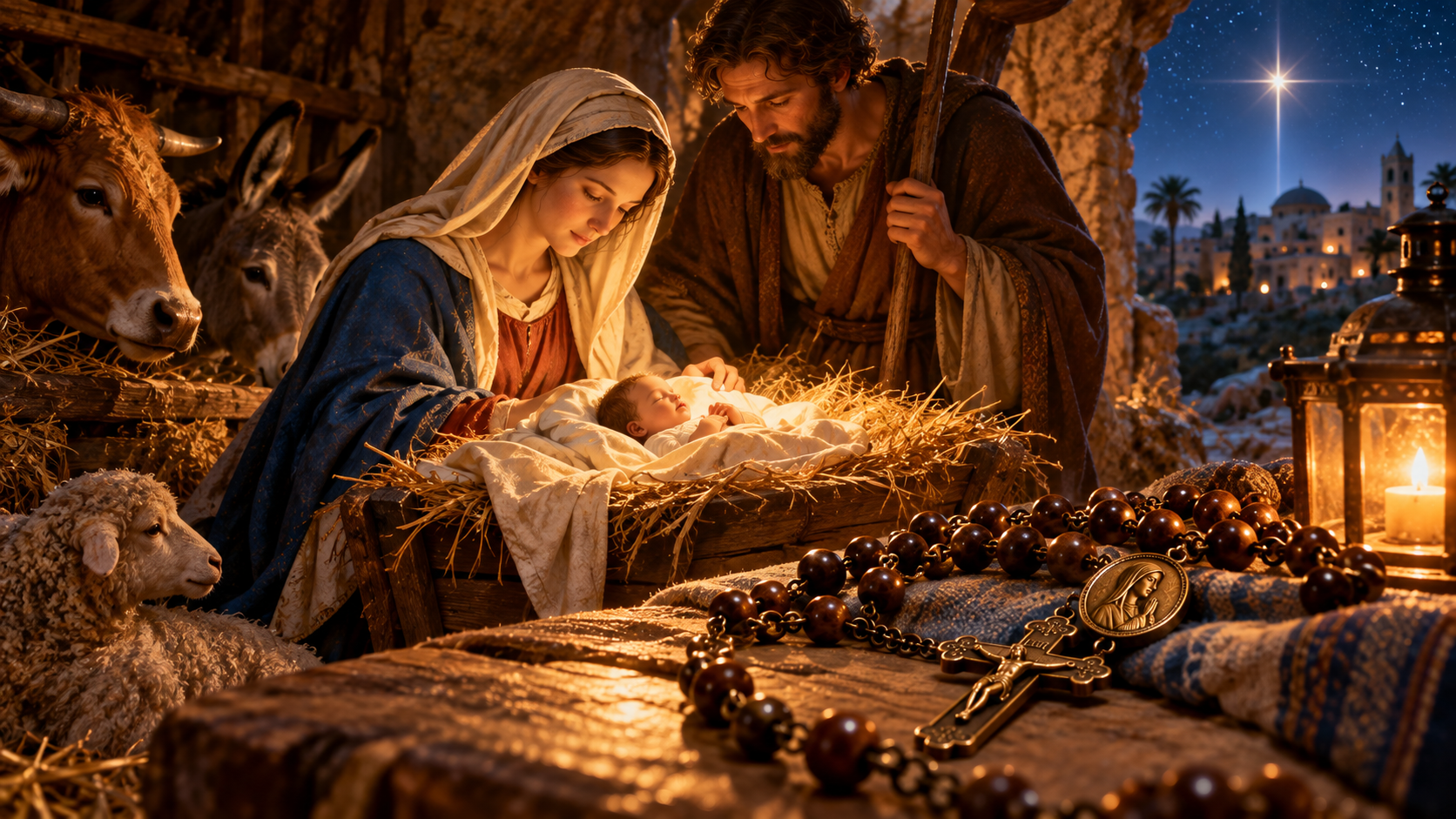
The Nativity is among the most beloved scenes in Christianity.
We picture Bethlehem, the manger, the shepherds, and the Holy Family gathered around the newborn Jesus.
But familiarity can soften the astonishing theological truth at the center of this mystery.
The Child lying in the manger is the eternal Son of God.
The One through whom all things were made has entered the world as an infant.
The Creator has accepted the vulnerability of human childhood.
He who sustains the universe has taken a human nature and entered into the dependence proper to infancy.
The Nativity reveals divine greatness through humility.
Jesus is not born in an imperial palace.
He does not arrive surrounded by earthly power.
He enters the world in poverty.
And among those who first hear the announcement of His birth are shepherds.
The Gospel presents a striking contrast between the glory of God and the humble circumstances in which the Savior appears.
This is not a romantic celebration of material deprivation.
Poverty brings real hardship and suffering.
The Church calls Christians to assist those in need and defend the dignity of every human person.
Rather, the Nativity reveals that wealth, status, and worldly importance do not determine human dignity.
The Son of God accepted the condition of the poor.
His presence gives the humble circumstances of Bethlehem a significance that surpasses the splendor of earthly kingdoms.
The Nativity also reveals the dignity of the human body.
The Word did not merely seem to be human.
He truly became man.
He possessed a real human body and soul.
The Incarnation therefore challenges any understanding of Christianity that treats the material world as inherently unworthy of God’s concern.
Human life matters.
The body matters.
The vulnerable matter.
The unborn child, the elderly person, the poor, the sick, and the forgotten all possess dignity that does not depend upon usefulness or worldly accomplishment.
The Child in the manger reminds us that the value of human life cannot be measured by strength or independence.
There is also an important lesson about gratitude.
The modern world continually encourages comparison.
We compare possessions, homes, careers, appearances, and achievements.
Bethlehem exposes the poverty of that way of thinking.
The greatest gift ever given to humanity arrived in conditions the world might easily have dismissed.
God’s greatest work was revealed through humility.
Carry the Mystery into Daily Life
Offer a material gift or practical assistance to someone experiencing need.
Practice gratitude for what God has provided rather than comparing your circumstances with those of others.
Consider how you treat vulnerable people.
Ask whether the humility of Bethlehem is shaping your understanding of human dignity and Christian charity.
The Fourth Joyful Mystery: The Presentation in the Temple
Scripture: Luke 2:22–40
Contemplate: Christ’s consecration to the Father’s mission and the mystery of faithful suffering.
Grace to Seek: Faithfulness, purity of intention, and perseverance.
The fourth Joyful Mystery brings us to the Temple in Jerusalem.
Mary and Joseph present the Child Jesus in accordance with the requirements of the Law.
Their action reveals their faithfulness to the religious obligations entrusted to Israel.
They do not treat their extraordinary vocation as an excuse to disregard obedience.
Instead, they fulfill what the Law requires.
Within the Temple, they encounter Simeon, a righteous and devout man who has been awaiting the consolation of Israel.
The Holy Ghost has revealed that he will not see death before seeing the Lord’s Christ.
When Simeon receives Jesus, he recognizes the fulfillment of God’s promise.
He blesses God because his eyes have seen the salvation prepared for all peoples.
But the moment of joy is accompanied by a solemn prophecy.
Simeon announces that the Child will be a sign of contradiction.
He also tells Mary that a sword will pierce her own soul.
Suddenly, the joy of the Incarnation is directed toward the suffering of Calvary.
The same Child who brings salvation will be rejected.
The same Mother who rejoices in His birth will one day stand beneath His Cross.
This reveals something essential about Christian joy.
The presence of God does not guarantee freedom from suffering.
Mary’s faithfulness does not spare her every sorrow.
Joseph’s obedience does not remove every difficulty from the Holy Family.
And the saving mission of Jesus Christ will lead through suffering and death to the glory of the Resurrection.
The Presentation teaches that love and sacrifice are often inseparable.
To love faithfully sometimes means accepting burdens we did not choose.
It may require perseverance when obedience is difficult.
It may involve trusting God when the meaning of our suffering remains hidden.
Simeon and Anna also provide beautiful examples of patient hope.
They have spent years awaiting the fulfillment of God’s promises.
Their faith has endured.
Their hope has not disappeared with age.
They remind us that holiness is not measured only by dramatic acts or extraordinary achievements.
There is profound dignity in patient faithfulness.
Years of prayer, worship, obedience, and waiting may prepare a soul to recognize the Lord when He comes.
Carry the Mystery into Daily Life
Bring one unresolved sorrow before God.
Perhaps it concerns illness, grief, family difficulties, or uncertainty about the future.
Ask for the grace to remain faithful without demanding that every mystery be immediately explained.
Then fulfill the duty directly before you.
Sometimes the next faithful action is the clearest response we can offer to God’s will.
The Fifth Joyful Mystery: The Finding of Jesus in the Temple
Scripture: Luke 2:41–52
Contemplate: Christ’s divine mission and the call to seek Him above all things.
Grace to Seek: Wisdom, perseverance, and a deeper desire for God.
The fifth Joyful Mystery begins with an experience familiar to many parents.
Mary and Joseph are traveling home after the Passover celebration in Jerusalem.
They discover that Jesus is not among their traveling companions.
They begin searching for Him.
For three days, they experience the anguish of not knowing where He is.
Finally, they find Him in the Temple, sitting among the teachers, listening and asking questions.
Those present are astonished at His understanding and answers.
When Mary speaks of the sorrow with which she and Joseph have searched for Him, Jesus responds by referring to His Father’s business.
His words reveal that His deepest identity and mission come from His relationship with the heavenly Father.
Jesus is not merely another child growing up within the religious life of Israel.
He is the eternal Son of God made man.
His mission cannot be understood apart from the will of the Father.
Yet the Gospel does not end with Jesus rejecting family life.
He returns to Nazareth with Mary and Joseph and lives in obedience to them.
This is a profound mystery.
The eternal Son, through whom the universe was created, freely embraces the ordinary obedience appropriate to His human childhood.
The One who possesses divine authority accepts a hidden life within a human family.
The Catechism of the Catholic Church reflects upon the significance of Christ’s hidden life in CCC 531–534.
During these years, Jesus shares the condition of ordinary human existence.
He participates in family life, work, religious observance, and obedience.
These realities are not obstacles to holiness.
They are part of the human life that the Son of God freely assumed.
The Finding in the Temple also challenges our priorities.
Every family is called to recognize that children ultimately belong to God.
Parents have a sacred responsibility to nurture, protect, educate, and guide their children.
But parental love must never become possessiveness.
Likewise, children are called to honor their parents while recognizing that obedience to God remains supreme.
The mystery holds together divine authority, family responsibility, and the humility of ordinary life.
It also offers a lesson for those who struggle to understand God’s ways.
Mary does not fully comprehend everything that Jesus says.
Yet she continues to ponder these events.
St. Luke tells us that she keeps His words in her heart.
Faith does not always receive complete explanations.
Sometimes it must continue to trust, remember, and contemplate.
The Finding in the Temple reminds us that seeking Christ requires perseverance.
We may not understand everything God permits.
We may experience periods of confusion or spiritual dryness.
But the proper response is not to abandon the search.
It is to keep turning toward Him.
Carry the Mystery into Daily Life
Set aside ten minutes to read the Gospel in silence.
Choose a time when you would normally turn toward entertainment, social media, or another distraction.
Use those minutes to seek Christ deliberately.
Ask Him to help you place your relationship with God above lesser priorities.
And consider whether the hidden life of Nazareth is teaching you to recognize holiness within your own family responsibilities.
The Hidden Life of Nazareth: The Holiness of Ordinary Things
The Joyful Mysteries contain an important lesson that is easily overlooked.
Much of the life of Jesus Christ was hidden from public attention.
Before His public ministry began, He spent years in Nazareth.
The Gospels provide relatively few details about those years.
Yet the Church recognizes their theological significance.
The eternal Son of God did not spend His entire earthly life performing publicly visible miracles or preaching before crowds.
He lived within a family.
He experienced the ordinary responsibilities of human life.
He grew in His human life and participated in the familiar rhythms of home and community.
This should transform the way Christians understand holiness.
We sometimes imagine that sanctity requires extraordinary opportunities.
We picture heroic missionaries, renowned theologians, martyrs, or contemplatives who spent their lives in monasteries.
Their examples are indeed worthy of admiration.
But holiness is not limited to exceptional circumstances.
A mother caring for a sick child can act with profound charity.
A father working faithfully to provide for his family can offer his labor to God.
A young person resisting temptation can grow in virtue.
An elderly Catholic enduring illness with patience can unite suffering to Christ.
A worker performing an ordinary task honestly and diligently can serve God through that duty.
These actions may never attract public attention.
But they can become genuine expressions of Christian love.
The hidden life of Nazareth reminds us that God does not measure the spiritual significance of our lives according to worldly visibility.
Faithfulness matters more than recognition.
Charity matters more than prestige.
Obedience matters more than applause.
The Joyful Mysteries teach us to recognize that ordinary life is not something we must escape in order to become holy.
It is often precisely where God calls us to grow in holiness.
The Heart of the Joyful Mysteries: God Is with Us
The five Joyful Mysteries unfold one extraordinary truth.
God did not save humanity from a distance.
He entered the world He created.
He came among His people.
He assumed our human nature and lived within the circumstances of human existence.
The Annunciation reveals the divine initiative and Mary’s faithful response.
The Visitation shows that Christ’s presence moves the believer toward gratitude and charity.
The Nativity reveals the humility of the Incarnation and the dignity of vulnerable human life.
The Presentation teaches faithfulness amid suffering and patient hope in God’s promises.
The Finding in the Temple reveals Christ’s divine mission and the holiness of family life and obedience.
Together, these mysteries form a school of Christian discipleship.
They show us how to respond to God’s grace.
They teach us how to serve others.
They correct our attachment to worldly status.
They prepare us to remain faithful in suffering.
And they remind us to seek Jesus Christ above all things.
The Incarnation changes the meaning of ordinary life because the eternal Son of God truly entered it.
Our homes can become schools of charity.
Our work can become an offering.
Our suffering can become an occasion for deeper trust.
Our waiting can become an expression of hope.
And our daily responsibilities can become opportunities to love God through faithful action.
This is the deeper joy of the Joyful Mysteries.
It is not simply that beautiful things happened long ago.
It is that the Savior who entered human history continues to call us into communion with Himself.
The CatholicG33k Practice: Five Mysteries, Five Acts of Love
This Week’s Spiritual Practice: Living the Joyful Mysteries
Scripture: Luke 1–2
Grace to Seek: The ability to recognize and respond to God’s presence in ordinary life.
For this week’s practice, meditate upon one Joyful Mystery each day for five days.
Before each decade, read the corresponding Gospel passage.
Ask for the grace associated with the mystery.
Then perform one concrete act inspired by what you have contemplated.
Day 1: The Annunciation — Trusting Obedience
Read Luke 1:26–38.
Pray one decade asking for the grace to accept God’s will.
Choose one neglected responsibility and fulfill it without unnecessary delay.
Day 2: The Visitation — Charity in Action
Read Luke 1:39–56.
Pray one decade asking for generous love.
Perform a hidden act of service for someone who needs assistance or encouragement.
Day 3: The Nativity — Humility and Gratitude
Read Luke 2:1–20.
Pray one decade asking for poverty of spirit.
Give something meaningful to someone in need, whether material assistance, time, or personal attention.
Day 4: The Presentation — Faithfulness in Suffering
Read Luke 2:22–40.
Pray one decade asking for perseverance.
Entrust a particular sorrow to God and fulfill one duty you have found difficult.
Day 5: The Finding in the Temple — Seeking Christ
Read Luke 2:41–52.
Pray one decade asking for wisdom and a deeper desire for God.
Spend ten minutes in prayerful Scripture reading without unnecessary distractions.
At the end of the fifth day, consider the week as a whole.
Which mystery challenged you most?
Where did you recognize an opportunity to respond to grace?
Did your meditation lead to a greater willingness to serve, forgive, trust, or obey?
The purpose is not simply to complete five devotional exercises.
It is to allow the mysteries of Jesus Christ to shape your ordinary life.
The Rosary becomes especially fruitful when the truths contemplated in prayer are carried into the decisions and relationships of each day.
Questions for Reflection
1. Recognizing God’s Presence
Where am I tempted to believe that God is absent simply because my life appears ordinary or unremarkable?
2. Learning from the Holy Family
Which of the five Joyful Mysteries most challenges the way I approach family responsibilities, work, vulnerability, suffering, or obedience?
3. Living the Incarnation
What hidden act of charity could help make the love of the Incarnate Word visible in my daily life?
These questions invite us to examine whether our understanding of holiness has been shaped more by worldly expectations or by the Gospel.
God often accomplishes extraordinary things through ordinary faithfulness.
The Joyful Mysteries teach us to recognize that truth.
A Prayer for Joyful Faithfulness
Heavenly Father,
Through the Incarnation of Your beloved Son, You drew near to humanity in humility and love.
You sent the eternal Word into our world, not in earthly splendor, but within the simplicity of human life.
Teach us to recognize Your presence in the ordinary circumstances of our days.
Through the example and intercession of the Blessed Virgin Mary, grant us the grace to welcome Your will with humility and trust.
As Mary responded to the angel, teach us to say yes to Your divine plan.
As she visited Elizabeth, inspire us to serve our neighbors with generosity and joy.
As the Holy Family welcomed the Child Jesus in Bethlehem, teach us to honor the dignity of every human life and to find our treasure in You rather than in worldly possessions.
As Mary and Joseph presented Jesus in the Temple, strengthen our faithfulness when sorrow and uncertainty enter our lives.
And as they sought Him in Jerusalem, deepen our desire to seek Your Son above all things.
May the Holy Family inspire our homes to become places of prayer, charity, patience, forgiveness, and peace.
Help us to understand that holiness is not reserved for extraordinary moments.
It is a calling to love You faithfully in every circumstance.
May the Joyful Mysteries draw us closer to Jesus Christ and teach us to find our deepest joy in His presence.
Through the same Christ our Lord.
Amen.
Conclusion: The Extraordinary Holiness of Ordinary Life
The Joyful Mysteries reveal a truth that every Catholic needs to remember.
God enters ordinary life.
The eternal Son of God did not come into the world merely to observe humanity from a distance.
He became one of us.
He was conceived in the womb of the Blessed Virgin Mary.
He was born into a family.
He experienced the vulnerability of childhood.
He lived in humble circumstances.
He participated in ordinary human responsibilities.
And through His Incarnation, He opened the way for humanity to share in the divine life.
These mysteries reveal that the Christian life is not an escape from the world of daily responsibilities.
It is a call to live those responsibilities in communion with Jesus Christ.
The Annunciation teaches us to trust.
The Visitation teaches us to serve.
The Nativity teaches us humility.
The Presentation teaches us perseverance.
The Finding in the Temple teaches us to seek God above everything else.
Each mystery offers a different lesson.
Together, they reveal the shape of a life formed by grace.
We do not need to live in extraordinary circumstances to become saints.
We need to cooperate faithfully with the grace God gives us.
The parent who loves patiently, the worker who acts honestly, the neighbor who serves generously, and the suffering Christian who perseveres in hope can all reflect the life of Christ.
The world may never recognize these hidden acts of love.
But God sees them.
The Joyful Mysteries also remind us that Christian joy cannot be reduced to pleasant circumstances or passing emotions.
Mary’s life included uncertainty, sacrifice, and sorrow.
Joseph faced responsibilities that required trust and courage.
Even the early years of Jesus’ life were marked by poverty, danger, and misunderstanding.
Yet through these circumstances, God was accomplishing His saving plan.
That is the foundation of Christian joy.
Not that every moment will be easy.
Not that suffering will disappear.
Not that every question will receive an immediate answer.
But that God is faithful.
And that in Jesus Christ, He has truly come among us.
The Rosary invites us to return to these mysteries again and again, allowing them to transform the way we understand our lives.
When we contemplate the Joyful Mysteries, we are not simply looking backward at events from the distant past.
We are learning to recognize the Savior whose Incarnation has forever changed human history.
We are learning to see our families, responsibilities, sacrifices, and ordinary decisions in the light of His presence.
And we are learning that the path to holiness often passes through the most familiar places of all.
A home.
A journey.
An act of service.
A moment of obedience.
A responsibility faithfully fulfilled.
The Joyful Mysteries teach us that these ordinary moments can become places of extraordinary grace.
Because the Word was made flesh.
And God has entered our ordinary lives.
Sources and Further Reading
Sacred Scripture
- Luke 1:26–38 — The Annunciation.
- Luke 1:39–56 — The Visitation and the Magnificat.
- Luke 2:1–20 — The Nativity of Our Lord.
- Luke 2:22–40 — The Presentation in the Temple.
- Luke 2:41–52 — The Finding of Jesus in the Temple.
- Matthew 1:18–25 — St. Joseph and the birth of Jesus.
- John 1:14 — The Word made flesh.
Catechism of the Catholic Church
- CCC 456–460 — Why the Word became flesh.
- CCC 461–463 — The mystery of the Incarnation.
- CCC 464–483 — Jesus Christ, true God and true man.
- CCC 522–526 — Preparation for and celebration of the Nativity.
- CCC 527–530 — The mysteries of Christ’s infancy.
- CCC 531–534 — The hidden life of Jesus and the Finding in the Temple.
Ecumenical Councils and Magisterial Teaching
- Second Vatican Council, Lumen Gentium, paragraphs 56–58 — The Blessed Virgin Mary’s faith, obedience, and association with the saving mission of Christ.
- Pope St. John Paul II, Rosarium Virginis Mariae (2002), paragraph 20 — The mysteries of the Rosary and the revelation of Christ.
- Pope St. John Paul II, Rosarium Virginis Mariae, paragraph 25 — Contemplating the mysteries of Christ as a means of deepening Christian life.
The Rosary, Rediscovered — Article 8 of 12
CatholicG33k — Faith. Truth. Reason.