

The Rosary, Rediscovered — Article 5 of 12
Does Jesus condemn repetitive prayer in Matthew 6:7? Discover what Scripture actually teaches about vain repetition, why the Rosary does not contradict Christ’s words, and how repeated prayer can become an expression of persevering love.
Scripture for Meditation: Matthew 6:5–13; Matthew 26:36–44; Luke 18:1–8
If Jesus warned against repeating prayers, why do Catholics pray the Hail Mary ten times during each decade of the Rosary?
It is a question that deserves more than a quick dismissal.
For many Christians, the concern begins with the words of Jesus in the Sermon on the Mount. The Lord explicitly warns against a kind of prayer that relies upon many words. At first glance, the Rosary—with its repeated Our Fathers, Hail Marys, and Glory Bes—might appear to contradict His teaching.
But is repetition itself what Jesus condemns?
Or is He warning against something much deeper?
To answer honestly, we must examine His words in context, consider the wider testimony of Sacred Scripture, and understand what the Catholic Church actually teaches about prayer.
The distinction is essential.
Because there is a profound difference between words repeated without faith and words repeated because of love.
Read the Warning in Its Proper Context
The objection usually begins with Matthew 6:7.
In the Douay-Rheims Bible, Jesus says:
“And when you are praying, speak not much, as the heathens. For they think that in their much speaking they may be heard.”
— Matthew 6:7, Douay-Rheims
Some modern translations render the warning using expressions such as “vain repetitions” or “empty phrases.”
The immediate question is straightforward.
If Catholics repeat the Hail Mary fifty-three times in a traditional five-decade Rosary, are they doing precisely what Jesus forbade?
The answer requires us to examine the context.
In Matthew 6, Christ is teaching His disciples about authentic righteousness before God.
He addresses almsgiving, prayer, and fasting, warning against religious acts performed for human admiration rather than out of sincere devotion.
When He turns to prayer, His first criticism concerns hypocrisy.
“And when ye pray, you shall not be as the hypocrites, that love to stand and pray in the synagogues and corners of the streets, that they may be seen by men.”
— Matthew 6:5, Douay-Rheims
The problem is not that these individuals are praying in public.
Public worship is commanded and practiced throughout Scripture.
The problem is that they are using prayer as a performance.
Their attention is directed toward the admiration of others rather than toward God.
Jesus then warns against the mistaken belief that multiplying words will somehow guarantee a divine response.
This is the setting for Matthew 6:7.
Christ is condemning prayer distorted by vanity, superstition, and a false understanding of God’s relationship with His children.
He is not establishing a mathematical limit on how many times a particular prayer may be spoken.
Nor is He teaching that a repeated sentence automatically becomes sinful.
The very next verse explains His reasoning.
Our heavenly Father already knows what we need before we ask Him (Matthew 6:8).
Prayer, therefore, is not a technique for informing an ignorant God or overcoming divine reluctance through verbal persistence.
It is an act of faith, trust, worship, and communion with the Father.
The problem Jesus condemns is not repetition itself.
It is the belief that prayer becomes effective merely because enough words have been spoken.
Jesus Himself Gave His Disciples a Prayer to Repeat
Immediately after warning against empty prayer, Jesus teaches His disciples the Our Father.
“Thus therefore shall you pray: Our Father who art in heaven, hallowed be thy name.”
— Matthew 6:9, Douay-Rheims
This is significant.
If Christ intended to forbid the use of established words in prayer, His decision to teach a specific prayer would be difficult to explain.
He gives His disciples a pattern of prayer containing definite petitions.
In Luke’s Gospel, the connection is even more explicit.
When a disciple asks Jesus to teach them to pray, the Lord responds:
“When you pray, say: Father, hallowed be thy name. Thy kingdom come.”
— Luke 11:2, Douay-Rheims
The command is not merely to think generally about certain themes.
Jesus gives His followers words they may actually say.
The Our Father has consequently occupied a central place in Christian prayer and worship from the earliest centuries of the Church.
Catholics repeat it at Mass, in the Rosary, during private devotions, and throughout their daily lives.
Other Christians repeat it as well.
The prayer does not become vain simply because it has been prayed before.
Its sincerity depends upon the disposition of the person praying.
A prayer established by Christ does not lose its value through faithful repetition.
Instead, repeated prayer can gradually deepen our understanding of the truths we profess.
The words remain the same.
But the heart that offers them is continually called to conversion.
Sacred Scripture Repeatedly Uses Holy Words
The Bible itself contains numerous examples of repeated prayer and praise.
These examples are important because Scripture cannot reasonably be interpreted as condemning every practice that Scripture itself presents as holy.
Consider Psalm 135 in the traditional Douay-Rheims numbering, corresponding to Psalm 136 in many modern Bibles.
Throughout the psalm, the same refrain appears repeatedly:
For his mercy endureth for ever.
The psalm recounts God’s mighty works while repeatedly proclaiming His enduring mercy.
The repetition is not presented as meaningless.
It is the poetic and liturgical structure through which the worshipper remembers the faithfulness of God.
Each repetition reinforces the same central truth.
God’s mercy does not fail.
The prophet Isaiah also describes heavenly worship in which the seraphim proclaim:
“Holy, holy, holy, the Lord God of hosts, all the earth is full of his glory.”
— Isaiah 6:3, Douay-Rheims
The repetition of “holy” is not an embarrassment to biblical worship.
It is a solemn proclamation of God’s transcendent holiness.
The Book of Revelation presents a similar scene.
The four living creatures continually praise God, declaring His holiness and eternal reign (Revelation 4:8).
Heavenly worship is not characterized by an absolute prohibition against repeated words.
Quite the opposite.
Sacred Scripture shows that repetition can serve adoration, thanksgiving, remembrance, and praise.
If repeating holy words were intrinsically sinful, these biblical examples would be difficult to reconcile with Christ’s teaching.
The reasonable conclusion is that repetition must be evaluated according to its purpose and spiritual character.
Repeated words may be vain.
But they may also be profoundly holy.
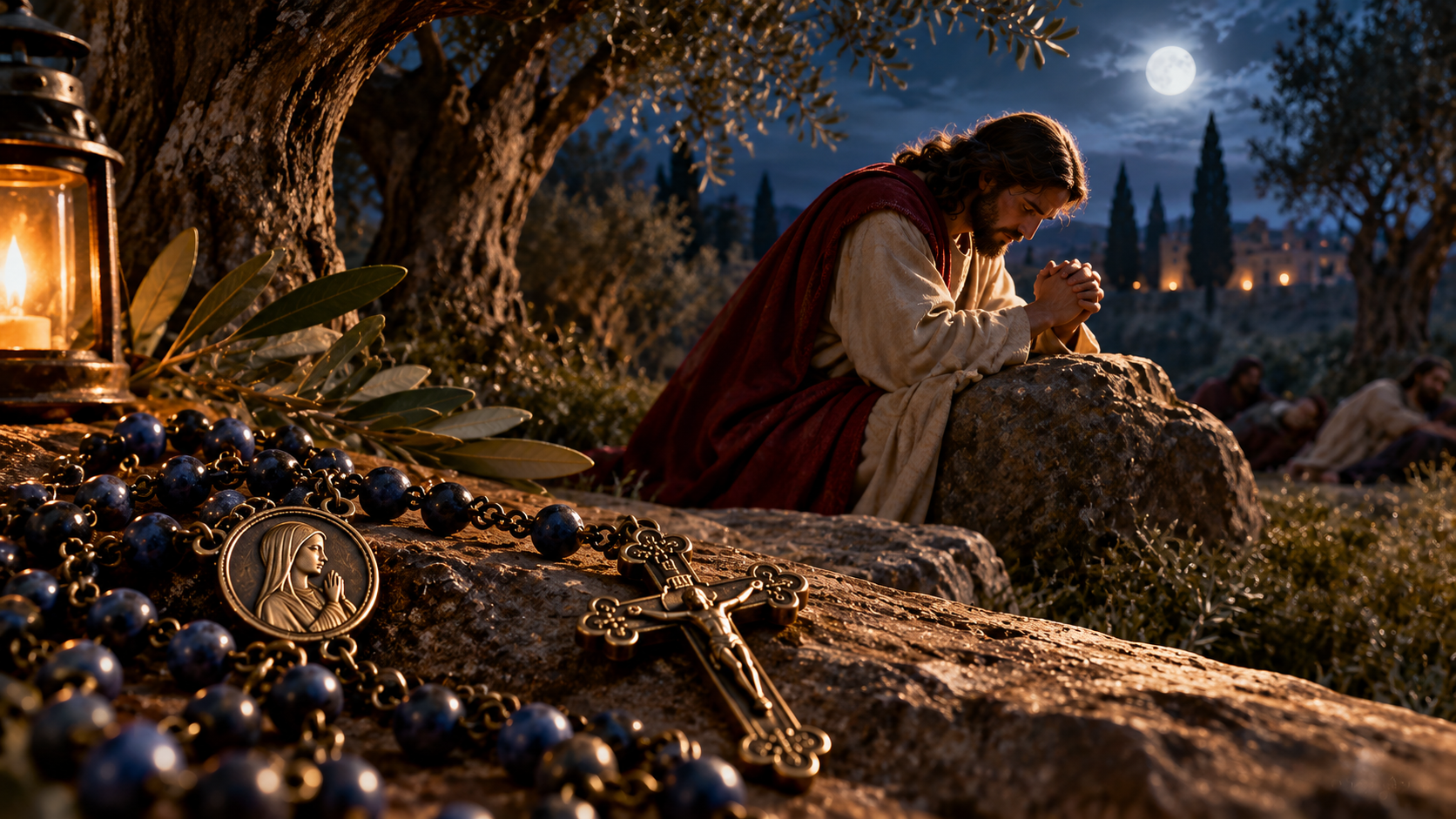
Christ Repeated His Own Prayer in Gethsemane
Perhaps the clearest answer comes from Jesus Himself.
In the Garden of Gethsemane, Christ enters into His Agony before the Passion.
He withdraws to pray to the Father.
The Gospel records His surrender:
“My Father, if it be possible, let this chalice pass from me. Nevertheless not as I will, but as thou wilt.”
— Matthew 26:39, Douay-Rheims
After returning to His disciples, Jesus withdraws again to pray.
Then St. Matthew records something especially important:
“And leaving them, he went again: and he prayed the third time, saying the selfsame word.”
— Matthew 26:44, Douay-Rheims
Christ prayed repeatedly.
And He repeated the same prayer.
This should settle one important part of the discussion.
The repetition of words cannot, by itself, be the evil condemned in Matthew 6:7.
Jesus Christ, who is without sin, repeated His prayer to the Father.
But notice the character of that repetition.
There is nothing mechanical or manipulative about it.
Christ does not attempt to force the Father to submit to His human desire to avoid suffering.
Instead, He repeatedly expresses His complete surrender to the divine will.
His repeated prayer reveals obedience.
It reveals trust.
It reveals love.
This is the opposite of vain repetition.
The Son’s words are not empty because they are spoken again.
They are holy because they express His perfect union with the will of the Father.
The lesson is especially important for Catholics who pray the Rosary.
We do not repeat prayers in order to force God to act.
We repeat them as an expression of faith and as an aid to contemplating the mysteries of Christ.
The repetition should train our hearts in the same obedience that Jesus manifested in Gethsemane.
The Persistent Widow and the Call to Persevere
Jesus also teaches the importance of perseverance through the parable of the persistent widow.
St. Luke introduces the parable by explaining its purpose:
“And he spoke also a parable to them, that we ought always to pray, and not to faint.”
— Luke 18:1, Douay-Rheims
In the parable, a widow repeatedly approaches an unjust judge seeking justice.
The judge initially refuses, but her persistence eventually leads him to respond.
Christ uses the story to teach His disciples the importance of persevering in prayer.
We must be careful not to misunderstand the comparison.
God is not an unjust judge who must be exhausted into granting our petitions.
Jesus explicitly contrasts God’s goodness with the judge’s reluctance.
The lesson concerns perseverance rooted in faith, not manipulation.
Christian prayer involves continued dependence upon God.
We may ask repeatedly for forgiveness, healing, conversion, strength, wisdom, and the salvation of those we love.
Repeated petition does not necessarily indicate that we distrust God.
When rightly offered, it expresses our ongoing reliance upon His providence.
The persistent widow teaches us not to abandon prayer merely because an answer is delayed.
Gethsemane teaches us to persevere while surrendering ourselves to the Father’s will.
Together, these passages reveal a fundamental truth.
God calls us to persistent prayer, not empty prayer.
Why the Rosary Repeats the Same Prayers
The Rosary places vocal prayer in the service of contemplation.
Its structure is intentionally repetitive.
The Our Father, the Hail Mary, and the Glory Be form a familiar rhythm through which the Christian meditates upon the saving mysteries of Jesus Christ.
The goal is not to accumulate words.
It is to contemplate the Lord.
As we pray, we return to the Incarnation, the public ministry, the Passion, the Resurrection, and the glory of Christ.
We consider not merely historical events, but the saving actions of God that continue to shape Christian life.
Imagine a child listening repeatedly to a beloved family story.
The words may remain familiar, but the child’s understanding deepens with age and experience.
The same story may communicate something different when heard in childhood, adolescence, and adulthood.
Something similar happens in the spiritual life.
The mystery of the Nativity is never exhausted.
A young parent may contemplate the poverty of Bethlehem with particular tenderness.
Someone grieving the loss of a loved one may discover new consolation in the Sorrowful Mysteries.
A person struggling with fear may find renewed hope in the Resurrection.
Someone facing an important decision may contemplate Mary’s obedience at the Annunciation.
The mysteries do not change.
But the circumstances of our lives give us new opportunities to understand and apply them.
This is why the Rosary is more than a sequence of memorized prayers.
It is a school of contemplation.
Its repetition provides a stable foundation while the heart returns again and again to the inexhaustible mystery of Christ.
The Church Warns Against Mechanical Prayer
The Catholic Church does not teach that all repetition is automatically fruitful.
In fact, she explicitly warns against reducing the Rosary to a mechanical exercise.
Pope St. Paul VI addresses this concern in his apostolic exhortation Marialis Cultus.
In paragraph 47, he emphasizes that contemplation is essential to the Rosary and warns that without it, the prayer risks becoming a merely mechanical repetition of formulas.
This warning is directed not only toward critics of the Rosary, but also toward Catholics who pray it.
The Church recognizes that it is possible to recite sacred words while remaining spiritually inattentive.
We can speak without reflecting.
We can complete prayers without seriously intending to follow Christ.
We can become more concerned with finishing a devotion than with allowing it to form our souls.
When that happens, something important has been lost.
Pope St. John Paul II also emphasizes the contemplative character of the Rosary in Rosarium Virginis Mariae, particularly paragraph 26.
The purpose of the Rosary is not to distract us from Jesus Christ.
It is to keep the mysteries of His life before our minds and hearts.
This is why the Church encourages attentive, reverent, and meditative prayer.
The problem is not that the same words appear repeatedly.
The problem arises when the words become detached from faith, understanding, and love.
Repetition Is Not Magic
Because the Rosary includes a particular number of prayers, it can sometimes be misunderstood as a spiritual formula that automatically produces a desired result.
Someone might think:
If I repeat these prayers enough times, God must give me what I want.
That is not Catholic teaching.
God is not a machine activated by religious formulas.
Nor can divine grace be purchased through a certain number of words.
The Catechism of the Catholic Church explicitly rejects superstition.
CCC 2111 explains that superstition can arise even in connection with otherwise legitimate religious practices when their effectiveness is attributed to the mere external performance of the acts apart from the interior dispositions they require.
This warning applies to the misuse of any Catholic devotion.
A Rosary is not a magical object.
The prayers are not incantations.
Their purpose is not to place God under an obligation to satisfy our demands.
God hears His children because He is a loving Father.
He gives grace according to His wisdom and goodness.
Prayer is an act of dependence upon that goodness, not a method of controlling it.
A Rosary prayed with faith, humility, and repentance is a genuine expression of Christian devotion.
But it is never a bargaining chip.
At the same time, we should avoid an opposite error.
Some assume that only spontaneous prayers can be sincere.
That is equally mistaken.
Memorized prayers can be profoundly personal.
The Our Father contains words given by Christ Himself.
The Hail Mary draws upon the inspired words of Sacred Scripture.
The Glory Be expresses the Church’s adoration of the Holy Trinity.
These prayers give us truthful words when our own language feels inadequate.
They unite our private devotion with the worship and faith of the wider Church.
And when grief, illness, or exhaustion leaves us struggling to find words, familiar prayers can become a source of spiritual strength.
The sincerity of prayer is not determined by whether its words are new.
It is determined by whether we offer them to God with faith and love.
The Heart Must Follow the Voice
How, then, can Catholics prevent the Rosary from becoming empty repetition?
The answer begins with cultivating the proper interior disposition.
The Catechism of the Catholic Church teaches that vocal prayer is an essential element of Christian prayer, while also emphasizing the importance of interior attention (CCC 2700–2704).
The words we speak should lead us toward the God whom we address.
Several practices can help.
Understand the Words
The Our Father directs us toward God as our loving Father.
The Hail Mary recalls the Incarnation, honors the Mother of God, and asks for her intercession.
The Glory Be adores the Father, the Son, and the Holy Ghost.
When we understand these words, repetition becomes an opportunity to renew our faith in what they express.
Contemplate the Mystery
Before each decade, announce the mystery.
Consider the Gospel event being remembered.
Ask what it reveals about Jesus Christ.
The Rosary should be rooted in the concrete events of salvation history.
Our attention is not meant to remain fixed upon the number of prayers completed.
It is meant to turn toward the Savior.
Bring Your Real Life Before God
Prayer should not become an escape from the moral and spiritual responsibilities of daily life.
If you are resentful, ask for the grace to forgive.
If you are afraid, entrust your fear to Christ.
If you are struggling with temptation, acknowledge your weakness.
If you need conversion, do not hide that need behind religious language.
The mysteries of the Rosary are not distant stories disconnected from our lives.
They reveal the truth by which our lives must be transformed.
Allow Prayer to Produce Conversion
The purpose of Christian prayer is not merely to create a peaceful feeling.
It is to deepen communion with God and shape our lives according to His will.
Someone who contemplates Christ forgiving His persecutors should become more willing to forgive.
Someone who meditates on the Visitation should become more attentive to the needs of others.
Someone who contemplates the Crucifixion should grow in gratitude for the sacrifice of Christ.
Someone who meditates on the Resurrection should live with greater hope.
The goal is neither constant emotional excitement nor flawless concentration.
It is sincere prayer that gradually conforms us to Jesus Christ.
The CatholicG33k Practice: The Two Gethsemane Prayers
This Week’s Spiritual Practice: The First Sorrowful Mystery — The Agony in the Garden
Scripture: Matthew 26:36–44
Grace to Seek: Trust in Divine Providence and surrender to the will of God.
This week’s practice focuses on the repeated prayer of Jesus in Gethsemane.
Begin by reading Matthew 26:36–44 slowly.
Notice how Christ returns to prayer more than once.
Consider the anguish He experiences and the obedience He expresses.
His prayer is not an attempt to control the Father.
It is an act of surrender.
Before praying your decade, meditate on His words:
Not as I will, but as thou wilt.
Then pray one decade of the Rosary, contemplating the Agony in the Garden.
At each Hail Mary, return quietly to this intention:
Father, teach me to trust Your will.
If your attention wanders, return gently to the mystery.
There is no need to begin again or become discouraged.
After completing the decade, remain silent for a few moments.
Consider one situation in your life in which you are attempting to force an outcome.
Perhaps you are anxious about a relationship, a financial concern, a family difficulty, or a decision whose future remains uncertain.
Ask yourself:
Am I praying because I trust God’s goodness, or because I am trying to make Him follow my plan?
Then ask the Lord for two graces.
First, the grace to act responsibly and faithfully in whatever remains within your control.
Second, the grace to surrender what lies beyond your control to His providence.
True surrender does not mean abandoning responsibility.
It means fulfilling our duties while recognizing that God remains Lord of the outcome.
This is the lesson Christ teaches in Gethsemane.
Prayer becomes an act of trust when we unite our desires to the will of the Father.
Questions for Reflection
1. Repetition and Sincerity
Do I criticize repetitive prayer too quickly, or do I sometimes practice it mechanically without genuine attention to God?
2. Trust and Surrender
What does Jesus’ repeated prayer in Gethsemane teach me about obedience and surrender to the Father’s will?
3. Relationship and Control
Am I approaching prayer as an opportunity for communion with God, or primarily as a way to secure the outcomes I desire?
These questions invite us to examine our approach to prayer honestly.
The goal is not to make us suspicious of every repeated word.
It is to help ensure that our prayers are rooted in faith, trust, and charity.
A Prayer for Persevering Love
Heavenly Father,
Teach me to pray as Your Son taught His disciples.
Guard me against the vanity of religious performance and the superstition of treating prayer as a magical formula.
Free my heart from the desire to control Your will through the multiplication of words.
Teach me instead to approach You with the trust of a child who knows the goodness of his Father.
When my prayers become distracted, draw my attention back to You.
When repetition becomes mechanical, renew my love for the mysteries of Christ.
When my petitions seem unanswered, strengthen my perseverance.
Through the grace of the Holy Spirit, make my repeated words an expression of sincere devotion, humility, and faith.
May the Rosary deepen my contemplation of Jesus Christ and form my heart according to His example.
And when I struggle to surrender my desires, teach me to pray with Your Son:
Not as I will, but as thou wilt.
Through the intercession of the Blessed Virgin Mary, grant that my prayers may bear fruit in conversion, obedience, and persevering love.
Amen.
Conclusion: When Repetition Becomes Love
The question is not simply whether Christians should repeat prayers.
Sacred Scripture has already shown us that repetition can be holy.
The Psalms repeat words of praise.
The angels continually proclaim the holiness of God.
Jesus Christ repeated His prayer in Gethsemane.
And the Lord Himself taught His disciples to persevere in prayer.
The real question is what our repetition expresses.
When we repeat words to impress others, manipulate God, or substitute external religious activity for genuine conversion, we have misunderstood the purpose of prayer.
But when we repeat prayers with faith, humility, and love, repetition can become a powerful expression of devotion.
The Rosary is meant to cultivate precisely this kind of perseverance.
Its familiar prayers create space for contemplating the mysteries of Jesus Christ.
Its repetition reminds us that divine truth is inexhaustible.
Its steady rhythm invites us to return to the Lord, even when we are tired, distracted, or spiritually dry.
And its mysteries continually draw our attention toward the One who teaches us how to pray.
The Rosary is not a competition to see how many words we can say.
It is an invitation to remain with Jesus Christ.
We return to the same prayers because we return to the same Lord.
We contemplate the same mysteries because their spiritual riches can never be exhausted.
We ask for grace repeatedly because we remain dependent upon God at every moment of our lives.
And we persevere not because we imagine our words can force heaven to act, but because we trust the Father who already knows our needs.
There is a world of difference between vain repetition and persevering love.
One treats prayer as a mechanical transaction.
The other treats prayer as a relationship.
Christ condemns the first.
He calls us to the second.
And when the Rosary is prayed as the Church intends, its repeated words become not an obstacle to authentic prayer, but a school in which the heart learns to love Jesus Christ more deeply.
Sources and Further Reading
Sacred Scripture
- Matthew 6:5–13 — Christ’s warning against hypocritical and empty prayer and His teaching of the Our Father.
- Matthew 26:36–44 — The Agony in the Garden and Christ’s repeated prayer of surrender.
- Luke 11:1–4 — Jesus teaches His disciples to pray.
- Luke 18:1–8 — The persistent widow and perseverance in prayer.
- Psalm 135 (Psalm 136 in many modern Bibles) — Repeated praise of God’s enduring mercy.
- Isaiah 6:3 — The seraphim proclaiming the holiness of God.
- Revelation 4:8 — The continual worship of God in heaven.
Catechism of the Catholic Church
- CCC 2111 — The danger of superstition in religious practices.
- CCC 2668 — The repetition of the holy name of Jesus in prayer.
- CCC 2700–2704 — Vocal prayer and the importance of interior attention.
Papal Documents
- Pope St. Paul VI, Marialis Cultus (1974), paragraphs 44–47 — The Rosary as a prayer rooted in the Gospel, the relationship between repetition and contemplation, and the danger of mechanical recitation.
- Pope St. John Paul II, Rosarium Virginis Mariae (2002), paragraph 26 — The contemplative character of the Rosary and the importance of prayerful attention to Christ.
The Rosary, Rediscovered — Article 5 of 12
CatholicG33k — Faith. Truth. Reason.