

The Rosary, Rediscovered — Article 4 of 12
Discover the profound biblical and theological meaning behind the Hail Mary, a prayer that reveals the mystery of the Incarnation, the power of divine grace, and the Christian hope of eternal life.
Scripture for Meditation: Luke 1:26–45; Luke 1:46–55; John 1:14
What if a prayer you have said thousands of times is also a concise confession of the Incarnation?
For countless Catholics, the Hail Mary is among the first prayers learned in childhood. Its words become so familiar that they can be recited almost without thought.
Yet behind those familiar words lies something extraordinary.
The Hail Mary contains a remarkably rich expression of Catholic faith. It speaks of God’s grace, the identity of Jesus Christ, the mystery of His Incarnation, the communion of saints, our need for mercy, and our hope of salvation.
It is not merely a prayer addressed to the Blessed Virgin Mary.
At its heart, it is a proclamation of what God has accomplished through His Son.
Familiar Words Can Hold Astonishing Truths
Many Catholics learn the Hail Mary as children, long before they can explain its theology.
This is one of the Church’s gentle methods of formation: the lips learn a prayer, and over time the mind and heart grow into its meaning.
A child may first understand the Hail Mary as a simple request for the Blessed Mother’s prayers. Years later, that same Catholic may discover that nearly every phrase contains a profound biblical truth.
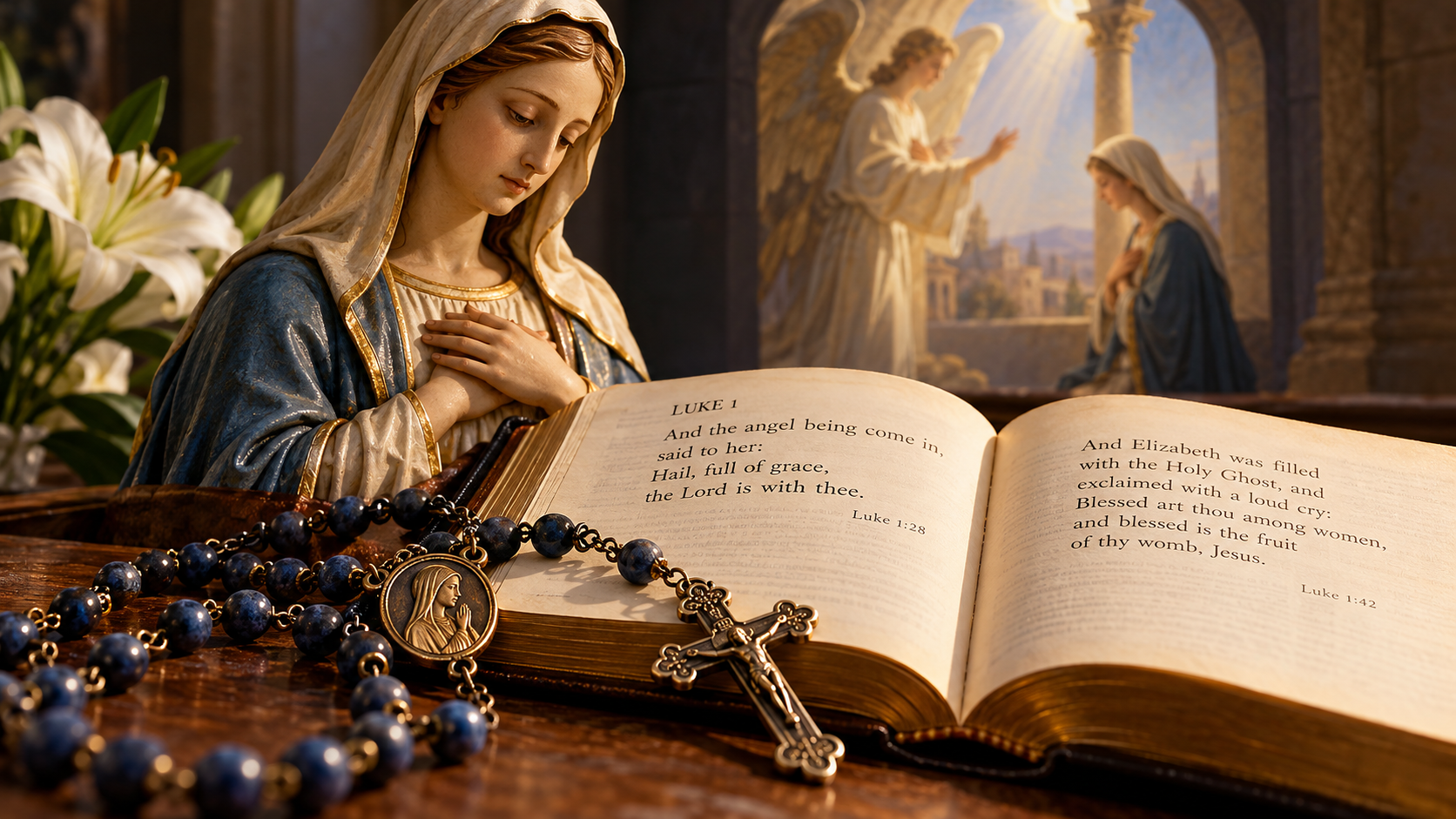
The prayer’s opening words come directly from the Gospel of Luke.
At the Annunciation, the angel Gabriel greets Mary:
“Hail, full of grace, the Lord is with thee: blessed art thou among women.”
— Luke 1:28, Douay-Rheims
Later, when Mary visits Elizabeth, Scripture tells us that Elizabeth is filled with the Holy Ghost and exclaims:
“Blessed art thou among women, and blessed is the fruit of thy womb.”
— Luke 1:42, Douay-Rheims
These are not ordinary compliments.
They are words recorded in Sacred Scripture at one of the most important moments in human history.
The eternal Son of God is entering the world through the Incarnation.
The Hail Mary does not begin with a human invention detached from salvation history. It begins with the biblical announcement that God has come to dwell among His people.
The prayer then turns to a petition formed by the Church’s faith:
Holy Mary, Mother of God, pray for us sinners, now and at the hour of our death.
Within these few lines, the Church expresses truths that theologians have spent centuries explaining.
We confess the priority of grace, the Incarnation, the divine identity of Jesus Christ, the communion of saints, our need for repentance, and our dependence upon God’s mercy at the hour of death.
What appears simple on the surface is remarkably profound.
“Full of Grace”: God’s Initiative in Salvation
The angel Gabriel does not begin by praising Mary’s human accomplishments.
He announces what God has done in her.
“Hail, full of grace.”
These words direct our attention first to divine grace.
Mary’s holiness is not the story of a human being who achieved perfection through her own unaided efforts.
It is the story of God preparing a woman, by His grace, for the extraordinary vocation of becoming the Mother of His incarnate Son.
This truth is particularly important when considering the Catholic doctrine of the Immaculate Conception.
The Church teaches that the Blessed Virgin Mary, from the first moment of her conception, was preserved from original sin by a singular grace and privilege of Almighty God, in view of the merits of Jesus Christ (CCC 491–492).
This does not mean that Mary had no need of a Savior.
It means precisely the opposite.
Mary was redeemed by Jesus Christ in an especially profound and anticipatory manner.
The grace that preserved her came entirely from the saving merits of her Son.
Her holiness is therefore a testimony to Christ’s redeeming power, not an exception to it.
This distinction matters because Catholic devotion never places Mary outside the work of salvation accomplished by Jesus.
Everything she possesses has been received from God.
There is also a lesson here for every Christian.
Holiness begins with God’s initiative.
We do not first make ourselves worthy of divine love and then receive grace as a reward.
God acts, and we are called to respond.
Mary’s faithful response was real and free, but it was always a response to the grace of God.
Every time we pray “full of grace,” we are reminded that salvation begins not with human achievement, but with divine generosity.
“The Lord Is with Thee”: The Nearness of God
Throughout Sacred Scripture, God’s presence accompanies those whom He calls to accomplish His will.
The Lord assures Moses of His presence when sending him to confront Pharaoh.
He strengthens Joshua as he prepares to lead Israel.
He calls the prophets to missions that often appear beyond their human ability.
In these biblical encounters, the assurance of God’s presence becomes the foundation of courage and obedience.
Gabriel’s words to Mary belong to this wider biblical pattern.
Yet something entirely unique is taking place.
Mary is not simply being told that God will assist her in a difficult mission.
She is being called to become the Mother of the eternal Son made flesh.
St. John expresses the mystery with astonishing simplicity:
“And the Word was made flesh, and dwelt among us.”
— John 1:14, Douay-Rheims
The Incarnation changes everything.
The eternal Son of the Father has assumed a true human nature.
The God who created the universe has entered human history.
The Child conceived in Mary’s womb is truly man and truly God.
This is why the Hail Mary is not merely an affirmation that Mary is admirable.
It rejoices in the nearness of God, who has come to save His people.
The prayer directs our hearts toward Jesus Christ, who is both Mary’s Son according to His humanity and the eternal Son of the Father according to His divinity.
The words “the Lord is with thee” therefore carry a depth that reaches to the very heart of Christianity.
God has not abandoned His creation.
He has come among us.
“Blessed Art Thou Among Women”: Honoring What God Has Done
Catholics sometimes encounter objections to calling Mary blessed or giving her special honor.
Yet Sacred Scripture itself provides the foundation for this language.
Elizabeth, filled with the Holy Ghost, calls Mary blessed among women (Luke 1:41–42).
Mary herself declares in the Magnificat:
“Because he hath regarded the humility of his handmaid; for behold from henceforth all generations shall call me blessed.”
— Luke 1:48, Douay-Rheims
Notice what follows.
Mary does not claim that her greatness originates in herself.
She immediately directs attention toward God:
“Because he that is mighty, hath done great things to me; and holy is his name.”
— Luke 1:49, Douay-Rheims
This is the proper foundation of Marian honor.
To call Mary blessed is to acknowledge what the Almighty has accomplished in her.
It is not to place her above God.
It is to praise the generosity of God, who chose her for a unique role in salvation history.
True devotion to Mary is never separated from gratitude for God’s saving work.
When the Church honors Mary, she honors the grace of God manifested in His servant.
“Blessed Is the Fruit of Thy Womb, Jesus”: The Center of the Prayer
The theological center of the Hail Mary is the name of Jesus.
Everything before that name points toward Him.
Everything after it receives its meaning from Him.
The angel’s greeting announces the grace given to Mary.
Elizabeth’s blessing recognizes the extraordinary identity of the Child she carries.
The name Jesus reveals why these blessings matter.
He is the Savior.
As the angel tells St. Joseph:
“And thou shalt call his name JESUS. For he shall save his people from their sins.”
— Matthew 1:21, Douay-Rheims
The name Jesus is inseparable from His mission of salvation.
When we pray the Rosary, we repeat that holy name while meditating upon the mysteries of His life.
During the Nativity, we contemplate the eternal Son born into poverty.
During the Baptism in the Jordan, we encounter the beloved Son revealed by the Father.
During the Crucifixion, we behold the Redeemer offering Himself for the salvation of the world.
During the Resurrection, we proclaim His victory over sin and death.
The name remains the same, but each mystery reveals another dimension of the One whom we love and worship.
Pope St. John Paul II draws particular attention to this truth in Rosarium Virginis Mariae, paragraph 33.
He recommends giving special emphasis to the name of Jesus within the Hail Mary, allowing the particular mystery being contemplated to illuminate its meaning.
This is a valuable practice.
The Rosary should never become merely a sequence of words directed toward Mary while our attention remains detached from Christ.
Its purpose is to lead us into deeper contemplation of the Savior.
Every Hail Mary places the name of Jesus upon our lips.
Every mystery invites us to know Him more deeply.
“Mother of God”: A Confession of Christ’s Divinity
The words “Mother of God” are among the most theologically significant in the entire prayer.
They are also among the most frequently misunderstood.
Some object that Mary cannot be the Mother of God because God is eternal and has no beginning.
Catholic doctrine agrees completely that Mary did not originate the divine nature.
She did not create God.
She did not exist before the Holy Trinity.
The title Mother of God means that the Person whom Mary conceived and bore is truly God the Son made man.
Motherhood concerns a person, not merely an isolated nature.
Mary is the mother of Jesus Christ according to His humanity.
But Jesus Christ is not a human person separate from the eternal Son of God.
He is one divine Person possessing two natures, divine and human.
Therefore, Mary can rightly be called the Mother of God.
The Greek title Theotokos, meaning “God-bearer,” was solemnly defended at the Council of Ephesus in AD 431.
The purpose was to safeguard the truth about Jesus Christ.
The Council rejected an understanding of Christ that improperly divided His divine and human identity.
The Church later expressed the unity of Christ’s two natures with particular clarity at the Council of Chalcedon in AD 451.
Jesus Christ is truly God and truly man, one divine Person in two natures, without confusion, change, division, or separation.
The title Mother of God therefore serves as a safeguard of orthodox Christology.
It protects the truth of the Incarnation.
The Catechism of the Catholic Church affirms Mary’s divine motherhood in CCC 495.
Every time Catholics pray “Holy Mary, Mother of God,” they confess something essential about Jesus Christ.
The Child born of Mary is not merely a prophet or an exceptionally holy man.
He is the eternal Son of God made flesh.
“Pray for Us Sinners”: Humility and the Communion of Saints
The second half of the Hail Mary begins with a humble acknowledgment of our condition.
“Pray for us sinners.”
We do not approach Mary claiming to be perfect.
We do not ask her to congratulate us on our holiness.
We acknowledge our need for divine mercy.
This is an act of spiritual realism.
Sin is not an imaginary problem.
Human weakness is not something we overcome through confidence in ourselves alone.
We need God’s forgiveness, healing, and grace.
The request for Mary’s intercession rests upon the Church’s teaching concerning the communion of saints.
Christ has united His people into one Body.
Those who have died in His friendship and now share in heavenly glory have not ceased to belong to that Body.
The Catechism of the Catholic Church teaches that the saints continue to intercede for us before God (CCC 956).
Mary’s intercession is understood within this same communion, according to her unique maternal role (CCC 2677).
This does not make Mary the source of forgiveness.
It does not displace Jesus Christ as the one mediator between God and men (1 Timothy 2:5).
Rather, the prayers of the saints depend entirely upon His mediation.
When Catholics ask Mary to pray for them, they are asking a glorified member of Christ’s Body to intercede on their behalf.
All grace comes from God through the saving work of Jesus Christ.
The Hail Mary therefore teaches humility without despair.
We confess that we are sinners.
But we also express hope that God hears the prayers of His people.
“Now and at the Hour of Our Death”: A Prayer for the Whole of Life
The final words of the Hail Mary are especially moving.
“Now and at the hour of our death.”
In this brief petition, the Church gathers the entirety of our earthly existence between two moments.
The present moment.
And the final moment of our earthly life.
We need grace now.
We need strength against temptation, wisdom in our decisions, patience in suffering, forgiveness for our sins, and charity toward our neighbors.
But we will also need grace at the hour of death.
Catholic spirituality has always encouraged the faithful to prepare for death, not through morbid fear, but through repentance, trust, and hope in Christ.
The hour of death is the moment when our earthly pilgrimage comes to its conclusion.
We ask for Mary’s prayers because she remained faithful to her Son even at Calvary.
St. John’s Gospel records her presence beneath the Cross (John 19:25–27).
She witnessed the suffering and death of the One whom she had carried in her womb.
Her fidelity in that hour gives special tenderness to the Church’s petition that she intercede for us when our own earthly life approaches its end.
This is not because Mary possesses power over death.
Christ alone has conquered death through His Resurrection.
Rather, we ask the Mother of the Redeemer to pray that we may remain faithful to her Son until the end.
The Hail Mary thus reminds us that the Christian life is directed toward eternity.
We pray for grace today so that we may persevere in grace until our final hour.
The CatholicG33k Practice: Pray One Phrase at a Time
This Week’s Spiritual Practice: Rediscovering the Hail Mary
Scripture: Luke 1:26–55; Matthew 1:21; John 1:14
Grace to Seek: A deeper love for Jesus Christ through understanding the prayer of His Blessed Mother.
For the next seven days, make a deliberate effort to pray the Hail Mary with greater attention.
Rather than reciting the familiar words automatically, meditate upon their meaning.
Day 1: “Hail Mary, full of grace.”
Read Luke 1:26–28.
Reflect upon the priority of God’s grace in salvation.
Ask for humility and gratitude for the gifts God has given you.
Day 2: “The Lord is with thee.”
Read Luke 1:30–38 and John 1:14.
Contemplate the mystery of the Incarnation.
Consider what it means that the eternal Son of God truly became man.
Day 3: “Blessed art thou among women.”
Read Luke 1:39–49.
Consider Mary’s humility and her willingness to praise God for His gifts.
Ask whether you recognize God’s work in your own life with similar gratitude.
Day 4: “Blessed is the fruit of thy womb, Jesus.”
Read Matthew 1:18–25.
Reflect upon the saving meaning of the name Jesus.
Pronounce His holy name slowly and reverently.
Day 5: “Holy Mary, Mother of God.”
Read Luke 1:39–45.
Contemplate the divine identity of Mary’s Son.
Thank God for the mystery of the Incarnation.
Day 6: “Pray for us sinners, now and at the hour of our death.”
Read John 19:25–27.
Acknowledge your need for mercy and perseverance.
Ask for the grace to remain faithful to Christ throughout your life and at the hour of death.
Day 7: Bring the Prayer Together
Pray one decade of the Rosary slowly.
Choose any mystery of Christ’s life.
As you pray each Hail Mary, pause inwardly at the name Jesus.
Allow the mystery to give that name a concrete Gospel setting.
Do not rush.
Do not attempt to manufacture an emotional experience.
Simply seek to understand what you are saying and to whom your prayer ultimately directs your heart.
The purpose is not merely to complete a devotional exercise.
It is to begin praying familiar words with renewed faith, understanding, and love.
Questions for Reflection
1. Familiarity and Understanding
Have I allowed familiarity to hide the profound Catholic doctrine contained in the Hail Mary?
2. The Holy Name of Jesus
What does the name of Jesus mean to me when I pronounce it? Do I speak His name with genuine reverence and love?
3. Mercy and Eternal Life
Am I willing to acknowledge myself as a sinner who needs God’s mercy both now and at the hour of death?
These questions invite us to move beyond mechanical repetition and toward a deeper understanding of Christian prayer.
The Hail Mary is not simply something to memorize.
It is something to contemplate.
A Prayer for Deeper Love of Christ
Lord Jesus Christ,
Blessed fruit of the Virgin Mary’s womb, grant that the words of the Hail Mary may lead me to know and love You more deeply.
Open my mind to the truths contained in this familiar prayer.
Teach me to recognize the greatness of Your Incarnation, the power of Your saving grace, and the mercy You offer to sinners.
Through the intercession of Your Blessed Mother, give me humility before Your grace, fidelity throughout my life, and unwavering trust in Your mercy at the hour of death.
May every Hail Mary draw my heart closer to You.
May the mysteries of the Rosary strengthen my faith, deepen my hope, and increase my charity.
And may Your holy name remain upon my lips and within my heart, now and forever.
Amen.
Conclusion: A Familiar Prayer That Proclaims the Gospel
The Hail Mary is far more than a collection of familiar religious words.
It is a prayer rooted in the Gospel.
Its opening greetings come from Sacred Scripture.
Its central name is Jesus.
Its doctrinal language safeguards the mystery of the Incarnation.
Its petition expresses the communion of saints and our dependence upon divine mercy.
Its final words direct our attention toward the hope of eternal life.
In a remarkably brief prayer, the Church places before us truths that reach to the very center of Christianity.
God has acted through grace.
The eternal Son has become man.
Jesus Christ is the Savior of the world.
His redeemed people remain united in the communion of saints.
And every human being stands in need of God’s mercy.
The Hail Mary teaches these truths not only through theological explanation, but through repetition shaped by faith.
Every time we pray it attentively, we have another opportunity to remember who Jesus Christ is and what He has accomplished for our salvation.
The words may be familiar.
Their meaning should never become ordinary.
Perhaps the next time we lift our Rosary beads and begin the Hail Mary, we will hear those words differently.
Not as a prayer we have already mastered.
But as an invitation to contemplate the Gospel once again.
For hidden within this familiar prayer is the extraordinary truth that stands at the heart of our faith:
The Word was made flesh.
And His name is Jesus.
Sources and Further Reading
Sacred Scripture
- Luke 1:26–38 — The Annunciation and the angel Gabriel’s greeting.
- Luke 1:39–45 — The Visitation and Elizabeth’s blessing.
- Luke 1:46–55 — The Magnificat.
- Matthew 1:18–25 — The birth of Jesus and the meaning of His name.
- John 1:14 — The Word made flesh.
- John 19:25–27 — Mary at the foot of the Cross.
- 1 Timothy 2:5 — Christ as the one mediator between God and men.
Catechism of the Catholic Church
- CCC 430–435 — The holy name of Jesus.
- CCC 491–492 — The Immaculate Conception and Mary’s preservation through the merits of Christ.
- CCC 495 — Mary as Mother of God.
- CCC 956 — The intercession of the saints.
- CCC 2676 — The biblical foundations and Christ-centered meaning of the Hail Mary.
- CCC 2677 — The Church’s petition for Mary’s intercession, now and at the hour of death.
Ecumenical Councils and Papal Teaching
- Council of Ephesus (AD 431) — The defense of Mary’s title Theotokos, Mother of God.
- Council of Chalcedon (AD 451) — The unity of Christ’s divine and human natures in one Person.
- Pope St. John Paul II, Rosarium Virginis Mariae (2002), paragraph 33 — The importance of emphasizing the holy name of Jesus in the Hail Mary.
The Rosary, Rediscovered — Article 4 of 12
CatholicG33k — Faith. Truth. Reason.