

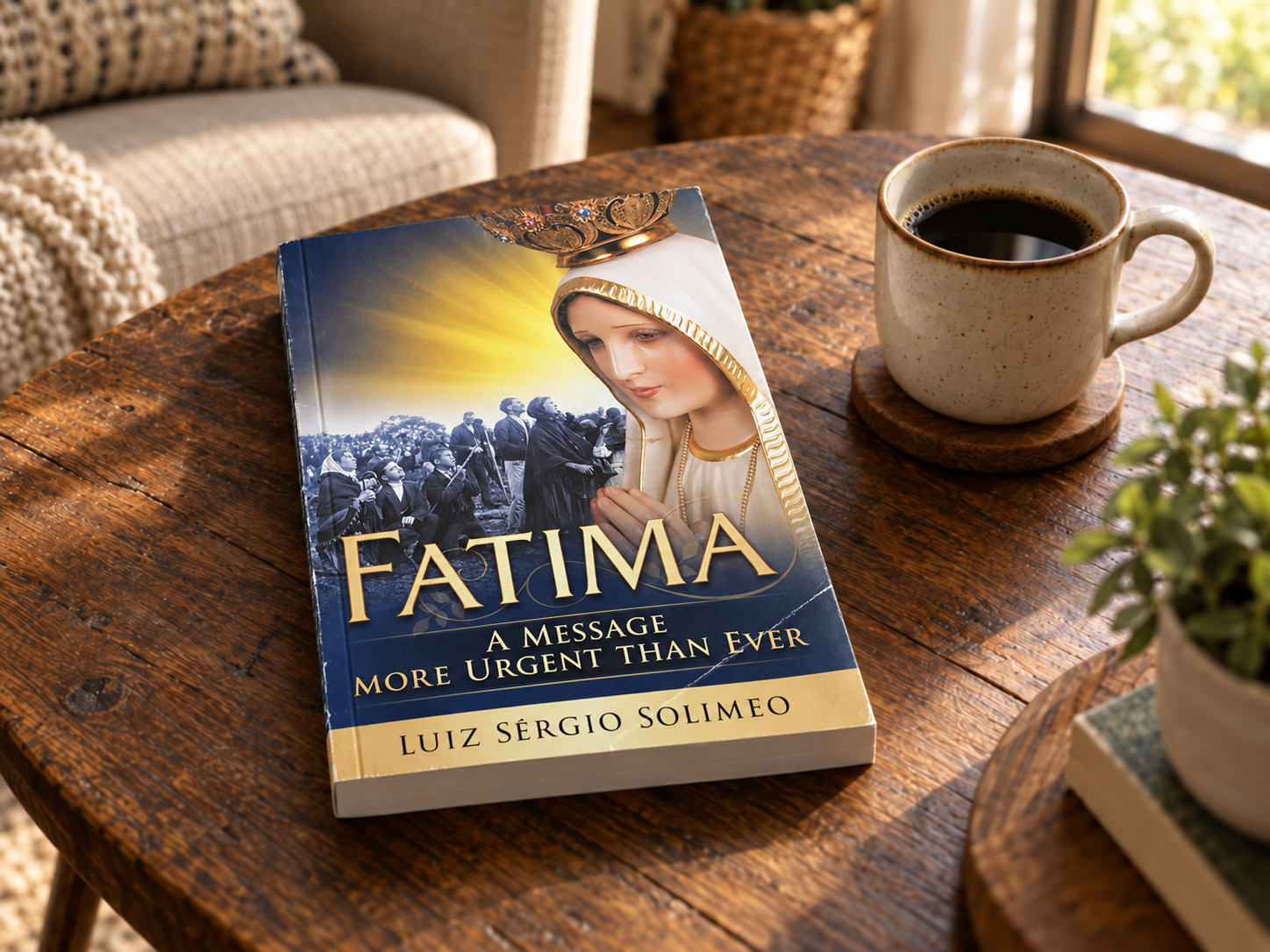
There are some Catholic books that teach us something new.
Others remind us of something we already knew but had allowed to become distant.
Fatima: A Message More Urgent Than Ever by Luiz Sergio Solimeo belongs to the second category.
Most Catholics have heard of Fatima.
We know the names Lucia, Francisco, and Jacinta.
We know about the Rosary.
We know about the Miracle of the Sun.
We have heard of the Immaculate Heart of Mary, the First Saturdays, Russia, penance, reparation, and the conversion of sinners.
And perhaps that familiarity creates a danger.
We can know the story of Fatima so well that we stop hearing the message.
That may be the deepest purpose of Solimeo’s book.
It does not merely ask us to believe that something extraordinary happened in Portugal.
It asks a much more uncomfortable question:
What if Our Lady meant what she said?
Fatima Is Not Primarily About Curiosity
The structure of the book makes this clear.
Solimeo begins with the ordinary Christian world from which the three shepherd children came: prayer, family life, work, sacrifice, First Communion, devotion to Our Lady, and a serious awareness of God. He then moves through the apparitions of the Angel, the appearances of Our Lady, the call to reparation, the warnings concerning sin, the secret, the Miracle of the Sun, the sufferings of the children, the Five First Saturdays, Russia, chastisement, and finally the promised triumph of the Immaculate Heart.
That progression matters.
The book does not treat Fatima as a supernatural spectacle.
The miracles authenticate the message.
But the message itself is about conversion.
Solimeo states this explicitly near the end: the Fatima message can be summed up as a “vehement appeal for the world’s conversion.”
That changes the way we should approach Fatima.
The question is not merely:
“Did the sun really dance?”
The more important question becomes:
If heaven went to such extraordinary lengths to call mankind back to God, what are we doing with that warning?
Before Our Lady Came, Heaven Taught the Children How to Pray
One of the most striking parts of the book is the preparation of Lucia, Francisco, and Jacinta before the Marian apparitions began.
The Angel of Peace did not entertain them with mysteries.
He taught them to pray.
He taught them adoration.
He taught them sacrifice.
He taught them reparation.
He taught them to offer themselves for sinners.
During the final apparition of the Angel, the children were taught to adore the Most Holy Trinity and to offer the Body, Blood, Soul, and Divinity of Jesus Christ in reparation for sacrilege and indifference, asking for the conversion of sinners through the merits of the Sacred Heart of Jesus and the Immaculate Heart of Mary.
That seems to reveal something important about the entire Fatima message.
Before heaven gave them warnings about nations, wars, Russia, persecution, and chastisement, it first formed them in Eucharistic love, prayer, humility, and sacrifice.
That order should teach us something.
It is easy to become fascinated by the prophetic dimension of Fatima.
It is much harder to imitate the children.
We can spend hours debating timelines and historical interpretations while avoiding the simpler questions:
Do I pray the Rosary?
Do I make reparation?
Do I receive the Eucharist worthily?
Do I go to confession?
Do I willingly offer suffering for the conversion of sinners?
Do I actually hate sin because it offends God?
Fatima becomes safe when it remains something we study.
It becomes demanding when we realize it is something we are meant to live.
The Most Frightening Part of Fatima May Be the Seriousness of Sin
Modern Christianity often speaks easily about God’s mercy.
And rightly so.
God is infinitely merciful.
But mercy makes sense only when there is something from which we need to be saved.
One of the strongest themes running through Solimeo’s book is that sin is not trivial.
It wounds.
It destroys.
It has consequences.
It separates souls from God.
The message described in the book includes warnings about hell, war, persecution, suffering, and chastisement precisely because mankind’s rejection of God has consequences. The author repeatedly presents devotion to the Immaculate Heart, penance, prayer, and conversion as heaven’s merciful answer to that crisis.
Fatima is therefore not a message of despair.
It is almost the opposite.
A warning is itself an act of mercy.
A doctor who sees a deadly disease and says nothing is not compassionate.
The compassionate doctor tells the truth because treatment is still possible.
That is how Fatima begins to look after reading this book carefully.
Our Lady does not come merely to announce punishment.
She comes because punishment can still be avoided through conversion.
She warns because she wants souls saved.
She asks for prayer because prayer matters.
She asks for sacrifice because sacrifice offered in charity can participate in the salvation of others.
She points to her Immaculate Heart because God desires to use her maternal intercession to bring souls back to Himself.
The warning is severe because the danger is real.
But the very fact that heaven warns us means mercy has not abandoned us.
Three Children Took the Salvation of Souls More Seriously Than Many Adults Do
Francisco and Jacinta may be the most unsettling figures in the book.
Not because they were frightening.
Because they were children.
Their response to Fatima exposes how casually adults can treat eternal things.
After the apparitions, their lives changed dramatically. They embraced prayer, sacrifice, and suffering for sinners with a seriousness that the book compares to the great penitential saints. Solimeo connects their sacrifices explicitly to the Communion of Saints: God accepts the prayers and sacrifices of generous souls for the good of others.
That idea deserves more attention.
The Communion of Saints is not merely a comforting doctrine about heavenly friendship.
It means our lives are mysteriously connected.
My holiness can benefit another soul.
My prayers can help another soul.
My sacrifices can be offered for another soul.
Likewise, my sins are never purely private.
Christianity does not permit the radical individualism that says:
“My choices affect only me.”
The children of Fatima understood the opposite.
They began offering suffering for people they had never met.
They cared about sinners who did not care about themselves.
Jacinta’s willingness to suffer for the conversion of sinners becomes especially moving because she was still a child. Even in illness and loneliness, the book presents her offering suffering for love of Jesus, the Holy Father, sinners, and in reparation to the Immaculate Heart of Mary.
There is something humbling about that.
We spend enormous energy avoiding inconvenience.
They learned to turn inconvenience into an offering.
We ask how little is required.
They asked how much they could give.
We often pray, “Lord, remove this suffering.”
They learned to ask, in effect, “Lord, use this suffering.”
That does not mean Catholics should seek pain for its own sake.
Suffering is not the good.
Love is the good.
But love can take suffering that already exists and refuse to let it be wasted.
That may be one of Fatima’s most difficult lessons.
Reparation Means Love Refuses to Remain Passive
The concept of reparation runs through the entire book.
For modern readers, the word can sound severe or unfamiliar.
But at its heart, reparation is an act of love.
When someone we love is insulted, wounded, ignored, or betrayed, love wants to make amends.
That is the spiritual logic of reparation.
The book describes the vision associated with the First Saturdays in which the Immaculate Heart is shown surrounded by thorns, symbolizing blasphemy and ingratitude. The requested response is confession, Holy Communion, five decades of the Rosary, and fifteen minutes of meditation on the mysteries of the Rosary, all offered with the intention of making reparation.
What strikes me is how Catholic the remedy is.
It is not exotic.
Confession.
The Eucharist.
The Rosary.
Meditation.
Grace.
Repentance.
Love.
The supernatural answer to the crisis of the world is not primarily cleverness.
It is holiness.
That is easy to underestimate.
We want enormous problems to have enormous visible solutions.
Fatima gives us ordinary Catholic practices charged with extraordinary seriousness.
The book summarizes the Five First Saturdays as a devotion combining reparation, love of the Eucharist, confession, love of the Immaculate Heart, the Rosary, and meditation.
In other words, heaven’s remedy is not detached from normal Catholic life.
It is normal Catholic life lived deeply.
The Immaculate Heart Is Not a Distraction From Jesus
One of the most important theological points in the book appears in its treatment of devotion to the Immaculate Heart.
The message attributed to Our Lady is that Jesus Himself desires this devotion.
Solimeo therefore presents the Immaculate Heart as a refuge and a path leading to God, emphasizing that Marian devotion is rooted in the will of Christ rather than competing with Him.
That matters because Marian devotion is frequently misunderstood as though Catholics place Mary between themselves and Jesus.
Fatima presents almost the reverse.
Mary comes because she belongs completely to Christ.
She seeks what He seeks.
She loves what He loves.
She wants sinners converted to Him.
Her Heart matters because it is perfectly oriented toward God.
To enter the spirituality of Fatima is therefore not to stop at Mary.
It is to let Mary teach us how seriously we should take Jesus.
That is why the Eucharist is everywhere in this story.
That is why reparation matters.
That is why sin matters.
That is why conversion matters.
That is why the Rosary matters.
The Immaculate Heart is not the destination.
It is maternal refuge on the road to God.
Fatima Refuses to Separate Personal Sin From the Fate of Society
Another striking aspect of the book is how easily Fatima moves between the soul and the world.
Personal conversion.
Then nations.
Private sin.
Then war.
Prayer.
Then history.
The book insists that spiritual and historical realities are connected.
Sin does not remain locked inside individual hearts.
Enough disordered hearts eventually produce disordered cultures.
Enough disordered cultures eventually produce disordered institutions.
And eventually entire societies can become organized around falsehood.
Solimeo spends significant attention on what the book calls the “errors of Russia,” treating them not merely as one twentieth-century political problem but as a broader rejection of Christian order whose effects continue culturally even when older political structures change.
Readers may differ over particular historical applications the author makes.
But the deeper Catholic principle is difficult to deny:
Ideas have consequences because beliefs eventually become ways of life.
If man believes there is no God, human dignity changes.
If marriage has no divine meaning, marriage changes.
If human life has no eternal destiny, the way societies treat the weak changes.
If freedom means liberation from moral truth, freedom eventually begins to destroy itself.
Fatima therefore refuses to let us think that conversion is merely a private religious hobby.
The conversion of hearts changes history.
And the corruption of hearts changes history too.
The Message Is Urgent Because Souls Are Eternal
The title says the message is “more urgent than ever.”
It would be easy to interpret that only politically or prophetically.
But after reading the whole book, I think the deeper urgency is simpler.
People still sin.
People still die.
Souls still need conversion.
Christ is still offended by sin.
Prayer still matters.
The Eucharist is still the Eucharist.
The Rosary can still be prayed.
Sacrifice can still be offered.
Confession is still available.
That is why Fatima does not become obsolete merely because 1917 grows more distant.
The historical circumstances change.
The spiritual problem does not.
Our Lady’s appeal to the children—to offer themselves, pray, and suffer for sinners—still challenges anyone willing to hear it.
The book’s conclusion makes precisely that move. It argues that the appeal originally addressed to the little shepherds is also addressed to us.
That may be the point where the reader can no longer remain a spectator.
Fatima stops being “their story.”
It becomes a question addressed to us.
“Finally, My Immaculate Heart Will Triumph”
The most important word in the title of the final chapter may be finally.
Not immediately.
Finally.
The book ends in confidence rather than fear.
That is essential.
Fatima contains warnings severe enough to frighten anyone who takes them seriously.
But fear is not the final message.
The final message is victory.
Solimeo’s conclusion argues that confidence is rooted in faith and that Christians have reason for confidence because the promised triumph belongs ultimately to God’s providence. The reader is not told simply to watch history unfold, but to participate through prayer, penance, witness, and fidelity.
That gives Fatima a very different character.
It is not fatalism.
Fatalism says:
“Terrible things will happen, so nothing matters.”
Fatima says:
“Your response matters precisely because history is under God.”
Pray.
Repent.
Offer sacrifice.
Make reparation.
Stay faithful.
Help convert sinners.
Do not surrender to the spirit of the age.
Trust God.
And expect the final word to belong not to sin, war, persecution, ideology, or darkness, but to Christ.
The triumph of the Immaculate Heart is therefore not Mary’s victory apart from Jesus.
It is the triumph of grace in a heart completely surrendered to Him.
It is Christ victorious through the woman who always belongs to Him.
Perhaps the Greatest Danger Is Thinking the Message Is for Someone Else
When we read about the conversion of sinners, there is a temptation to imagine other people.
The immoral.
The unbelieving.
The corrupt politician.
The atheist.
The person destroying the culture.
The person who needs to change.
But the first sinner I can bring to conversion is myself.
That may be where Fatima must begin.
Before asking whether the world has answered Our Lady, I should ask whether I have.
Do I pray?
Do I repent?
Do I make reparation?
Do I take the Eucharist seriously?
Do I confess my sins?
Do I pray for sinners?
Do I offer anything difficult to God instead of simply complaining about it?
Do I trust Our Lady?
Do I actually believe souls can be lost?
Do I live as though heaven and hell are real?
Those questions make Fatima uncomfortable again.
And perhaps that is exactly what we need.
Because a message from heaven that never disturbs our complacency has probably been reduced to decoration.
Fatima Is Ultimately a Message of Hope
After finishing Fatima: A Message More Urgent Than Ever, I do not think the proper response is panic.
It is seriousness.
Seriousness about sin.
Seriousness about prayer.
Seriousness about the Mass.
Seriousness about confession.
Seriousness about the Rosary.
Seriousness about sacrifice.
Seriousness about the salvation of souls.
And underneath all of that, confidence.
The same message that warns of consequences also promises triumph.
The same Mother who speaks about hell offers a path toward heaven.
The same apparition that calls for penance offers mercy.
The same story that contains war and persecution ends with peace.
That balance matters.
Fatima is severe because love is serious.
But it is hopeful because grace is stronger than sin.
The book left me with the sense that perhaps the real question is not whether Fatima remains relevant.
The question is whether we have become less capable of hearing what it says.
Our Lady asked three children whether they would offer themselves to God for sinners.
They said yes.
More than a century later, the question still hangs in the air.
Not only for Lucia.
Not only for Francisco.
Not only for Jacinta.
For us.
Will we pray?
Will we repent?
Will we make reparation?
Will we offer what suffering comes to us?
Will we live as though eternity is real?
Will we trust the Mother Christ gave us?
And will we believe her promise when the darkness appears strongest?
“Finally, my Immaculate Heart will triumph.”
Perhaps the purpose of Fatima is not primarily to tell us what will happen next.
Perhaps its purpose is to teach us how a Christian should live until the triumph comes.
Sources & Further Reading
- Luiz Sergio Solimeo, Fatima: A Message More Urgent Than Ever
The primary source for this reflection. The book draws extensively from Sister Lucia’s memoirs and presents the apparitions, the call to conversion and reparation, the First Saturdays, the warnings concerning sin and Russia, and the promised triumph of the Immaculate Heart. - Sister Lucia, Fatima in Lucia’s Own Words
A principal firsthand source for the apparitions and the spiritual experiences of Lucia, St. Francisco Marto, and St. Jacinta Marto. The official Shrine of Fatima frequently cites these memoirs in its historical accounts. Santuário de Fátima
Chronology of the Three Seers — Shrine of Fatima - Shrine of Fatima — The Event of Fatima
An official presentation of the message of Fatima, emphasizing grace, mercy, conversion, the Immaculate Heart, and the First Saturdays. Santuário de Fátima
The Event of Fatima - Shrine of Fatima — The Immaculate Heart
Explains the Immaculate Heart as a refuge and a way leading to God, and places consecration and reparation within the broader call to conversion and divine mercy. Santuário de Fátima
The Immaculate Heart - Shrine of Fatima — First Saturdays
Gives the traditional requirements of the Five First Saturdays: confession, Holy Communion, five decades of the Rosary, fifteen minutes of meditation, and the intention of making reparation. Santuário de Fátima
First Saturdays - Pope St. John Paul II, Homily at Fatima, May 13, 2000
At the beatification of Francisco and Jacinta Marto, John Paul II reflected on their call to reparation and on Our Lady’s maternal desire to lead souls safely to God. Vatican
Vatican — Beatification of Francisco and Jacinta Marto