

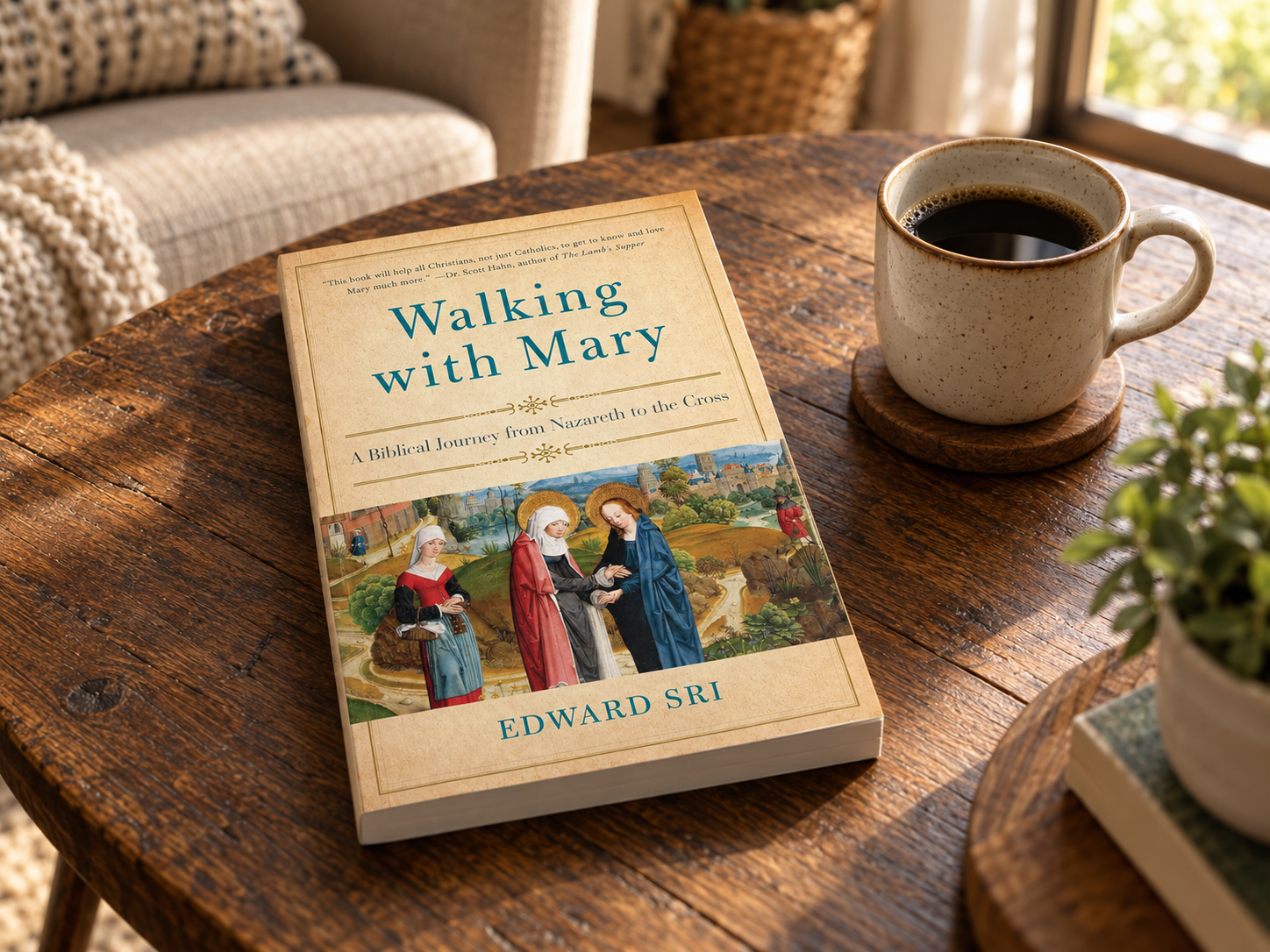
Edward Sri’s Walking with Mary: A Biblical Journey from Nazareth to the Cross initially appears to be a book about Mary.
By the end, it becomes clear that it is really a book about discipleship.
Mary is the one walking ahead of us.
The genius of the book is that it does not present the Blessed Virgin merely as a finished masterpiece—a woman already standing in heavenly glory, crowned with twelve stars, seemingly untouched by the uncertainty ordinary Christians experience.
Instead, Sri takes us backward.
Before the crown, there was the Cross.
Before the Cross, there was Cana.
Before Cana, there were years of silence.
There was a sword foretold.
There was a child lost for three days.
There was a manger.
And before all of it, there was a young woman in Nazareth confronted with a word from God that would completely rearrange her life.
That is where Mary becomes particularly important for us.
Not because she had everything figured out.
But because she trusted God when she did not.
Mary Did Not Say Yes Only Once
We often reduce the Annunciation to a single beautiful moment.
Gabriel appears.
Mary listens.
Mary answers:
“Behold the handmaid of the Lord; be it done to me according to thy word.”
— Luke 1:38
And we imagine that the great decision has been made.
In one sense, it has.
But Walking with Mary helped bring something else into focus: Mary spent the rest of her life living out the consequences of that sentence.
Her fiat was spoken once with her lips, but it had to be repeated countless times with her life.
“Yes” when the angel spoke.
“Yes” when she carried a mystery no one else could fully understand.
“Yes” when there was no room for her Son.
“Yes” when Simeon told her a sword would pierce her soul.
“Yes” when she could not understand why Jesus had remained behind in Jerusalem.
“Yes” when His public ministry began.
“Yes” when opposition grew.
“Yes” when the road led to Calvary.
“Yes” when she stood beneath a Cross on which hung the very Son Gabriel had promised would receive the throne of David.
That changes how we understand surrender.
We sometimes imagine surrender to God as one enormous spiritual decision: Lord, I give You my life.
But God usually receives that gift from us piece by piece.
The first yes opens the door.
Then come all the little yeses that prove whether we meant it.
Faith Does Not Mean Understanding Everything
One of the most striking parts of Mary’s biblical journey is that Scripture does not pretend she understood everything immediately.
When Jesus was found in the Temple, St. Luke says plainly:
“And they understood not the word that he spoke unto them.”
— Luke 2:50
That verse matters.
This is the Blessed Virgin Mary.
Full of grace.
Mother of God.
And she did not understand.
Yet the next verse tells us that she kept these things in her heart.
That may be one of the deepest lessons in the entire book.
Faith is not the same thing as having an explanation.
Sometimes we believe that if God were really leading us, everything would make sense.
The path would be obvious.
The pieces would fit.
Prayer would bring immediate clarity.
Suffering would arrive with an explanation attached.
Mary’s life destroys that illusion.
There are moments when God allows us to walk with Him without telling us exactly where we are going.
There are prayers whose answers we do not yet recognize.
There are losses whose meaning we cannot see.
There are seasons when Christ seems strangely absent—even though He has never abandoned us.
Mary teaches another response.
Keep it.
Ponder it.
Remain faithful.
Wait for God to reveal what you cannot presently understand.
There is an enormous difference between saying, “I do not understand God,” and saying, “Therefore I cannot trust God.”
Mary lived inside that difference.
The Sword Was Already Hidden Inside the Yes
Simeon tells Mary that a sword will pierce her soul.
From that moment forward, the shadow of the Cross lies across her motherhood.
This is where the book refuses sentimental Christianity.
Walking with God does not mean being spared suffering.
Sometimes walking closely with Christ means being brought close enough to Calvary that His suffering touches us too.
Mary’s intimacy with Jesus did not protect her from the Cross.
It brought her to it.
That is worth dwelling on.
We frequently ask God to draw us closer to Him while quietly assuming that closeness will make life easier.
But Christianity centers upon a crucified Lord.
To come closer to Jesus eventually means coming closer to the Cross.
Not because God delights in pain.
Not because suffering is good simply because it hurts.
But because love in a fallen world eventually costs something.
Anyone can say yes to God when His will coincides with ours.
The deeper surrender comes when obedience costs us the thing we would most like to keep.
Mary eventually had to surrender Jesus Himself—not by ceasing to love Him, but by refusing to possess Him.
At Cana, she allows His public mission to begin.
At Calvary, she allows that mission to reach its terrible fulfillment.
The mother who once held Him against her chest eventually stands beneath Him with empty hands.
And she remains.
“Do Whatever He Tells You”
Sri makes much of Mary’s final recorded words in Scripture:
“Whatsoever he shall say to you, do ye.”
— John 2:5
After reading the whole journey, those words sound different.
They are not a slogan spoken by someone for whom obedience has always been easy.
They are the words of a woman who has tested trust in the furnace.
Mary can tell the servants to trust Jesus because she has trusted Him herself.
She knows what it means to hear something she does not fully understand.
She knows what it means to surrender control.
She knows what it means to place the future into God’s hands.
She knows what it means to discover that God’s plan is larger than the moment in front of her.
Her last recorded words therefore summarize her entire spirituality:
Do what He tells you.
Not merely when you understand.
Not only when it is convenient.
Not only when obedience produces immediate consolation.
Do what He tells you because He is trustworthy.
Perhaps this is also why authentic Marian devotion never terminates in Mary.
She keeps pointing beyond herself.
At Cana she does not say, “Look at me.”
She says, in effect, Listen to Him.
That is what Our Lady continues to do.
The closer we genuinely draw to Mary, the more insistently she directs our attention toward Christ.
Mary at the Cross
The culmination of the journey is not a theological argument Mary makes.
It is where she stands.
“Now there stood by the cross of Jesus, his mother.”
— John 19:25
She stood.
There is something almost overwhelming in the simplicity of that sentence.
She could not stop the crucifixion.
She could not remove the nails.
She could not silence the mockery.
She could not make the suffering disappear.
But she could remain.
Sometimes that is the only fidelity left to us.
There are moments when we cannot fix what is broken.
We cannot restore what has been lost.
We cannot make sense of what God has permitted.
We cannot even find the words to pray.
But we can remain.
We can stand at the Cross.
We can refuse to run from Jesus merely because following Him has become painful.
That kind of faith may be more profound than the faith that accomplishes impressive things.
Mary’s greatness at Calvary is partly found in the fact that she stayed.
The Annunciation asked her to receive Christ.
Calvary asked her to surrender Him.
She said yes to both.
The Crown Only Makes Sense After the Cross
The book ends by looking toward the woman clothed with the sun in Revelation 12.
That is important because Christianity never ends at Calvary.
The woman who walks through uncertainty, sorrow, surrender, and the Cross is finally shown in glory.
The crown does not erase the journey.
It reveals what the journey was producing.
And perhaps this is one of the great purposes of Marian devotion.
Mary shows us what grace intends to do with a human life.
We look at her and see not merely someone to admire but a promise of what complete cooperation with God looks like.
God’s grace does not destroy Mary’s humanity.
It perfects it.
Her humility does not make her insignificant.
It makes room for God to exalt her.
Her surrender does not diminish her.
It allows God to do something through her greater than she ever could have designed for herself.
Her suffering is not the final word.
Glory is.
That pattern belongs not only to Mary.
It is the Christian pattern.
Grace.
Surrender.
Cross.
Perseverance.
Glory.
Walking With Mary Means Learning Her Way of Walking
After finishing Walking with Mary, I don’t think its central invitation is simply, “Know more about Mary.”
It is:
Learn how Mary walked with God, and then walk that way yourself.
Have an open heart when God speaks.
Ask honest questions without making understanding a condition for obedience.
Receive grace as gift rather than achievement.
Magnify God rather than yourself.
Keep and ponder what you do not yet understand.
Remain faithful when the sword comes.
Trust Christ in darkness.
Say yes again when yesterday’s yes suddenly becomes expensive.
Stand near the Cross.
Persevere until faith gives way to sight.
And through all of it, hear Mary’s final biblical instruction:
“Whatsoever he shall say to you, do ye.”
Perhaps the deepest realization from the book is that sanctity is rarely built through one spectacular act of faith.
It is built through a lifetime of renewed consent.
God asks.
We answer.
Then tomorrow He asks more deeply.
And we answer again.
Mary’s first fiat in Nazareth eventually carried her all the way to Calvary. But Calvary was not evidence that her yes had failed.
Calvary revealed how complete her yes had become.
That may be the lesson we most need when following God becomes difficult.
The darkness does not necessarily mean we took the wrong road.
The Cross does not mean God has abandoned His promise.
Not understanding does not mean we have ceased to be led.
Sometimes the path of faith looks exactly like Mary’s:
We receive a promise.
We walk.
We wonder.
We suffer.
We surrender.
We keep walking.
And only later do we discover that God was bringing every faithful yes toward a glory we could not yet see.
That is what it means to walk with Mary.
And ultimately, Mary teaches us that walking with her has only one destination:
Jesus Christ.
Sources & Further Reading
- Edward Sri, Walking with Mary: A Biblical Journey from Nazareth to the Cross
The primary source for this reflection. - Luke 1:26–38 — The Annunciation and Mary’s Fiat
https://bible.usccb.org/bible/luke/1 - Luke 2:19, 34–35, 41–51 — Mary Ponders, Simeon’s Prophecy, and the Finding in the Temple
https://bible.usccb.org/bible/luke/2 - John 2:1–11 — The Wedding Feast at Cana
Includes Mary’s instruction: “Do whatever he tells you.”
https://bible.usccb.org/bible/john/2 - John 19:25–27 — Mary at the Foot of the Cross
https://bible.usccb.org/bible/john/19 - Revelation 12:1–17 — The Woman Clothed with the Sun
https://bible.usccb.org/bible/revelation/12