

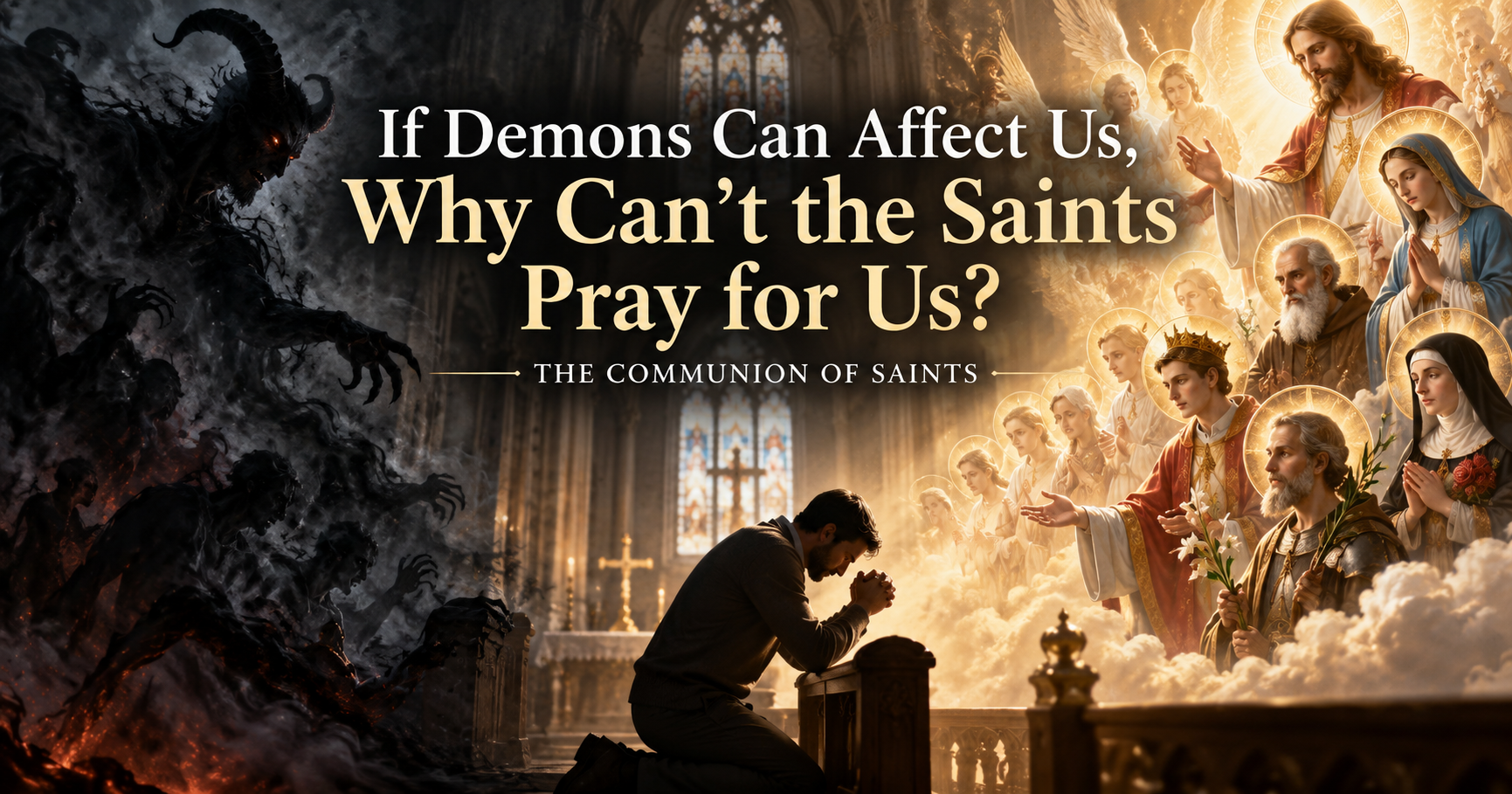
One of the more curious objections Catholics hear is that the saints in heaven cannot hear our requests for prayer, cannot know anything about what happens on earth, and certainly cannot intercede for us.
Yet many of the same Christians have no difficulty believing that demons can tempt human beings, influence the world, wage spiritual warfare, and work against souls.
That raises a simple question:
If evil spirits can interact with human beings, why would it be impossible for the saints in heaven to pray for us?
Why give darkness more credit than light? If we readily acknowledge that fallen spirits can act within the limits God permits, we should not act as though God is incapable of allowing the saints in glory to know our prayers and intercede for us. The limitation is not on God’s power, but on our assumptions about how He may choose to unite His Church.
Of course, Catholics do not believe that saints possess some independent supernatural power by which they roam the universe listening to millions of conversations. Whatever the saints know, they know because God permits them to know it. Whatever good they accomplish is accomplished through the grace and power of God.
The real issue, then, is not whether a creature in the spiritual realm can have any awareness of earthly events. Scripture itself makes clear that spiritual beings can interact with the earthly world.
The question is whether the members of Christ’s Body who have entered heavenly glory remain united to the rest of the Church.
Catholicism answers with a resounding yes.
The Saints Are Not Dead
Jesus Himself teaches that those who belong to God remain alive:
“For he is not the God of the dead, but of the living: for all live to him.”
— Luke 20:38, Douay-Rheims
The saints in heaven have not ceased to exist. They remain truly alive in Christ and behold God in glory.
Physical death does not destroy the supernatural communion established by Christ.
St. Paul teaches that nothing—not even death—can separate Christians from the love of God in Christ Jesus (Romans 8:38–39).
The Church is therefore not divided into completely disconnected groups of “living Christians” and “dead Christians.” There is one Body of Christ.
“So we being many, are one body in Christ, and every one members one of another.”
— Romans 12:5, Douay-Rheims
That communion does not disappear when one member of the Body enters heaven.
Heaven Is Aware of Earth
Scripture gives us remarkable glimpses of the heavenly Church.
Hebrews describes Christians on earth as being surrounded by a “cloud of witnesses” after recounting the heroes of faith who came before us (Hebrews 12:1).
Only a few verses later, the same chapter tells Christians that they have come spiritually to:
- Mount Sion,
- the heavenly Jerusalem,
- innumerable angels,
- the Church of the firstborn,
- God,
- and “the spirits of the just made perfect.”
See Hebrews 12:22–24.
This is not a picture of the Church on earth being completely isolated from heaven.
It is a picture of one supernatural family united in Christ.
Revelation Shows Heavenly Saints Presenting Prayers to God
The Book of Revelation makes the connection even clearer.
St. John sees heavenly figures holding golden bowls filled with incense:
“Golden vials full of odours, which are the prayers of saints.”
— Revelation 5:8, Douay-Rheims
Later, an angel stands before God offering incense together with the prayers of the saints:
“And the smoke of the incense of the prayers of the saints ascended up before God from the hand of the angel.”
— Revelation 8:4, Douay-Rheims
Whatever else we say about these passages, Scripture plainly depicts heaven as intimately involved with the prayers of God’s people.
The heavenly world is not portrayed as ignorant of the earthly Church.
Asking a Saint to Pray Is Still Asking for Prayer
Sometimes the objection becomes:
“Why ask a saint to pray for you when you can go directly to Jesus?”
But Catholics do go directly to Jesus.
Asking another Christian to pray for you does not replace Jesus.
If a friend tells you that his mother is sick and asks you to pray for her, you probably would not answer:
“Why are you asking me? Go directly to Jesus.”
You would pray for her.
Why?
Because Scripture encourages Christians to pray for one another.
St. Paul commands:
“I desire therefore, first of all, that supplications, prayers, intercessions, and thanksgivings be made for all men.”
— 1 Timothy 2:1, Douay-Rheims
And St. James tells us:
“Pray one for another, that you may be saved. For the continual prayer of a just man availeth much.”
— James 5:16, Douay-Rheims
The Catholic question is simple:
If the prayer of a righteous Christian on earth is powerful, why would the prayers of the righteous in heaven suddenly become useless?
They have not stopped being members of Christ’s Body.
They have been perfected in Him.
But Can the Saints Hear Millions of People?
This objection sometimes assumes Catholics believe saints are omniscient.
We do not.
Only God is omniscient.
A saint does not need to possess infinite knowledge in order for God to make a prayer known to him.
The Catechism explains:
“Being more closely united to Christ, those who dwell in heaven fix the whole Church more firmly in holiness.”
It continues by teaching that the saints “do not cease to intercede with the Father for us.”
— Catechism of the Catholic Church, 956
The saints intercede because they are united to Christ, not because they possess divine attributes independently of Him.
God is perfectly capable of making our requests known to those whom He has glorified.
The objection therefore should not be, “How could a saint possibly know?”
The real question is:
Could God make our prayers known to the saints?
Obviously, He could.
And Revelation gives us biblical reason to believe that the prayers of the faithful are indeed known in heaven.
What About Demons?
This brings us back to the original inconsistency.
Most Christians acknowledge biblical accounts in which demons influence, tempt, oppress, deceive, and interact with human beings.
Scripture certainly teaches the reality of spiritual warfare.
St. Peter warns:
“Your adversary the devil, as a roaring lion, goeth about seeking whom he may devour.”
— 1 Peter 5:8, Douay-Rheims
St. Paul likewise teaches that our struggle involves spiritual forces rather than merely human opponents (Ephesians 6:12).
So Christianity already recognizes that earthly life is not sealed off from the spiritual realm.
Yet it would be strange to believe that only the enemies of God can interact with or affect earthly Christians, while the glorified members of Christ’s own Body are completely cut off from us.
Catholic teaching presents a far more coherent picture.
There is a real spiritual battle.
There are fallen angels.
There are holy angels.
There are Christians still fighting the good fight on earth.
And there are victorious Christians already with Christ in heaven.
Together, those who belong to Christ form the Communion of Saints.
Could an Apparition of Mary Really Be Demonic?
Some critics go even further and argue that reported apparitions of the Blessed Virgin Mary must actually be demonic deceptions.
Catholics should certainly not believe every supernatural claim merely because someone says, “Mary appeared to me.”
The Church herself investigates alleged apparitions carefully.
Private revelations can never add to, replace, or correct the public Revelation given by God and completed in Christ. The Catechism makes this clear in CCC 66–67.
But declaring a Marian apparition demonic simply because it involves Mary proves nothing.
Christ gave us a principle for judging spiritual claims:
“By their fruits you shall know them.”
— Matthew 7:16, Douay-Rheims
The Church therefore examines alleged supernatural events according to their conformity with the Catholic faith, the credibility of the witnesses, their spiritual fruits, and many other considerations.
Authentic devotion to Mary does not lead souls away from Jesus.
Mary’s entire role points toward her Son.
Her words at Cana remain the foundation of genuine Marian devotion:
“Whatsoever he shall say to you, do ye.”
— John 2:5, Douay-Rheims
A supposed apparition that contradicted Christ or His Church would rightly be rejected.
But a message that calls people to repentance, prayer, conversion, reception of the sacraments, and deeper fidelity to Christ cannot simply be dismissed by saying, “It must be a demon because Mary cannot interact with us.”
That assumption is precisely what needs to be proven.
The Communion of Saints Makes Sense of the Whole Christian Family
Catholic belief does not divide Christ’s Church at the grave.
Christ conquered death.
Those who die in His friendship remain members of His mystical Body.
The Catechism beautifully summarizes this truth:
“We believe in the communion of all the faithful of Christ, those who are pilgrims on earth, the dead who are being purified, and the blessed in heaven, all together forming one Church.”
— Catechism of the Catholic Church, 962
That is the heart of the Catholic doctrine.
The saints do not compete with Jesus.
They belong to Jesus.
Their prayers do not diminish His unique mediation.
Their ability to intercede exists because of His mediation.
They do not possess omniscience.
God enables their participation in the life of His Church.
And when Catholics ask a saint to pray for us, we are ultimately doing something Christians already do every day:
asking another member of the Body of Christ to pray with us and for us.
If Christians can accept that demons seek our destruction, holy angels minister according to God’s will, and believers on earth can intercede for one another, there is nothing inherently unreasonable about believing that the saints who now stand before God can intercede for us as well.
Death does not defeat the Body of Christ.
Christ already defeated death.
And in Christ, His Church remains one.
Sources & Further Reading
- Catechism of the Catholic Church, 954–962 — The Communion of Saints
Especially CCC 955–956 on the continuing union of Christians on earth with those in heaven and the intercession of the saints. Vatican
Read at the Vatican - Catechism of the Catholic Church, 66–67 — Public and Private Revelation
Explains that private revelations do not add to or correct the definitive Revelation given in Christ. Vatican
Read at the Vatican - Revelation 5:8
The twenty-four elders in heaven possess golden bowls of incense identified as “the prayers of the holy ones.” USCCB
Read Revelation 5 at the USCCB - Hebrews 12:1, 22–24
Describes the “cloud of witnesses” and Christians approaching the heavenly Jerusalem, innumerable angels, and “the spirits of the just made perfect.” USCCB
Read Hebrews 12 at the USCCB - Luke 20:38 — “He is not God of the dead, but of the living.”
- Romans 8:38–39 — Neither death nor anything else in creation can separate us from the love of God in Christ.
- Romans 12:4–5 — Christians form one Body in Christ and are members of one another.
- 1 Timothy 2:1 — Scripture explicitly calls Christians to offer intercessions for others.
- James 5:16 — “The continual prayer of a just man availeth much.”
- 1 Peter 5:8 — Scripture’s warning concerning the devil and spiritual warfare.
- Ephesians 6:12 — Our struggle includes spiritual powers.
- Matthew 7:16 — “By their fruits you shall know them.”
- John 2:5 — Our Lady at Cana: “Whatsoever he shall say to you, do ye.”
- United States Conference of Catholic Bishops — Saints
The USCCB explains that the saints remain members of Christ’s Body and that Catholics may ask the saints in heaven to pray for us. USCCB
USCCB: Saints and Their Intercession