

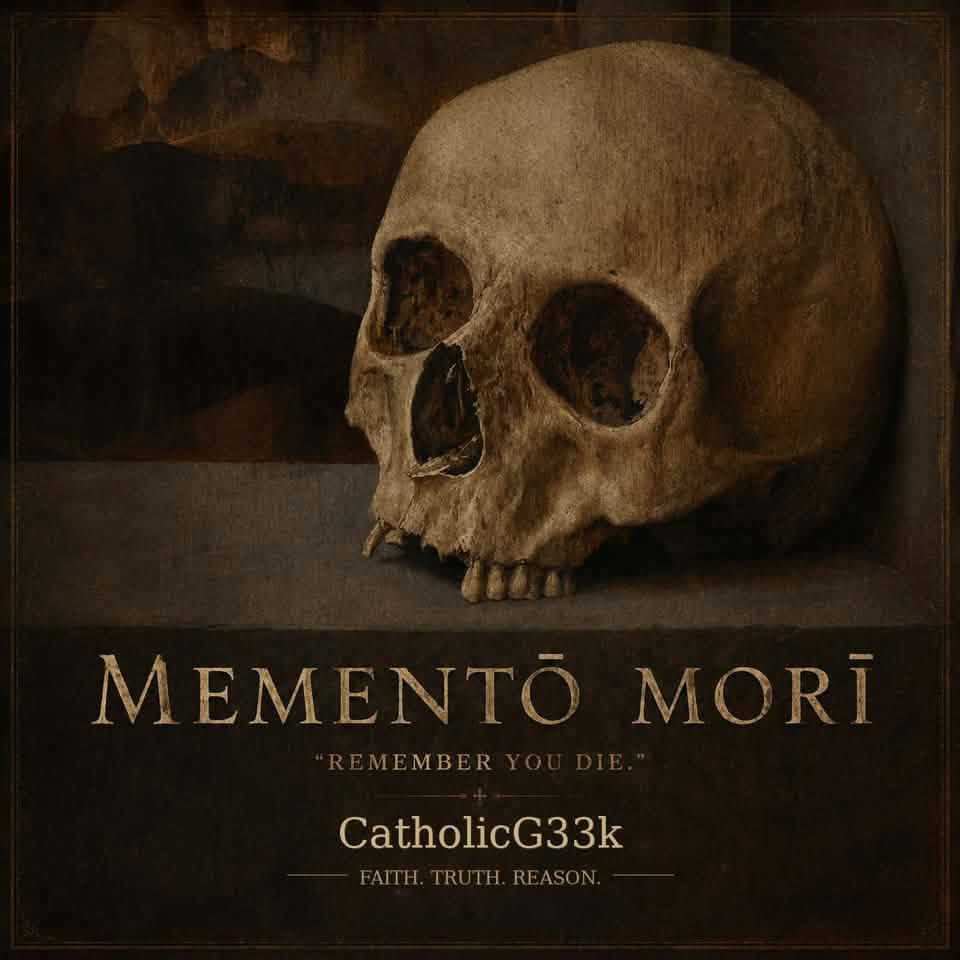
Why the Catholic remembrance of death is not morbid, but a school of wisdom, repentance, freedom, and hope
CatholicG33k — Faith. Truth. Reason.
There is a sentence the modern world does almost everything in its power to avoid:
You are going to die.
Not eventually in some vague, abstract sense. Not merely as a biological fact that applies to the human species. You personally will die. Your heart will beat for the last time. Your lungs will draw their final breath. The possessions you accumulated will belong to someone else. The arguments that consumed you will become irrelevant. Your reputation will pass into the hands of others. Your body will return to the earth.
And then you will stand before God.
This is the meaning behind the ancient Christian admonition:
Memento mori — remember that you will die.
To ears formed by modern culture, this can sound gloomy, fatalistic, or even psychologically unhealthy. But within the Catholic tradition, remembrance of death has never been an invitation to despair. It is precisely the opposite.
It is an invitation to wake up.
“In all thy works be mindful of thy last end, and thou shalt never sin.”
—
The Church places death before our eyes because she wants us to learn how to live.
Death Is Not the End God Intended
Christianity does not begin its reflection on death by pretending death is natural in the deepest theological sense.
Death is an enemy.
Sacred Scripture teaches that God created man for life and communion with Himself. Death enters human history through sin:
“Wherefore as by one man sin entered into this world, and by sin death; and so death passed upon all men, in whom all have sinned.”
— Romans 5:12
The Catechism teaches that although human nature is mortal, God had destined man not to die; bodily death entered human history as a consequence of sin. CCC 1008.
This matters enormously.
Christianity does not sentimentalize the grave. It does not tell the grieving mother that death is simply “the circle of life.” It does not pretend that separation from those we love is somehow beautiful in itself.
Christ Himself wept at the tomb of Lazarus.
“And Jesus wept.”
— John 11:35
Yet moments later, He commanded the dead man to come forth.
The Christian understanding of death therefore contains a paradox: death is an enemy, but Christ has conquered it.
St. Paul cries:
“Death is swallowed up in victory. O death, where is thy victory? O death, where is thy sting?”
— 1 Corinthians 15:54–55
Memento mori makes sense only beneath the shadow of the Cross and in the light of the empty tomb.
We remember death because Christ defeated death.
The Four Last Things
Catholic spiritual tradition often urges meditation upon what are called the Four Last Things:
Death, Judgment, Heaven, and Hell.
These are not medieval curiosities. They are realities toward which every human life is moving.
The Catechism states:
“Death puts an end to human life as the time open to either accepting or rejecting the divine grace manifested in Christ.”
— CCC 1021
Immediately after death comes the particular judgment.
“Each man receives his eternal retribution in his immortal soul at the very moment of his death, in a particular judgment.”
— CCC 1022
This means earthly life possesses tremendous seriousness.
Every act of charity matters.
Every confession matters.
Every Mass matters.
Every temptation resisted matters.
Every person forgiven matters.
Every hidden sacrifice matters.
Every deliberate mortal sin matters.
Every return to God matters.
History is not an endless cycle. Human life has a destination.
“It is appointed unto men once to die, and after this the judgment.”
— Hebrews 9:27
Memento mori therefore destroys one of Satan’s most effective illusions:
“There is plenty of time.”
Perhaps there is.
Perhaps there is not.
Christ deliberately warns His disciples against assuming tomorrow belongs to them.
In the parable of the rich fool, a man accumulates wealth and tells himself that he has many years ahead in which to rest, eat, drink, and enjoy himself.
God answers:
“Thou fool, this night do they require thy soul of thee.”
— Luke 12:20
The tragedy was not that the man possessed wealth.
The tragedy was that he lived as though earthly life were permanent.
Remembering Death Correctly Orders Life
A man who truly remembers death begins to see the world differently.
Money becomes useful rather than ultimate.
Pleasure becomes subordinate rather than sovereign.
Popularity loses some of its power.
Insults become smaller.
Forgiveness becomes more urgent.
Prayer becomes less optional.
The Eucharist becomes more precious.
Family becomes less easy to take for granted.
Sin becomes more frightening.
Grace becomes more astonishing.
This is one reason the saints repeatedly contemplated death.
Not because they hated life.
Because they understood its value.
The person who forgets death is tempted to waste life.
The person who remembers death realizes:
I do not have forever to become holy.
Memento Mori Is an Antidote to Vanity
Modern civilization spends extraordinary amounts of energy denying mortality.
We conceal aging.
We idolize youth.
We sanitize death.
We move cemeteries away from daily life.
We speak euphemistically of people “passing.”
We digitally preserve ourselves.
We obsess over physical appearance as though the body will never decay.
But ashes remain one of Christianity’s most devastating answers to vanity.
On Ash Wednesday the Church places ashes upon the human head.
Historically, one traditional formula accompanies the act:
“Remember, man, that thou art dust, and unto dust thou shalt return.”
The words echo God’s sentence after the Fall:
“For dust thou art, and into dust thou shalt return.”
— Genesis 3:19
The billionaire becomes dust.
The celebrity becomes dust.
The emperor becomes dust.
The beggar becomes dust.
The beautiful become dust.
The powerful become dust.
The forgotten become dust.
The grave is radically egalitarian.
Yet Christianity adds something infinitely greater:
the dust will rise.
The Resurrection Changes Everything
Catholic memento mori is fundamentally different from pagan fatalism.
The Christian does not stare at a skull and conclude:
“Everything is meaningless because I will die.”
He concludes:
“Everything matters because I will rise.”
The body itself has an eternal destiny.
The Creed professes:
“I believe in the resurrection of the body.”
The Catechism explains:
“We firmly believe, and hence we hope that, just as Christ is truly risen from the dead and lives for ever, so after death the righteous will live for ever with the risen Christ and he will raise them up on the last day.”
— CCC 989
Christianity does not teach merely the immortality of the soul.
It teaches the resurrection of the body.
The body that kneels in prayer.
The hands that serve the poor.
The eyes that look with purity.
The tongue that praises God.
The body that suffers.
The body that ages.
The body placed into the grave.
God will raise it.
Christ declares:
“The hour cometh, wherein all that are in the graves shall hear the voice of the Son of God. And they that have done good things, shall come forth unto the resurrection of life; but they that have done evil, unto the resurrection of judgment.”
— John 5:28–29
Memento mori therefore points beyond the skull.
It points toward resurrection.
The Skull in Christian Art
This is why skulls appear so frequently in Catholic art.
A skull at the feet of a saint does not proclaim nihilism.
It proclaims perspective.
St. Jerome is frequently portrayed with a skull nearby while meditating upon Scripture.
St. Mary Magdalene is sometimes depicted contemplating a skull in penitential art.
Crucifixes themselves have sometimes been portrayed above a skull representing Adam, reflecting the ancient Christian tradition associating Calvary with Adam’s burial and Christ with the New Adam.
The skull silently preaches:
Your body will become like this. Prepare your soul.
But above the skull stands the Cross.
That detail changes the entire meaning.
Death speaks.
Christ speaks louder.
“Teach Us to Number Our Days”
The Psalmist prays:
“So make thy right hand known: and men learned in heart, in wisdom.”
—
The familiar spiritual meaning traditionally associated with this verse is the petition that God teach us to reckon the brevity of our days so that we may gain wisdom.
Wisdom begins when man stops pretending he is immortal on earth.
Think of how many sins depend upon forgetting death.
Why remain angry for twenty years if you may die tonight?
Why destroy your soul for money that someone else will inherit?
Why trade eternal life for a few minutes of sexual pleasure?
Why refuse Confession because of embarrassment when the judgment of God awaits?
Why obsess over strangers’ opinions when Christ will judge you?
Why neglect your spouse, children, parents, or friends as though unlimited opportunities remain?
Death exposes the absurdity of countless earthly attachments.
Memento mori asks one piercing question:
Will this matter when I stand before Christ?
That question can reorder a life.
The Devil Wants Either Forgetfulness or Despair
There are two opposite errors concerning death.
The first is forgetfulness.
Live as though death will never arrive.
The second is despair.
Think about death as though Christ never rose.
Christianity rejects both.
The Catholic remembers death without losing hope because supernatural hope rests not upon human optimism but upon God’s promises.
Christ tells Martha:
“I am the resurrection and the life: he that believeth in me, although he be dead, shall live.”
— John 11:25
The goal of memento mori is therefore not anxiety.
It is conversion.
Not panic.
Preparedness.
Not obsession.
Wisdom.
Not hopelessness.
Hope rooted in Christ.
What If I Died Tonight?
This question has long functioned as a powerful examination of conscience:
If I knew I would die tonight, what would I do differently?
Would I go to Confession?
Would I forgive someone?
Would I apologize?
Would I pray?
Would I tell my family I love them?
Would I finally abandon a habitual sin?
Would I stop postponing my conversion?
Would I receive Holy Communion differently?
Would I care as much about money, politics, reputation, entertainment, or social media?
Most importantly:
Would I be ready to meet Jesus Christ?
The answer should not produce despair.
If you are alive, the door of repentance is still open.
That itself is mercy.
St. Paul writes:
“Behold, now is the acceptable time; behold, now is the day of salvation.”
— 2 Corinthians 6:2
Notice the word.
Not tomorrow.
Now.
Why Confession Makes Memento Mori Beautiful
The remembrance of death becomes particularly powerful when connected with the Sacrament of Penance.
Christ gave His apostles authority to forgive sins:
“Whose sins you shall forgive, they are forgiven them; and whose sins you shall retain, they are retained.”
— John 20:23
The Catechism teaches that those who approach the Sacrament of Penance receive from God’s mercy forgiveness for offenses committed against Him and are simultaneously reconciled with the Church. CCC 1422.
Imagine the difference between two ways of approaching death.
One man avoids thinking about God until his final breath.
Another repeatedly repents, confesses, receives absolution, receives Christ in the Eucharist, struggles against sin, performs works of mercy, and entrusts himself to God.
Memento mori teaches us not merely to fear dying badly, but to practice dying well.
Every sincere Confession is, in a sense, a small death.
The old sinful self is renounced.
Grace restores the soul.
The Christian rises again.
The Eucharist and the Hour of Death
There is an especially beautiful Catholic connection between death and the Eucharist.
Holy Communion given to someone approaching death is called Viaticum, from a Latin expression associated with provision for the journey.
The Catechism calls the Eucharist received at life’s end:
“the seed of eternal life and the power of resurrection.”
— CCC 1524
Consider the beauty of this.
At the threshold of death, the Christian receives the One who said:
“He that eateth my flesh, and drinketh my blood, hath everlasting life: and I will raise him up in the last day.”
— John 6:55
The dying Catholic does not walk toward eternity alone.
He receives Christ Himself.
The One awaiting him beyond death is the same Lord he receives sacramentally.
Pray for the Dead — Because Love Does Not End at the Grave
Memento mori also reminds Catholics of another neglected duty:
pray for the dead.
Sacred Scripture praises prayer and sacrifice for the departed:
“It is therefore a holy and wholesome thought to pray for the dead, that they may be loosed from sins.”
— 2 Machabees 12:46
The Church teaches:
“From the beginning the Church has honored the memory of the dead and offered prayers in suffrage for them, above all the Eucharistic sacrifice.”
— CCC 1032
Therefore, when you pass a cemetery, pray.
When someone dies, have Masses offered.
Pray the Rosary.
Offer indulgenced prayers according to the Church’s norms.
Visit graves.
Remember forgotten souls.
Death does not dissolve the communion of saints.
The Church is larger than those currently walking the earth.
A Catholic Should Learn to Die Before Death Arrives
Christian discipleship already contains a kind of death.
Christ says:
“If any man will come after me, let him deny himself, and take up his cross daily, and follow me.”
— Luke 9:23
To follow Christ is to die continually to the false self.
Die to pride.
Die to lust.
Die to resentment.
Die to greed.
Die to vanity.
Die to the need to control everything.
Die to the desire to be praised.
Die to sin.
This is why memento mori belongs naturally beside the Cross.
The Christian who learns every day to surrender himself to Christ is preparing for the final surrender.
Death eventually requires us to let go of everything.
The spiritual life trains us to say beforehand:
“Jesus, everything is Yours.”
Memento Mori and the Fear of Death
Does remembering death eliminate fear?
Not necessarily.
Fear of death can be deeply human.
Even Christ, according to His human nature, truly experienced anguish in Gethsemane:
“My soul is sorrowful even unto death.”
— Matthew 26:38
Christian courage is not emotional numbness.
It is fidelity in the presence of fear.
The Catechism acknowledges that death can cause anguish, yet Christians can transform their own death into an act of obedience and love toward the Father after the example of Christ. CCC 1009.
This is profound.
A Catholic’s final moment can become a final offering.
“Father, into thy hands I commend my spirit.”
— Luke 23:46
Those words of Christ can become our own.
The Saints Understood
The saints were often extraordinarily conscious of death precisely because they were extraordinarily alive.
St. Benedict instructs his monks:
“To keep death daily before one’s eyes.”
— Rule of St. Benedict, Chapter 4
St. Francis of Assisi famously referred to death as “Sister Death” in the Canticle of the Creatures—not because death ceased to be an enemy, but because in Christ even death becomes the doorway through which the faithful pass toward God.
St. Paul expressed the astonishing confidence of someone whose entire existence had become centered upon Christ:
“For to me, to live is Christ; and to die is gain.”
— Philippians 1:21
Only Christianity can speak this way without contradiction.
Death is an enemy.
Death has been conquered.
Death remains painful.
Death can nevertheless become gain.
Because beyond death stands Christ.
Someday Someone Will Speak Your Name for the Last Time
There is a sobering thought worth considering.
Someday your house may belong to strangers.
Your possessions may be scattered.
Your photographs may sit in boxes.
People who knew you personally will themselves die.
Eventually someone on earth may speak your name for the final time.
The world will continue.
But your existence will not become meaningless.
Because you were never created primarily to be remembered by the world.
You were created to know, love, and serve God and to possess Him forever.
Jesus warns against storing treasure merely on earth:
“Lay not up to yourselves treasures on earth: where the rust, and moth consume, and where thieves break through and steal. But lay up to yourselves treasures in heaven.”
— Matthew 6:19–20
The central question of life is therefore not:
Will people remember me?
It is:
Will I die in the friendship of God?
The Most Important Moment of Your Life
Catholic spiritual writers have often stressed the importance of perseverance until death.
Why?
Because our earthly pilgrimage culminates there.
Christ says:
“He that shall persevere unto the end, he shall be saved.”
— Matthew 24:13
This is why the Church prays repeatedly for assistance at the hour of death.
Every Hail Mary concludes:
“Holy Mary, Mother of God, pray for us sinners, now and at the hour of our death. Amen.”
Think about that.
A Catholic who prays the Rosary has asked Our Lady hundreds, thousands, perhaps tens of thousands of times to intercede at one particular future moment:
the hour of death.
We do not know when that hour will come.
But Heaven has heard the prayer.
Remember You Will Die — Then Live
Memento mori should not make you love earthly life less.
It should make you love it properly.
Drink coffee with gratitude.
Hold your children.
Call your parents.
Forgive quickly.
Go to Mass.
Read Scripture.
Make a good Confession.
Visit the lonely.
Feed the poor.
Stop feeding the sin you know is destroying you.
Tell people you love them.
Pray when you wake.
Pray before you sleep.
Receive Christ reverently.
Keep eternity before your eyes.
You have been given a finite number of mornings.
A finite number of conversations.
A finite number of opportunities to forgive.
A finite number of Masses.
A finite number of chances to repent.
But you have been created for an infinite destiny.
That is the secret at the heart of memento mori.
The skull does not get the last word.
The grave does not get the last word.
Sin does not get the last word.
Christ does.
“I am the resurrection and the life.”
— John 11:25
So remember death.
Not because life is meaningless.
Remember death because life is astonishingly meaningful.
Remember death because eternity is real.
Remember death because judgment is real.
Remember death because mercy is available now.
Remember death because Christ died.
Remember death because Christ rose.
And when your own final hour arrives, may the remembrance that once taught you how to live have taught you also how to die:
in the state of grace, beneath the Cross, with the name of Jesus upon your lips and the hope of resurrection in your heart.
Memento mori.
Remember that you will die.
And therefore, remember what you were created to live for.
CatholicG33k
Faith. Truth. Reason.
Principal sources: Sacred Scripture, Douay-Rheims Bible: Genesis 3:19; Ecclesiasticus 7:40; 2 Machabees 12:46; Matthew 6:19–20; 24:13; Luke 9:23; 12:20; John 5:28–29; 6:55; 11:25, 35; 20:23; Romans 5:12; 1 Corinthians 15:54–55; 2 Corinthians 6:2; Philippians 1:21; Hebrews 9:27. Catechism of the Catholic Church, §§989, 1008–1009, 1021–1022, 1032, 1422, 1524. St. Benedict, Rule, ch. 4. St. Francis of Assisi, Canticle of the Creatures.
Leave a Reply