

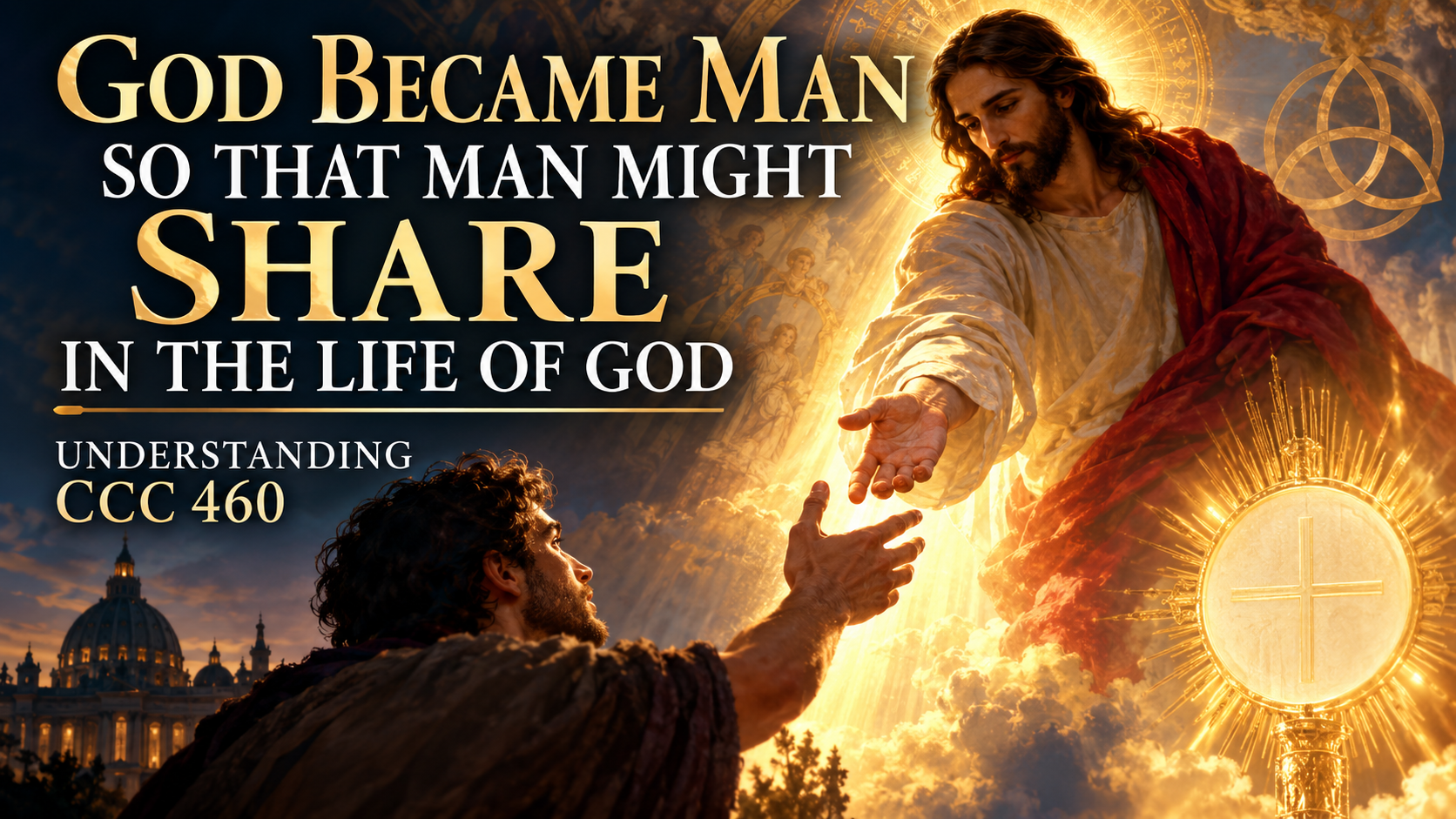
Understanding the Astonishing Teaching of Catechism 460
There are certain sentences in the Catechism of the Catholic Church that should make us stop reading for a moment.
CCC 460 contains one of them.
The Catechism teaches that:
“The Word became flesh to make us ‘partakers of the divine nature.’”
That is not merely poetic language.
It is one of the most profound truths in Christianity.
God became man so that human beings could share in the very life of God.
Not metaphorically.
Not by becoming gods alongside God.
Not by ceasing to be human.
But really and supernaturally, through grace.
This doctrine is traditionally called divinization, deification, or theosis.
And once we understand what the Church means by it, a huge amount of Catholic theology suddenly fits together.
Baptism makes more sense.
Sanctifying grace makes more sense.
The Eucharist makes more sense.
Mortal sin makes more sense.
The saints make more sense.
And heaven itself becomes something far greater than simply “going somewhere nice when we die.”
The Christian vocation is nothing less than participation in the divine life.
The Biblical Foundation
The Catechism is drawing directly from Scripture.
Saint Peter writes:
“By whom he hath given us most great and precious promises: that by these you may be made partakers of the divine nature.”
— 2 Peter 1:4, Douay-Rheims
That phrase is enormous:
partakers of the divine nature.
Saint Peter is not saying that human beings become God by essence.
There is only one God.
The Father, Son, and Holy Ghost possess one divine nature.
Human beings remain creatures forever.
But God can elevate creatures beyond what their natural powers could ever accomplish.
That is what grace does.
God gives us a created participation in His supernatural life.
Jesus Christ possesses divinity by nature.
We participate in divine life by grace.
That distinction is the key to understanding CCC 460.
God by Nature, Man by Grace
Jesus does not become divine.
He is divine.
Saint John opens his Gospel with one of the clearest statements of Christ’s divinity:
“In the beginning was the Word, and the Word was with God, and the Word was God.”
— John 1:1
Then, only a few verses later:
“And the Word was made flesh, and dwelt among us.”
— John 1:14
The Word did not stop being God when He became man.
Nor did the divine nature change into a human nature.
The eternal Son assumed a true human nature while remaining fully divine.
Jesus Christ is one divine Person in two natures: divine and human.
That is why the Incarnation is so important for our salvation.
The One who possesses divine life by nature entered into our humanity.
And through union with Him, we are elevated into supernatural communion with God.
Christ does not make us equal to Himself by nature.
He makes us adopted children of His Father.
Saint Athanasius Said It Boldly
One of the most famous statements in early Christianity comes from Saint Athanasius.
Speaking about the Incarnation, he teaches that the Son of God became man so that we might become God.
That sounds shocking.
It is supposed to.
But it only becomes dangerous if we remove the Catholic distinction between nature and grace.
Saint Athanasius was not teaching that Christians become separate divine beings.
He was teaching that humanity is elevated through Christ into participation in God’s life.
The Catechism of the Catholic Church deliberately cites this teaching in CCC 460.
This is not fringe theology.
It is not some strange mystical idea sitting at the edge of Catholic doctrine.
It belongs directly to the Church’s explanation of why God became man.
Saint Irenaeus and Divine Sonship
Saint Irenaeus of Lyons taught something similar centuries before Saint Thomas Aquinas.
For Irenaeus, the Incarnation was about restoring humanity and bringing man into communion with the Word.
The Son of God became the Son of Man so that man could receive divine adoption.
Saint Paul expresses this same mystery:
“For whosoever are led by the Spirit of God, they are the sons of God.”
— Romans 8:14
And:
“And if sons, heirs also; heirs indeed of God, and joint heirs with Christ.”
— Romans 8:17
That is one of the great differences between Christianity and a merely moral religion.
Christianity is not simply about obeying God from a distance.
The Christian becomes a child of God.
And this adoption is more than a legal title.
God actually gives the soul supernatural life.
Sanctifying Grace Is Divine Life in the Soul
This is where sanctifying grace becomes incredibly important.
Many Catholics hear the term “sanctifying grace” their whole lives without realizing how extraordinary it actually is.
Sanctifying grace is not simply God deciding to overlook our sins.
It is not merely a change in God’s attitude toward us.
It is an interior supernatural gift.
Saint Thomas Aquinas explains grace as a supernatural perfection given to the soul (Summa Theologiae, I-II, q. 110).
Grace elevates us beyond the order of nature.
It allows us to know and love God in a supernatural way.
Through grace, we receive the theological virtues of faith, hope, and charity.
Faith allows us to adhere to God revealing.
Hope directs us toward God as our eternal happiness.
Charity allows us to love God above all things for His own sake.
This is already the beginning of divinization.
The soul remains human.
But it now lives according to a supernatural principle that it could never have produced by itself.
Grace Does Not Destroy Nature
Sometimes religious language gives people the impression that holiness means becoming less human.
Catholic theology teaches the opposite.
Grace perfects nature.
It does not destroy it.
The Christian does not become holy by having his personality erased.
He becomes holy by having his nature healed, elevated, purified, and ordered toward God.
That helps explain why the saints are so different from one another.
Saint Francis of Assisi does not look like Saint Thomas Aquinas.
Saint Teresa of Ávila does not look like Saint Joan of Arc.
Saint Thérèse of Lisieux does not look like Saint Augustine.
Grace does not turn everyone into the same personality.
It perfects particular persons.
God does not save us by deleting our humanity.
He saves and glorifies it.
Baptism Is the Beginning of This Supernatural Life
So when does this participation in divine life begin?
Ordinarily, sacramentally, it begins in Baptism.
Jesus says:
“Unless a man be born again of water and the Holy Ghost, he cannot enter into the kingdom of God.”
— John 3:5
Baptism is not merely a public statement that someone has decided to follow Jesus.
It truly regenerates.
It forgives sin.
It gives sanctifying grace.
It incorporates us into Christ.
It makes us members of His Mystical Body.
It makes us adopted children of the Father.
The supernatural life described in CCC 460 is not something reserved for a tiny group of advanced mystics.
It begins with Christian initiation.
Every baptized Christian is called to holiness.
Every baptized Christian is called to supernatural communion with God.
The Eucharist Nourishes Divine Life
If Baptism gives supernatural life, the Eucharist nourishes it.
Jesus says:
“He that eateth my flesh, and drinketh my blood, hath everlasting life.”
— John 6:55
The Eucharist is not merely a symbol of Jesus being spiritually close to us.
It is Jesus Christ Himself, truly, really, and substantially present: Body, Blood, Soul, and Divinity.
In Holy Communion, the Christian is united sacramentally with the Incarnate Word.
This fits perfectly with CCC 460.
The Word became flesh.
The Word gave Himself for us.
And the Word continues to give Himself sacramentally to His Church.
Catholic Christianity is therefore not merely about learning information about God.
It is about communion with God.
Why Mortal Sin Is So Serious
CCC 460 also helps us understand why the Church speaks so seriously about mortal sin.
If sanctifying grace means participation in divine life, then mortal sin is not simply the breaking of an arbitrary rule.
Mortal sin destroys charity in the soul and deprives the person of sanctifying grace.
That means mortal sin is a turning away from the supernatural life God has given us.
This is why confession matters so much.
The Sacrament of Penance is not religious paperwork.
It is the restoration of supernatural life.
Christ takes the sinner who has turned away from divine friendship and reconciles him to God.
The soul is restored to grace.
Seen this way, confession becomes one of the most beautiful signs of divine mercy in the entire Catholic faith.
The Trinity Dwells in the Soul
Jesus says something extraordinary in Saint John’s Gospel:
“If any one love me, he will keep my word, and my Father will love him, and we will come to him, and will make our abode with him.”
— John 14:23
The Christian life is Trinitarian.
God does not merely improve us from a distance.
The Father, Son, and Holy Ghost dwell in the soul in sanctifying grace in a special manner.
That does not mean God is physically contained inside the soul.
God cannot be contained by creation.
It means the soul enters into a supernatural relationship of knowledge and love with the Triune God.
This is why Saint Paul can speak of Christians as temples of the Holy Ghost.
The goal of Christianity is communion.
Does Catholicism Teach That We Become Gods?
No — if by “gods” we mean divine beings who possess the divine essence.
Yes — if by the word we mean creatures who have been supernaturally elevated to participate in God’s life.
The distinction matters.
We never become omnipotent.
We never become omniscient.
We never become eternal in the sense that God is eternal.
We never become self-existent.
We never become additional persons of the Trinity.
We remain finite creatures forever.
But the Creator can share His life with His creatures.
That is what the Fathers meant by divinization.
A traditional analogy is an iron placed into a fire.
The iron begins to glow.
It becomes hot.
It takes on qualities associated with the fire.
But it never stops being iron.
The analogy is imperfect, as all analogies involving God are.
But it helps.
Grace transforms us without changing us into the divine essence.
The Saints Show Us What Grace Can Do
Want to know what divinization looks like in practice?
Look at the saints.
The saints did not become divine beings.
They became deeply transformed by divine grace.
Their wills became increasingly conformed to God’s will.
Their love became more purified.
Their faith deepened.
Their hope became stronger.
Their charity grew.
The saints show us what human beings look like when grace is allowed to transform them.
Saint Thérèse of Lisieux shows spiritual childhood and confidence in God.
Saint Francis of Assisi shows radical poverty and love.
Saint Thomas Aquinas shows the sanctification of the intellect.
Saint Teresa of Ávila and Saint John of the Cross show the extraordinary depths of contemplative union with God.
The holiness of the saints does not compete with God’s glory.
It reveals it.
Mary Is the Greatest Created Example
The Blessed Virgin Mary is the greatest example of a human creature transformed by grace.
She is not divine.
She is not a goddess.
She is not a fourth person of the Trinity.
She is entirely a creature.
And yet no merely human creature has been more perfectly united to God.
Mary shows us something deeply important about Catholic spirituality:
complete dependence upon God does not make a person smaller.
It makes the person holy.
Her greatness comes entirely from God.
Her entire life points to Him.
Her response at the Annunciation summarizes the attitude of the saint:
“Behold the handmaid of the Lord; be it done to me according to thy word.”
— Luke 1:38
Heaven Is More Than “Going Somewhere”
The final fulfillment of CCC 460 is the Beatific Vision.
Heaven is not merely an eternal location.
It is the direct vision of God.
Saint John writes:
“We shall be like to him: because we shall see him as he is.”
— 1 John 3:2
The blessed see God Himself.
This does not mean they become infinite.
Saint Thomas Aquinas carefully explains that the blessed truly see God without comprehending Him exhaustively (Summa Theologiae, I, q. 12).
A finite intellect cannot exhaust the infinite God.
The distinction between Creator and creature remains forever.
But communion reaches its highest possible perfection.
Faith becomes vision.
Hope reaches possession.
Charity remains forever.
The supernatural life that began through grace reaches glory.
And the Body Is Not Left Behind
Christian salvation is not about escaping the body forever.
The human person is a unity of body and soul.
At death, body and soul are separated.
But that is not the final state God intends for humanity.
At the resurrection, the body will rise.
Saint Paul writes:
“For this corruptible must put on incorruption; and this mortal must put on immortality.”
— 1 Corinthians 15:53
The final destiny of man therefore includes the glorification of the whole human person.
Again, grace does not destroy nature.
God redeems it.
The soul is glorified.
The body is raised.
Human nature reaches its final perfection in communion with God.
CCC 460 Changes the Way We See Christianity
Once this doctrine sinks in, Catholicism starts looking different.
Baptism is no longer merely initiation.
It is supernatural birth.
The Eucharist is no longer merely a Sunday obligation.
It is communion with the Incarnate Word.
Confession is no longer merely admitting mistakes.
It is restoration to divine friendship.
Prayer is no longer merely asking for things.
It is communion with the God who dwells in the soul.
Holiness is no longer merely “being nice.”
It is transformation in Christ.
Heaven is no longer simply a reward.
It is the fulfillment of the supernatural destiny for which God created us.
Christianity is far bigger than moral improvement.
It is supernatural participation.
The CatholicG33k Takeaway
CCC 460 may be one of the most astonishing paragraphs in the entire Catechism.
God did not become man merely to give us better rules.
He did not come merely to provide a moral example.
He did not even come merely to forgive sins, although He certainly did that.
The Incarnation opens the way for something much greater.
God became man so that man could share in the life of God.
Jesus Christ is God by nature.
We remain creatures.
But through Christ, the Holy Ghost gives us sanctifying grace.
Through grace, we become adopted children of the Father.
Through Baptism, that supernatural life begins.
Through the Eucharist, it is nourished.
Through confession, it can be restored.
Through charity, it grows toward perfection.
And in heaven, it reaches fulfillment in the Beatific Vision.
That is the destiny of the Christian.
Not merely survival after death.
Not merely moral respectability.
Not merely a place in heaven.
Communion with the Most Holy Trinity.
The Word became flesh so that we could become “partakers of the divine nature.”
That is CCC 460.
And once you really understand what the Church is saying, it is difficult to read the Christian life the same way again.
Sources
Catechism of the Catholic Church, §§456–460, 1262–1270, 1373–1396, 1855–1861, 1987–2005, 1023–1029.
Sacred Scripture, Douay-Rheims: John 1:1–14; John 3:5; John 6:55; John 14:23; Romans 8:14–17, 29; 1 Corinthians 15:53; 2 Peter 1:4; 1 John 3:2.
Saint Irenaeus of Lyons, Against Heresies, III, 18–19.
Saint Athanasius of Alexandria, On the Incarnation, 54.
Saint Thomas Aquinas, Summa Theologiae, I, q. 12; I, q. 43; I-II, q. 110; II-II, q. 184.
Council of Chalcedon, Definition of Faith, AD 451.
Council of Trent, Session VI, Decree on Justification, AD 1547.