

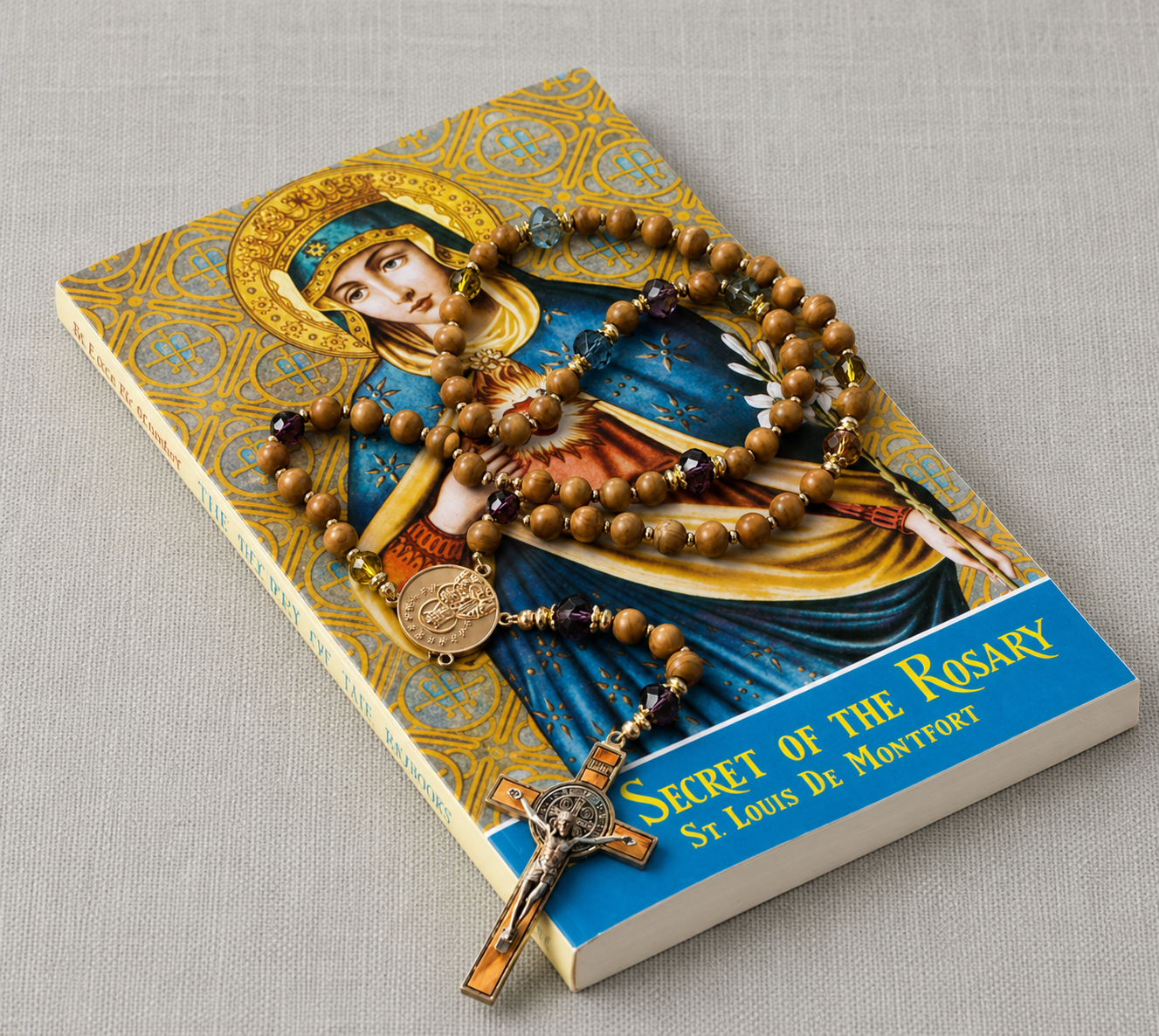
There are prayers that we say, and there are prayers that slowly teach us how to see.
The Rosary belongs to the second kind.
At first glance, it seems almost too simple: a crucifix, a string of beads, the Apostles’ Creed, the Our Father, and repeated Hail Marys. Yet inside that apparent simplicity is an entire school of Christian memory. The Rosary carries us from Nazareth to Bethlehem, from the Garden of Gethsemani to Calvary, and from the empty tomb to the glory of Heaven.
This is the great conviction running through St. Louis de Montfort’s The Secret of the Rosary. For him, the Rosary is not merely a collection of familiar prayers. It is a way of entering the Gospel until the life of Jesus begins to shape our own.
The preface to the book calls it a “school of Christian life.” That description captures the heart of the whole work. The Rosary is meant not only to be recited but lived.
A Book Arranged Like a Rosary
St. Louis organizes his work with remarkable care.
The book contains fifty short chapters, each called a “Rose.” Those fifty Roses are arranged into five groups of ten, like five decades of a Rosary:
- The origin, history, and name of the Rosary
- The prayers contained within it
- The mysteries and their power to sanctify
- Stories of conversions and remarkable effects
- The proper manner of praying it
Even the structure teaches something. St. Louis does not begin by giving techniques. He first explains what the Rosary is, where it comes from, what its prayers mean, and why its mysteries matter. Only after establishing its spiritual value does he teach us how to pray it properly.
Before the fifty Roses, he offers the book itself as four different flowers.
The White Rose is addressed to priests, asking them to preach and personally practice the Rosary.
The Red Rose is offered to sinners, presenting the Rosary as a road away from sin and back toward grace.
The Mystical Rose Tree is offered to devout souls who desire greater holiness.
The Rosebud is offered to children, showing that this prayer is not reserved for scholars, mystics, or religious professionals. It belongs to the whole Catholic family.
This alone reveals something essential about the Rosary’s history: it has always been a prayer capable of crossing social boundaries. It can be prayed by children and theologians, by laborers and kings, by families gathered at night and by religious communities chanting in choir.
The Man Behind the Book
Louis-Marie Grignion de Montfort was born in Brittany, France, in AD 1673. He studied at the Jesuit college in Rennes and was ordained a priest in AD 1700 at the age of twenty-seven.
His early ministry included service as a hospital chaplain. He later discovered that his particular calling was missionary preaching. Beginning around AD 1705, he traveled through western France, often on foot, preaching parish missions, serving the poor, teaching the Faith, encouraging Confession, and establishing devotion to the Rosary.
The supplemental biography describes him walking thousands of miles with a pilgrim staff and a large Rosary. People came to know him as the priest with the Rosary.
His ministry unfolded in a turbulent religious environment. France was still living with the wounds caused by the Protestant Reformation and the Wars of Religion. The Church was also struggling against Jansenism, a severe theological movement that distorted Catholic teaching about grace, freedom, human nature, and God’s mercy.
St. Louis answered religious coldness not with a merely academic program, but with missions, catechesis, the Sacraments, devotion to the Blessed Virgin, and the public preaching of Jesus Christ Crucified.
He founded the Company of Mary, now commonly associated with the Montfort Missionaries, and helped establish the Daughters of Wisdom. He died in AD 1716, only forty-three years old, and was canonized by Pope Pius XII in AD 1947.
The edition reproduced in the uploaded book carries a 1954 imprimatur. Its publishing history records more than 5.5 million copies printed in that edition by AD 2013. That extraordinary circulation shows how deeply St. Louis’ presentation of the Rosary has entered modern Catholic devotional life.
The Rosary Is Mental Prayer and Vocal Prayer
The opening Rose gives the book’s foundational definition:
“The Rosary is made up of two things: mental prayer and vocal prayer.”
Vocal prayer means that our lips pronounce the Creed, the Our Father, the Hail Mary, and the Glory Be.
Mental prayer means that our minds and hearts contemplate the mysteries of the life, death, Passion, Resurrection, and glory of Jesus Christ.
Remove the vocal prayers, and we no longer have the ordinary structure of the Rosary. Remove meditation on Christ, and the Rosary risks becoming a mechanical repetition of words.
The two belong together.
The repeated prayers create a peaceful spiritual rhythm. Within that rhythm, the mind rests upon a scene from the Gospel. We hear Gabriel’s greeting. We stand beside the manger. We watch Christ sweat blood in Gethsemani. We remain with Mary beneath the Cross. We encounter the risen Lord.
The Rosary is therefore not primarily about counting prayers. The beads prevent us from worrying about the count so that the heart can remain with Jesus.
The Scriptural Heart of the Rosary
The Rosary is deeply rooted in Scripture.
The Our Father comes directly from Jesus Christ, who taught His disciples how to pray. The opening words of the Hail Mary come from the Annunciation and the Visitation:
“Hail, full of grace, the Lord is with thee.”
—Luke 1:28, Douay-Rheims
“Blessed art thou among women, and blessed is the fruit of thy womb.”
—Luke 1:42, Douay-Rheims
The mysteries themselves are a meditation upon the Gospel. Even the traditional title “Psalter of Mary” points to a biblical pattern.
The ancient form of the complete Rosary contained 150 Hail Marys, corresponding to the 150 Psalms. Monks and clergy could chant the Psalter, but many ordinary Christians could not read or memorize all the Psalms. The Marian Psalter provided a form of prayer that ordinary families could remember and carry with them.
This did not make it an inferior prayer for the uneducated. Its simplicity became part of its strength.
A person could pray while walking, working, traveling, keeping vigil beside the sick, or gathering with the family at the end of the day. The mysteries placed the principal events of salvation history within reach of every Christian household.
The Creed: Beginning With Faith
St. Louis begins his explanation of the Rosary’s prayers with the Apostles’ Creed.
The Creed is not an ornamental introduction. It places the whole Rosary within the profession of the Catholic Faith. Before contemplating the mysteries, we confess the God who acts within them: Father, Son, and Holy Ghost.
Faith is the foundation of Christian prayer:
“He that cometh to God, must believe.”
—Hebrews 11:6, Douay-Rheims
The Rosary does not invite us into a vague spirituality. We begin by professing belief in God the Father Almighty, in Jesus Christ His only Son, in the Incarnation, Passion, Resurrection, Ascension, judgment, the Holy Ghost, the Catholic Church, the communion of saints, the forgiveness of sins, the resurrection of the body, and everlasting life.
The entire journey of the Rosary rests upon that foundation.
The Our Father: The Prayer Given by Christ
St. Louis devotes three Roses to the Our Father.
Its greatness comes first from its Author. Christ Himself gave this prayer to His disciples. Every phrase orders the soul correctly.
We begin not with ourselves but with God:
- His fatherhood
- His holiness
- His kingdom
- His will
Only then do we ask for what we need:
- Daily bread
- Forgiveness
- Help in temptation
- Deliverance from evil
For St. Louis, the Our Father contains acts of nearly every central Christian virtue. In calling God “our Father,” we exercise faith, trust, humility, and charity. In asking for His kingdom, we express hope. In asking that His will be done, we practice obedience. In asking for forgiveness as we forgive others, we accept the demanding law of mercy.
Every decade of the Rosary begins by turning our attention toward God before we speak to Mary.
The Hail Mary: A Prayer Centered on Jesus
The Hail Mary occupies a central place in The Secret of the Rosary. St. Louis devotes six Roses to its beauty, meaning, blessings, and spiritual fruits.
The prayer begins with words spoken by the Angel Gabriel and St. Elizabeth. Its central name is Jesus.
That is important. Authentic Marian devotion never ends with Mary as though she were separated from Christ. Mary’s greatness comes entirely from her relationship to God and her unique vocation as the Mother of the Incarnate Word.
Every Hail Mary reaches its center in the words:
“Blessed is the fruit of thy womb, Jesus.”
The second half asks Mary to pray for us now and at the hour of our death.
These are the two moments in which we always need grace: the present moment and our final moment.
The prayer therefore moves from the Incarnation to our own death. It remembers the moment when the Word became flesh and asks the Mother of God to accompany us when our earthly life reaches its conclusion.
St. Louis describes every devout Hail Mary as a spiritual rose offered to Our Lady. A complete Rosary becomes a “Crown of Roses.” This is the image from which the prayer receives its familiar name.
The Traditional History of St. Dominic and the Rosary
The second and third Roses relate the traditional Dominican account of the Rosary’s origin.
According to the tradition presented by St. Louis, the Blessed Virgin directed St. Dominic to preach her Psalter during his struggle against the Albigensian heresy in the early thirteenth century. St. Dominic then used the mysteries and prayers of the Rosary as an instrument of preaching and conversion.
The book places this event in AD 1214.
A careful reader should understand the kind of history St. Louis is writing. He is transmitting devotional and Dominican tradition through sources such as Blessed Alan de la Roche and earlier religious chronicles. He is not writing a modern critical history supported by archival footnotes.
That distinction does not make the tradition meaningless. It helps us read it according to its purpose.
For St. Louis, the story expresses a spiritual truth: error is not defeated by argument alone. People must be brought into living contact with Jesus Christ. By preaching the mysteries of the Incarnation, Passion, and Resurrection, St. Dominic was preaching the Gospel itself.
Blessed Alan and the Revival of the Rosary
The book explains that devotion to the Rosary declined after the time of St. Dominic.
Blessed Alan de la Roche, a fifteenth-century Dominican, became one of its great restorers. Around AD 1460, he preached the Marian Psalter, promoted Rosary confraternities, and helped spread the familiar organization of the devotion.
St. Louis presents him as a crucial link between the early Dominican tradition and the form of Rosary devotion inherited by later generations.
This historical pattern is worth noticing. Devotions do not spread automatically. They are carried by real people—parents, preachers, religious communities, missionaries, and ordinary lay Catholics. When one generation neglects a spiritual treasure, another must rediscover it.
The Rosary Confraternity
Several Roses discuss the Confraternity of the Most Holy Rosary.
A confraternity is a spiritual association of the faithful united by common prayers and devotional commitments. St. Louis describes different levels of participation based upon how often members recited the complete fifteen-decade Rosary.
He repeatedly emphasizes that these voluntary commitments did not bind under pain of sin.
The deeper purpose of the confraternity was communal. A person was not merely praying alone but joining his prayers with those of other members throughout the Church.
The book also associates confraternity membership with indulgences. Its appendices contain historical regulations and grants relating to indulgences. Because ecclesiastical discipline concerning indulgences has been revised at different times, the old lists should be read as part of the edition’s devotional history rather than treated automatically as a current canonical handbook.
The enduring theology remains: Christians do not journey toward Heaven as isolated individuals. The Church prays as one body.
The Fifteen Mysteries as a Map of Christian Life
The original form used throughout St. Louis’ book consists of fifteen mysteries: five Joyful, five Sorrowful, and five Glorious.
The Rosary moves through the central pattern of Christianity:
Incarnation, Cross, and Glory.
It does not pretend that life is always joyful. Nor does it leave us permanently at Calvary. Joy passes through sorrow and sorrow opens into glory.
The Joyful Mysteries
The Annunciation — Humility
The eternal Son enters the world through Mary’s humble consent.
The mystery teaches that God’s greatest works often begin quietly. Mary does not seize a throne. She receives a vocation.
The Visitation — Charity Toward Our Neighbor
Having received Christ, Mary goes out to serve Elizabeth.
True devotion does not close us within ourselves. Grace received becomes charity given.
The Nativity — Poverty of Spirit
Christ is born in poverty.
The Creator enters His creation without worldly display, teaching detachment from riches and love for the poor.
The Presentation — Wisdom and Purity
Jesus is presented in the Temple in obedience to the Law.
The mystery draws the soul toward purity, consecration, and the wisdom of belonging entirely to God.
The Finding of Jesus in the Temple — Conversion
Mary and Joseph seek Jesus sorrowfully and find Him in His Father’s house.
The mystery speaks to anyone who feels that Christ has been lost through distraction, negligence, or sin. We must seek Him again.
The Sorrowful Mysteries
The Agony in the Garden — Contrition and Obedience
Christ experiences anguish yet submits Himself perfectly to the Father:
“Not my will, but thine be done.”
—Luke 22:42, Douay-Rheims
The mystery teaches sorrow for sin and obedience to God’s will.
The Scourging at the Pillar — Mortification
Christ’s sacred body is wounded.
We are invited to discipline disordered desires rather than allowing our appetites to rule us.
The Crowning With Thorns — Freedom From Worldly Pride
The true King is mocked with a false crown.
The mystery reveals the emptiness of vanity, status, and human praise.
The Carrying of the Cross — Patience
Jesus carries the instrument of His execution.
We ask for strength to carry our daily crosses without bitterness or despair.
The Crucifixion — Love of the Cross and Hatred of Sin
At Calvary, the love of God is revealed through sacrifice.
The Cross shows both the horror of sin and the greater power of divine mercy.
The Glorious Mysteries
The Resurrection — Living Faith
Christ rises from the dead.
Christian faith is not merely admiration for a teacher who lived long ago. It is faith in the living Lord who conquered death.
The Ascension — Hope and Desire for Heaven
Christ returns to the Father and prepares a place for His people.
The mystery reminds us that earthly life is a pilgrimage, not our final home.
Pentecost — Wisdom and the Gifts of the Holy Ghost
The Holy Ghost descends upon the Apostles gathered with Mary.
The frightened disciples become courageous witnesses. Prayer must eventually become mission.
The Assumption of Mary — Grace and True Devotion
Mary is brought body and soul into heavenly glory.
Her destiny reveals what divine grace intends for the whole human person.
The Coronation of Mary — Perseverance
Mary is honored as Queen of Heaven and Earth because she is perfectly united to Christ the King.
The final mystery encourages perseverance until death and the hope of the eternal crown.
The Rosary as a School of Imitation
St. Louis is not satisfied with simply remembering the mysteries. We must imitate the virtues revealed within them.
He cites the Christian call to become imitators of God:
“Be ye therefore followers of God, as most dear children.”
—Ephesians 5:1, Douay-Rheims
The mysteries are like images placed before the soul. By contemplating Christ repeatedly, His life gradually leaves an impression upon us.
The Annunciation teaches humility.
The Visitation teaches service.
Bethlehem teaches poverty of spirit.
Gethsemani teaches surrender.
Calvary teaches sacrificial love.
Easter teaches faith.
Pentecost teaches courage.
The Rosary becomes fruitful when the mystery prayed in the morning affects the choices we make in the afternoon.
Memory as an Act of Love
One of the most beautiful ideas in the book is that Christ desires His works of love to be remembered.
Human beings naturally preserve the memory of those they love. We keep their letters, remember their sacrifices, revisit important places, and tell their stories.
The Rosary does this with the life of Jesus.
Each mystery is a memorial of divine love. We remember that He became a child, accepted poverty, healed, suffered, died, rose, and opened Heaven.
This remembrance is not nostalgia. In Christian prayer, remembering the works of God renews their power within us. The mystery is past as a historical event, but the grace flowing from Christ remains living and active.
Stories of Kings, Soldiers, Sinners, and Religious Communities
The fourth decade of the book contains a series of dramatic accounts illustrating the effects attributed to the Rosary.
Among them are stories involving:
- Blanche of Castile and the desire for a child
- King Alphonsus VIII
- Don Perez, a relative of St. Dominic who lived immorally
- People said to have been freed from demonic influence
- Soldiers and military victories
- Cardinal Pierre
- A woman who had given herself to the devil but later repented
- A monastery recalled from laxity to religious discipline
- A bishop whose diocese was spiritually renewed
- A Danish priest whose parish was transformed
- Hardened sinners converted after many years
Some accounts are miraculous and highly dramatic. They belong to the hagiographical and devotional style in which St. Louis wrote. He often receives them through Blessed Alan, Dominican traditions, earlier chronicles, and missionary preaching.
Their recurring message is more important than their dramatic details: no sinner should consider himself beyond the reach of grace.
The Rosary is repeatedly presented as a prayer of return.
The person may begin praying badly, distractedly, or even without much desire for holiness. Yet by continuing to place himself before the mysteries of Christ, his conscience may awaken. He begins to desire Confession. He recognizes destructive habits. He becomes capable of repentance.
The beads do not operate like magic. The Rosary bears fruit because it places a person before Jesus and disposes the soul to receive grace.
What the Rosary Is Supposed to Produce
St. Louis lists many spiritual fruits of meditating upon the mysteries:
- Knowledge and love of Jesus Christ
- Purification from sin
- Victory over temptation
- Growth in virtue
- Detachment from the world
- Peace of conscience
- Love of the Cross
- Perseverance in prayer
- Charity toward one’s neighbor
- Desire for Heaven
- A holy preparation for death
The book’s appendix adds other intentions for which Catholics have historically prayed the Rosary:
- Peace in the world
- Protection of the home
- Courage during hardship
- Preservation of the Faith
- Healing of social evils
- Growth in Christian perfection
- Guidance in one’s vocation
- The obtaining of necessary graces
- Final perseverance
These intentions show why the Rosary became such an important family prayer. It brings the largest concerns of the world and the smallest concerns of the home into the same act of faith.
One Hail Mary Said Well
St. Louis strongly opposes careless prayer.
He writes that one Hail Mary prayed well is worth more than a great number recited without attention or devotion. His point is not mathematical. He is warning us against treating prayer as spiritual production.
The value of prayer is not determined simply by speed, length, or quantity.
A slowly prayed decade in which we sincerely seek God may transform us more deeply than many rushed Rosaries said only to finish an obligation.
This does not mean we should stop praying whenever our attention is imperfect. That would make regular prayer nearly impossible. St. Louis distinguishes between distractions that come without our consent and distractions we deliberately entertain.
The wandering mind is not the same as the unwilling heart.
When we notice that our thoughts have wandered, we should return peacefully to the mystery rather than becoming discouraged.
How to Pray the Rosary Well
The final ten Roses are intensely practical.
Begin With a Pure Intention
We should pray to honor God, remember the life of Christ, grow in holiness, obtain legitimate graces, help sinners, assist the dying, and pray for the faithful departed.
Prayer should not be used to nourish pride or superstition.
Place Yourself in God’s Presence
Before beginning, pause.
Remember that God sees you, hears you, and knows the condition of your heart. Ask the Holy Ghost to help you pray.
This brief pause can change the entire experience. Instead of immediately racing through familiar words, we become conscious of entering into prayer.
Announce and Contemplate the Mystery
Before each decade, picture the Gospel scene.
Who is present? What is happening? What does Jesus reveal? What virtue do you need?
The goal is not to create a perfect mental movie. A simple loving awareness of the mystery is enough.
Ask for the Grace of the Mystery
St. Louis connects each mystery to a particular virtue.
The decade is therefore not only retrospective. We are not merely saying, “This happened.” We are praying, “Let the grace revealed there enter my life.”
Pray at a Measured Pace
He warns against rushing so quickly that the words lose their meaning.
The Rosary should be natural and reverent. It does not need to be painfully slow, but the words should remain recognizable as prayer.
Fight Distractions Patiently
St. Louis acknowledges that the Rosary can be difficult precisely because its repeated prayers make distraction easy.
The struggle itself can become an offering. Every quiet return of attention is an act of love.
Pray With Reverence
Kneeling is encouraged when possible, but St. Louis explicitly recognizes that the sick may pray in bed, travelers may pray while walking, and those whose duties require it may pray while working.
The external posture serves the interior act. It should never become an obstacle for someone who is ill, weak, or carrying out necessary responsibilities.
Pray With Others
St. Louis particularly praises communal recitation.
When families, parishes, or religious communities pray together, the strong support the distracted, the fervent encourage the weary, and individual voices become one act of praise.
Group prayer also requires charity. We adjust our pace, listen to one another, and stop treating prayer as something purely private.
Pray With Faith, Humility, Confidence, and Perseverance
These four dispositions summarize the final spiritual lessons of the book.
We pray with faith because God is real.
We pray with humility because grace is His gift.
We pray with confidence because He is our Father.
We pray with perseverance because holiness normally grows slowly.
The book’s advice can be summarized in one short phrase:
“Faith, humility, confidence and perseverance.”
St. Louis’ Practical Method
The Fiftieth Rose provides different methods for praying.
St. Louis begins by invoking the Holy Ghost, placing himself in God’s presence, uniting his prayer with the saints in Heaven and the just on earth, and renouncing distractions.
He then offers each mystery for a specific grace:
| Mystery | Grace Requested |
|---|---|
| Annunciation | Profound humility |
| Visitation | Charity toward one’s neighbor |
| Nativity | Detachment and love of the poor |
| Presentation | Wisdom and purity |
| Finding in the Temple | Conversion |
| Agony in the Garden | Contrition and obedience |
| Scourging | Mortification |
| Crowning with Thorns | Freedom from worldliness |
| Carrying of the Cross | Patience |
| Crucifixion | Love of the Cross and a holy death |
| Resurrection | Living faith |
| Ascension | Hope and desire for Heaven |
| Pentecost | Divine wisdom |
| Assumption | True devotion to Mary |
| Coronation | Perseverance until death |
This method prevents the Rosary from becoming vague. Each decade becomes a direct prayer for conversion.
St. Louis also suggests adding a short phrase after the name of Jesus in each Hail Mary to keep the mystery present—for example, Jesus incarnate, Jesus scourged, Jesus crucified, Jesus risen, or Jesus ascending into Heaven.
The essential principle is flexibility. He explicitly allows readers to choose the method that helps them most or to construct another suitable method.
The method serves contemplation. Contemplation does not serve the method.
The Rosary and True Devotion to Mary
The uploaded edition includes supplemental material introducing St. Louis’ True Devotion to Mary.
This addition reveals the larger spiritual vision behind The Secret of the Rosary.
For St. Louis, devotion to Mary is not sentimental admiration. It is a disciplined way of belonging more completely to Jesus Christ.
Mary never competes with her Son. Everything she has comes from Him, leads to Him, and serves His glory. The Christian entrusts himself to Mary so that she may form him more perfectly as a disciple of Jesus.
The supplement describes this as going to Jesus through Mary.
That phrase must be understood correctly. Christ alone is the Redeemer. Mary’s role is entirely dependent upon Him. Her spiritual motherhood leads souls toward obedience, humility, purity, sacrifice, and union with her Son.
The Rosary is one of the chief practical expressions of this devotion because it contemplates Jesus with Mary and asks her to help us receive the mysteries as she received them.
The Wider Influence of St. Louis
The supplemental reading traces the influence of St. Louis through later Catholic history.
His work was continued by the Daughters of Wisdom and the Montfort Missionaries. Blessed Marie Louise Trichet became one of the earliest and most remarkable fruits of his apostolate, devoting her life to the sick, the poor, and the education of children.
Father Frederick Faber produced an influential English translation of True Devotion to Mary in the nineteenth century.
The supplement also describes the esteem shown for Montfort’s spirituality by Popes Leo XIII, St. Pius X, and Pius XI. His theology strongly influenced the Legion of Mary, founded by Frank Duff in AD 1921.
The text situates this legacy within what it calls the “Age of Mary,” mentioning the Marian apparitions associated with St. Catherine Labouré, La Salette, Lourdes, and Fatima.
Whether expressed through missionary preaching, religious communities, lay apostolates, consecration, or family prayer, the recurring theme is the same: authentic love for Mary should produce a more faithful life in Christ.
A Seven-Day Practical Examination
The supplemental guide adapts themes from True Devotion to Mary into a one-week spiritual exercise:
Day One: Examine Your Attachments
Notice the possessions, comforts, opinions, and habits that control you.
Day Two: Practice Custody of the Eyes
Become more deliberate about what you watch, seek, and allow into your imagination.
Day Three: Watch for Pride
Notice the desire to be admired, praised, obeyed, or proven correct.
Day Four: Know Yourself
Examine your weaknesses honestly without falling into self-hatred.
Day Five: Study Mary
Contemplate her humility, faith, purity, obedience, and charity.
Day Six: Study Jesus
Return to Christ as the source and goal of the entire devotion.
Day Seven: Look Back and Pray for Grace
Review what has been revealed and ask God for the strength to act upon it.
This practical section protects devotion from becoming merely emotional. True devotion changes habits.
The Rosary in the Home
Although St. Louis frequently addresses priests, religious communities, confraternities, and missionaries, the Rosary found perhaps its most natural home within the family.
A family Rosary is rarely flawless.
Children become restless. Someone answers too quickly. A parent is exhausted. A decade is interrupted. Minds wander. The telephone rings. The day has already been long.
Yet there is something beautiful in the imperfection.
The family is still gathering around the life of Christ. Children are learning the names of the mysteries before they fully understand them. The suffering person is being carried by the voices of others. The home is being reminded that its deepest center is not entertainment, work, money, or anxiety, but God.
The Rosary does not require an ideal family before it can be prayed. It helps an imperfect family keep turning toward Christ.
Reading the Miracle Stories With Faith and Wisdom
Modern readers may react differently to the book’s extraordinary stories.
Some will receive them readily. Others will wonder about their historical documentation. A mature historical appreciation does not require us to pretend that a devotional chronicle is the same kind of writing as a modern academic study.
St. Louis is preaching. He wants to awaken confidence, repentance, perseverance, and love.
The miracle stories should be read within that spiritual purpose. Their central claim is not that Catholics should chase wonders. Their central claim is that grace can accomplish what appears humanly impossible.
The greatest miracle in the book is not a military victory, a vision, or a dramatic deliverance.
It is the conversion of a human heart.
Why Repetition Matters
People sometimes object that the Rosary repeats the same words.
But human love naturally repeats itself.
We say “I love you” more than once. We repeat the names of those dear to us. The Church repeats “Holy, holy, holy.” Christ repeated His prayer in Gethsemani. The Psalms repeat praises, laments, and appeals for mercy.
Repetition becomes empty only when the heart refuses to enter it.
In the Rosary, the words remain stable while the mystery changes. The Hail Mary becomes like the steady rhythm of breathing while the mind contemplates different moments in the life of Christ.
The purpose of repetition is not to give God new information. It is to make the truth sink more deeply into us.
What This Old Book Still Understands About Us
The Secret of the Rosary was written in a very different world, yet it understands several problems that remain familiar.
We are easily distracted.
We begin devotions enthusiastically and abandon them quickly.
We confuse quantity with quality.
We want dramatic results without perseverance.
We think holiness is for people with more time, education, or spiritual talent.
St. Louis answers all of these weaknesses with a prayer that is structured, portable, scriptural, communal, and patient.
Take the beads.
Begin with the Cross.
Profess the Faith.
Enter the mystery.
Ask for grace.
Return when distracted.
Continue tomorrow.
The Complete Map of the Fifty Roses
For readers who want to see the full movement of the book, the fifty Roses unfold as follows:
First Decade: Origin and Name
- The Prayers of the Rosary — Mental and vocal prayer joined together
- Origin — The traditional account of the Rosary and St. Dominic
- St. Dominic — The Rosary as an instrument of preaching
- Blessed Alan de la Roche — The revival of the devotion
- Confraternity — Forms of membership and shared prayer
- Mary’s Psalter — The 150 Hail Marys and the 150 Psalms
- Crown of Roses — The spiritual meaning of the Rosary’s name
- Marvels of the Rosary — Graces associated with its promotion
- Enemies — Warnings against despising or obstructing the devotion
- Miracles — Traditional accounts of conversions and deliverances
Second Decade: The Prayers
- The Creed — Faith as the foundation of prayer
- The Our Father — The excellence of the prayer taught by Christ
- The Our Father Continued — God’s perfections honored in its words
- The Our Father Continued — The virtues contained in its petitions
- The Hail Mary — The dignity of the Angelic Salutation
- The Beauty of the Hail Mary — Praise offered to God through Mary
- The Fruits of the Hail Mary — Spiritual effects of faithful recitation
- The Blessings of the Hail Mary — Grace associated with honoring Jesus and Mary
- The Happy Exchange — Offering praise and receiving spiritual riches
- Explanation of the Hail Mary — Applying its words to the soul’s needs
Third Decade: The Mysteries
- The Fifteen Mysteries — The meaning of sacred mystery
- The Rosary Likens Us to Christ — Contemplation as spiritual formation
- A Memorial — Remembering Christ’s works of love
- A Means of Perfection — Following the example of the saints
- A Wealth of Sanctification — The mysteries as sources of grace
- A Sublime Prayer — The Rosary’s place among spiritual practices
- Benefits — Knowledge of Christ and growth in virtue
- Salutary Effects — The fruits of meditating upon the Passion
- A Means of Salvation — Prayer joined to the work of saving souls
- Confraternity Privileges — The communal and indulgenced tradition
Fourth Decade: Remarkable Effects
- Blanche of Castile and Alphonsus VIII — Royal petitions and perseverance
- Don Perez — Hope and conversion for a public sinner
- A Diabolical Possession — A traditional account of deliverance
- Simon de Montfort and Others — Military events interpreted through devotion
- Cardinal Pierre — Ecclesiastical promotion of the Rosary
- Freed From Satan — Repentance after a grave spiritual fall
- A Monastery Reformed — Renewal through regular prayer
- A Bishop’s Devotion — The effect of the Rosary upon a diocese
- A Parish Transformed — Communal conversion through shared prayer
- Admirable Effects — Persevering sinners restored to grace
Fifth Decade: How to Pray
- Purity of Intention — Fervor matters more than mere length
- With Attention — God listens to the heart
- Fighting Distractions — Returning patiently to prayer
- A Good Method — Contemplating and offering each mystery
- With Reverence — Appropriate posture and external devotion
- Group Recitation — The special value of praying together
- Proper Dispositions — Faith, humility, confidence, and perseverance
- Perseverance — Continuing in prayer until death
- Indulgences — Their theology and historical connection to confraternities
- Various Methods — Practical forms for meditating on all fifteen mysteries
The Real Secret of the Rosary
The title promises a secret, but the secret is not hidden knowledge available only to a spiritual elite.
It is something far simpler and far more demanding.
The Rosary bears fruit when it is prayed with faith, attention, humility, and perseverance; when its mysteries are not merely announced but imitated; when the life of Jesus is allowed to confront our sins, reshape our desires, and enter our homes.
Its goal is not simply to produce people who finish many Rosaries.
Its goal is to produce Christians who resemble Jesus Christ.
The beads begin at the Cross and eventually return us to the Cross. Between those two moments, they lead us through the entire drama of salvation.
We begin with our fingers holding a Rosary.
Over time, we discover that the Rosary has been holding us.
Sources: St. Louis-Marie Grignion de Montfort, The Secret of the Rosary, especially the Preface, the four introductory Roses, Roses 1–50, the appendix on indulgences and methods of prayer, and the supplemental introduction to True Devotion to Mary in the uploaded TAN Books edition; Holy Bible, Douay-Rheims, Luke 1:28, Luke 1:42, Luke 22:42, Ephesians 5:1, and Hebrews 11:6.
Leave a Reply