

Church Documents · Creeds and Professions of Faith
HISTORICAL PROFESSIONS OF FAITH
Ancient Symbols, Conciliar Confessions, Reunion Formulas, and Modern Ecclesiastical Professions
Historical Professions of Faith Library
Ancient Symbols and Early Professions
Medieval Conciliar Professions
Modern and Contemporary Professions
Start Here
The Church’s principal creeds are not the only historical professions of Catholic faith. Local Churches, popes, councils, reunion negotiations, and modern canon law have also produced formulas that clarify doctrine or express the responsibilities of ecclesial office.
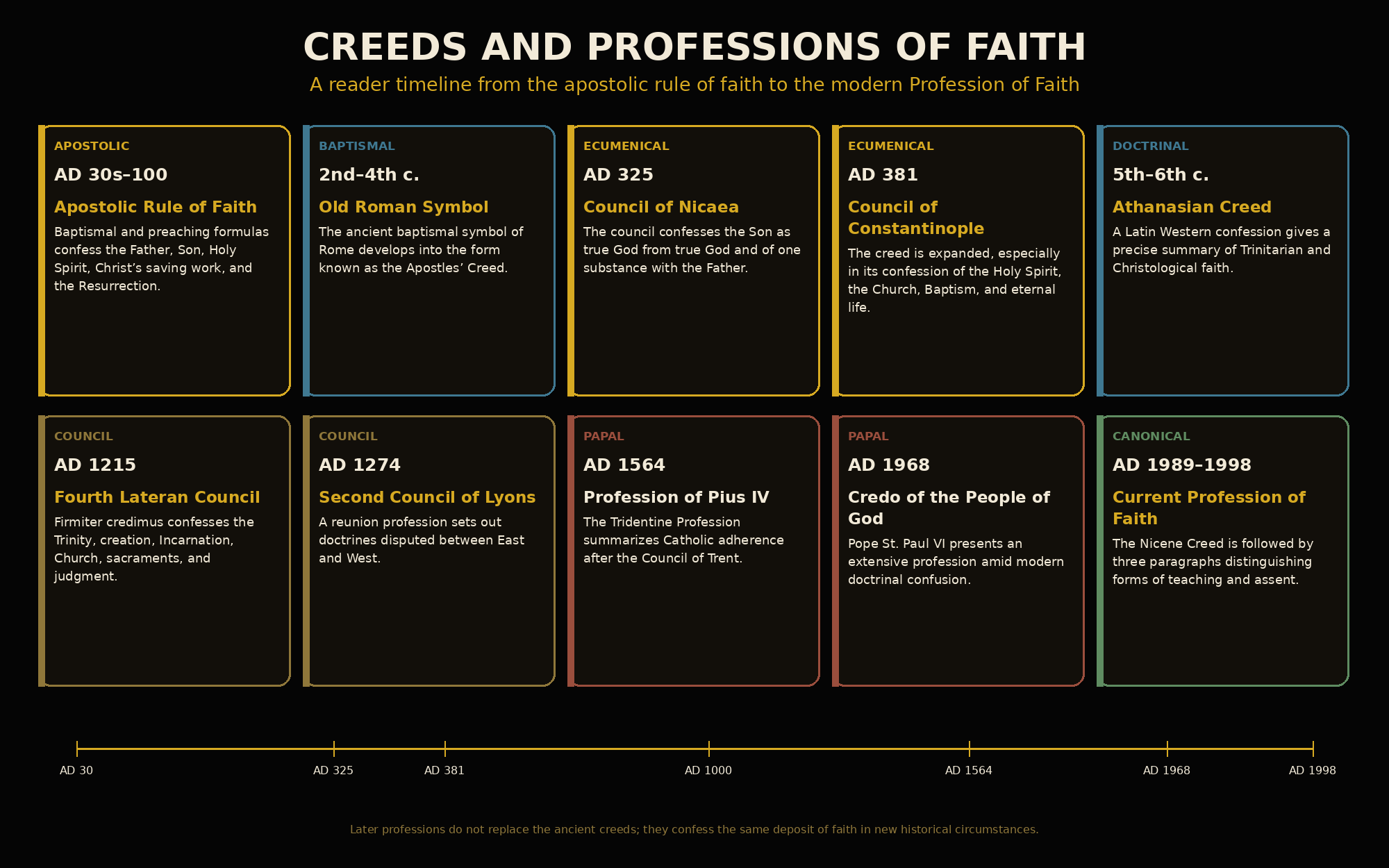
This library follows ten major texts from the ancient Roman baptismal symbol to the modern Profession of Faith and Oath of Fidelity. Each page distinguishes the text’s historical origin, doctrinal content, authority, current use, and common misinterpretations.
Later professions do not add a second revelation. They defend, explain, and apply the apostolic deposit under new historical circumstances.
The Branch at a Glance
Ancient Symbols and Early Professions
Old Roman Symbol
The ancient Roman baptismal form that stands behind the Apostles’ Creed.
I believe in God the Father almighty; and in Christ Jesus, His only Son, our Lord.
Short representative clause from the ancient Roman baptismal profession; reconstructed forms and translations vary.
Fides Damasi
A late-antique Latin Trinitarian profession traditionally associated with Pope St. Damasus I.
Formula of Hormisdas
The reunion profession that helped end the Acacian Schism in AD 519.
Toledo XI Creed
A detailed Western Trinitarian and Christological confession from AD 675.
Medieval Conciliar Professions
Lateran IV: Firmiter Credimus
The AD 1215 profession on the Trinity, creation, Church, Eucharist, resurrection, and judgment.
We firmly believe and simply confess that there is only one true God.
Short identifying excerpt from Constitution 1; English translations differ.
Lyons II Profession of Faith
The AD 1274 reunion profession addressing the Holy Spirit, purgatory, sacraments, and Roman primacy.
Modern and Contemporary Professions
Tridentine Profession of Faith
Pope Pius IV’s AD 1564 post-Tridentine profession for ecclesiastical and teaching responsibility.
Credo of the People of God
Pope St. Paul VI’s comprehensive profession proclaimed on 30 June 1968.
Profession of Faith — 1989
The current doctrinal formula with three concluding paragraphs and corresponding forms of assent.
I also firmly accept and hold each and everything definitively proposed by the Church regarding teaching on faith and morals.
Short excerpt from the approved formula; the official text governs its canonical use.
Oath of Fidelity
The promise attached to specified offices exercised in the name of the Church.
Not Every Profession Has the Same Status
A baptismal symbol, local council’s creed, Ecumenical Council’s constitution, papal profession, reunion formula, and canonical oath differ in origin and use.
Baptismal
Forms the catechumen and identifies the faith into which Baptism is received.
Doctrinal
Clarifies truths about the Trinity, Christ, Church, sacraments, or salvation.
Conciliar
Issued by a council and interpreted according to that council’s authority and literary form.
Reunion-Related
States disputed doctrines and visible conditions of restored communion.
Canonical
Required by law of persons assuming specified responsibilities in the Church.
These categories can overlap. The critical task is to identify what kind of act a text is before assigning it authority or current legal use.
One Deposit, Increasing Explicitness
The apostolic deposit of faith was complete with the death of the last Apostle. Later history does not supply new public revelation.
Development occurs when the Church distinguishes implications, answers new errors, or gives precise language to truths already present in Scripture and Tradition.
The Old Roman Symbol expresses baptismal essentials. Toledo XI develops Trinitarian relations. Lateran IV gives a medieval conciliar synthesis. Trent answers Reformation disputes. The modern Profession distinguishes modes of magisterial teaching and assent.
These changes in explicitness are compatible with identity of faith when later formulas preserve rather than contradict what came before.
How to Use Each Page
Begin with the Start Here panel. It identifies the document and states the most important historical caution.
Then read the authority section. A local creed should not be labeled ecumenical; a reunion formula should not be detached from negotiations; a former canonical formula should not be presented as current law.
Use the doctrinal sections to connect the document with Scripture, councils, and the Catechism. Finally, consult Common Mistakes and the plain-text source list before using the page for teaching or apologetics.
Texts and Translations
Ancient and medieval documents often survive in Latin or Greek manuscripts with several modern translations. A translated phrase may vary without changing the underlying doctrine.
Modern papal and dicasterial texts may remain under copyright in particular translations. These pages therefore explain their structure and teaching rather than reproducing long official translations.
For formal theological or canonical work, consult the official language, the Acta Apostolicae Sedis, a current Denzinger-Hünermann edition, and the competent canonical text.
Historical Context without Relativism
Context explains why a document speaks as it does. The Formula of Hormisdas names bishops because it healed a concrete schism. Lyons II uses reunion language because East and West were negotiating disputed doctrines. Pius IV’s profession responds directly to Reformation controversies.
Context does not make truth relative. It helps readers distinguish enduring doctrine from contingent discipline, political circumstances, translation, and rhetorical form.
A Catholic reading therefore avoids both fundamentalism about every historical phrase and skepticism about all doctrinal development.
Suggested Reading Paths
Creedal Development
Read the Old Roman Symbol, Fides Damasi, and Toledo XI to follow the movement from baptismal summary to increasingly exact Trinitarian confession.
Roman Communion
Read the Formula of Hormisdas, Lyons II, and the modern Oath to distinguish doctrine, visible communion, primacy, and office.
Sacramental Doctrine
Read Lateran IV and the Tridentine Profession for Eucharist, transubstantiation, priesthood, Penance, and the sacramental economy.
Modern Magisterium
Read Paul VI’s Credo and the 1989 Profession to study postconciliar continuity and the forms of doctrinal assent.
Readers preparing catechesis should normally begin with the Apostles’ and Nicene Creeds in the parent branch. These historical pages assume that basic framework and then show how particular controversies required further precision.
Common Mistakes to Avoid
- Do not assign identical authority to every profession.
- Do not call every page’s document a universal liturgical creed.
- Do not reproduce uncertain authorship as established fact.
- Do not ignore the political circumstances of reunion professions.
- Do not confuse doctrinal development with contradiction.
- Do not present superseded canonical formulas as current law.
- Do not isolate short quotations from the complete document.
- Do not use historical professions as weapons against persons.
Key Takeaways
- This branch contains one landing page and ten focused document pages.
- The documents range from baptismal symbols to canonical formulas.
- Their authority depends upon source, issuing body, purpose, and reception.
- Ancient professions clarify the Trinity and Incarnation.
- Medieval texts address creation, sacraments, reunion, and primacy.
- Modern formulas address Trent, postconciliar continuity, assent, and office.
- Later professions preserve and explain the one apostolic deposit.
- Exact source identification is essential for responsible Catholic teaching.
Sources and Further Reading
- Holy Bible, Douay-Rheims: Matthew 28:19; John 16:13; Romans 10:9–10; First Corinthians 15:1–8; Jude 3.
- Catechism of the Catholic Church, 166–197 and 84–95.
- Denzinger-Hünermann, Enchiridion Symbolorum, Definitionum et Declarationum de Rebus Fidei et Morum.
- J. N. D. Kelly, Early Christian Creeds.
- Norman P. Tanner, ed., Decrees of the Ecumenical Councils.
- Pope St. Paul VI, Credo of the People of God.
- Code of Canon Law, canons 750, 752, and 833.
- Congregation for the Doctrine of the Faith, Profession of Faith and Oath of Fidelity.
- Pope St. John Paul II, Ad Tuendam Fidem.