

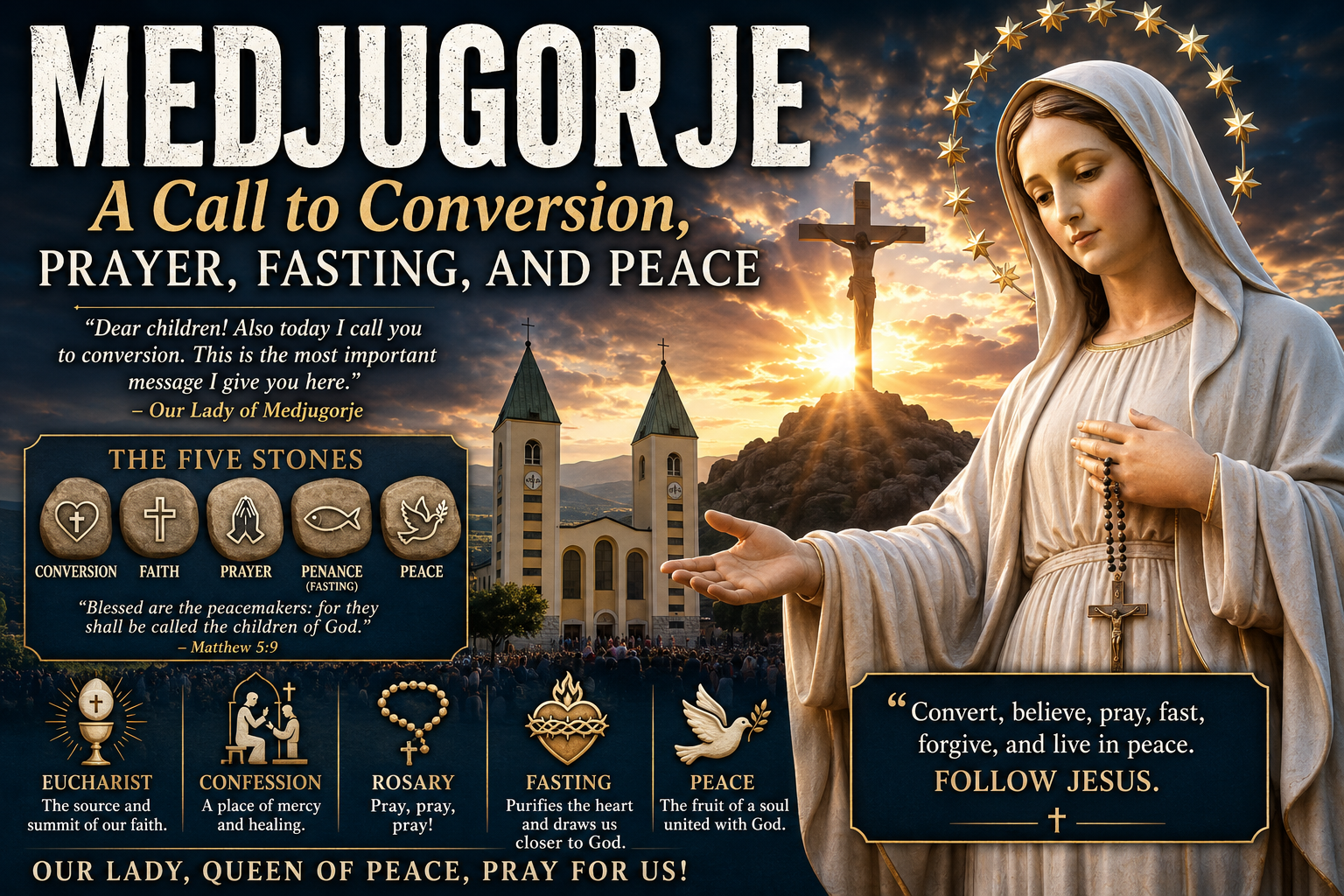
What the reported apparitions teach—and how Catholics can approach them faithfully
Estimated audio length: 7:43
Category: Marian Apparitions, Catholic Spirituality, Conversion
Tags: Medjugorje, Blessed Virgin Mary, Queen of Peace, Five Stones, Prayer, Fasting, Conversion
At the Foot of the Cross
Medjugorje is more than a disputed apparition site or a destination on a Catholic pilgrimage map. For millions of people, it has become a place associated with conversion, confession, Eucharistic devotion, prayer, fasting, reconciliation, and a renewed desire to follow Jesus Christ.
In Queen of the Cosmos: Interviews with the Visionaries of Medjugorje by Jan Connell, editor David Manuel presents Medjugorje as a call capable of reaching across religious and denominational divisions. At the foot of the Cross, every human being encounters the same Savior, bears the same need for mercy, and hears the same invitation to repentance.
This does not mean that the differences between Catholic and Protestant belief are meaningless. Christ desires unity in truth, not the abandonment of truth. Yet no denominational label can substitute for personal conversion, supernatural faith, obedience to God, or a life transformed by grace.
As Saint Paul teaches:
“For in Christ Jesus neither circumcision availeth any thing, nor uncircumcision: but a new creature.”
—Galatians 6:15, Douay-Rheims
The enduring appeal of Medjugorje is found precisely here: in its insistence that each of us must become a new creation in Christ.
What Happened at Medjugorje?
The story began on June 24, 1981, in the village of Medjugorje, then part of Communist Yugoslavia and now located in Bosnia and Herzegovina.
According to the young people involved, a brilliant figure appeared on a nearby hillside. The figure was subsequently identified as the Blessed Virgin Mary. Six young people became associated with the reported apparitions: Mirjana Dragićević, Ivanka Ivanković, Vicka Ivanković, Marija Pavlović, Ivan Dragićević, and Jakov Čolo.
Connell’s book recounts their experiences, their reported conversations with the Blessed Mother, and their descriptions of Heaven, Purgatory, Hell, spiritual warfare, prayer, fasting, peace, and certain secrets concerning the future.
The events attracted intense attention during a period of Communist repression. Priests and laypeople who supported the visionaries faced interrogation, intimidation, and imprisonment. Father Jozo Zovko, the parish priest at the time, became one of the best-known figures to suffer under the Communist authorities.
Pilgrims nevertheless continued to arrive.
Over the following decades, Medjugorje became associated with numerous conversions, priestly and religious vocations, returns to the sacraments, reconciliations within families, Eucharistic Adoration, and renewed lives of prayer. These spiritual fruits have now been explicitly acknowledged by the Church’s highest doctrinal authority.
What Has the Church Said?
Catholics should speak about Medjugorje carefully and accurately.
On September 19, 2024, the Dicastery for the Doctrine of the Faith published The Queen of Peace: Note About the Spiritual Experience Connected with Medjugorje. With the approval of Pope Francis, the Church granted a nihil obstat to the spiritual experience associated with Medjugorje.
This means that the faithful may prudently embrace its spiritual proposal and that public acts of devotion may be authorized. The Church recognized many positive spiritual fruits, including conversions, sacramental participation, prayer, vocations, family reconciliation, and renewed commitment to Christian life.
However, the nihil obstat does not declare that the alleged apparitions are supernatural. Catholics are not obligated to believe in them, and references to messages from Our Lady must still be understood as references to alleged messages. The Church has also cautioned that some reported messages contain confusing, imprecise, or problematic expressions that should not be accepted uncritically.
The Church’s guidance is beautifully simple: pilgrims should not go primarily to meet alleged visionaries or chase extraordinary signs. They should go to encounter Mary as Queen of Peace and, through her maternal guidance, encounter Jesus Christ in Scripture, the Eucharist, Confession, and Adoration.
This is also consistent with the Church’s teaching on private revelation. Nothing can be added to the definitive Revelation given in Jesus Christ. Authentic private revelations do not improve or complete the Gospel; they may only help Christians live the Gospel more faithfully in a particular period of history.
See the Catechism of the Catholic Church, paragraphs 66–67.
The Five Stones
The spirituality associated with Medjugorje is frequently summarized through five practices known as the Five Stones. The name recalls David selecting five smooth stones before confronting Goliath.
These practices are not spiritual novelties. Each is deeply rooted in Scripture and the life of the Catholic Church.
1. Conversion
The first and most urgent message is conversion.
Conversion means more than experiencing an emotional moment or identifying oneself as religious. It means turning away from sin and reordering one’s entire life toward God.
It may require ending a sinful relationship, abandoning a destructive habit, forgiving an enemy, returning to Sunday Mass, making an honest Confession, or surrendering a hidden area of life that we have refused to give to Christ.
Conversion is not completed once. It is the daily work of grace.
“Do penance: for the kingdom of heaven is at hand.”
—Matthew 3:2, Douay-Rheims
The Church’s 2024 note identified the call to conversion as one of the strongest and most consistent elements within the Medjugorje spirituality.
2. Faith
Faith is not merely believing that God exists. Even the devils believe in God and tremble before Him.
Christian faith means entrusting oneself to God. It means believing Christ, obeying Christ, and allowing His grace to shape every part of our lives.
Mary’s entire mission is directed toward her Son. Her words at Cana remain the perfect summary of authentic Marian devotion:
“Whatsoever he shall say to you, do ye.”
—John 2:5, Douay-Rheims
True devotion to Mary never terminates in Mary. She brings us to Jesus, the one Mediator and Savior of mankind. The Dicastery’s note repeatedly emphasizes the Christ-centered character of the most valuable alleged messages associated with Medjugorje.
3. Prayer
The call to prayer is constant: pray, pray, pray.
This includes the Holy Rosary, silent prayer, meditation upon Scripture, Eucharistic Adoration, the Holy Sacrifice of the Mass, and frequent reception of the Sacrament of Penance.
The Christian is called to do more than recite words. We must learn to pray with the heart—attentively, sincerely, humbly, and with a real desire to encounter God.
“Pray without ceasing.”
—1 Thessalonians 5:17, Douay-Rheims
The summit of prayer is the Holy Mass. No apparition, vision, locution, miraculous sign, or private revelation can equal the miracle occurring upon the altar. In the Eucharist, Jesus Christ is truly present—Body, Blood, Soul, and Divinity.
The Church’s note emphasizes that the spirituality of Medjugorje properly places the Eucharist above the alleged apparitions themselves.
4. Penance and Fasting
The fourth stone is penance, especially fasting.
The Medjugorje tradition particularly encourages fasting on Wednesdays and Fridays, commonly with bread and water. Health, age, vocation, and legitimate responsibilities must always be considered prudently. A person who cannot fast from food may offer another meaningful sacrifice.
Fasting detaches us from created comforts so that we can desire the Creator more deeply. It exposes our appetites, strengthens the will, aids prayer, and teaches the body that it is not the master of the soul.
“This kind can go out by nothing, but by prayer and fasting.”
—Mark 9:28, Douay-Rheims
Fasting is not a spiritual transaction by which we purchase favors from God. It is an act of love and surrender. The Church’s note describes fasting as a freely offered sacrifice rather than an inflexible burden imposed without regard for a person’s circumstances.
5. Peace
Peace is the fruit of conversion, faith, prayer, and penance.
The peace promised by Christ is not merely the absence of conflict. It is the tranquility that comes when the human person is rightly ordered toward God.
“Peace I leave with you, my peace I give unto you: not as the world giveth, do I give unto you.”
—John 14:27, Douay-Rheims
Peace begins when we are reconciled with God. It spreads into marriages, families, parishes, workplaces, and nations when we forgive one another and live according to the commandments.
This is why the title Queen of Peace stands at the center of the Medjugorje spirituality. Mary’s peace is never independent of Christ. Jesus is the King of Peace, and peace can finally be found only in Him.
Spiritual Warfare Is Real
Connell’s interviews also contain serious warnings about the devil.
The visionaries describe Satan as working through confusion, resentment, division, hatred, temptation, family conflict, and attractive disguises. Whether or not one accepts every reported statement, the underlying warning is entirely consistent with Catholic teaching.
The devil is real. He is not an impersonal symbol of evil. He is a fallen angel who seeks to separate human beings from God and from one another.
Yet Satan’s power is limited. He is a creature, not an equal opposite to God. Christ has already conquered him through the Cross and Resurrection.
Prayer, fasting, sacramental Confession, worthy reception of Holy Communion, forgiveness, humility, and obedience to God are powerful weapons in spiritual warfare. Hatred gives the enemy room to work; forgiveness closes the door.
“Be subject therefore to God, but resist the devil, and he will fly from you.”
—James 4:7, Douay-Rheims
Heaven, Purgatory, and Hell
The visionaries interviewed by Connell report receiving glimpses of Heaven, Purgatory, and Hell. Catholics are not required to accept these particular descriptions, but the realities themselves belong to Catholic doctrine.
Heaven
Heaven is the definitive fulfillment of humanity’s deepest desires: eternal communion with the Blessed Trinity, the Blessed Virgin Mary, the angels, and the saints.
It is not merely a beautiful location. It is the Beatific Vision—the direct vision of God.
See the Catechism of the Catholic Church, paragraphs 1023–1029.
Purgatory
Purgatory is the final purification of those who die in God’s friendship but are not yet perfectly purified.
The souls in Purgatory are saved. Their suffering is temporary and ordered toward the perfect holiness necessary for Heaven. The Church therefore offers prayers, indulgences, almsgiving, and especially the Holy Sacrifice of the Mass for the faithful departed.
See the Catechism of the Catholic Church, paragraphs 1030–1032.
Hell
Hell is eternal separation from God through definitive, unrepented mortal sin.
God does not predestine anyone to Hell. He desires the salvation of all, offers grace, and continually calls sinners to repentance. Nevertheless, God respects human freedom. A person can persistently reject grace and freely exclude himself from communion with God.
See the Catechism of the Catholic Church, paragraphs 1033–1037.
Warnings about Hell are therefore not meant to produce despair. They are acts of mercy. Christ Himself spoke about judgment because our choices possess eternal significance.
What About the Secrets and Extraordinary Signs?
The reported visionaries have spoken of ten secrets concerning future events, warnings, and a permanent sign.
Connell’s interviews also discuss healings, unusual solar phenomena, rosaries reportedly changing color, and other extraordinary occurrences.
Catholics should approach such claims with prudence.
Signs are not the center of the Christian faith. They cannot replace Scripture, Tradition, the sacraments, obedience to the Church, or works of charity. An obsession with secrets, dates, catastrophes, and predictions can distract us from the ordinary duties through which God sanctifies us.
The Church’s 2024 note explicitly warns against overemphasizing extraordinary events. It teaches that the faithful should devote their energy to Scripture, prayer, worship, service, reconciliation, and the building of peace.
The most important “secret” has already been revealed publicly:
Christ has died.
Christ is risen.
Christ will come again.
The correct time for conversion is not after a predicted sign appears. It is today.
“Behold, now is the acceptable time; behold, now is the day of salvation.”
—2 Corinthians 6:2, Douay-Rheims
The Real Test of Medjugorje
The lasting importance of Medjugorje will not be determined by spinning suns, changing rosaries, dramatic predictions, or curiosity about visionaries.
Its spiritual value is measured by its fruits.
Does it lead us to Jesus Christ?
Does it bring us back to Confession?
Does it increase our love for the Eucharist?
Does it move us to forgive?
Does it produce fidelity to the Catholic Church?
Does it inspire prayer, fasting, charity, peace, and care for the poor?
Does it make us more humble?
Mary’s authentic mission is always maternal and Christ-centered. She does not compete with her Son. She points to Him.
At the foot of the Cross, Jesus entrusted the beloved disciple to His Mother:
“After that, he saith to the disciple: Behold thy mother.”
—John 19:27, Douay-Rheims
The safest and most fruitful way to approach Medjugorje is therefore neither blind enthusiasm nor cynical rejection. It is faithful discernment: receive what leads unmistakably to Christ and His Church, remain obedient to ecclesiastical authority, and avoid becoming consumed by extraordinary claims.
The essential invitation is already the invitation of the Gospel:
Convert. Believe. Pray. Fast. Forgive. Receive the sacraments. Live in peace. Follow Jesus.
That message is urgent because God is merciful and does not desire any of His children to be lost.
Share the Message
Consider sharing this post with someone who may need encouragement to return to prayer, Confession, the Eucharist, or a deeper relationship with Jesus Christ.
Our Lady, Queen of Peace, pray for us.
Sources and Further Reading
- Jan Connell, Queen of the Cosmos: Interviews with the Visionaries of Medjugorje.
- Dicastery for the Doctrine of the Faith, The Queen of Peace: Note About the Spiritual Experience Connected with Medjugorje, September 19, 2024.
- Dicastery for the Doctrine of the Faith, Norms for Proceeding in the Discernment of Alleged Supernatural Phenomena, May 17, 2024.
- Catechism of the Catholic Church, paragraphs 66–67, 1023–1037.
- Second Vatican Council, Lumen Gentium, paragraph 62.
- Saint John Paul II, Redemptoris Mater, paragraph 39.