

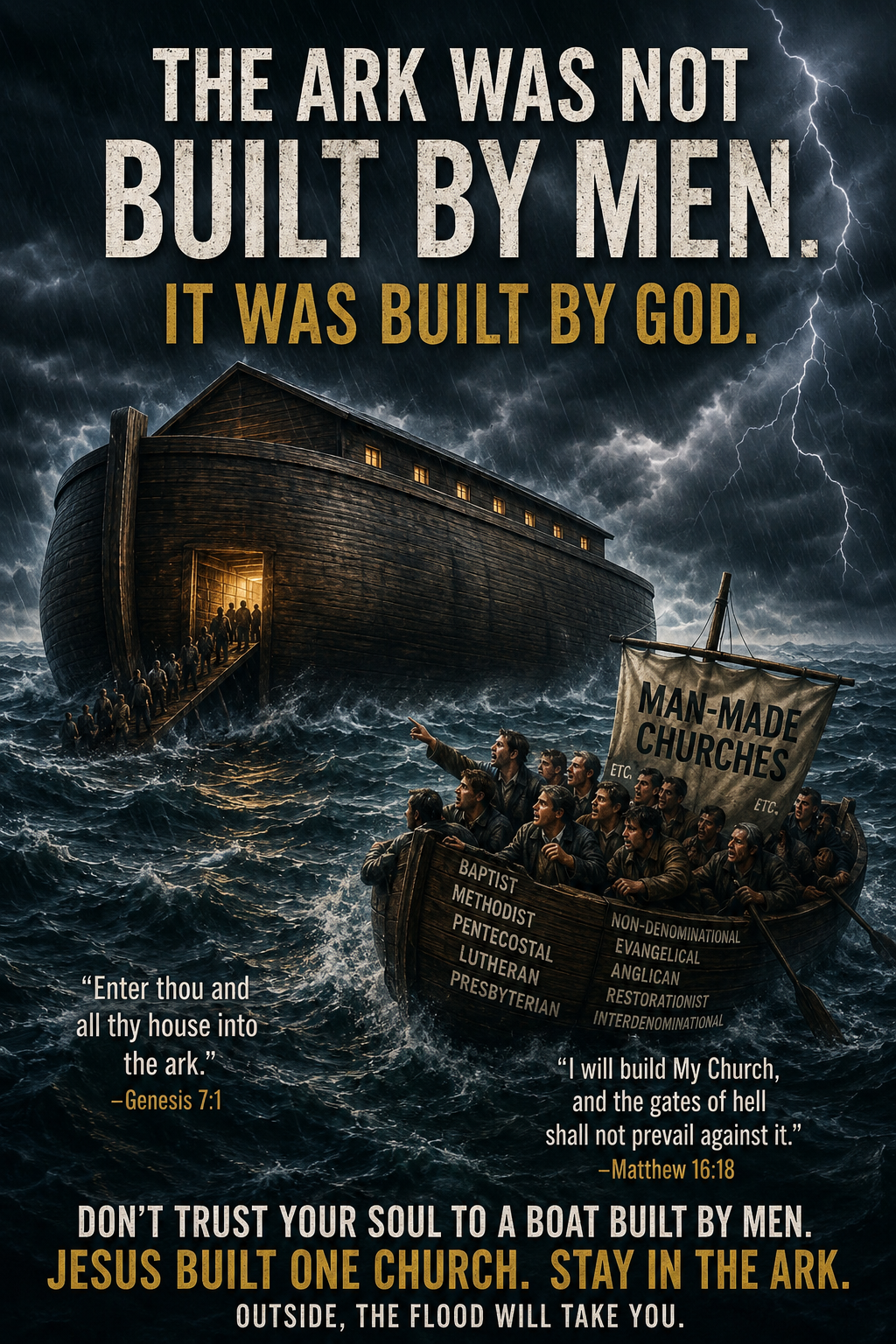
A Loving Invitation to Come Home to the Ark Christ Built
“And I say to thee: That thou art Peter; and upon this rock I will build my church, and the gates of hell shall not prevail against it.” — Matthew 16:18 (Douay-Rheims)
Imagine standing in the middle of a violent ocean.
Towering waves crash around you. The sky is black. Lightning tears across the heavens. Every direction looks the same. The sea is swallowing everyone who trusts in themselves.
Then you see two choices.
One is a massive ark built according to God’s command.
The other is a collection of small boats—well-intentioned perhaps—but built by men, each captain insisting his course is the correct one.
Which would you choose?
Noah’s Ark Was Never Just About Noah
The story of Noah was not simply ancient history.
The Church Fathers consistently saw the Ark as a foreshadowing of Christ’s Church.
God did not command Noah to build ten arks.
He did not tell every family to construct their own version.
He provided one Ark, one means of rescue from the flood.
“Enter thou and all thy house into the ark.” (Genesis 7:1)
Those outside the Ark perished—not because God was cruel, but because they rejected the means of salvation He Himself had established.
Likewise, Christ established one visible Church through which He continues His saving mission.
Christ Built One Church—Not Thousands
Jesus never said:
“I will build thousands of churches that disagree on baptism, salvation, the Eucharist, authority, and worship.”
He declared:
“I will build My Church.” (Matthew 16:18)
Singular.
One Church.
Saint Paul echoes the same truth:
“One body and one Spirit… one Lord, one faith, one baptism.” (Ephesians 4:4–5)
The unity Christ prayed for (John 17:21) was never intended to become the doctrinal fragmentation we witness today.
The Problem With Man-Made Denominations
Many Protestant communities began with sincere people who desired reform.
Good intentions, however, do not establish divine authority.
From the sixteenth century onward, countless denominations emerged, often because sincere Christians reached different conclusions while relying on private interpretation of Scripture.
Today there are thousands of Protestant groups that disagree on essential doctrines:
- Is Baptism necessary?
- Can salvation be lost?
- Is the Eucharist truly Christ’s Body and Blood?
- Is divorce and remarriage permissible?
- Does Baptism regenerate the soul?
- Is confession to a priest biblical?
- What books belong in the Bible?
- Is Sunday worship required?
- Can women be ordained?
- What is the nature of the Church itself?
They cannot all be correct.
Truth does not contradict itself.
As St. Paul warns:
“For God is not the God of dissension, but of peace.” (1 Corinthians 14:33)
The Catholic Church Is Not a Human Invention
The Catholic Church did not begin with Constantine.
It did not begin in AD 1054.
It did not begin at the Council of Trent.
It began when Jesus Christ founded it upon the Apostles, with Peter as the visible head (Matthew 16:18–19; Luke 22:31–32; John 21:15–17).
From the first century onward, Christians recognized this visible, apostolic Church.
Around AD 107, St. Ignatius of Antioch wrote:
“Wherever Jesus Christ is, there is the Catholic Church.”
The name Catholic Church is not a medieval invention. It belongs to the earliest generations of Christianity.
“Outside the Church There Is No Salvation”
This ancient expression, repeated by saints such as St. Cyprian of Carthage, is often misunderstood.
The Catholic Church does not teach that every non-Catholic is automatically condemned.
The Catechism explains that all salvation comes through Christ and His Church, even when someone, through no fault of his own, does not yet recognize the fullness of the Catholic faith (CCC 846–848).
The Church is the ordinary means of salvation because she is Christ’s Body.
God is not bound by His sacraments—but we are not free to reject the means He established.
A Loving Appeal
If you are Protestant, this is not written to insult you.
Many Protestants deeply love Jesus.
Many sincerely seek the truth.
Many have been taught things about Catholicism that simply are not true.
This is an invitation—not an attack.
Ask yourself:
- If Jesus founded one Church…
- If Christians for the first fifteen centuries were visibly united under apostolic authority…
- If the Bible itself came to us through the Catholic Church…
- If the early Christians believed in the Real Presence, apostolic succession, sacramental confession, and the authority of bishops…
Then why remain separated from the Church Christ established?
Don’t Gamble With Eternity
Imagine again that raging ocean.
Would you entrust your life to a vessel built according to God’s command…
Or to one built centuries later by sincere but fallible men?
The storm of false doctrine is real.
Confusion is real.
Division is real.
But Christ’s promise remains:
“The gates of hell shall not prevail against it.” (Matthew 16:18)
That promise was made to His Church.
Not to competing denominations.
Not to private interpretation.
Not to ever-changing human opinions.
It was made to the Church He founded.
Come aboard the Ark.
Come home to the Church that has preserved the apostolic faith for two thousand years.
Your soul is infinitely precious.
Don’t entrust your eternity to human invention when Christ has already provided the Ark.
Sources
Sacred Scripture (Douay-Rheims)
- Genesis 6–8 (Noah’s Ark)
- Genesis 7:1
- Matthew 16:18–19
- Matthew 28:18–20
- Luke 22:31–32
- John 10:9
- John 17:20–23
- John 21:15–17
- Acts 2:42
- Ephesians 4:4–5
- 1 Corinthians 1:10
- 1 Corinthians 14:33
- 1 Timothy 3:15
- 2 Thessalonians 2:15
Catechism of the Catholic Church
- CCC 748–750 (The Church in God’s plan)
- CCC 763–766 (Christ founded the Church)
- CCC 816 (The sole Church of Christ subsists in the Catholic Church)
- CCC 846–848 (Outside the Church there is no salvation)
- CCC 857–860 (Apostolic succession)
Church Fathers
- St. Ignatius of Antioch, Letter to the Smyrnaeans 8:2 (AD 107) “Wherever Jesus Christ is, there is the Catholic Church.”
- St. Cyprian of Carthage, On the Unity of the Catholic Church 6 (AD 251) “He can no longer have God for his Father, who has not the Church for his mother.”
- St. Augustine, Sermon 96 (or Against the Letter of Mani, 5:6) “I would not believe the Gospel except as moved by the authority of the Catholic Church.”
- St. Irenaeus of Lyons, Against Heresies 3.3.2 (c. AD 180)
- On apostolic succession and the Church of Rome preserving the apostolic faith.
Magisterial Documents
- Second Vatican Council, Lumen Gentium, §§8, 14
- Second Vatican Council, Unitatis Redintegratio, §§3–4
- First Vatican Council, Pastor Aeternus (1870)