

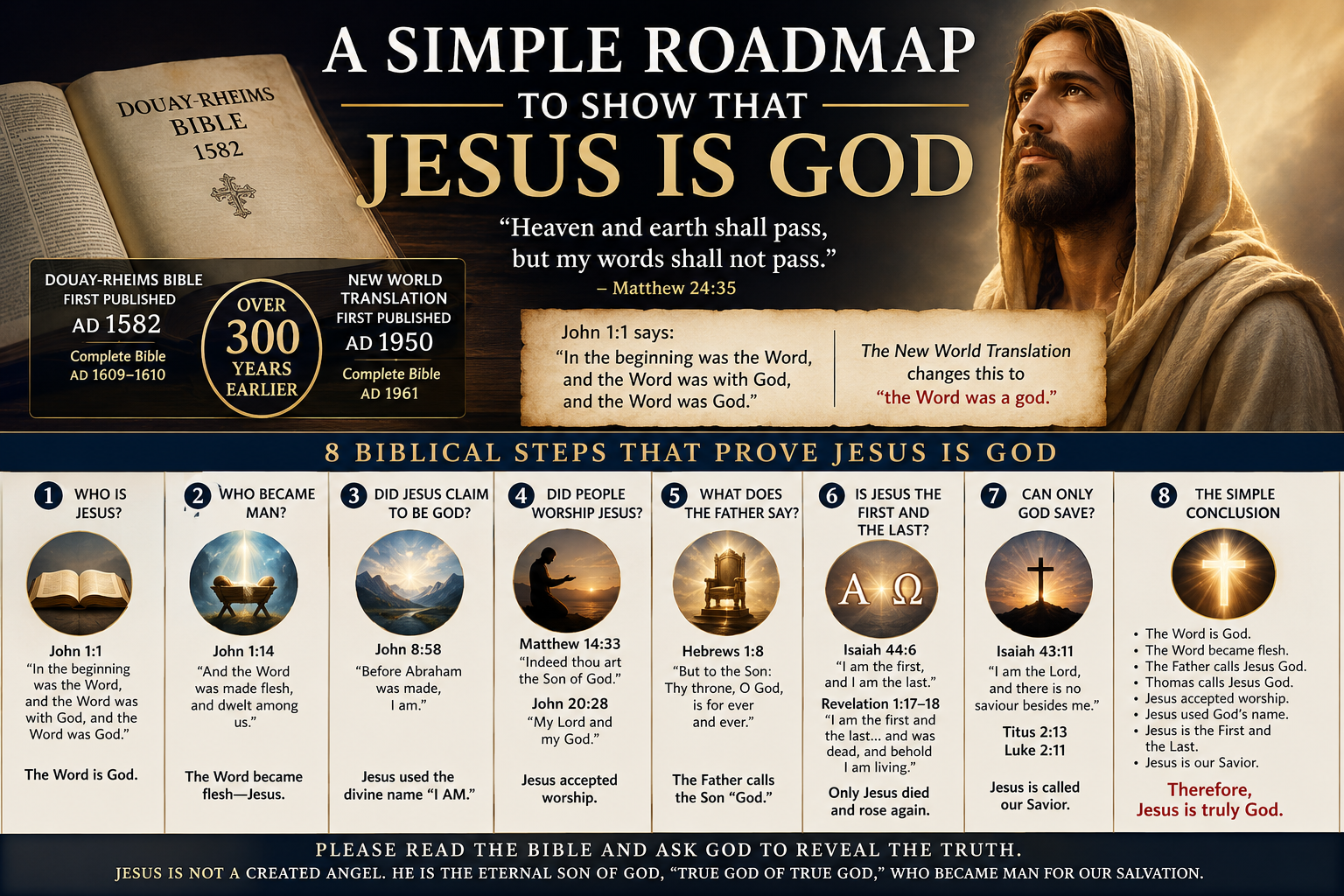
Before anyone responds with insults or accusations, let us slow down and examine what Scripture actually says about Jesus Christ.
This is not merely a disagreement about words. The identity of Jesus is at the heart of the Christian faith. Is Jesus a created angel, as Jehovah’s Witnesses teach, or is He the eternal Son of God who became man for our salvation?
The Bible gives a clear answer.
A Brief Note About the Bible Translations
The Douay-Rheims New Testament was first published in AD 1582, and the complete Bible appeared in AD 1609–1610.
The Jehovah’s Witnesses’ New World Translation did not begin appearing until AD 1950, and the complete version was published in AD 1961.
Therefore, the Douay-Rheims Bible existed more than three hundred years before the New World Translation.
Of course, a translation is not automatically correct merely because it is older. However, the age of the translations raises an important question: Why does the New World Translation render certain passages about Jesus differently from traditional Christian translations?
A clear example is John 1:1.
The Douay-Rheims Bible says:
“In the beginning was the Word, and the Word was with God, and the Word was God.”
The New World Translation renders the final words as:
“The Word was a god.”
That change is not small. It changes the identity of Jesus from God to a lesser, created being.
Yet Scripture teaches that God’s truth does not change:
“Heaven and earth shall pass, but my words shall not pass.”
—Matthew 24:35
“The word of the Lord endureth for ever.”
—1 Peter 1:25
God’s Word does not change to fit a religious organization’s doctrine. Human doctrine must submit to the Word of God.
Step 1: Who Is the Word?
John 1:1 says:
“In the beginning was the Word, and the Word was with God, and the Word was God.”
Was the Word God?
Yes. The verse plainly says that the Word was God.
The Word was already present “in the beginning.” He did not begin to exist as a created creature. He existed eternally with God and was God.
Step 2: Who Became Man?
John 1:14 says:
“And the Word was made flesh, and dwelt among us.”
Who became flesh?
Jesus Christ.
The argument is simple:
The Word was God.
The Word became flesh.
Jesus Christ is the Word made flesh.
Therefore, Jesus Christ is God who became man.
This does not mean that Jesus is the Father. The Father and the Son are distinct Persons. However, the Son possesses the same divine nature as the Father.
Step 3: Did Jesus Use the Divine Name?
In John 8:58, Jesus says:
“Before Abraham was made, I am.”
Jesus did not merely say, “Before Abraham existed, I existed.” He said, “I am.”
This recalls the name God revealed to Moses:
“I AM WHO AM.”
—Exodus 3:14
The people who heard Jesus understood the seriousness of His claim. The next verse says that they took up stones to throw at Him.
Why?
Because they believed He had committed blasphemy by identifying Himself with the divine name.
Jesus was not claiming merely to be older than Abraham. He was declaring His eternal existence.
Step 4: Did People Worship Jesus?
After Jesus walked upon the water, His disciples worshipped Him:
“And they that were in the boat came and adored him, saying: Indeed thou art the Son of God.”
—Matthew 14:33
Jesus accepted their worship.
This is important because Scripture teaches that worship belongs to God alone:
“The Lord thy God shalt thou adore, and him only shalt thou serve.”
—Matthew 4:10
If Jesus were merely a created angel, He should have refused worship.
Created angels refuse worship. In Revelation 22:8–9, when Saint John attempts to worship an angel, the angel immediately tells him not to do so.
Jesus, however, repeatedly accepts worship because He is not a created angel. He is the divine Son.
Step 5: What Did Thomas Call Jesus?
After seeing the risen Christ, Thomas said directly to Him:
“My Lord, and my God.”
—John 20:28
Thomas did not merely say that Jesus was godlike. He addressed Jesus personally as “my God.”
Jesus did not rebuke him.
Instead, Jesus responded:
“Because thou hast seen me, Thomas, thou hast believed: blessed are they that have not seen, and have believed.”
—John 20:29
Jesus accepted Thomas’s confession of faith.
The Gospel of John begins by declaring that the Word was God and reaches its climax when Thomas confesses Jesus as Lord and God.
Step 6: What Does the Father Call the Son?
Hebrews 1:8 says:
“But to the Son: Thy throne, O God, is for ever and ever.”
The Father addresses the Son as God.
The same chapter also distinguishes Jesus from the angels. Hebrews 1:5 asks:
“For to which of the angels hath he said at any time: Thou art my Son?”
The answer is none.
Jesus is not one angel among many. He is the eternal Son, superior to all angels, whom the angels themselves are commanded to adore:
“And let all the angels of God adore him.”
—Hebrews 1:6
Step 7: Who Is the First and the Last?
In Isaiah 44:6, God says:
“I am the first, and I am the last, and besides me there is no God.”
Yet in Revelation, Jesus says:
“Fear not. I am the First and the Last, and alive, and was dead; and behold I am living for ever and ever.”
—Revelation 1:17–18
Who was dead and is now alive forever?
Jesus Christ.
The title “the First and the Last” belongs to God. Jesus applies that divine title to Himself.
Step 8: Who Is the Savior?
God says in Isaiah:
“I am the Lord, and there is no saviour besides me.”
—Isaiah 43:11
Yet the New Testament calls Jesus the Savior:
“This day is born to you a Saviour, who is Christ the Lord.”
—Luke 2:11
Saint Paul also writes:
“Looking for the blessed hope and coming of the glory of the great God and our Saviour Jesus Christ.”
—Titus 2:13
If God alone is Savior, and Jesus is our Savior, then Jesus shares the divine identity.
The Simple Conclusion
Even a child can follow the basic argument:
The Word is God.
The Word became flesh.
Jesus is the Word made flesh.
The Father calls the Son God.
Thomas calls Jesus “my Lord and my God.”
Jesus accepts worship.
Jesus uses the divine name.
Jesus is called the First and the Last.
Jesus is our Savior.
Therefore, Jesus Christ is truly God.
A Final Appeal to Jehovah’s Witnesses
Jehovah’s Witness teaching presents a false understanding of Jesus because it reduces the eternal Son of God to a created being.
Jesus is not Michael the Archangel.
Jesus is not “a god.”
Jesus is not the first creature made by Jehovah.
Jesus Christ is the eternal Word, the divine Son of the Father, who became man for our salvation.
I encourage every Jehovah’s Witness to read these passages carefully and honestly. Do not begin with what the Watchtower says the verses must mean. Begin with the words of Scripture themselves.
God’s Word must judge every human organization, every teacher, and every doctrine.
Jesus Christ is Lord and God.
The truth is simple:
He is “true God of true God,” eternally begotten of the Father, who came down from heaven, became man, died for our sins, and rose again for our salvation.