

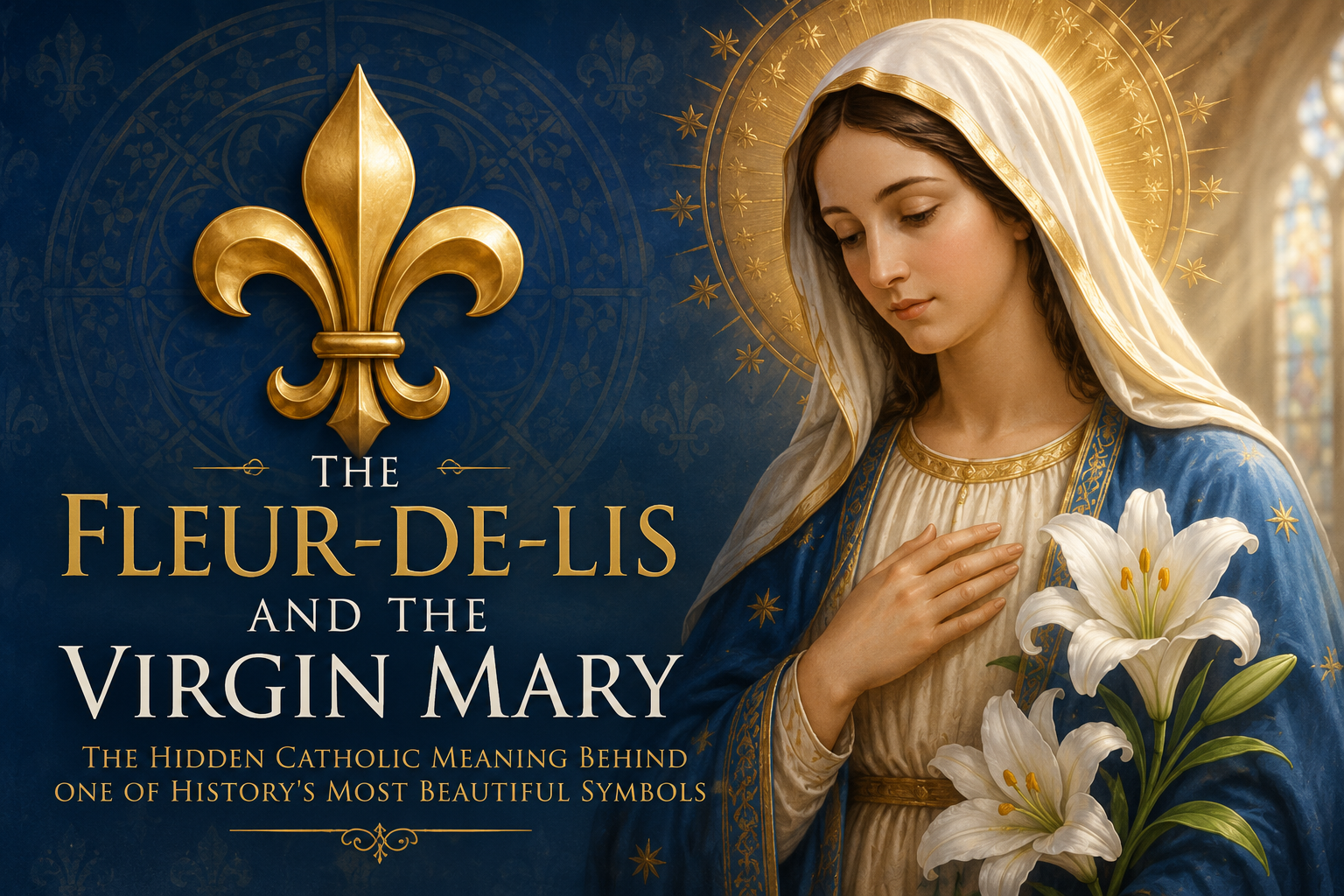
Walk through an old Catholic cathedral. Look closely at stained glass windows, carved altars, illuminated manuscripts, or ancient vestments, and you’ll likely notice a beautiful three-petaled flower appearing again and again.
It is the fleur-de-lis.
Many people recognize it as a symbol of French royalty or medieval heraldry. Others see it on sports logos, family crests, or historical monuments without giving it a second thought.
But for Catholics, the fleur-de-lis carries a much deeper meaning.
For centuries it has served as a powerful reminder of the Blessed Virgin Mary—her purity, her humility, her queenship, and above all, the transforming power of God’s grace.
Far from being merely decorative, the fleur-de-lis is a visual catechism. It teaches profound truths about Christ through the woman He chose to become His Mother.
More Than a Flower
The phrase fleur-de-lis is French for “flower of the lily.”
Although historians debate whether the original design was inspired by a true lily or an iris, Christian tradition quickly embraced it as a stylized lily because of what the lily had already come to represent.
Throughout Scripture and Christian history, lilies symbolize:
- Purity
- Holiness
- Innocence
- Beauty born from God’s grace
- Complete dedication to God
These qualities reach their fullest human expression in the Blessed Virgin Mary.
When Catholics see the fleur-de-lis, they are not merely seeing a flower.
They are seeing a reminder of the woman who perfectly cooperated with God’s plan of salvation.
Why the Lily Represents Mary
The Gospel of Luke records one of the most important moments in human history.
The Archangel Gabriel appears before a young woman in Nazareth.
“Hail, full of grace, the Lord is with thee.”
Luke 1:28
The angel does not simply call Mary by her name.
He greets her according to what she has become through God’s grace.
She is “full of grace.”
Catholics understand this greeting to reveal something extraordinary.
Before the Incarnation ever took place, God had already prepared Mary through His grace to become the Mother of His Son.
Her purity was not simply external.
It was the complete holiness of a soul entirely surrendered to God.
This is why Christian artists almost immediately began associating Mary with white lilies.
The flower became a visual language proclaiming what Scripture already teaches.
Mary is the new Eve.
The pure vessel.
The Ark of the New Covenant.
The woman whose “yes” opened the door for the Savior of the world.
The Annunciation and the Lily
One of the most common scenes in Christian art is the Annunciation.
Again and again throughout history, artists depict Gabriel holding a white lily while speaking to Mary.
This detail is no accident.
The lily represents:
- Mary’s virginity
- Her purity of heart
- Her complete openness to God’s will
- The new creation beginning through Christ
When Mary responds,
“Behold the handmaid of the Lord; be it unto me according to thy word.”
Luke 1:38
history changes forever.
The Eternal Word becomes flesh.
The Creator enters His creation.
The lily becomes forever connected with this moment of divine grace.
The Three Petals
The fleur-de-lis is not a random flower.
Its design has inspired centuries of Christian reflection.
While the Church has never dogmatically assigned a single interpretation to its shape, many Catholic writers have seen profound symbolism within its three petals.
The Holy Trinity
The three upward petals naturally remind Christians of:
- The Father
- The Son
- The Holy Spirit
Mary’s entire life points toward the Trinity.
She is the beloved daughter of the Father.
The Mother of the Son.
The spouse of the Holy Spirit.
Everything about her existence directs our attention back to God Himself.
Mary’s Perpetual Virginity
Many theologians have also understood the three petals to symbolize Mary’s perpetual virginity:
- Before the birth of Christ
- During the birth of Christ
- After the birth of Christ
This ancient doctrine has been consistently taught throughout Christian history and defended by the early Church Fathers.
The fleur-de-lis quietly reflects this mystery without speaking a single word.
Faith, Hope, and Charity
Others have seen the three petals as representing the three theological virtues:
- Faith
- Hope
- Charity
These virtues reached remarkable perfection within Mary’s life.
She believed when others doubted.
She hoped when all seemed lost.
She loved with complete self-giving.
The Band Holding the Flower Together
Near the base of the fleur-de-lis is a horizontal band binding the petals into one flower.
Many Christian artists interpreted this as symbolizing unity.
The virtues of Mary are not isolated qualities.
Her purity, humility, obedience, and love all flow together because they are rooted in one source:
God’s grace.
A holy life is never merely about one virtue.
It is the harmonious work of the Holy Spirit transforming the entire person.
Mary’s Royal Dignity
Long before France adopted the fleur-de-lis as a royal emblem, Christians already understood Mary to possess a unique royal dignity.
Not because she ruled apart from Christ—
but because she is the Mother of the King.
In the Old Testament kingdom of David, the queen was not ordinarily the king’s wife.
It was his mother.
She served as the Queen Mother (Gebirah), holding a place of honor beside the king.
We see this clearly in the reign of Solomon:
“The king rose to meet her and bowed down to her… and had a throne brought for the king’s mother, and she sat at his right hand.”
1 Kings 2:19
Jesus is the eternal Son of David.
If Christ is King, His mother shares in His royal dignity—not as an equal, but because of her unique relationship to Him.
The fleur-de-lis therefore became an especially fitting emblem of Mary’s queenship.
Its elegance reflects the honor God Himself bestowed upon the woman who bore the Savior into the world.
France and the “Eldest Daughter of the Church”
The fleur-de-lis eventually became the symbol of the French monarchy.
Many Catholic kings viewed their authority as flowing from God and sought the intercession of the Blessed Virgin Mary.
Although political history is often messy, the widespread use of the fleur-de-lis helped preserve its Marian associations throughout Europe.
Churches, monasteries, cathedrals, and religious communities adopted the symbol not merely because it represented France, but because it had already become associated with Our Lady.
A Flower That Points to Christ
Some non-Catholics object to Marian symbols because they believe honoring Mary somehow distracts from Jesus.
The opposite is true.
Authentic Marian devotion always points to Christ.
Mary never says,
“Look at me.”
Instead she tells every Christian exactly what she told the servants at Cana:
“Do whatever He tells you.”
John 2:5
The fleur-de-lis functions the same way.
It draws our attention to Mary’s holiness.
Mary’s holiness points to God’s grace.
God’s grace points to Jesus Christ.
The symbol ultimately becomes another way of proclaiming the Gospel.
Common Misconceptions
“The fleur-de-lis is just a French political symbol.”
While it certainly became associated with the French monarchy, its Christian use extends far beyond politics. Catholic churches throughout the world have employed it as a Marian symbol for centuries.
“Catholics worship Mary.”
The Catholic Church has never taught this.
Worship belongs to God alone.
Mary receives honor because God honored her first.
As she herself prophesied:
“From this day all generations will call me blessed.”
Luke 1:48
To honor Mary is to recognize the greatness of God’s work in her life.
“The fleur-de-lis is officially required by the Church.”
No.
The Church has never declared the fleur-de-lis an official Marian symbol.
Rather, it belongs to the rich treasury of Catholic artistic and devotional tradition that helps communicate theological truths visually.
What the Fleur-de-Lis Can Teach Us
The beauty of the fleur-de-lis is not ultimately about medieval art or French history.
It is about the kind of person every Christian is called to become.
Like Mary, we are called to:
- Receive God’s grace.
- Live lives of purity and integrity.
- Say “yes” to God’s will.
- Reflect Christ to the world.
- Let every part of our lives point back to the Holy Trinity.
The fleur-de-lis reminds us that holiness is beautiful.
Not because it makes us impressive—
but because it makes Christ visible.
Every time we encounter this ancient symbol, we are invited to remember the woman who perfectly responded to God’s call and to ask for the grace to echo her words:
“Behold the servant of the Lord; let it be done to me according to your word.”
That simple “yes” changed history.
And by God’s grace, our own “yes” can become the beginning of something beautiful as well.