

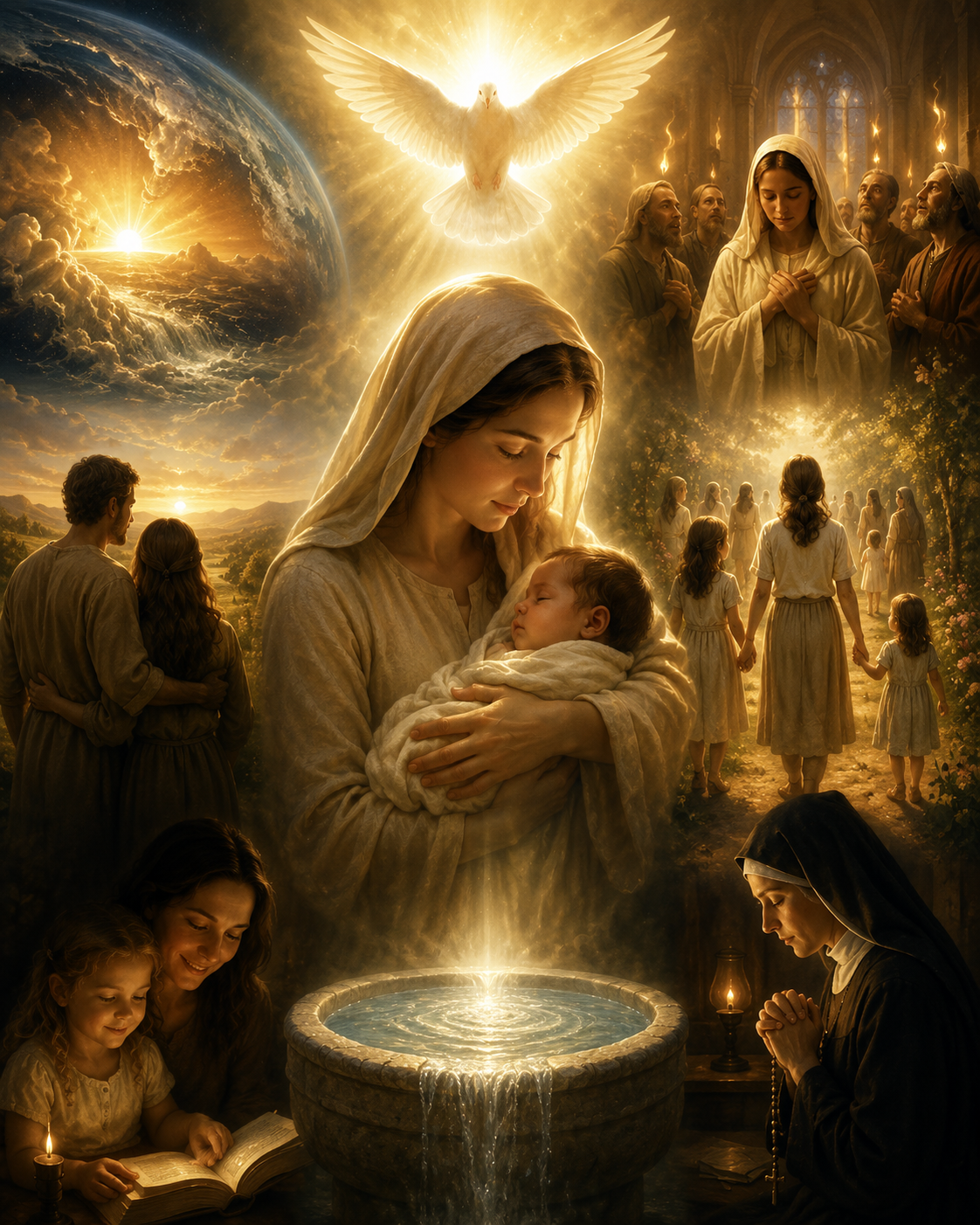
When we profess in the Nicene Creed that the Holy Spirit is “the Lord and Giver of Life,” we are not merely affirming that He creates. We are confessing that wherever divine life appears, the Holy Spirit has already been there.
Before there was light, before there were stars, before Adam drew his first breath, “the Spirit of God moved over the waters” (Genesis 1:2). The Fathers of the Church often saw in this hovering the image of a bird brooding over her young—not because God is female, but because God reveals His tenderness through images of both fatherhood and motherhood. Before creation had a heartbeat, the Holy Spirit was preparing it to receive life.
Then God created woman.
This was not an afterthought. It was a revelation.
The first thing Adam says is not a command or a definition but a poem:
“This now is bone of my bones, and flesh of my flesh.”
Why? Because in woman he sees the mystery of communion. Man images God’s strength and fatherhood in one way; woman images His life-receiving and life-nurturing love in another. Together they reveal the image of God more completely than either alone (Genesis 1:27).
This is why Satan has always attacked women. If he can distort the meaning of womanhood, he can obscure one of the clearest earthly signs of God’s life-giving love.
Every woman carries within her vocation an icon of the Holy Spirit’s mission.
The Holy Spirit receives nothing selfishly; He eternally proceeds as Love and pours Himself out as Gift. Likewise, authentic femininity is ordered toward receiving, protecting, nurturing, and giving life. Whether in the hidden sanctuary of the womb or in the hidden sacrifices of spiritual motherhood, woman proclaims that life is not manufactured—it is received as a gift.
Then comes Nazareth.
The angel does not force God’s will upon Mary. Heaven waits.
The salvation of the world pauses before the freedom of one young woman.
“The Holy Ghost shall come upon thee…”
At that instant, creation begins anew.
Notice that the Incarnation required no human father, but it did require the free “yes” of a woman. The Holy Spirit overshadows Mary, not to replace her humanity, but to elevate it. Grace does not destroy nature; it perfects it.
Mary becomes the New Eve because she becomes the perfect dwelling place of the Holy Spirit.
Her womb becomes what the waters of Genesis foreshadowed—a place where the Spirit brings forth new creation.
This mystery did not end in Bethlehem.
At Pentecost, Mary is once again present as the Holy Spirit descends. The same Spirit who formed Christ’s physical Body within her now forms His Mystical Body, the Church.
The pattern remains.
The Holy Spirit gives life.
Woman receives life.
The Church gives birth to souls.
The font becomes a womb.
The Eucharist becomes nourishment.
The Bride becomes a mother.
Every Baptism is another birth.
Every absolution is another resurrection.
Every Eucharist is another infusion of divine life.
The Church is not merely an institution that teaches truth. She is a mother who bears children for eternity.
This is why St. John Paul II spoke of the “feminine genius.” It is not sentimentality. It is theology.
Woman possesses a unique capacity to recognize the person before the achievement, the soul before the success, the child before the accomplishment. She instinctively asks not, “What can this person do?” but, “Who is this person?” This reflects the Holy Spirit, who never treats us as projects to complete but as beloved children to sanctify.
Even women who never bear children physically are still called to motherhood spiritually. A religious sister, a consecrated virgin, a widow, a teacher, a grandmother, a woman praying alone before the Blessed Sacrament—all can become mothers of souls. The Holy Spirit’s fruitfulness is never confined to biology.
The deepest mystery may be this:
The Holy Spirit is invisible.
You cannot see the wind, only what it moves.
So too, you often cannot see grace itself—you see it in the lives it transforms.
In much the same way, the hidden genius of countless holy women has quietly sustained families, parishes, vocations, civilizations, and saints. History often records kings, bishops, and generals. Heaven remembers mothers, grandmothers, nuns, widows, and faithful women whose hidden “yes” became the soil where holiness flourished.
Perhaps that is why Satan fears holy women.
A holy woman reminds the world that life is sacred, that love is fruitful, that sacrifice gives birth to joy, and that the smallest hidden “fiat” can change history.
Every cradle whispers Genesis.
Every tabernacle echoes Nazareth.
Every baptismal font proclaims Pentecost.
And every holy woman, in her own vocation, reflects something of the Holy Spirit—the Lord and Giver of Life—not because the Spirit is feminine, but because God, in His wisdom, chose woman to reveal in a singular way that all life is first received, then nurtured, and finally given away in love.
The world measures greatness by power.
The Holy Spirit measures greatness by fruitfulness.
And wherever divine life quietly grows—in a mother’s womb, in a saint’s heart, in the silence of a convent, in the waters of Baptism, or in the soul that whispers “yes” to God—the Lord and Giver of Life is already at work.
Leave a Reply