

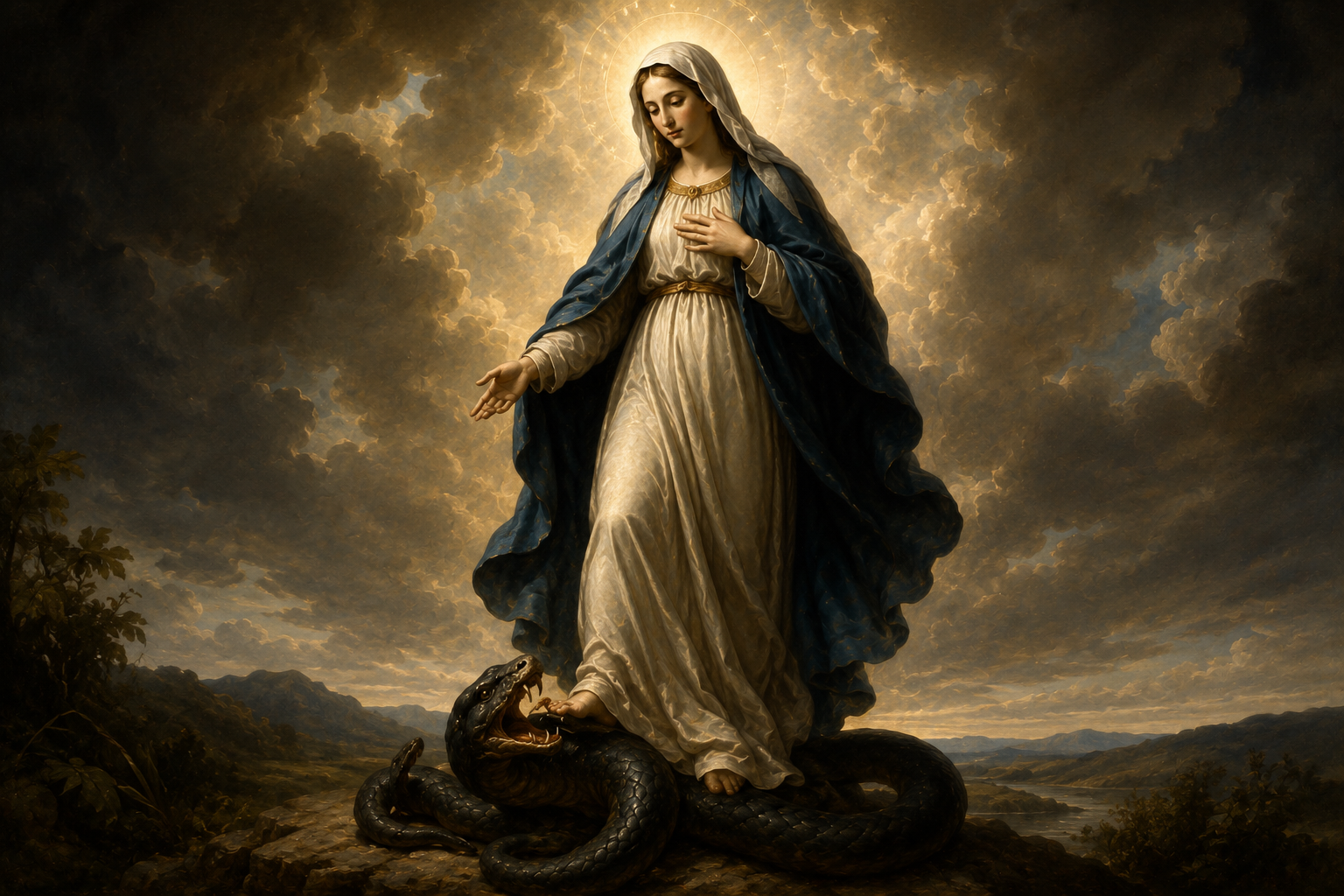
Some Protestants claim that Catholics invented Marian doctrine by mistranslating Genesis 3:15. The accusation usually goes like this: St. Jerome changed the Bible from “he shall crush your head” to “she shall crush your head” in order to force Mary into the text.
That charge sounds powerful.
It is also historically shallow.
The truth is more nuanced, more ancient, and far more Catholic.
Genesis 3:15 is the first Gospel promise. After the fall, God says to the serpent:
“I will put enmities between thee and the woman, and thy seed and her seed: she shall crush thy head, and thou shalt lie in wait for her heel.”
— Genesis 3:15, Douay-Rheims
This is called the Protoevangelium, the “first Gospel,” because it announces the coming victory over Satan. The serpent will not win. Sin will not have the final word. A Woman and her Seed will be set in total opposition to the devil.
The dispute is over one word: she.
The Hebrew text more directly reads “he” or “it shall crush your head,” referring to the seed of the woman. In the fullest sense, that Seed is Christ. He is the one Redeemer. He is the New Adam. He is the one who definitively crushes Satan.
So did Jerome mistranslate the passage?
No.
The evidence indicates that Jerome’s original Latin likely read:
ipse conteret caput tuum
“He shall crush your head.”
That agrees with the Hebrew sense and with the Greek Septuagint tradition. The later Latin reading ipsa conteret — “she shall crush” — appears to have entered the manuscript tradition after Jerome and was later preserved in the Clementine Vulgate.
So Catholics do not need to pretend the Hebrew says “she.” It does not.
And Catholics do not need to claim Jerome deliberately changed the verse. He almost certainly did not.
But here is where the Protestant objection collapses: Catholic teaching on Mary does not depend on the pronoun “she.”
Even if Genesis 3:15 is translated “he shall crush your head,” the Catholic interpretation remains intact. Why? Because the verse does not speak only of the Seed. It also speaks of the Woman.
God says there will be enmity between the serpent and the Woman, and between the serpent’s seed and her Seed. This is not ordinary dislike. It is total spiritual opposition. The Woman and her Seed stand together against the serpent.
Christ crushes Satan absolutely. Mary shares in that victory dependently.
That is Catholic doctrine.
Mary does not defeat Satan as a rival redeemer. She defeats Satan as the Mother of the Redeemer, the obedient Woman whose “yes” stands against Eve’s “no.”
Eve listened to the fallen angel. Mary listened to Gabriel.
Eve received the word of the serpent and brought death. Mary received the word of God and bore Life Himself.
Eve said, in effect, “my will be done.” Mary said:
“Behold the handmaid of the Lord; be it done to me according to thy word.”
— Luke 1:38, Douay-Rheims
That is why the early Church saw Mary as the New Eve.
St. Irenaeus, writing in the second century, said:
“The knot of Eve’s disobedience was loosed by Mary’s obedience.”
— Against Heresies 3.22.4
That is not medieval invention. That is ancient Christianity.
Christ is the New Adam, as St. Paul teaches:
“For as in Adam all die, so also in Christ all shall be made alive.”
— 1 Corinthians 15:22, Douay-Rheims
And again:
“The first man Adam was made into a living soul; the last Adam into a quickening spirit.”
— 1 Corinthians 15:45, Douay-Rheims
If Christ is the New Adam, then the question naturally follows: who is the New Eve?
Many Protestants answer: the Church.
Catholics can agree in a broader sense. The Church is the Bride of Christ. St. Paul speaks of Christ loving the Church as His bride (Ephesians 5:25–32), and Revelation shows the holy city prepared “as a bride adorned for her husband” (Revelation 21:2).
But this does not exclude Mary.
It actually strengthens the Catholic view.
Mary is not in competition with the Church. Mary is the beginning, image, and model of the Church. The Catechism says that Mary is “a preeminent and wholly unique member of the Church” and that she is the Church’s “exemplary realization” (CCC 967). It also says that Mary’s role in relation to the Church is inseparable from her union with Christ (CCC 964).
So yes, the Church can be called the Bride. But Mary is personally the New Eve: the obedient Woman standing beside the New Adam at the dawn of redemption.
The Protestant mistake is treating these truths as rivals.
They are not rivals.
Christ is the New Adam.
Mary is the New Eve.
The Church is the Bride of Christ.
And all the redeemed share in Christ’s victory over Satan.
Genesis 3:15 is not weakened by translating the pronoun as “he.” In fact, the Catholic reading becomes even clearer: Christ is the victorious Seed, and Mary is the Woman uniquely united to Him in that victory.
That is why Catholic art can show Mary crushing the serpent. It is not saying Mary replaces Christ. It is saying Satan is humiliated through the very Woman whose obedience God chose to involve in the coming of the Redeemer.
The devil attacked humanity through a woman and a tree.
God answered through a Woman and the Tree of the Cross.
Eve stood at the beginning of the old creation. Mary stands at the beginning of the new.
Eve became “the mother of all the living” in the order of nature (Genesis 3:20). Mary becomes mother in the order of grace, because she gives birth to Christ, the source of supernatural life.
This is why Genesis 3:15 matters.
It is not a Catholic embarrassment. It is a Catholic weapon.
We can say plainly:
Jerome did not need to falsify Scripture.
The Church does not need a mistranslation.
Mary does not need to steal Christ’s glory.
The true reading already gives us everything: the Woman, the Seed, the enmity, and the victory.
Christ crushes the serpent as Redeemer.
Mary crushes the serpent by participation in Christ’s triumph.
The Church crushes the serpent by belonging to Christ and sharing in His victory.
That is the full Catholic answer.
Not either Christ or Mary.
Not either Mary or the Church.
But Christ the Head, Mary the New Eve, and the Church His Bride — all ordered to the glory of God and the defeat of the ancient serpent.
As the Catechism teaches, Genesis 3:15 is the first announcement of the Messiah and Redeemer, and also of the Woman, Mary, who would be associated with His victory over evil (CCC 410–411).
So when someone says, “Genesis 3:15 says he, not she,” the Catholic answer is simple:
Correct. Christ crushes the serpent.
And because Mary belongs perfectly to Christ, the serpent is crushed under her feet too.