

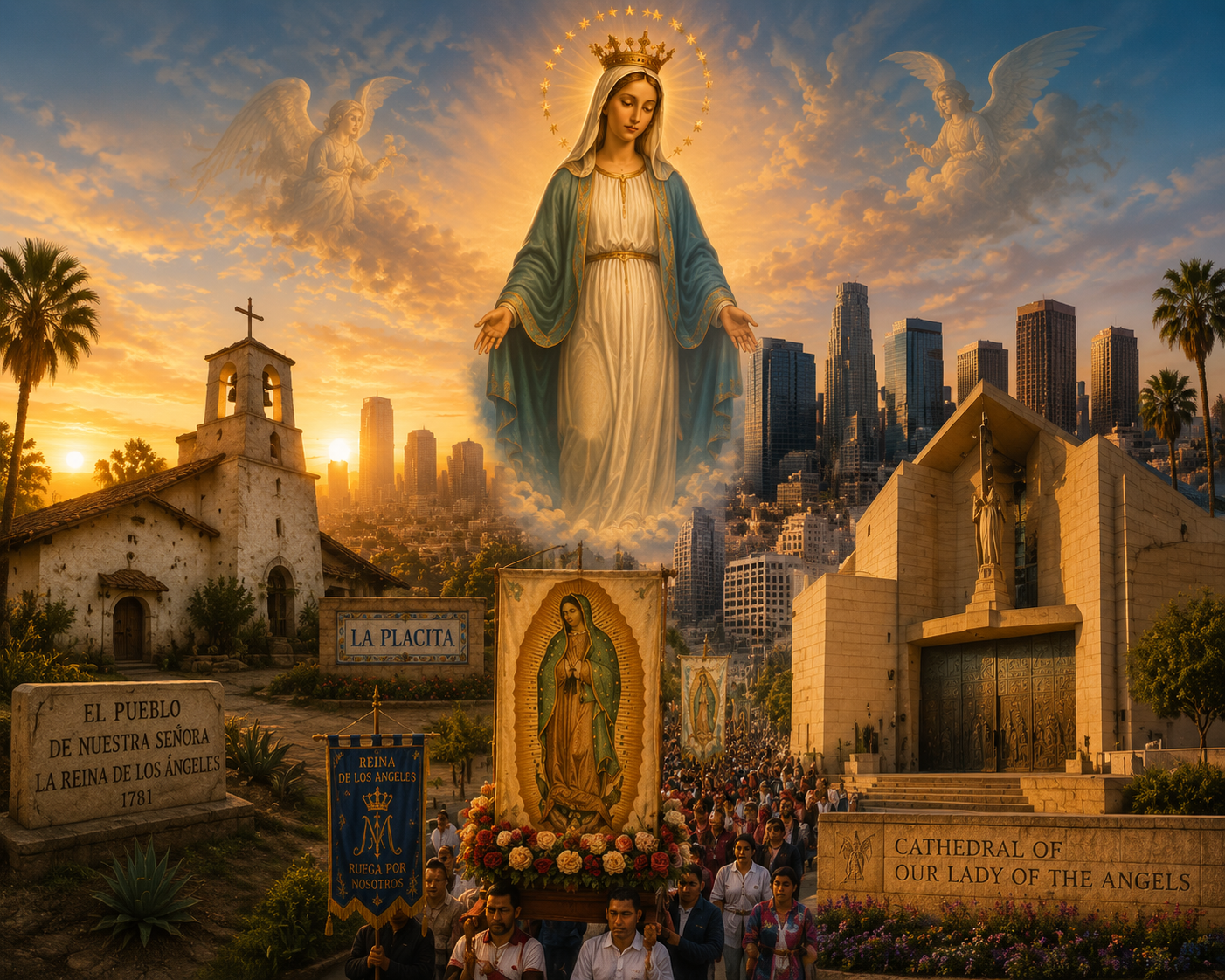
Los Angeles has a deeply Marian origin. Its very name recalls the Blessed Virgin Mary under the title Our Lady, Queen of the Angels.
The Franciscan beginning
On August 2, 1769, the Franciscan missionary Father Juan Crespí and the expedition of Gaspar de Portolá reached a river in Southern California. August 2 was traditionally associated with the Franciscan feast of Our Lady of the Angels of the Portiuncula, connected with the small chapel beloved by Saint Francis of Assisi.
The river consequently became known as the Río de Nuestra Señora la Reina de los Ángeles de Porciúncula—“River of Our Lady, Queen of the Angels of the Portiuncula.”
Founding of the city
On September 4, 1781, forty-four settlers founded the pueblo that became Los Angeles. Its early Spanish name is commonly given as:
El Pueblo de Nuestra Señora la Reina de los Ángeles
This means:
The Town of Our Lady, Queen of the Angels.
Although historians discuss the exact length and wording of the earliest official name, its Marian character is certain: the city was placed symbolically under the patronage of the Mother of God as Queen of the Angels. The Cathedral of Los Angeles itself preserves this tradition and identifies Mary as the Queen of the city.
La Placita and the early Catholic community
The historic church known as La Iglesia de Nuestra Señora la Reina de los Ángeles, or simply La Placita, was established near the original pueblo in the early nineteenth century. It became the spiritual center of Catholic life in the young city.
From its beginnings, the faith of Los Angeles was shaped by Spanish, Mexican, Indigenous and Franciscan Catholic traditions, in which devotion to the Blessed Virgin occupied an important place.
Our Lady of Guadalupe
As the Mexican and Mexican-American population of Los Angeles grew, devotion to Our Lady of Guadalupe became one of the city’s most prominent expressions of Marian faith.
Public celebrations, Masses and processions honoring Our Lady of Guadalupe became especially important during the twentieth century. A major Marian celebration in 1937 included the solemn crowning of an image of Our Lady of Guadalupe before tens of thousands of Catholics.
The annual Guadalupe procession in East Los Angeles eventually became one of the oldest and largest Marian processions in the United States.
The Cathedral of Our Lady of the Angels
After the old Cathedral of Saint Vibiana was damaged and judged unsuitable following the 1994 Northridge earthquake, a new cathedral was constructed in downtown Los Angeles.
The Cathedral of Our Lady of the Angels was completed and dedicated in 2002. It is the mother church of the Archdiocese and deliberately restores the Marian title connected with the city’s foundation.
Above its bronze entrance doors stands a modern statue of Mary inspired by the woman described in the Apocalypse:
“A woman clothed with the sun, and the moon under her feet, and on her head a crown of twelve stars.”
—Apocalypse 12:1, Douay-Rheims
The cathedral also contains a chapel dedicated to Our Lady of the Angels.
Spiritual significance
The Marian history of Los Angeles is more than a matter of civic naming. It expresses a Catholic vision of Mary as:
- Mother of God, because she bore Jesus Christ.
- Queen of Angels, because her queenship comes from her Son, the King of heaven.
- Mother of the Church, who intercedes for the disciples of Christ.
- Patroness and spiritual mother of the people of Los Angeles.
Catholics do not worship Mary. Worship belongs to God alone. Mary is honored because God chose her to be the Mother of the Incarnate Word:
“Behold from henceforth all generations shall call me blessed.”
—Luke 1:48, Douay-Rheims
Thus, hidden within the familiar name Los Angeles is a Marian prayer and profession of faith: the city is historically the pueblo of Our Lady, Queen of the Angels.