

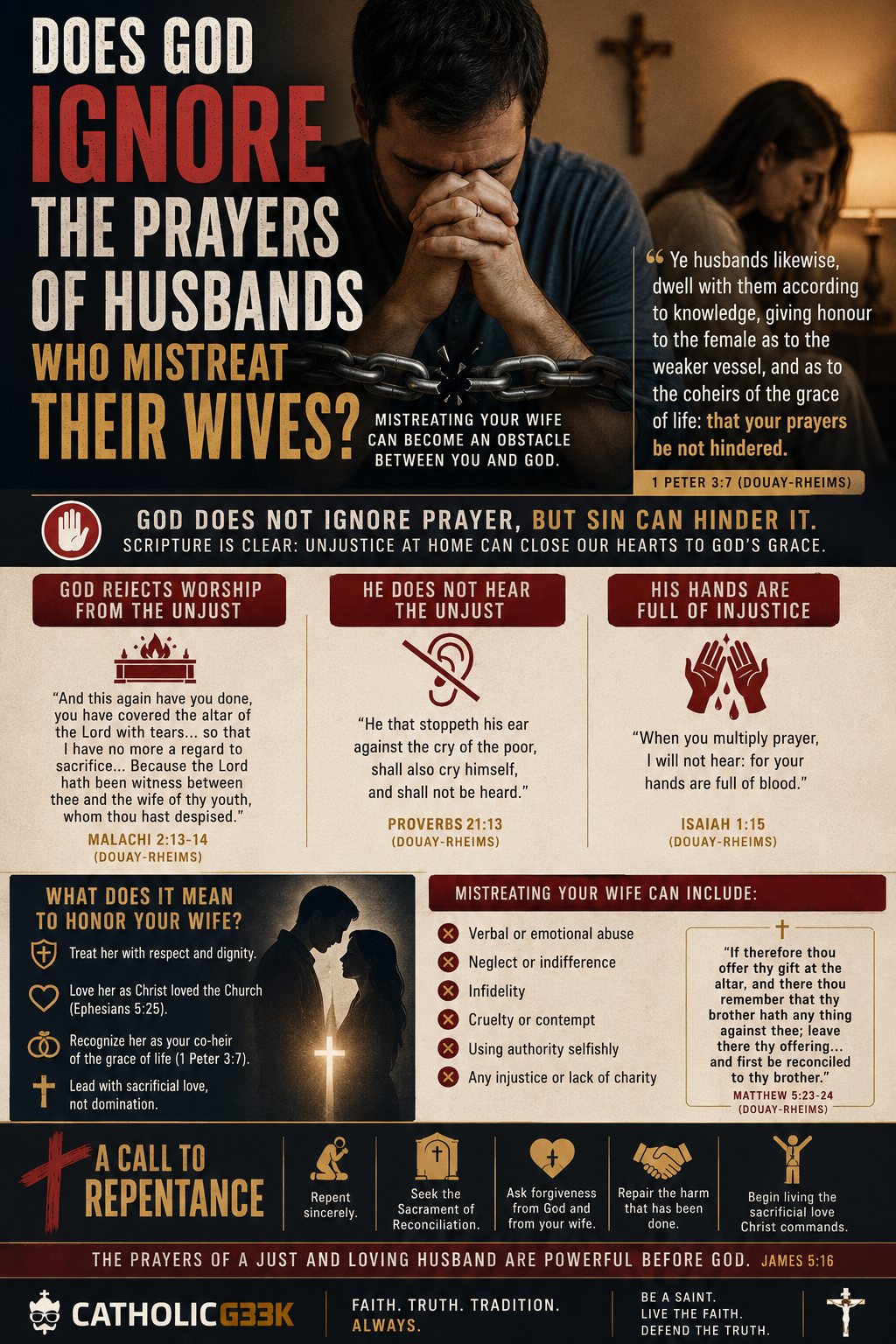
Many Christians have heard that God answers prayer, but few realize that Scripture also teaches there are circumstances in which our prayers can be hindered. One of the most sobering examples is found in God’s warning to husbands.
A Warning Every Christian Husband Should Read
St. Peter writes:
“Ye husbands likewise, dwell with them according to knowledge, giving honour to the female as to the weaker vessel, and as to the coheirs of the grace of life: that your prayers be not hindered.”
— 1 Peter 3:7 (Douay-Rheims)
This verse is striking. Peter does not merely encourage husbands to be kind. He connects the way a husband treats his wife with his relationship to God.
If a husband fails to honor his wife, his prayers are hindered.
The Greek word translated “hindered” means to be impeded, obstructed, or blocked. In other words, mistreating one’s wife places an obstacle between the husband and God.
What Does It Mean to Honor Your Wife?
The Catholic understanding of marriage teaches that husband and wife are equal in dignity, both made in the image of God (Genesis 1:27), while having distinct and complementary roles within the family.
St. Peter reminds husbands that their wives are:
- Co-heirs of the grace of life.
- Worthy of honor.
- Not to be treated harshly, selfishly, or abusively.
True Christian leadership in the home is never domination. It is sacrificial love modeled after Christ.
As St. Paul teaches:
“Husbands, love your wives, as Christ also loved the church, and delivered himself up for it.”
— Ephesians 5:25 (Douay-Rheims)
Christ’s love was self-sacrificing, patient, and holy—not abusive or self-serving.
God Rejects Worship from the Unjust
This principle is not unique to the New Testament.
Through the prophet Malachi, God rebuked men who were unfaithful to their wives:
“And this again have you done, you have covered the altar of the Lord with tears… so that I have no more a regard to sacrifice… Because the Lord hath been witness between thee and the wife of thy youth, whom thou hast despised.”
— Malachi 2:13–14 (Douay-Rheims)
These men continued offering sacrifices and expected God’s blessing while treating their wives unjustly.
God rejected their worship.
Their religious acts could not cover their lack of justice at home.
A Biblical Pattern
Scripture repeatedly teaches that our treatment of others affects our relationship with God.
Consider these passages:
- Proverbs 21:13 — “He that stoppeth his ear against the cry of the poor, shall also cry himself, and shall not be heard.”
- Isaiah 1:15 — “When you multiply prayer, I will not hear: for your hands are full of blood.”
- Sirach 35:16–21 — God hears the cry of the oppressed and judges against those who wrong them.
Jesus Himself taught:
“If therefore thou offer thy gift at the altar, and there thou remember that thy brother hath any thing against thee; leave there thy offering… and first be reconciled to thy brother.”
— Matthew 5:23–24 (Douay-Rheims)
God desires justice, repentance, and charity before external acts of worship.
This Is About More Than Physical Abuse
Mistreating a wife can take many forms:
- Verbal abuse.
- Emotional manipulation.
- Neglect.
- Infidelity.
- Cruelty.
- Contempt.
- Using authority selfishly instead of sacrificially.
A husband may faithfully attend Mass, pray the Rosary, and participate in parish life, yet if he refuses to repent of grave injustice toward his wife, Scripture warns that his prayers are hindered.
The Catholic Perspective
The Catechism of the Catholic Church teaches that sin wounds our communion with God and neighbor. Love of God cannot be separated from love of those made in His image.
Marriage is a sacrament in which spouses are called to help one another attain holiness. A husband who loves his wife imitates Christ. A husband who mistreats his wife contradicts the very mystery that Christian marriage signifies.
The Church has consistently condemned abuse, cruelty, and infidelity within marriage as serious violations of justice and charity.
A Call to Repentance
The good news is that God’s mercy is always available to the repentant sinner.
If a husband has failed in his vocation, Christ calls him not to despair but to conversion.
Repent sincerely.
Seek the Sacrament of Reconciliation.
Ask forgiveness from God and from your wife.
Repair the harm that has been done.
Begin living the sacrificial love Christ commands.
God desires not merely our prayers, but hearts transformed by His grace.
As St. James reminds us:
“The continual prayer of a just man availeth much.”
— James 5:16 (Douay-Rheims)
May every Catholic husband strive to become that just man—one whose love for his wife reflects the love of Christ for His Church, and whose prayers rise unhindered before the throne of God.