

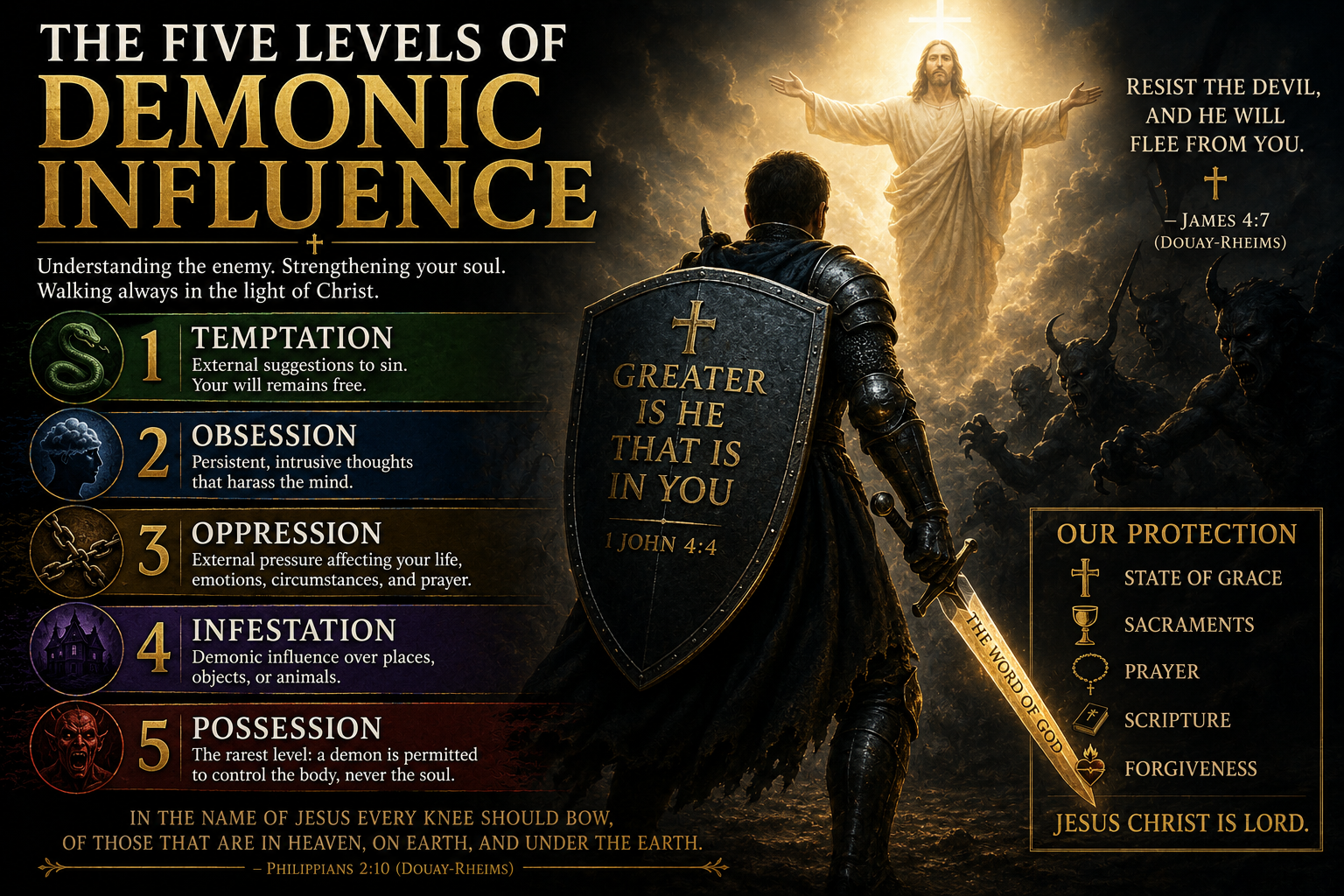
What the Catholic Church actually teaches about temptation, oppression, possession, and spiritual warfare.
“Greater is he that is in you, than he that is in the world.”
Hollywood vs. Catholic Reality
We live in a strange age.
Modern culture often rejects belief in the supernatural while simultaneously obsessing over demonic possession, haunted houses, and exorcism movies.
Hollywood portrays the devil as nearly unstoppable.
The Catholic Church does not.
For two thousand years, the Church has treated the devil neither with fascination nor fear, but with sober realism.
The devil is real.
But he is not God’s equal.
He is a fallen creature whose power exists only within the limits permitted by Divine Providence.
As Christians, we should never become fascinated with demons.
Our focus belongs entirely to Jesus Christ.
This article explores the five levels of demonic influence according to Catholic teaching—not to inspire fear, but to strengthen faith.
Level One: Temptation
The first and by far the most common form of demonic influence is temptation.
Every human being experiences temptation.
Even Our Lord Himself was tempted in the desert.
“Then Jesus was led by the spirit into the desert, to be tempted by the devil.”
Temptation consists of external suggestions toward sin:
- Evil thoughts
- Sudden desires
- Unwanted images
- Interior suggestions
The crucial truth is this:
Temptation is not sin.
Sin begins only when the will freely consents.
Many faithful Catholics mistakenly believe they have sinned simply because disturbing thoughts entered their minds.
This is not Catholic teaching.
The will always remains free.
The devil can suggest.
He cannot compel.
Level Two: Obsession
The second level is obsession.
Unlike ordinary temptation, obsession involves persistent, intrusive thoughts that repeatedly assault the mind.
These often involve:
- Blasphemous thoughts
- Despair
- Excessive guilt
- Self-hatred
- Scrupulosity
Saint Alphonsus Liguori taught that unwanted thoughts are not sinful unless the person freely embraces them.
The Church also exercises great prudence here.
Many psychological conditions resemble spiritual obsession.
For this reason, authentic discernment often includes professional psychological evaluation.
The Christian response is not panic.
It is perseverance.
Continue praying.
Continue receiving the sacraments.
Continue trusting Christ.
Level Three: Oppression
Oppression moves the battle outward.
Rather than attacking thoughts alone, oppression involves heavy external spiritual pressure.
It may include:
- Extraordinary discouragement
- Persistent spiritual dryness
- Intense resistance to prayer
- Unusual suffering
- Serious disturbances following occult involvement or grave habitual sin
The defining characteristic is this:
The soul remains free.
The person is afflicted.
They are not possessed.
The enemy attempts to produce despair.
Grace instead produces perseverance.
Faithfulness during spiritual darkness becomes a powerful act of trust in God.
Level Four: Infestation
Unlike the previous levels, infestation concerns places or objects rather than people.
Examples include:
- Locations associated with occult practices
- Places dedicated to grave evil
- Objects intentionally used in occult rituals
The Church addresses these situations calmly through:
- Blessings
- Holy Water
- Blessed Salt
- Sacramentals
- The prayers of the Church
Matter itself is good because God created it.
The problem is never creation itself but its misuse.
When the Church blesses a home, it reclaims that place for Christ.
Darkness cannot remain where Christ’s authority is invoked.
Level Five: Possession
Possession is the rarest and most extraordinary form of demonic influence.
In authentic possession, a demon may be permitted to influence a person’s body.
The soul, however, remains beyond the demon’s control.
The Church traditionally looks for specific signs before considering possession, including:
- Violent aversion to sacred things
- Speaking unknown languages
- Knowledge naturally impossible to possess
- Extraordinary physical strength beyond normal human ability
Mental illness is not automatically possession.
Neither is trauma.
The Catholic Church requires extensive medical and psychological evaluation before authorizing a solemn exorcism.
According to Canon 1172, only a priest who has explicit permission from his bishop may perform a solemn exorcism.
The possessed person is never viewed as morally guilty simply because of the manifestations occurring during possession.
Important Catholic Clarifications
Several truths must remain firmly in mind.
Possession Is Extremely Rare
Most spiritual warfare occurs through temptation and ordinary struggles—not dramatic manifestations.
Demons Cannot Override Free Will
The devil may tempt.
He may harass.
He may pressure.
But he cannot force anyone to commit sin.
Grace Is Always Stronger
Saint John reminds us:
“Greater is he that is in you, than he that is in the world.”
The Christian never fights alone.
Christ has already won the victory.
The Greatest Protection
People often ask how to protect themselves from demonic influence.
The Catholic answer is beautifully simple.
Live in the state of grace.
The ordinary means of protection are the ordinary means of holiness:
- Frequent Confession
- Worthy reception of the Holy Eucharist
- Daily prayer
- Sacred Scripture
- The Holy Rosary
- Forgiveness
- Humility
- Obedience to God
These are not superstitions.
They are the ordinary weapons Christ has given His Church.
The Power of the Holy Name
When temptation becomes intense, invoke the Holy Name of Jesus.
“That in the name of Jesus every knee should bow, of those that are in heaven, on earth, and under the earth.”
The Name of Jesus is feared by the powers of darkness because it belongs to the victorious Lord.
The Christian need not argue with demons.
He simply turns toward Christ.
Final Thoughts
The devil thrives on fear, distraction, and despair.
Christ offers peace, truth, and freedom.
Do not become fascinated with demons.
Become fascinated with Christ.
Remain close to the sacraments.
Remain faithful in prayer.
Remain rooted in Scripture.
As Saint James writes:
“Be subject therefore to God, but resist the devil, and he will fly from you.”
The Christian life is not about constantly looking over your shoulder.
It is about fixing your eyes upon Jesus Christ.
For He alone is Lord.
Sources
Sacred Scripture (Douay-Rheims):
- Matthew 4:1–11
- Mark 9:17–29
- James 4:7
- Philippians 2:9–11
- 1 John 4:4
Catechism of the Catholic Church:
- §§391–395 (The Fall of the Angels)
- §1673 (Exorcism)
- §§1422–1498 (The Sacrament of Penance)
Code of Canon Law:
- Canon 1172
Church Fathers & Doctors of the Church:
- St. Anthony the Great
- Evagrius Ponticus
- St. Alphonsus Liguori
Leave a Reply