

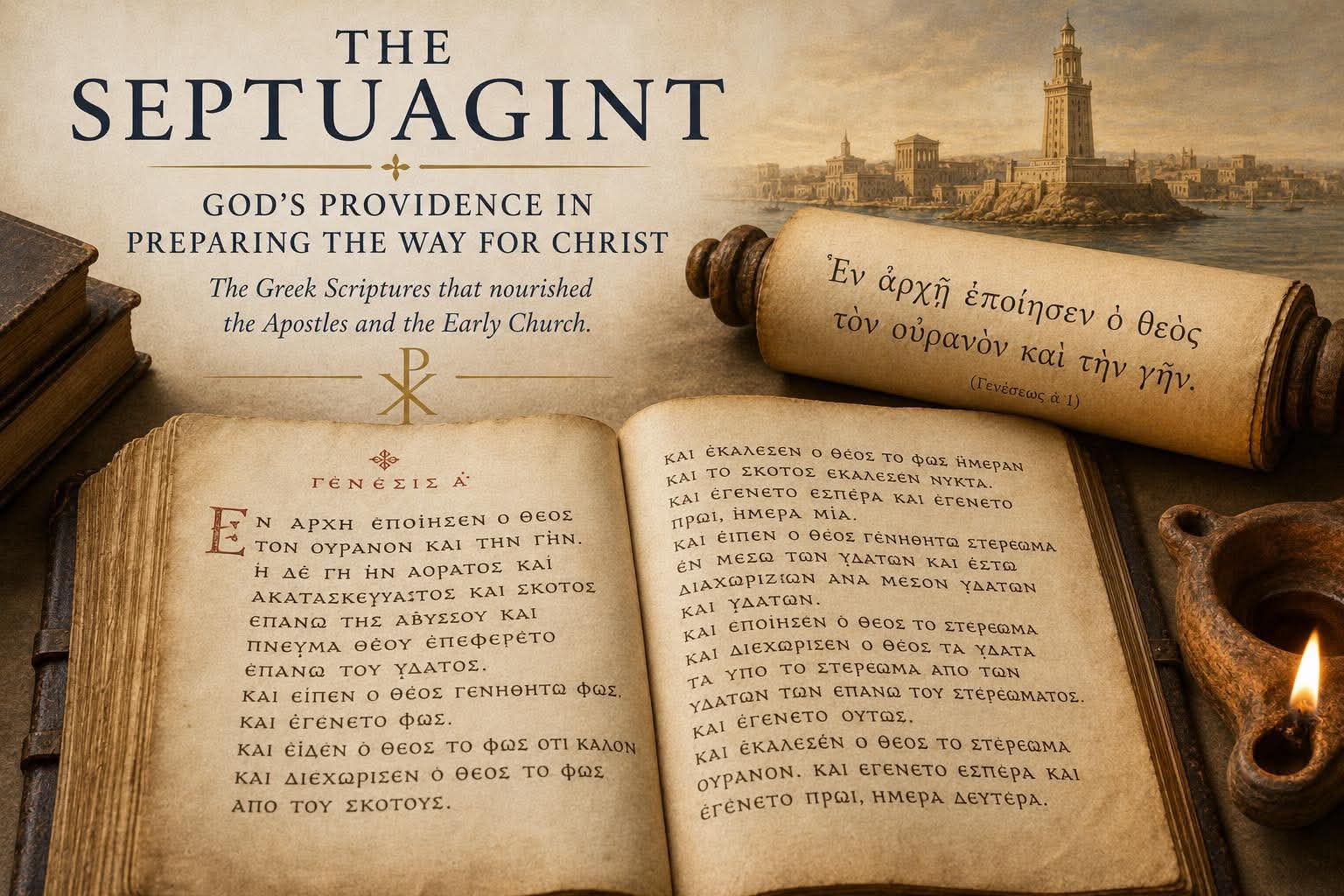
A reflection on the ancient Greek translation of the Hebrew Scriptures that became the Bible of the early Church.
Introduction
In the divine economy of salvation, God prepares His people long before great events unfold. He works through cultures, languages, empires, and even the labors of scholars to accomplish His saving plan.
One of the most remarkable examples of this preparation is the Septuagint (LXX)—the ancient Greek translation of the Old Testament produced by Jewish scholars in Alexandria, Egypt, roughly two to three centuries before the birth of Christ.
This translation would become the primary version of Sacred Scripture used by the Apostles, the early Church Fathers, and many of the first Christians. Through it, God prepared the world to receive the Gospel.
The Origins of the Septuagint
The name Septuagint comes from the Latin septuaginta, meaning “seventy.”
According to the ancient Letter of Aristeas, King Ptolemy II Philadelphus sought a Greek translation of the Jewish Law for the famous Library of Alexandria. The High Priest in Jerusalem selected six scholars from each of the twelve tribes of Israel, seventy-two translators in total, to undertake the work.
Tradition recounts that although the translators worked independently, their completed translations were in remarkable agreement. Both Jewish and Christian writers saw this harmony as a sign of divine guidance.
While modern scholars recognize legendary elements in the account, the historical reality remains clear: Jewish scholars in Alexandria translated the Hebrew Scriptures into Greek during the third and second centuries BC.
The Pentateuch was translated first, followed by the Prophets, the Writings, and the books later known as the Deuterocanon.
Why Alexandria?
Alexandria was one of the greatest cities of the ancient world and home to a large Jewish population.
Following the conquests of Alexander the Great, Greek became the common language of much of the Mediterranean world. Many Jews living outside the Holy Land no longer spoke Hebrew fluently.
The Septuagint allowed these Jewish communities to hear and study God’s Word in the language they understood.
What seemed like a practical translation project would later become a providential preparation for the spread of Christianity.
The Bible of the Apostles
By the time of Christ, the Septuagint had become the most widely used version of Scripture among Greek-speaking Jews.
The New Testament frequently reflects Septuagint wording, and many Old Testament quotations found in the Gospels and Epistles follow the Greek text rather than the later Masoretic Hebrew tradition.
One of the most famous examples appears in Isaiah 7:14:
“Behold, a virgin shall conceive.”
The Septuagint uses the Greek word parthenos (“virgin”), a reading embraced by the Gospel writers and understood by the Church as a prophecy of the Virgin Birth of Jesus Christ.
For the Apostles, the Septuagint was not merely a translation—it was Sacred Scripture.
The Witness of the Church Fathers
The early Fathers of the Church held the Septuagint in great esteem.
St. Justin Martyr (c. 100–165 AD)
St. Justin defended the Septuagint’s authority and argued that its translations faithfully preserved messianic prophecies fulfilled in Christ.
St. Irenaeus of Lyons (c. 130–202 AD)
St. Irenaeus viewed the harmonious work of the translators as evidence of God’s providence and compared their unity to the unity of the Church itself.
For many generations of Christians, the Septuagint was the Old Testament through which the Gospel was proclaimed.
The Septuagint and the Catholic Canon
One of the most important features of the Septuagint is that it contains the books known today as the Deuterocanonical Books:
- Tobit
- Judith
- Wisdom
- Sirach (Ecclesiasticus)
- Baruch
- 1 Maccabees
- 2 Maccabees
- Additions to Esther
- Additions to Daniel
These books were received and used by the early Church and were later affirmed by:
- Council of Rome (382 AD)
- Council of Hippo (393 AD)
- Council of Carthage (397 AD)
- Council of Carthage (419 AD)
- Council of Trent (1546)
The Catholic canon follows the tradition preserved in the Septuagint rather than the narrower Hebrew canon adopted by rabbinic Judaism after the destruction of the Temple.
St. Jerome and the Vulgate
St. Jerome, one of the Church’s greatest Scripture scholars, initially preferred working directly from the Hebrew text.
However, he ultimately submitted his personal preference to the judgment of the Church and included the Deuterocanonical books within the Latin Vulgate.
The Vulgate became the standard Bible of Western Christianity for more than a thousand years and remained deeply connected to the Septuagint tradition.
God’s Providence Through History
The Septuagint stands as a powerful reminder that God guides history according to His perfect plan.
He used:
- The spread of the Greek language
- The Jewish Diaspora
- The city of Alexandria
- Faithful translators
- Even pagan rulers
to prepare the world for the coming of Christ.
What appeared to be a translation project became one of the greatest instruments in salvation history.
Lessons for Catholics Today
The Septuagint reminds us of several important truths:
Sacred Scripture Belongs to the Church
The Bible was entrusted to the Church, which preserves, proclaims, and authentically interprets it.
God Works Through Human Instruments
Throughout salvation history, God accomplishes His purposes through ordinary people, scholars, leaders, and saints.
The Old and New Testaments Form One Story
The Septuagint reveals the deep unity between the promises of the Old Covenant and their fulfillment in Jesus Christ.
Study Must Lead to Prayer
Knowledge of Scripture should never remain merely academic. Like Our Lady, we are called to ponder God’s Word in our hearts and allow it to transform our lives.
Conclusion
The Septuagint is far more than an ancient translation.
It is a testimony to God’s providence, a bridge between the Old and New Testaments, and a witness to the faith of the Apostles and early Church.
As Catholics, we can give thanks for this treasure that helped prepare the world for Christ and continues to enrich our understanding of Sacred Scripture today.
St. Jerome, Doctor of the Church and patron of Scripture scholars, pray for us.
St. Irenaeus and all the holy Fathers who cherished the Septuagint, pray for us.
Our Lady, Seat of Wisdom, pray for us.
Sources
- Catholic Encyclopedia, “Septuagint Version”
- Catholic Encyclopedia, “Versions of the Bible”
- Council of Trent, Session IV
- St. Irenaeus, Against Heresies
- St. Justin Martyr, Dialogue with Trypho
Leave a Reply