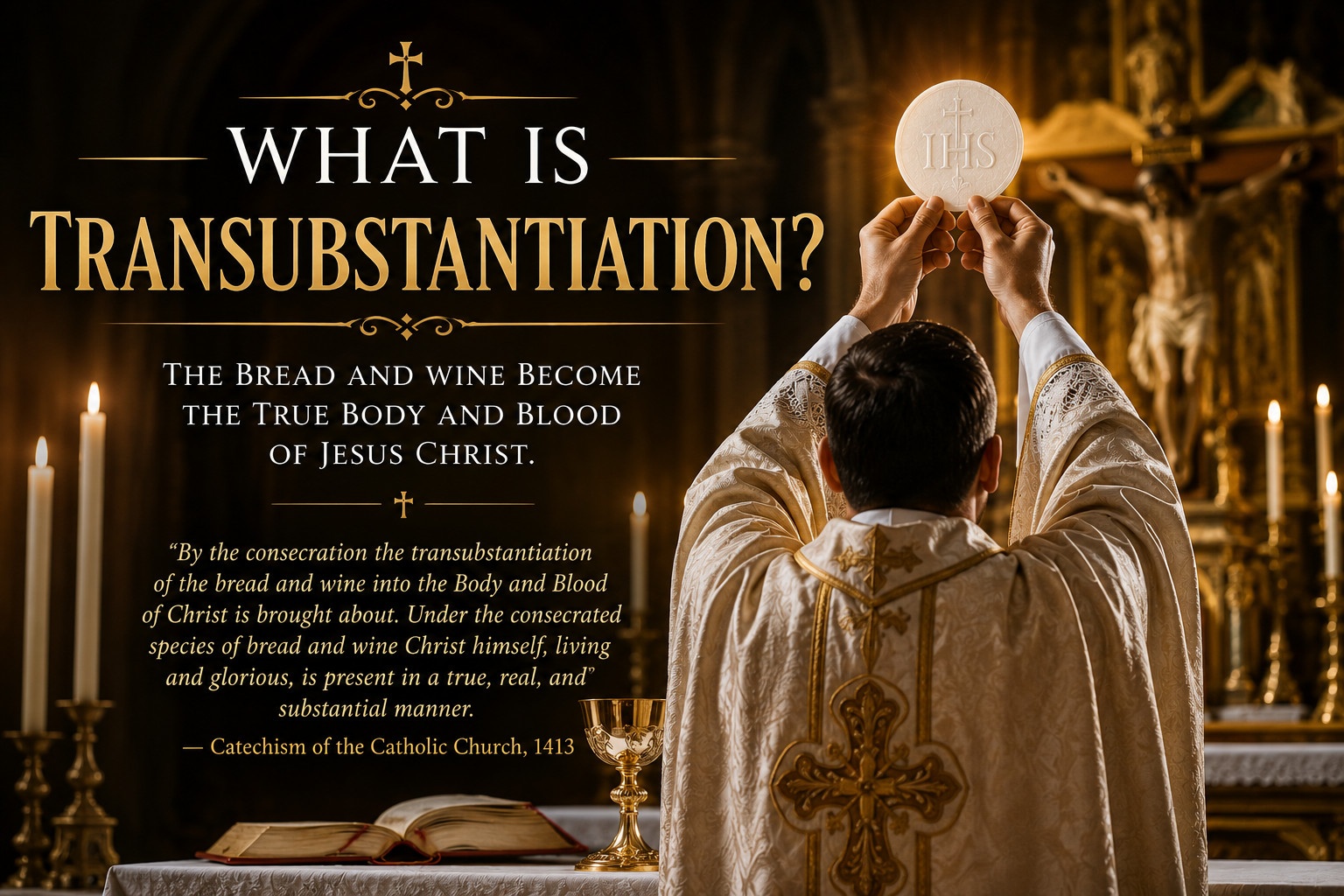
What Is Transubstantiation?
A Catholic explanation of the sacred mystery by which bread and wine become the true Body and Blood of Jesus Christ.
When we come to Holy Mass, we witness something truly miraculous.
At the moment of consecration, when the priest repeats the words of Christ spoken at the Last Supper, the bread and wine become the true Body and Blood of Jesus Christ.
This sacred mystery is called Transubstantiation.
The Catholic Church teaches that although the appearances of bread and wine remain, their substance is completely changed by the power of God into the Body, Blood, Soul, and Divinity of Jesus Christ.
By the consecration the transubstantiation of the bread and wine into the Body and Blood of Christ is brought about. Under the consecrated species of bread and wine Christ himself, living and glorious, is present in a true, real, and substantial manner. — Catechism of the Catholic Church, 1413
The Philosophical Explanation
To understand transubstantiation, it is helpful to distinguish between substance and accidents.
Substance is what a thing truly is in its deepest reality.
Accidents are the properties we perceive with our senses, such as appearance, taste, smell, texture, and weight.
St. Thomas Aquinas explains that in the Eucharist a unique and miraculous change occurs. The accidents of bread and wine remain, but their substance is entirely changed into Christ Himself.
The whole substance of the bread is changed into the whole substance of Christ’s body, and the whole substance of the wine into the whole substance of Christ’s blood. — Summa Theologiae, III, q. 75, a. 4
This change cannot be explained by any natural process. It is accomplished solely by the omnipotent power of God.
The word transubstantiation comes from the Latin words trans, meaning “across” or “change,” and substantia, meaning “substance.” It literally means a change of substance.
Thus, while the Eucharist still appears to be bread and wine, it is no longer bread and wine in its reality. It is Jesus Christ Himself.
Old Testament Foreshadowings of the Eucharist
The Eucharist did not appear suddenly at the Last Supper. Throughout the Old Testament, God prepared His people through persons, sacrifices, and sacred meals that pointed forward to Christ’s gift of Himself in the Holy Eucharist.
These biblical foreshadowings find their complete fulfillment in Jesus Christ, who is both Priest and Victim and who gives us His Body and Blood under the appearances of bread and wine.
The New Testament lies hidden in the Old, and the Old Testament is unveiled in the New. — St. Augustine
Melchizedek’s Offering of Bread and Wine
But Melchizedek the king of Salem, bringing forth bread and wine, for he was the priest of the most high God. — Genesis 14:18
Melchizedek is both a king and a priest who offers bread and wine and blesses Abraham. Psalm 109 prophesies that the Messiah will be “a priest for ever according to the order of Melchizedek.”
The Church has always recognized Melchizedek as a foreshadowing of Christ, the eternal High Priest. Unlike the animal sacrifices of the Old Covenant, Melchizedek’s offering of bread and wine points directly toward the Eucharistic sacrifice instituted by Christ at the Last Supper.
The Passover Lamb
And they shall eat the flesh that night, and unleavened bread with wild lettuce. — Exodus 12:8
The Passover was the central saving event of the Old Covenant. Israel was commanded not only to sacrifice the lamb but also to eat it. The blood of the lamb protected God’s people from death.
Jesus instituted the Eucharist during the Passover meal and fulfilled everything the Passover foreshadowed. The lamb without blemish points to Christ, the spotless Lamb of God. The blood that saved Israel from physical death points to Christ’s Blood, which saves humanity from sin and eternal death.
Just as the Passover lamb had to be eaten, Christ gives Himself to us as food in Holy Communion.
The Manna from Heaven
Behold I will rain bread from heaven for you. — Exodus 16:4
For forty years God miraculously fed Israel in the wilderness with manna.
Jesus directly identifies Himself as the fulfillment of this miracle:
Your fathers did eat manna in the desert, and are dead. This is the bread which cometh down from heaven; that if any man eat of it, he may not die. — John 6:49–50
The manna sustained earthly life for a time. The Eucharist is the true Bread from Heaven that nourishes the soul and leads to eternal life.
The Sacrifice of Isaac
Take thy only begotten son Isaac, whom thou lovest. — Genesis 22:2
Abraham’s willingness to offer Isaac foreshadows the Father offering His Son on Calvary.
Isaac is Abraham’s beloved son. Jesus is the beloved Son of the Father. Isaac carries the wood for his sacrifice. Christ carries the wood of the Cross. Isaac willingly submits to his father’s will, just as Christ freely offers Himself for our salvation.
Because the Eucharist makes present the sacrifice of Calvary, this event also foreshadows the Eucharistic sacrifice.
The Bread of the Presence
And thou shalt set upon the table loaves of proposition in my sight always. — Exodus 25:30
The Bread of the Presence consisted of twelve loaves placed continually before God in the Tabernacle and later in the Temple.
This sacred bread remained in God’s presence and was consumed by the priests. Catholic tradition sees in it a foreshadowing of Christ, the true Bread from Heaven, and of His Real Presence in the Blessed Sacrament reserved in the tabernacle.
Elijah’s Bread for the Journey
Arise, eat: for thou hast yet a great way to go. — 3 Kings 19:7
After Elijah became exhausted in the wilderness, an angel provided miraculous bread and water.
Strengthened by this heavenly food, Elijah journeyed for forty days and forty nights to Mount Horeb. The Church has long seen this as a beautiful image of the Eucharist, which strengthens Christians on their pilgrimage toward Heaven.
For this reason, Holy Communion given to the dying is called Viaticum — food for the journey.
Wisdom’s Banquet
Come, eat my bread, and drink the wine which I have mingled for you. — Proverbs 9:5
In Proverbs, Divine Wisdom prepares a banquet and invites all to partake.
The Church Fathers recognized Christ as the Wisdom of God and saw this banquet as a prophetic image of the Eucharistic feast. Just as Wisdom invites all people to her table, Christ invites all believers to receive His Body and Blood.
The Todah Sacrifice
The Hebrew Todah was a thanksgiving sacrifice offered after deliverance from danger. It included sacrifice, bread, wine, and a communal meal of thanksgiving.
The Greek word for thanksgiving is eucharistia, from which we derive the word Eucharist.
Many theologians have recognized the Todah sacrifice as one of the clearest Old Testament foundations for understanding the Mass as Christ’s perfect sacrifice of thanksgiving to the Father.
Isaiah’s Purifying Coal
Behold this hath touched thy lips, and thy iniquities shall be taken away. — Isaiah 6:7
The seraph touches Isaiah’s lips with a burning coal taken from the heavenly altar.
Many Church Fathers saw this as a figure of Holy Communion, in which Christ Himself purifies and sanctifies those who receive Him worthily.
Ezekiel Eats the Scroll
Son of man, eat this book. — Ezekiel 3:1
God commands Ezekiel to consume the scroll containing His word.
This foreshadows the intimate union between God and His people, fulfilled perfectly in the Eucharist, where believers receive not merely God’s message but Christ Himself.
The Fulfillment of Every Type
All of these Old Testament foreshadowings point toward the same reality: Jesus Christ giving Himself to His Church in the Holy Eucharist.
Melchizedek’s bread and wine, the Passover Lamb, the manna from Heaven, Isaac’s sacrifice, the Bread of the Presence, Elijah’s miraculous bread, Wisdom’s banquet, and the Todah sacrifice all point toward Christ and His Eucharistic gift.
This is my body. This is my blood.
The Eucharist is not merely one symbol among many. It is the fulfillment of the entire sacrificial and liturgical life of the Old Covenant.
What was hidden in figure and prophecy has been revealed and made present in Christ.
The Institution of the Eucharist
Take ye, and eat. This is my body. Drink ye all of this. For this is my blood of the new testament, which shall be shed for many unto remission of sins. — Matthew 26:26–28
Christ does not say, “This represents my body,” or “This symbolizes my blood.” He declares, “This is my body” and “This is my blood.”
Because God’s word accomplishes what it declares, when Christ speaks these words, the reality is changed by divine power.
So shall my word be… it shall not return to me void, but it shall do whatsoever I please. — Isaiah 55:11
The Bread of Life Discourse
Jesus prepares His disciples for the Eucharist in John chapter 6.
The bread that I will give, is my flesh, for the life of the world. — John 6:51
The crowd responded, “How can this man give us his flesh to eat?” Rather than correcting them, Jesus intensifies His teaching.
Amen, amen I say unto you: Except you eat the flesh of the Son of man, and drink his blood, you shall not have life in you. — John 6:53
For my flesh is meat indeed: and my blood is drink indeed. — John 6:55
Many disciples found this teaching difficult and left Him. Jesus did not call them back to explain a metaphor. Instead, He turned to the Twelve and asked, “Will you also go away?”
Lord, to whom shall we go? Thou hast the words of eternal life. — John 6:68
Peter’s response reveals the proper attitude toward divine mysteries: faith in Christ even when His words surpass human understanding.
St. Paul’s Testimony
The chalice of benediction, which we bless, is it not the communion of the blood of Christ? And the bread, which we break, is it not the partaking of the body of the Lord? — 1 Corinthians 10:16
Therefore whosoever shall eat this bread, or drink the chalice of the Lord unworthily, shall be guilty of the body and of the blood of the Lord. — 1 Corinthians 11:27
Such warnings make sense only if the Eucharist is truly Christ’s Body and Blood. One cannot be guilty of profaning mere bread and wine.
The Apostolic Church Believed in the Real Presence
The belief in the Real Presence did not begin in the Middle Ages. It comes directly from the Apostles and the earliest Christians.
They abstain from the Eucharist and from prayer, because they do not confess that the Eucharist is the flesh of our Savior Jesus Christ, which suffered for our sins and which the Father, in His goodness, raised up again. — St. Ignatius of Antioch
We do not receive these as common bread and common drink; but… the food which has been made into the Eucharist… is both the flesh and blood of that incarnated Jesus. — St. Justin Martyr
That which you see is the bread and the chalice; that is what your eyes report to you. But what your faith obliges you to accept is that the bread is the Body of Christ and the chalice the Blood of Christ. — St. Augustine
Even Martin Luther Rejected a Merely Symbolic Eucharist
Although Martin Luther rejected many Catholic doctrines, he firmly opposed the idea that the Eucharist is merely symbolic.
Whoever says, “Christ is not in the Supper,” denies the Word of God.
While Luther disagreed with the Catholic explanation of transubstantiation, he nevertheless maintained Christ’s real presence in the Eucharist and strongly opposed those who reduced the Lord’s Supper to a symbol.
The Church’s Definitive Teaching
Because Christ our Redeemer declared that what He offered under the appearance of bread was truly His Body… this change the holy Catholic Church fittingly and properly calls Transubstantiation. — Council of Trent
The Church therefore teaches that Christ is present in the Eucharist truly, really, and substantially — Body, Blood, Soul, and Divinity.
The Source and Summit of Christian Life
Because the Eucharist is Jesus Christ Himself, the Church calls it “the source and summit of the Christian life.”
Every Holy Communion is a personal encounter with the living Christ. Every Mass makes present the sacrifice of Calvary in an unbloody manner. Every tabernacle contains the Lord of Heaven and Earth.
Therefore, when Catholics kneel before the Blessed Sacrament, they are not worshipping bread. They are worshipping Jesus Christ, truly present in the Holy Eucharist.
He that eateth my flesh, and drinketh my blood, abideth in me, and I in him. — John 6:56
The Eucharist is not merely a reminder of Christ. It is Christ Himself — offering Himself to us just as He promised.
Sources: Sacred Scripture, Genesis 14:18; Exodus 12:8; Exodus 16:4; Genesis 22:2; Exodus 25:30; 3 Kings 19:7; Proverbs 9:5; Isaiah 6:7; Ezekiel 3:1; Isaiah 55:11; Matthew 26:26–28; John 6:47–58; 1 Corinthians 10:16–17; 1 Corinthians 11:23–29; Catechism of the Catholic Church §§1324–1327, 1374, 1413; Fourth Lateran Council; Council of Trent, Session XIII; St. Ignatius of Antioch, Letter to the Smyrnaeans; St. Justin Martyr, First Apology; St. Irenaeus of Lyons, Against Heresies; St. Cyril of Jerusalem, Mystagogical Catecheses; St. Augustine of Hippo, Sermon 272; St. Thomas Aquinas, Summa Theologiae III, qq. 75–77; Martin Luther, The Sacrament of the Body and Blood of Christ Against the Fanatics; Martin Luther, The Babylonian Captivity of the Church; Pope St. Paul VI, Mysterium Fidei; Pope St. John Paul II, Ecclesia de Eucharistia; Pope Benedict XVI, Sacramentum Caritatis.