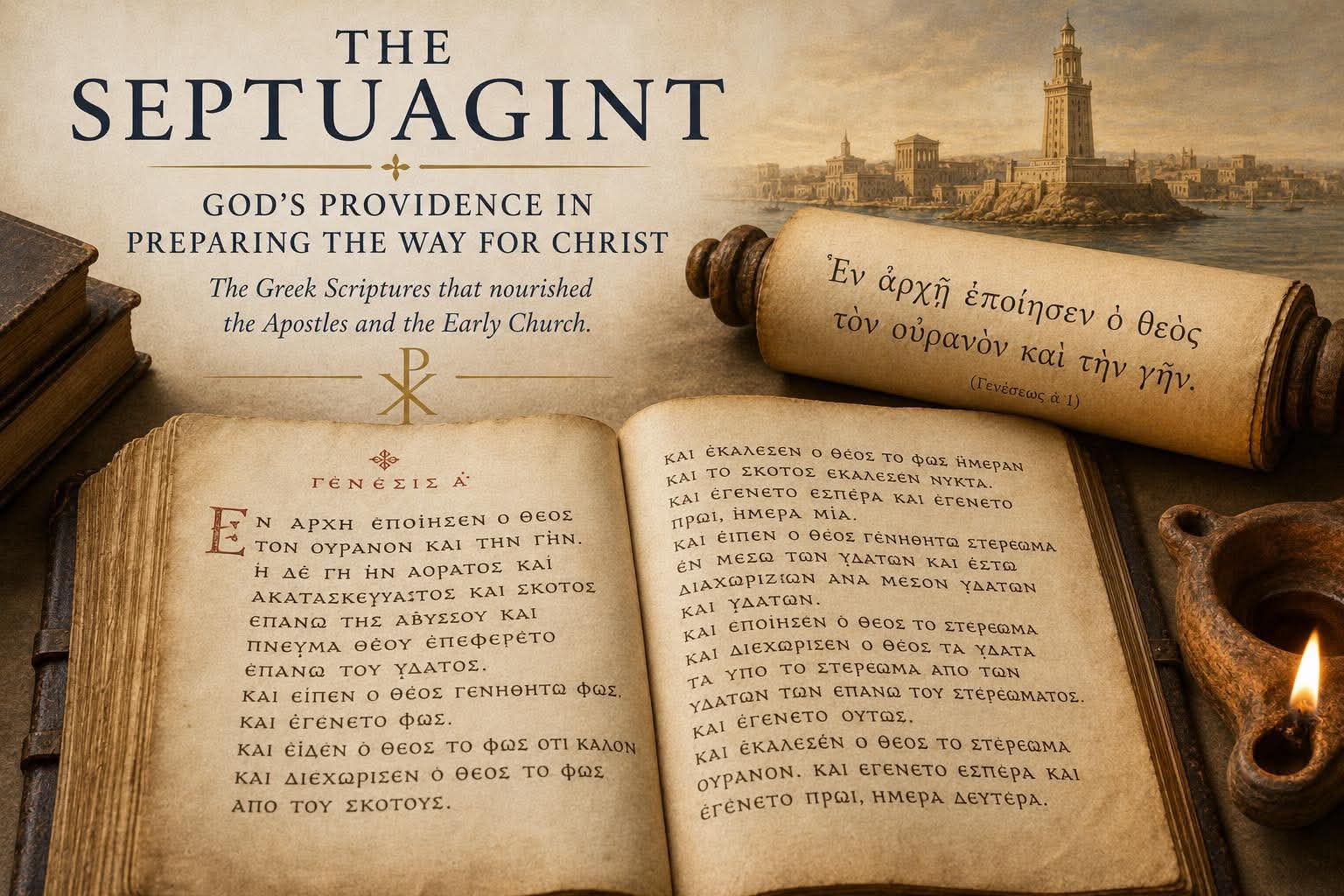
The Septuagint: God’s Providence in Preparing the Way for Christ
A reflection on the ancient Greek translation of the Hebrew Scriptures that became the Bible of the early Church.
In the divine economy of salvation, God orchestrates history with perfect wisdom, using even human languages, empires, and scholarly labors to prepare humanity for the fullness of revelation in His Son, Jesus Christ.
One of the most striking examples of this preparation is the Septuagint (LXX), the Greek translation of the Old Testament produced by Jewish scholars in Alexandria roughly two to three centuries before the Incarnation.
This monumental work became the primary version of Sacred Scripture used by our Lord Jesus Christ, the Apostles, and the early Church Fathers, profoundly shaping Christian theology, liturgy, and the biblical canon.
Historical Origin and the Miracle of Translation
The name “Septuagint” comes from the Latin septuaginta, meaning “seventy,” referring to the traditional number of translators involved in its production.
The foundational account comes from the Letter of Aristeas, which describes how King Ptolemy II Philadelphus sought a Greek translation of the Jewish Law for the Library of Alexandria.
Seventy-two elders from the twelve tribes were said to have produced translations that agreed in remarkable harmony.
While historians debate aspects of the story, Catholic tradition recognizes the historical reality that Jewish scholars translated the Hebrew Scriptures into Greek under God’s providential guidance.
The Pentateuch was translated first, followed by the Prophets, Writings, and the deuterocanonical books over subsequent generations.
The Bible of Christ and the Apostles
By the first century, the Septuagint had become the dominant version of Scripture among Greek-speaking Jews and the emerging Christian community.
Many Old Testament quotations found in the New Testament follow the Septuagint wording rather than the later Masoretic Hebrew text.
“Behold, a virgin shall conceive.” — Isaiah 7:14 (LXX)
The Greek word parthenos (“virgin”) became foundational to the Church’s understanding of the Virgin Birth of Christ.
The Gospels, Acts, and Epistles frequently reflect Septuagint language, demonstrating its central role in Apostolic preaching.
The Witness of the Church Fathers
The Fathers of the Church regarded the Septuagint as a providential gift.
St. Justin Martyr defended its reliability, while St. Irenaeus saw the harmony among the translators as a sign of divine inspiration and a foreshadowing of the unity of the Church.
For the early Christians, the Septuagint was not merely a translation. It was the Word of God proclaimed in the language through which the Gospel would spread throughout the Roman world.
The Canon and Catholic Tradition
The Septuagint preserved the deuterocanonical books that remain part of the Catholic Bible today: Tobit, Judith, Wisdom, Sirach, Baruch, 1 and 2 Maccabees, and portions of Esther and Daniel.
These books were affirmed by the Councils of Rome, Hippo, and Carthage, and definitively confirmed by the Council of Trent.
The Catholic canon reflects the Scriptural tradition received by the early Church rather than the narrower canon later adopted within rabbinic Judaism.
St. Jerome and the Vulgate
St. Jerome initially favored direct translation from the Hebrew texts. Yet in obedience to the Church, he included the deuterocanonical books within the Latin Vulgate.
The Vulgate would become the standard Bible of the Western Church for more than a thousand years and remained deeply rooted in the Septuagint tradition.
Providence and Relevance for Today
The Septuagint stands as a remarkable testimony to God’s providence.
Through empires, languages, scholars, and historical circumstances, the Lord prepared His Word to reach the nations precisely when the Messiah would enter history.
In our own digital age, where Scripture is available instantly across countless devices and languages, the Septuagint reminds us that God continues to work through human instruments to accomplish His saving plan.
“In thee shall all the families of the earth be blessed.” — Genesis 12:3
Sacred Scripture is a gift entrusted to the Church. It is meant to be studied diligently, prayed faithfully, and interpreted within the living Tradition handed down from the Apostles.
The same providence that guided the translators of Alexandria continues to guide Christ’s Church today.
As Roman Catholics, let us give thanks for this ancient treasure. May it deepen our love for Sacred Scripture and strengthen our confidence in the Church that faithfully preserves and interprets God’s Word.
St. Jerome, Doctor of the Church and patron of Scripture scholars, pray for us.
St. Irenaeus and all the holy Fathers who cherished the Septuagint, pray for us.
Our Lady of the Rosary, Seat of Wisdom, pray for us.
Sources: Catholic Encyclopedia, “Septuagint Version”; Catholic Encyclopedia, “Versions of the Bible”; Council of Trent, Session IV; St. Irenaeus, Against Heresies; St. Justin Martyr, Dialogue with Trypho.