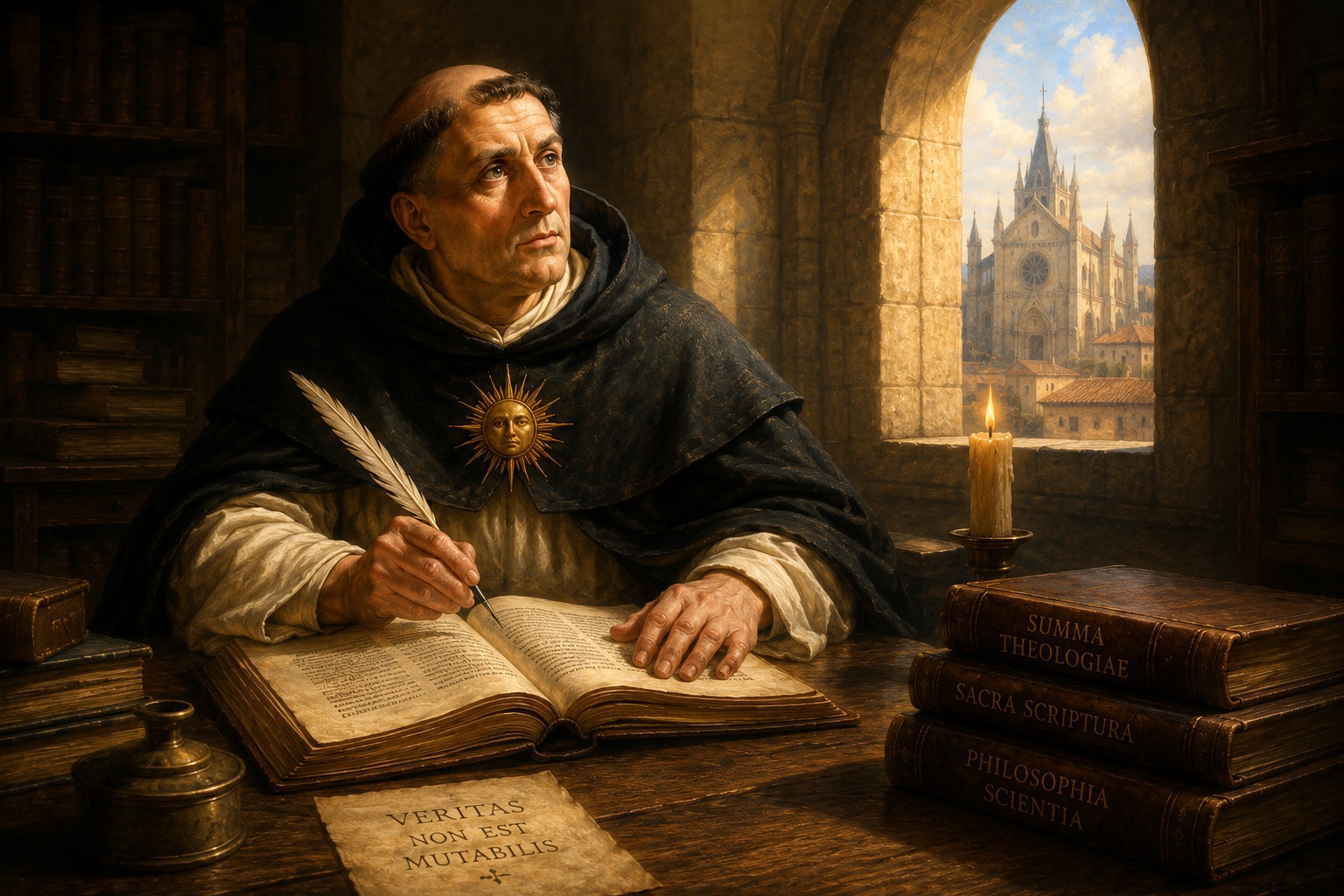
St. Thomas Aquinas: The Original Digital Thinker
The Doctor of the Church. Deep Thinker. Truth Seeker. Let’s dive into his timeless wisdom.
If St. Thomas Aquinas were alive today, he might not have a smartphone in his pocket, but he would certainly have a mind perfectly suited for the digital age.
In a world overflowing with information, opinions, and endless content, Aquinas offers something increasingly rare: clarity.
Born around AD 1225, St. Thomas lived centuries before computers, search engines, and artificial intelligence. Yet his approach to learning, reasoning, and discovering truth feels surprisingly modern. He gathered enormous amounts of information, organized it systematically, examined competing viewpoints, and sought truth wherever it could be found.
In many ways, he was doing what the best digital thinkers strive to do today — only with greater wisdom and holiness.
The Angelic Doctor and the Art of Asking
The Church calls him the Angelic Doctor, and for good reason.
Aquinas possessed a remarkable gift for asking the right questions. Rather than avoiding difficult topics, he welcomed them. Open almost any page of his masterpiece, the Summa Theologiae, and you’ll find a fascinating pattern.
He begins with a question. Then he presents objections to his own position. He allows opposing arguments to speak. Only then does he carefully respond, weighing evidence and reasoning toward the truth.
Truth is not discovered by shouting louder. Truth is discovered by seeking honestly.
In today’s online world, many people rush to conclusions before hearing opposing views. Aquinas did the opposite. He listened first. He understood arguments fairly. Then he responded with charity and precision.
There is a lesson there for every Christian navigating social media and digital culture.
All Truth Comes From God
One of Aquinas’ most famous principles was simple: all truth comes from God.
Whether truth is discovered through theology, philosophy, science, mathematics, or human experience, its ultimate source is the Creator Himself. For Aquinas, faith and reason were not enemies. They were partners.
Reason helps us understand the world God made, while faith reveals truths that God has graciously made known.
This harmony between faith and reason is desperately needed today.
Many people assume they must choose between intelligence and belief, between science and religion, between thinking deeply and trusting God. Aquinas rejected this false choice.
He believed that the God who created the universe also created the human mind. Therefore, genuine truth can never contradict genuine truth.
Knowledge Ordered Toward Worship
But Aquinas was not merely an intellectual giant.
He was a saint.
This is what makes him so compelling.
His brilliance was matched by humility. Despite producing millions of words and becoming one of history’s greatest theologians, he never viewed knowledge as an end in itself.
For Aquinas, learning was meant to lead to worship.
Knowledge was not about winning arguments. It was about knowing God.
Near the end of his life, after a profound mystical experience while celebrating Mass, Aquinas stopped writing. When encouraged to continue his work, he reportedly replied that everything he had written seemed “like straw” compared to what had been revealed to him.
Think about that.
The man who wrote some of the greatest theological works in Christian history recognized that God Himself infinitely exceeds every human explanation.
Wisdom in the Digital Age
That humility is perhaps his greatest lesson for the digital age.
We live in a culture that often mistakes information for wisdom. We can access vast libraries from our phones. We can search answers in seconds. Artificial intelligence can summarize books, generate essays, and process data at incredible speed.
But wisdom is something different.
Wisdom is knowing what matters most. Wisdom is seeing reality as God sees it. Wisdom is ordering our lives toward the highest good.
Aquinas understood that intelligence without virtue can become dangerous, while knowledge guided by faith becomes transformative.
The internet can tell us many things. It cannot tell us why we exist.
Search engines can provide information. They cannot provide meaning.
Algorithms can predict our preferences. They cannot satisfy our deepest longing for God.
Only divine truth can do that.
The Answer Who Never Changes
This is why St. Thomas Aquinas remains so relevant. His writings remind us that every question ultimately points beyond itself. Every search for truth, if pursued honestly, leads toward the One who is Truth itself.
I am the way, and the truth, and the life. — John 14:6
Aquinas spent his life following that Truth.
And perhaps that is why, nearly eight centuries later, his voice still speaks so clearly.
In an age of endless scrolling, he teaches us to think. In an age of confusion, he teaches us to reason. In an age of noise, he teaches us to seek wisdom.
And in an age hungry for answers, St. Thomas Aquinas points us toward the Answer who never changes.
The original digital thinker was never really searching for information.
He was searching for God.
And in doing so, he found the truth that every generation still longs to discover.
Sources: St. Thomas Aquinas, Summa Theologiae, Prologue and throughout; Pope Leo XIII, Aeterni Patris (1879); Catechism of the Catholic Church §§31–35, 159; John 14:6.