

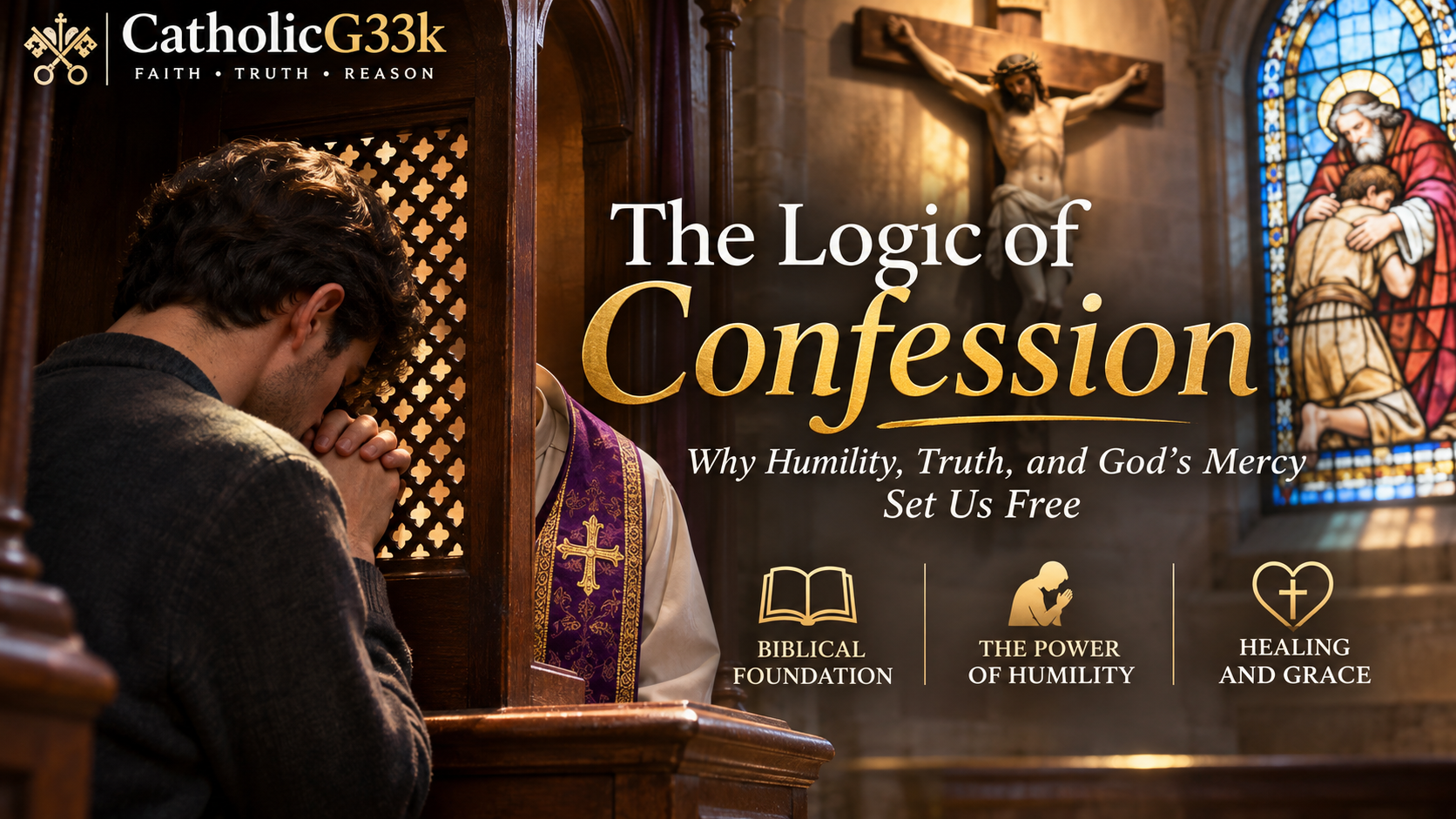
An exploration of the biblical foundations of Catholic Confession, the wisdom behind confessing our sins to a priest, and why the uncomfortable experience of humility can become a profound encounter with divine mercy.
CatholicG33k | Faith • Truth • Reason
Category: Catholic Apologetics • Sacraments • Spiritual Life
Introduction: Why Would God Ask Us to Confess Our Sins?
There is something deeply uncomfortable about admitting our sins aloud.
We would often rather explain ourselves, excuse our actions, minimize our failures, or quietly promise God that we will do better next time.
Yet the Catholic Church teaches that Christ established a sacrament in which we approach another human being, acknowledge our sins, express repentance, and receive forgiveness through priestly absolution.
Why would God choose such a humbling experience?
Why not simply forgive everyone privately, without requiring anyone to confront the embarrassment of confession?
The answer becomes clearer when we understand three truths:
- Sin separates us from God and wounds our communion with others.
- Pride encourages us to hide from the truth about ourselves.
- Christ established Confession as a sacrament of reconciliation, humility, healing, and grace.
Confession is not merely a religious obligation. It is part of God’s remedy for the spiritual damage caused by sin.
And remarkably, the very vulnerability we often fear becomes an opportunity to practice one of the most important Christian virtues: humility.
1. The Biblical Foundation: Christ Gives His Apostles Authority to Forgive Sins
Following His Resurrection, Jesus appeared to His Apostles and said:
“Whose sins you shall forgive, they are forgiven them: and whose sins you shall retain, they are retained.”
— John 20:23, Douay-Rheims
This passage is foundational to the Catholic understanding of sacramental Confession.
Earlier in the Gospels, the scribes correctly recognized that forgiving sins is a divine prerogative (Mark 2:7). Jesus then demonstrated His authority to forgive sins when He healed the paralytic (Mark 2:1–12).
After His Resurrection, Christ entrusted His Apostles with a real ministry of forgiveness.
Consider the reasoning.
First: God alone forgives sins by His own divine authority.
Second: Jesus Christ, being truly God, possesses this authority.
Third: Christ explicitly commissions His Apostles to forgive and retain sins.
Fourth: The Church exercises this ministry through the sacrament of Penance and Reconciliation.
The priest does not independently possess divine power. He acts as an ordained minister through whom Christ exercises His authority.
St. Paul describes this ministry:
“And all things are of God, who hath reconciled us to himself by Christ, and hath given to us the ministry of reconciliation.”
— 2 Corinthians 5:18, Douay-Rheims
This understanding is reflected in the Catechism of the Catholic Church, paragraphs 1441–1445 and 1461.
2. Why Confess to a Priest Instead of God Alone?
One of the most common objections to Catholic Confession is simple:
Why can’t I just tell God my sins directly?
Catholics absolutely should acknowledge their sins to God, repent, and ask for forgiveness in personal prayer.
However, private repentance and sacramental Confession are not interchangeable.
Consider the Incarnation.
God could have redeemed humanity without entering the world in a visible human nature. Yet He chose to become man.
Likewise, Jesus frequently communicated His healing through visible actions: touching the sick, speaking words of forgiveness, and using physical signs.
The sacraments continue this pattern of communicating invisible grace through visible signs established by Christ.
Human beings are not disembodied spirits. We are a unity of body and soul.
We learn, communicate, love, and reconcile through physical and personal encounters.
In Confession, we speak our sins, hear absolution, and receive sacramental reconciliation through the ministry Christ established.
The priest is not an obstacle between the sinner and God. He is an instrument of Christ’s mercy.
This is why Catholic teaching describes individual confession and absolution as the ordinary means of reconciliation for the faithful conscious of grave sin after Baptism.
See CCC 1422–1424, 1446, 1456, and 1484.
3. The Logic of Humility: Why Admitting Sin Changes Us
The human desire to preserve a good reputation is powerful.
We naturally want others to consider us honorable, trustworthy, intelligent, and morally upright.
But pride can corrupt that desire.
Instead of wanting to become good, we can become preoccupied with appearing good.
This distinction is essential.
A person who wants to appear righteous may hide wrongdoing.
A person who genuinely desires righteousness must be willing to confront wrongdoing.
Confession challenges the false security of appearances.
When someone enters the confessional and admits wrongdoing without making excuses, that person performs an act of humility.
St. Thomas Aquinas teaches that humility restrains the disordered tendency to seek greatness beyond what accords with truth and right reason (Summa Theologiae, II-II, q. 161).
Humility does not require a person to deny their dignity or goodness.
Rather, it requires an honest recognition of one’s condition before God.
The humble person does not pretend to be worthless. The humble person refuses to pretend to be sinless.
This is why Confession can help overcome pride.
It requires us to stop defending an imaginary version of ourselves and begin cooperating with God’s grace in becoming holy.
4. Adam, Eve, and the Human Instinct to Hide
The Book of Genesis provides a profound insight into human behavior after sin.
When Adam and Eve disobeyed God, they became aware of their nakedness and hid themselves (Genesis 3:7–10).
When God questioned Adam, he blamed the woman.
When God questioned Eve, she blamed the serpent.
Genesis 3:12–13 reveals a pattern that continues throughout human history.
Sin is often followed by fear, concealment, and blame.
How frequently do we respond similarly?
We might say:
- “I only did it because someone provoked me.”
- “Everyone else does the same thing.”
- “My intentions were good.”
- “What I did was not really that serious.”
Circumstances can genuinely affect moral responsibility, and not every explanation is an excuse. Nevertheless, we can also use explanations to avoid taking responsibility.
Confession reverses the movement toward concealment.
Instead of hiding, we approach God.
Instead of blaming others, we acknowledge our own actions.
Instead of defending sin, we express sorrow for it.
The contrast is striking.
Adam hid after sinning. The repentant Christian comes out of hiding.
In this sense, Confession is not simply the disclosure of wrongdoing.
It is a movement from self-deception toward truth.
5. Why Confession Can Feel Embarrassing, Frightening, and Liberating
To understand why Confession can feel so powerful, we should distinguish the psychological experience of vulnerability from the supernatural grace of the sacrament.
Before Confession: The Struggle With Shame
A person preparing for Confession may experience nervousness, embarrassment, anxiety, or reluctance.
One possible source of discomfort is wounded pride.
Admitting sin means acknowledging that we have failed to live according to the goodness we recognize.
It can also involve a genuine fear of being judged or misunderstood.
These feelings are not automatically sinful. Nor does anxiety necessarily indicate pride.
The important question is what we choose to do with them.
Will we allow embarrassment to prevent repentance?
Or will we entrust ourselves to God’s mercy despite our discomfort?
During Confession: The Courage of Truth
When someone names a sin without justifying it, the person accepts moral responsibility.
There can be a powerful simplicity in saying:
“I sinned.”
These words express something our pride may resist.
They acknowledge that God’s moral law is greater than our personal preferences and that we need forgiveness.
Yet humility is not humiliation for its own sake.
God does not require us to despise ourselves.
He calls us to repent because He loves us and desires our restoration.
After Confession: The Peace of Reconciliation
Many Catholics describe feeling lighter, peaceful, or deeply grateful after receiving absolution.
Others experience tears, relief, or renewed spiritual motivation.
These experiences are understandable, but they must not be confused with the sacrament’s objective effects.
A valid Confession does not depend on experiencing strong emotions.
Someone may leave the confessional feeling completely ordinary and nevertheless have received genuine sacramental forgiveness.
The grace of the sacrament is grounded in Christ’s action, not in the intensity of our feelings.
See CCC 1451–1453 and 1468–1470.
6. The Prodigal Son: A Biblical Portrait of Confession
One of Scripture’s most beautiful illustrations of repentance appears in Luke 15:11–32.
The younger son demands his inheritance, leaves his father’s household, and wastes his possessions.
Eventually, he recognizes the consequences of his actions.
He decides to return home.
When he reaches his father, he admits:
“Father, I have sinned against heaven, and before thee.”
— Luke 15:21, Douay-Rheims
Notice that the son does not return with an elaborate defense.
He acknowledges his wrongdoing.
Yet the father’s response is extraordinary.
Rather than rejecting his repentant son, the father welcomes him, embraces him, and celebrates his return.
The father does not pretend that the wrongdoing never occurred.
He responds to genuine repentance with mercy.
This parable reveals something essential about Confession.
God does not wait for us to become perfect before offering mercy.
His grace calls us to repentance, and He welcomes the sinner who returns.
The humiliation the prodigal son feared was not the final word.
The father’s love was.
7. The Publican and the Pharisee: When Humility Becomes the Path to Justification
In Luke 18:9–14, Jesus tells the parable of two men who enter the Temple to pray.
One is a Pharisee who emphasizes his religious achievements.
The other is a publican, or tax collector, who acknowledges his sinfulness.
The Pharisee compares himself favorably with others.
The publican asks God for mercy.
Jesus concludes:
“Every one that exalteth himself, shall be humbled: and he that humbleth himself, shall be exalted.”
— Luke 18:14, Douay-Rheims
The lesson is not that good works are unimportant.
Rather, genuine righteousness cannot be built upon self-righteousness.
The publican recognizes his need for mercy.
The Pharisee struggles to recognize his own need.
Confession places us in the spiritual posture of the publican.
We come before God not to advertise our goodness, but to acknowledge our need for His forgiveness.
8. Why Naming Our Sins Matters
St. James writes:
“Confess therefore your sins one to another: and pray one for another, that you may be saved.”
— James 5:16, Douay-Rheims
This passage demonstrates the biblical importance of acknowledging sin within the Christian community.
Taken alone, it does not establish every element of the Catholic sacrament, but it supports the broader biblical understanding that repentance is not always merely private.
There is also a practical distinction between acknowledging sin generally and recognizing it specifically.
Consider two statements:
“I make mistakes sometimes.”
And:
“I lied because I was afraid of losing someone’s respect.”
The first statement acknowledges imperfection.
The second identifies a particular wrongdoing and begins to expose its underlying motivation.
The Church therefore teaches the importance of confessing remembered mortal sins according to their kind and number after a diligent examination of conscience.
Confession of venial sins, though not strictly necessary, is also strongly encouraged because it helps form our conscience, fight evil tendencies, and grow in the spiritual life.
See CCC 1455–1458.
9. Does Humility Earn God’s Forgiveness?
A crucial distinction must be made.
Confession does not mean that we earn forgiveness by enduring embarrassment.
God’s mercy is not purchased through discomfort.
Forgiveness is a gift of divine grace made possible through the saving work of Jesus Christ.
The Catechism teaches that contrition involves sorrow of the soul and detestation for sin, together with the resolution not to sin again (CCC 1451).
Perfect contrition arises from love of God above all things and includes the firm resolution to receive sacramental Confession as soon as possible when mortal sins are involved (CCC 1452).
Imperfect contrition, arising from motives such as recognition of sin’s ugliness or fear of punishment, is also a gift of God that disposes a person to receive forgiveness in the sacrament (CCC 1453).
Thus, humility is not a payment for grace.
It is a virtue that helps us accept the truth and cooperate with the grace God freely gives.
10. The Spiritual Freedom That Comes From No Longer Pretending
One of the most exhausting effects of pride is the constant effort to maintain an image of ourselves that does not correspond to reality.
If our security depends on appearing morally flawless, every failure becomes a threat.
We may begin concealing our faults even from ourselves.
But Christianity does not teach that our worth depends upon appearing perfect.
Our dignity is rooted in being created in the image of God, and our supernatural calling is to share in His divine life through grace.
Confession teaches us that acknowledging sin does not destroy our dignity.
Rather, repentance helps restore us to the right relationship with God that sin has damaged or destroyed.
The sacrament also reminds us that Christian holiness is not simply a matter of improving our self-image.
It requires real conversion.
We must turn away from sin, accept forgiveness, seek to repair the harm we have caused, and cooperate with God’s grace.
Sometimes this will be emotionally difficult.
Sometimes it will bring an immediate sense of peace.
Sometimes the struggle against the same temptation will continue.
But the sacrament remains a source of forgiveness and strengthening grace for the repentant sinner.
11. The Profound Reversal: Pride Hides, Humility Confesses, Mercy Restores
We can now see the remarkable spiritual logic underlying Catholic Confession.
Pride says: “I must hide my faults to preserve my dignity.”
Humility says: “I can acknowledge my faults without denying my dignity.”
Repentance says: “I have sinned, and I desire to change.”
Faith says: “Christ has established a sacrament through which I can receive His forgiveness.”
Mercy says: “Your sins need not be the final word.”
Confession is therefore not simply about bringing wrongdoing into the open.
It is about allowing the truth to become the beginning of reconciliation.
The sinner admits what pride would rather conceal.
The priest exercises the ministry Christ entrusted to His Church.
And through sacramental absolution, the repentant person receives the forgiveness of Christ.
The experience is deeply fitting to our human nature.
We are beings who can hide behind words, but who can also use words to speak the truth.
We can use our freedom to sin, but through grace we can freely return to God.
We can allow shame to drive us into isolation, or we can respond to God’s invitation to reconciliation.
What begins as the uncomfortable admission of sin can become a profound encounter with mercy.
Conclusion: The Beauty of Being Known and Forgiven
Perhaps the deepest lesson of Confession is that God already knows everything we are afraid to admit.
He knows our weaknesses, our failures, our compromises, and our sins.
Yet He continues to call us to repentance.
Confession does not reveal information to an ignorant God.
It helps us acknowledge the truth before the God who already knows us, and receive the reconciliation Christ established through His Church.
We do not become holy by pretending that we have never fallen.
We grow in holiness by turning away from sin, receiving grace, and allowing God to transform our lives.
The confessional is not a place where human dignity disappears.
It is a place where a sinner can encounter the mercy of Christ and begin again.
Pride wants us to remain hidden. Humility brings us into the truth. And God’s mercy invites us home.
Prayer for Humility and a Contrite Heart
Lord Jesus Christ,
You know my heart more completely than I know myself.
You see my sins, my weaknesses, and the excuses I sometimes make to avoid the truth.
Give me the courage to acknowledge my faults without despair and to seek Your forgiveness without fear.
Free me from the pride that makes repentance difficult.
Teach me true humility, not so that I may think less of my dignity, but so that I may recognize my need for Your grace.
Help me approach the Sacrament of Reconciliation with sincerity, contrition, and trust in Your mercy.
May I never fear returning to You, no matter how far I have wandered.
Amen.
Sources and References
I. Sacred Scripture
All Scripture references are from the Douay-Rheims Catholic Bible.
- Genesis 3:7–13 — The fall of Adam and Eve, concealment, fear, and the tendency to shift responsibility.
- Mark 2:1–12 — Jesus demonstrates His divine authority to forgive sins.
- John 20:19–23 — The risen Christ entrusts His Apostles with the authority to forgive and retain sins.
- 2 Corinthians 5:18–20 — The ministry of reconciliation entrusted by God through Christ.
- James 5:14–16 — Prayer, the ministry of the Church, and confession of sins.
- Luke 15:11–32 — The Prodigal Son, repentance, and the mercy of the father.
- Luke 18:9–14 — The Pharisee and the publican; humility before God.
- 1 John 1:8–9 — Acknowledging sin and trusting God’s forgiveness.
- Psalm 50 (51) — David’s prayer of repentance and plea for a clean heart.
- John 9:1–7 — Christ’s use of visible means in healing.
II. Catechism of the Catholic Church
- CCC 1422–1424 — The names, meaning, and purpose of the Sacrament of Penance and Reconciliation.
- CCC 1430–1433 — Interior repentance, conversion of heart, and God’s grace.
- CCC 1441–1445 — God’s forgiveness of sins and Christ’s entrusting of the ministry of reconciliation to the Church.
- CCC 1446 — The sacrament instituted for the forgiveness of sins committed after Baptism.
- CCC 1450–1453 — The acts of the penitent, contrition, perfect contrition, and imperfect contrition.
- CCC 1455–1458 — Confession of sins, examination of conscience, and the spiritual benefits of confessing venial sins.
- CCC 1461–1467 — The minister of the sacrament and the seal of Confession.
- CCC 1468–1470 — The spiritual effects of the sacrament and reconciliation with God and the Church.
- CCC 1484 — Individual and integral Confession with absolution as the ordinary means of reconciliation for grave sin.
III. St. Thomas Aquinas
- Summa Theologiae, II-II, Question 161, Articles 1–2 — The nature of humility and its relationship to the virtues.
- Summa Theologiae, III, Question 84, Articles 1–3 — Penance as a sacrament and its sacramental form.
- Summa Theologiae, III, Question 85, Articles 1–3 — Penance as a virtue and its relationship to repentance.
IV. Church Fathers and Councils
- St. Augustine, Tractates on the Gospel of John, Tractate 12, Section 13 — Recognition and condemnation of one’s own sins as the beginning of repentance.
- Council of Trent, Session XIV (AD 1551), Doctrine on the Sacrament of Penance, Chapters 1–6 — The institution, nature, parts, confession of sins, and ministerial absolution of the sacrament.
- Fourth Lateran Council (AD 1215), Canon 21, Omnis utriusque sexus — The Church’s discipline concerning the confession of sins.
CatholicG33k — Faith. Truth. Reason.
Exploring the beauty, depth, and reasonableness of the Catholic faith through Sacred Scripture, Sacred Tradition, and the teaching of the Church.