

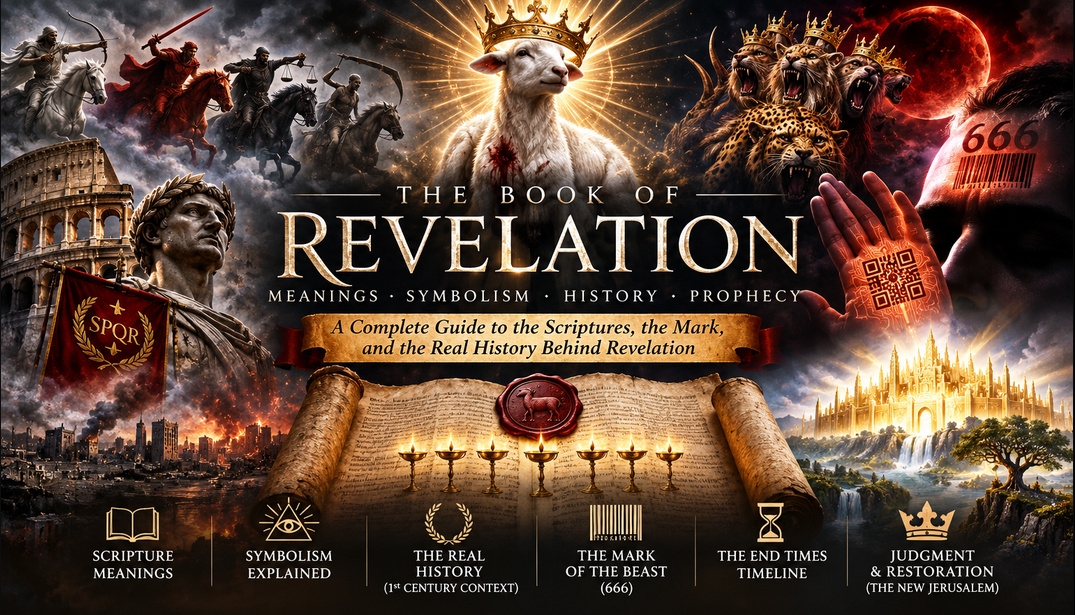
Understanding the history, symbolism, and Catholic theology of Revelation and the Scriptures for the Solemnity of All Saints
Scripture: Revelation 7:2–4, 9–14; Psalm 24:1–6; 1 John 3:1–3; Matthew 11:28; Matthew 5:1–12
Central theme: Holiness is not reserved for a privileged few. Through Jesus Christ, God calls people of every nation to become His children, remain faithful through tribulation, and enter the eternal communion of Heaven.
Introduction: Whose Mark Do We Bear?
The Solemnity of All Saints invites us to contemplate one of the most extraordinary scenes in Sacred Scripture: an innumerable multitude standing before the throne of God and the Lamb, clothed in white, carrying palm branches, and worshiping the Lord.
These are the saints, those who have reached the fulfillment of the Christian vocation.
Yet the reading from Revelation begins with an image that deserves special attention. Before John sees the great multitude, he witnesses an angel bearing the seal of the living God. The servants of God are marked upon their foreheads.
What is this mysterious seal? Why are the servants of God marked? What is the significance of the number 144,000? How does this heavenly mark relate to the notorious mark of the beast described later in Revelation? And what did these symbols mean to Christians living under Roman imperial power?
These questions lead us into the historical and spiritual world of the Apocalypse.
Revelation is not primarily a collection of frightening predictions intended to make Christians afraid of the future. It is an unveiling of God’s sovereignty, Christ’s victory, the spiritual struggle between good and evil, and the eternal destiny of those who remain faithful.
The other readings for All Saints explain how this victory becomes personal. Psalm 24 describes the purity required to stand before God. The First Letter of John reveals our identity as God’s children. The Beatitudes describe the character of those who inherit the Kingdom.
Together, the readings reveal the journey from Baptism to holiness, from earthly struggle to heavenly victory, and from faith to the vision of God Himself.
1. The Historical World of Revelation: Christians Living Under Rome
To understand Revelation, we must begin with the world in which it was written.
The book identifies its author as John, who was on the island of Patmos because of the word of God and testimony to Jesus (Revelation 1:9). Christian tradition commonly identifies him with St. John the Apostle, although questions of authorship have been discussed since antiquity.
The book is addressed to seven Christian churches in the Roman province of Asia, in what is now western Turkey: Ephesus, Smyrna, Pergamum, Thyatira, Sardis, Philadelphia, and Laodicea (Revelation 1:11).
These were real Christian communities living within the political, religious, and economic structures of the Roman Empire.
When was Revelation written?
An important early Christian witness is St. Irenaeus of Lyons, writing around AD 180. In Against Heresies V, 30, 3, he associates the apocalyptic vision with the end of Emperor Domitian’s reign.
Domitian ruled from AD 81 to AD 96. Consequently, many biblical scholars date Revelation to approximately AD 95.
Other scholars argue for an earlier composition, possibly during or shortly after the reign of Nero, who ruled from AD 54 to AD 68.
The precise date remains debated. Likewise, the available historical evidence does not establish a uniform, empire-wide persecution of Christians under Domitian. Local hostility, religious pressure, exclusion, and episodes of violence provide a more cautious description of the setting.
The important point is that Revelation was written for actual Christian communities facing the problem of fidelity to Christ within an overwhelmingly pagan imperial society.
The Roman imperial cult
Roman emperors possessed extraordinary political power, but Roman political life could also express religious loyalty through sacrifices, images, temples, and honors offered to the emperor or his divine predecessors.
The imperial cult was particularly prominent in parts of Asia Minor.
Participation in public religious activities could be closely connected with civic identity, professional relationships, commerce, and social standing. The extent of pressure differed by city, period, and circumstance.
For Christians, however, there was a fundamental conflict.
They could honor legitimate political authority, but they could not offer divine worship to the emperor.
Jesus had already established the principle in Matthew 22:21: legitimate obligations to Caesar must not displace what belongs to God.
Revelation exposes the danger that arises when political authority demands the worship that belongs to God alone.
The Roman imperial world therefore provides an important historical background for the book’s beasts, false worship, and imagery of economic coercion.
Why does Revelation use such extraordinary imagery?
The Greek title Apokalypsis means an unveiling or revelation.
The book belongs to the Jewish and Christian tradition of apocalyptic literature. It uses visions, numbers, heavenly messengers, symbolic animals, cosmic disturbances, and dramatic contrasts to reveal spiritual realities.
Its imagery draws extensively from Daniel, Ezekiel, Zechariah, Isaiah, Exodus, and the Psalms.
The Catechism teaches that Scripture must be interpreted according to its literary forms, historical circumstances, and the unity of God’s revelation (CCC 109–119).
This means we should neither dismiss Revelation as meaningless fantasy nor treat every image as a literal description of an object that must appear in modern history.
Its symbolic language communicates profound truths about real spiritual conflict and God’s final victory.
2. Revelation 7: The Seal of the Living God
In Revelation 7:1–3, John sees four angels restraining destructive winds while another angel approaches from the rising of the sun, carrying the seal of the living God.
Before the coming judgment proceeds, the servants of God are sealed upon their foreheads.
The image contains several layers of meaning.
The four angels and the four corners of the earth
In biblical symbolism, the number four frequently represents the created world in its geographical extent.
The four corners and four winds indicate that the vision concerns the whole earth.
The angels’ restraint shows that the forces of judgment operate under God’s sovereignty. History is not ultimately governed by chaos, Satan, or earthly empires.
God retains authority over creation.
Why does the angel come from the East?
The East is associated with the rising sun and the coming of light.
In Genesis 2:8, Eden is described as a garden planted toward the East. Ezekiel 43:2 describes the glory of the God of Israel coming from the East.
Christian tradition also associates the rising sun with Christ, the light of the world, whose Resurrection brings salvation.
The direction in Revelation can therefore evoke hope, illumination, and God’s saving intervention.
What did a seal mean in antiquity?
A seal was commonly used to authenticate a document, identify ownership, or establish authority.
A ruler or property owner might use a signet ring to mark something as his own.
Thus, the seal in Revelation communicates three closely related realities: belonging to God, identification with Him, and protection under His authority.
The servants of God are not spiritually ownerless. They belong to the Lord.
The seal reveals whose people they are.
This does not promise freedom from all earthly suffering. The same book describes faithful Christians who endure persecution and martyrdom.
The protection is ultimately ordered toward their fidelity and final salvation.
3. The Old Testament Origin of the Seal: Ezekiel 9
One of the most important passages for interpreting Revelation 7 is Ezekiel 9:1–6.
In Ezekiel’s vision, Jerusalem faces judgment because of its sins. Before judgment proceeds, a mark is placed upon the foreheads of those who grieve over the abominations committed in the city.
Those marked are distinguished from those subject to judgment.
John draws upon this prophetic image.
The resemblance is unmistakable: a coming judgment, a heavenly command, a mark upon the forehead, and the identification of those belonging to God.
But Revelation transforms the imagery through the victory of Jesus Christ.
The decisive identity of the redeemed is now their belonging to God and to the Lamb.
Other biblical passages deepen this symbolism.
In Exodus 12, the blood of the Passover lamb marks the houses of the Israelites during the judgment upon Egypt. In Deuteronomy 6:4–8, God’s commandments are to be bound symbolically upon the hand and between the eyes, expressing a life ordered to His covenant.
Together, these passages help explain the symbolic language of the forehead and hand: thoughts, identity, conduct, covenant fidelity, and allegiance.
These associations become especially important when we compare God’s seal with the mark of the beast.
4. The Seal of God and the Sacraments of Baptism and Confirmation
The Catholic understanding of the seal finds a profound sacramental connection.
St. Paul teaches that Christians are sealed with the Holy Spirit (Ephesians 1:13–14; 4:30; 2 Corinthians 1:21–22).
The Catechism explains that Baptism imprints an indelible spiritual character upon the soul.
CCC 1272–1274: Baptism marks the Christian as belonging to Christ. This spiritual character cannot be erased, even though serious sin can prevent baptismal grace from bearing its intended fruit.
Confirmation likewise imprints an indelible spiritual character and strengthens the baptized person for Christian witness.
CCC 1295–1296: The seal of the Holy Spirit signifies our belonging to Christ, our service in His mission, and the promise of divine protection in the final spiritual trial.
This offers an extraordinary connection to Revelation.
The Christian has already been marked as belonging to Christ through sacramental initiation.
However, the sacramental character is not a mechanical guarantee of final salvation. A baptized person is still called to live in faith, charity, repentance, and perseverance.
The saints depicted in Heaven reveal the fulfillment toward which sacramental life is directed.
The seal given in the Christian life points toward the eternal belonging that reaches its perfection in Heaven.
5. The Mystery of the 144,000
John next hears the number of those sealed: 144,000 from the tribes of Israel.
The number has inspired many competing interpretations.
Some have treated it as the exact numerical limit of those who will be saved. Yet the literary structure and numerical symbolism of Revelation strongly support a different reading.
The number can be expressed as:
12 × 12 × 1,000 = 144,000
Twelve represents the tribes of Israel and, in the New Testament, also recalls the twelve Apostles.
Multiplying twelve by twelve suggests covenant fullness. Multiplication by one thousand intensifies the image of completeness and an immense company.
The number is therefore widely understood as a symbolic expression of the fullness of God’s redeemed people.
Why are the tribes of Israel mentioned?
Salvation history begins with God’s covenant promises to Israel.
Jesus is the Messiah of Israel, and the Church’s identity cannot be separated from those covenantal roots.
The New Jerusalem in Revelation 21 bears the names of the twelve tribes upon its gates and the names of the twelve Apostles upon its foundations.
The symbolism unites the promises of the Old Covenant with their fulfillment in Christ.
We should not interpret this unity as a justification for contempt toward the Jewish people. As St. Paul teaches in Romans 11:28–29, God’s gifts and calling are irrevocable.
Why is Judah listed first?
In Revelation 7:5, Judah appears first in the enumeration.
Judah has particular significance because the Messiah descends from the tribe of Judah. Revelation 5:5 identifies Christ as the Lion of the tribe of Judah.
The tribe list is also unusual: Dan is omitted, while Joseph and Manasseh are both named.
These features make it difficult to treat the passage as a straightforward demographic census.
The Church has not defined a dogma identifying each numerical detail of the 144,000. The broader biblical symbolism, however, directs us toward the completeness of God’s saving work.
Are the 144,000 and the great multitude the same people?
Immediately after hearing the number 144,000, John sees a multitude that no one can count, drawn from every nation, tribe, people, and language.
A widely held interpretation understands the two visions as complementary portrayals of the redeemed: the covenant people heard in symbolic numerical form and the universal multitude seen in heavenly glory.
This resembles Revelation 5:5–6, where John first hears about the Lion of Judah and then sees a Lamb.
The images differ, but both reveal Christ.
Other interpreters distinguish the two groups more sharply.
The precise relationship remains a matter of biblical interpretation rather than a separately defined Catholic dogma.
What is unmistakable is the central truth: the redeemed belong to God through the Lamb, and God’s saving purpose reaches people of every nation.
6. The Mark of the Beast: Revelation 13 and Its Historical Meaning
The mark of the beast does not appear in the All Saints first reading itself. It appears in Revelation 13:16–18.
Nevertheless, the connection is essential because Revelation deliberately contrasts those who belong to God with those who worship the beast.
In Revelation 13, John sees a beast rising from the sea, followed by another beast rising from the earth.
The first beast receives authority from the dragon, who represents Satan (Revelation 12:9; 13:2).
The imagery draws upon Daniel 7, where monstrous beasts symbolize oppressive kingdoms.
The second beast promotes the worship of the first and uses deception and coercion to secure allegiance.
The text describes a mark associated with the beast’s name or number, placed on the right hand or forehead, and connected with the ability to buy and sell.
What did the beast represent historically?
The first beast is closely associated by many scholars with the persecuting power of pagan Rome, particularly imperial authority when it sets itself against God.
The second beast can be understood in relation to the religious and ideological mechanisms that promoted imperial worship.
In a Roman setting, these images would have confronted Christians with a serious question: would they remain faithful to Christ when public conformity to pagan religious expectations could affect their standing, security, or livelihood?
Revelation is not saying that every ordinary exchange in the Roman marketplace required a physical mark.
Rather, its apocalyptic imagery portrays the conflict between fidelity to God and submission to an idolatrous system of power, including the economic pressures such a system can exert.
Why the forehead and the right hand?
This imagery recalls Deuteronomy 6:8, in which God’s commandments are symbolically placed upon the hand and before the eyes.
In biblical thought, the forehead can represent identity, conviction, and allegiance. The hand can represent actions, labor, and practical conduct.
This yields a powerful interpretation: the beast seeks not simply outward compliance but allegiance expressed in thought and action.
God’s people bear the Father’s name. The followers of the beast bear the beast’s name or number.
The contrast is fundamentally one of lordship and worship.
| The seal of God | The mark of the beast |
|---|---|
| Revelation 7:3 and 14:1 | Revelation 13:16–18 |
| Identifies those belonging to God and the Lamb | Identifies allegiance to the beast |
| Associated with divine fidelity and protection | Associated with idolatrous worship and coercion |
| Points toward eternal communion with God | Points toward judgment upon rebellion against God |
| Finds a spiritual connection with Baptism and Confirmation | Warns against surrendering worship and moral allegiance to evil |
These are not two sacramental rites of equal and opposite power. The beast’s mark is a counterfeit of the divine seal within Revelation’s symbolic presentation of spiritual warfare.
Is the mark of the beast a microchip, barcode, or modern identification system?
Revelation does not identify the mark with any particular modern technology.
Claims that an ordinary payment method, identification document, medical intervention, or electronic device automatically constitutes the mark go beyond what the biblical text establishes.
The context of Revelation 13 repeatedly associates the beast’s mark with worship, allegiance, deception, coercion, and opposition to God.
This does not mean that technology or political authority can never be used for evil. Such questions must be examined through moral theology and the actual circumstances involved.
But Christians should resist attempts to identify every new invention or public controversy as the fulfillment of Revelation without sound evidence.
The central warning remains spiritually serious: no earthly authority may demand the worship, loyalty, or moral surrender that belongs to God.
7. The Number 666: Nero, Imperial Power, and Ancient Numerology
Perhaps no number in Scripture has attracted more speculation than 666.
Revelation 13:18 invites the reader to calculate the number of the beast, describing it as the number associated with a person.
Ancient Hebrew and Greek letters could possess numerical values. Names could therefore be represented by numerical totals, a practice commonly called gematria when using Hebrew letters.
Why do scholars associate 666 with Nero?
A prominent historical explanation identifies the number with the name Nero Caesar.
When the Greek form of Nero Caesar’s name is transliterated into Hebrew letters as Neron Qesar, the conventional numerical values sum to 666.
A related spelling, Nero Qesar, gives 616.
This matters because some ancient manuscripts of Revelation preserve 616 instead of 666.
The variation offers evidence for the possibility that both numbers were understood in connection with the name Nero.
Nero reigned from AD 54 to AD 68 and became closely associated in Christian memory with imperial cruelty. The Roman historian Tacitus reports the punishment of Christians following the great fire of Rome in AD 64 (Annals XV, 44).
Yet identifying Nero as a major historical referent is not identical to proving that Nero exhausts the meaning of the beast.
Revelation’s imagery may also characterize recurring patterns of tyrannical authority that imitate divine sovereignty and demand idolatrous submission.
Does the Church teach that 666 definitely means Nero?
No definitive Catholic dogma identifies one historical individual as the exclusive meaning of 666.
The Nero interpretation has substantial scholarly support, including the 616 textual variant, but it remains an interpretation rather than a dogmatically settled conclusion.
Scholars also debate how the number relates to the composition date and larger symbolism of Revelation.
Why three sixes?
In Revelation, seven frequently communicates fullness or completeness.
Six falls short of seven.
Consequently, 666 has also been interpreted symbolically as intensified imperfection, a counterfeit of divine perfection, or human power attempting to exalt itself as divine.
This symbolism is suggestive, but it should not be treated as a mathematically proven key to every detail in Revelation.
The deeper warning is clear: created authority becomes monstrous when it attempts to replace God.
What can Catholics learn from this today?
Christians are called to be vigilant against idolatry in every age.
Money, political identity, ideology, reputation, personal power, and technological control can become objects of disordered allegiance.
We need not identify a particular modern person as the beast to recognize the spiritual danger of making an earthly power absolute.
This brings us back to the seal of God.
The central question is not whether we can discover a secret numerical code hidden in current events.
It is whether we remain faithful to Jesus Christ when fidelity becomes costly.
8. The White Robes: Made Clean by the Blood of the Lamb
In Revelation 7:9, the great multitude appears before God’s throne wearing white robes.
An elder explains that they have come through the great tribulation and have washed their robes in the blood of the Lamb.
The symbolism contains a striking paradox.
Ordinarily, blood stains clothing.
Yet here the Blood of Christ makes the garments white.
The image reveals the saving and purifying power of Christ’s sacrifice.
It recalls the Passover lamb of Exodus 12, the suffering servant of Isaiah 53, and the testimony that Jesus Christ cleanses us from sin (1 John 1:7).
Are the white robes connected to Baptism?
Yes, there is a rich sacramental connection.
At Baptism, the newly baptized person receives a white garment, expressing the new life of grace and the call to preserve that gift.
The Catechism explains the symbolism in CCC 1243 and describes the grace and spiritual character of Baptism in CCC 1262–1274.
Revelation’s heavenly robes are not simply identical with the earthly baptismal garment. Rather, the images harmonize: salvation is received through Christ, and holiness reaches its fulfillment in those redeemed by Him.
What does the great tribulation mean?
For Revelation’s first readers, tribulation would have evoked the trials endured by Christians who resisted compromise with paganism and remained faithful despite persecution.
The image can also encompass the broader struggles of the Church across history and the trials associated with the final conflict before Christ’s return.
The Catechism teaches that before Christ’s second coming, the Church must pass through a final trial that will test the faith of many (CCC 675–677).
We should not reduce the great tribulation exclusively to one contemporary event or assign dates that Scripture has not revealed.
Why are the saints holding palm branches?
Palm branches were associated with victory, festivity, and rejoicing.
They recall the biblical celebration of God’s saving deeds and the welcoming of Jesus into Jerusalem (John 12:12–13).
In Revelation, they become signs of triumph through the Lamb.
The victory is paradoxical. The saints conquer not through domination or violence, but through fidelity to Christ, including fidelity unto death.
The persecuted become victors because the crucified Lamb is risen.
9. The Heavenly Liturgy and the Communion of Saints
The great multitude does not stand before an empty throne.
At the center of the vision are God and the Lamb.
Angels, elders, living creatures, and the redeemed offer worship.
Revelation’s heavenly scenes are therefore profoundly liturgical.
They reveal a universe ordered around the worship of the true God.
The Catechism teaches that the Church’s earthly liturgy participates in and anticipates the heavenly liturgy (CCC 1090, 1137–1139).
This provides an important connection to the Holy Mass.
At Mass, the faithful join the praise of angels and saints in worshiping God through Jesus Christ.
The Church in Heaven and the Church on earth are not two unrelated communities.
They belong to the one Body of Christ.
Do Catholics worship the saints?
No.
Adoration belongs to God alone.
The saints are honored because God’s grace has triumphed in their lives. Their holiness does not compete with Christ’s glory; it manifests the power of His redemption.
The Church also teaches that the saints in Heaven intercede for the faithful on earth.
The Catechism describes this communion in CCC 946–962 and the intercession of the saints in CCC 956 and 2683.
Christ alone is the one mediator of redemption. The saints’ intercession is dependent upon and united to His unique mediation.
The Solemnity of All Saints celebrates not only saints formally canonized by the Church, but the whole company of those who have attained heavenly glory.
The great multitude is thus a fitting scriptural image for the feast.
10. Psalm 24: Who May Ascend the Mountain of the Lord?
The Responsorial Psalm asks who may stand in God’s holy place.
The answer concerns clean hands, purity of heart, freedom from vanity, and a sincere desire for God.
Historically, Psalm 24 reflects worship centered on the sanctuary of the Lord. It evokes a procession approaching the divine presence.
The psalm teaches that true worship cannot be separated from holiness.
What do clean hands signify?
Hands represent human actions.
Clean hands therefore suggest upright conduct, innocence, and freedom from wrongdoing.
The connection with Revelation is especially striking.
Revelation contrasts God’s faithful servants with those whose actions express allegiance to the beast.
Psalm 24 asks whether our conduct reflects belonging to God.
What does a pure heart signify?
The heart is the interior center of desire, intention, and moral choice.
A pure heart is not simply outward respectability.
It is a heart ordered toward God rather than divided by idolatry and deliberate sin.
Jesus develops the same teaching in Matthew 5:8:
“Blessed are the clean of heart: for they shall see God.”
Psalm 24 asks who may ascend God’s mountain. Revelation shows the redeemed standing in His presence. The Beatitudes promise the vision of God to the pure of heart.
The three passages illuminate one another.
The Catechism discusses purity of heart in CCC 2517–2519 and its relationship to the vision of God.
Yet no one attains this holiness through unaided human effort. It is Christ who purifies and sanctifies us, and we are called to cooperate with His grace.
11. First John 3: We Are Children of God Now
The second reading offers the theological foundation for understanding the saints.
St. John tells us that the Father has bestowed such great love upon us that we are called children of God—and truly are His children.
This is more than a poetic title.
Through Baptism and sanctifying grace, Christians participate in the divine life as adopted sons and daughters of the Father (CCC 1265–1266, 1996–1997).
We are children of God now
Christian holiness begins in the present.
The saints did not first become God’s children after death. Their earthly lives were transformed by grace, and that life reaches perfection in Heaven.
This is why the Church teaches the universal call to holiness.
CCC 2013: Every Christian, whatever his or her state or vocation, is called to the fullness of Christian life and perfection in charity.
Sanctity is not reserved only for clergy, religious, theologians, or extraordinary mystics.
The same grace calls parents, workers, students, the elderly, the poor, the sick, and every baptized person to holiness.
We shall see God as He is
St. John then describes the ultimate destiny of God’s children.
The blessed will see God as He is.
The Church calls this the beatific vision.
The Catechism explains that God grants the blessed the capacity for direct and immediate contemplation of His divine glory (CCC 1023–1029).
This is the fulfillment of the deepest human longing.
In this vision, the blessed are perfectly united to God in love.
Does this mean humans become God?
Catholic theology teaches that the redeemed participate in the divine nature by grace (2 Peter 1:4; CCC 460).
This participation does not erase the distinction between Creator and creature.
The saints do not become divine persons or acquire God’s nature as something independently their own.
Instead, by God’s freely given grace, they share in His life and are perfected in communion with Him.
This is why holiness is both extraordinary and humbling.
Everything the saints possess in glory is ultimately a gift flowing from Jesus Christ.
Hope leads to purification
First John 3:3 teaches that those who hope to see God seek purity.
Christian hope is therefore not passive.
The promised destiny shapes the present life.
Because we are called to see God, we seek to live as His children today.
This is the bridge between Revelation’s heavenly multitude and the Beatitudes preached by Jesus.
12. The Alleluia: Christ Gives Rest to the Burdened
Before the Gospel, the Church proclaims Jesus’ invitation from Matthew 11:28.
Christ calls those who labor and are burdened to come to Him for rest.
This verse is particularly appropriate on All Saints.
The saints are not people who never suffered.
Many endured persecution, poverty, disease, rejection, sorrow, and long spiritual struggles.
Yet their hope was centered on Jesus Christ.
In the following verses, Jesus describes Himself as meek and humble of heart and invites His disciples to take His yoke upon them (Matthew 11:29–30).
The rest He offers is not freedom from every earthly difficulty.
It is the rest found in communion with Him.
The heavenly multitude of Revelation displays the ultimate fulfillment of that invitation.
Those who persevered in Christ now share the joy and peace of His presence.
13. The Beatitudes: The Portrait of a Saint
The Gospel for All Saints comes from the opening of Jesus’ Sermon on the Mount.
The setting is significant.
Moses received the Law on Mount Sinai. Jesus now teaches His disciples from a mountain, revealing the definitive pattern of life in the Kingdom of God.
The Beatitudes are not merely moral advice.
They reveal the character of Christ Himself and describe the life He calls His disciples to share.
The Catechism says that the Beatitudes depict Christ’s face and charity, express the Christian vocation, and sustain hope amid tribulation (CCC 1716–1717).
The eight Beatitudes and their meaning
| Beatitude | Meaning for the Christian life |
|---|---|
| Poor in spirit | Recognize our complete dependence upon God rather than trusting in pride, possessions, or self-sufficiency |
| Those who mourn | Grieve over sin, suffering, and the brokenness of the world while trusting God’s promised consolation |
| The meek | Exercise strength with humility, patience, and self-control rather than arrogance or domination |
| Those who hunger and thirst for righteousness | Desire holiness, justice, and conformity to God’s will |
| The merciful | Show forgiveness, compassion, and concrete concern for the suffering |
| The clean of heart | Seek purity of intention, freedom from sin, and an undivided love of God |
| The peacemakers | Work for true reconciliation, justice, charity, and peace |
| Those persecuted for righteousness | Remain faithful to Christ when obedience brings suffering, rejection, or opposition |
The final blessing, addressed directly to disciples insulted and persecuted because of Jesus, applies this last Beatitude personally.
Why do the Beatitudes seem paradoxical?
The world often associates happiness with wealth, power, approval, comfort, and freedom from suffering.
Jesus reveals a different standard.
True blessedness is found in belonging to God and sharing in His Kingdom.
This does not mean that poverty, grief, injustice, or persecution are good in themselves.
Rather, God’s grace can sustain the faithful even amid these evils, and Christ promises a Kingdom in which evil will not have the final word.
The Beatitudes explain Revelation’s multitude
The relationship between the Gospel and Revelation is profound.
Those who mourn receive consolation. Those persecuted for righteousness inherit the Kingdom. The pure of heart see God. The poor in spirit possess the Kingdom of Heaven.
Revelation reveals this promised destiny in its heavenly imagery.
The Gospel describes the road to holiness. Revelation shows the glory toward which that road leads.
14. The Feast of All Saints: Its Origins and Purpose
The Church’s celebration of all the saints developed over centuries.
Early Christians honored martyrs who had given their lives for Christ. As the number of recognized martyrs grew, common commemorations developed alongside individual feast days.
In Rome, Pope Boniface IV dedicated the Pantheon to the Blessed Virgin Mary and all the martyrs in AD 609 or 610.
Pope Gregory III, who reigned from AD 731 to AD 741, established a November 1 commemoration associated with a chapel dedicated to all the saints in St. Peter’s Basilica.
The celebration subsequently spread more widely through the Western Church.
All Saints emphasizes the triumph of divine grace in those already enjoying heavenly glory.
It is distinct from All Souls’ Day on November 2, when the Church especially prays for the faithful departed who are still undergoing purification (CCC 1030–1032).
The distinction expresses the Catholic understanding of the one Church in different states: pilgrims on earth, those undergoing purification, and the blessed in Heaven (CCC 954).
15. The Great Spiritual Conflict: Two Kingdoms, Two Allegiances
We can now bring the symbolism together.
Revelation describes the forces of evil attempting to secure worship and loyalty.
God seals His servants. The beast marks its followers.
Babylon represents corrupt worldly power and idolatrous luxury. The New Jerusalem represents the fulfillment of God’s dwelling with His redeemed people.
The Lamb appears slain yet victorious. The saints appear afflicted yet triumphant.
These images reveal that the deepest struggle in history is not simply a contest between competing human political systems.
It is the struggle between fidelity to God and rebellion against Him.
The Church teaches that human history is marked by a serious struggle against the powers of evil, while Christ’s victory remains decisive (CCC 409, 2852–2854).
This conflict enters every human heart.
Whenever we choose truth over deception, charity over hatred, purity over corruption, and fidelity over idolatry, we participate in the Christian life that the saints have already brought to its fulfillment.
The final victory, however, is not achieved through human strength alone.
It belongs to Christ, the Lamb who was slain and who lives forever.
16. What All Saints Teaches Us Today
The All Saints readings invite a serious examination of our lives.
Revelation challenges us to consider where our ultimate allegiance lies. Psalm 24 calls us to clean hands and a pure heart. First John reminds us that our holiness begins with the Father’s love. The Beatitudes show us how that holiness becomes visible.
These teachings are deeply practical.
A Christian preparing for Heaven should be growing in prayer, sacramental life, purity of heart, humility, mercy, reconciliation, courage, and charity.
We should ask whether our work, friendships, political commitments, habits, and personal ambitions reflect the fact that we belong to Christ.
We should also remember that the saints themselves were not all alike.
They came from different peoples, cultures, occupations, centuries, and states of life. Some were martyrs, others contemplatives, pastors, parents, teachers, or servants of the poor.
Their circumstances differed greatly.
What united them was the grace of Jesus Christ, received and lived through faith and charity.
This diversity is beautifully anticipated by Revelation’s multitude from every nation and language.
The Church does not invite us to imitate every historical detail of a particular saint’s life.
She invites us to imitate the saints’ fidelity to Christ.
Conclusion: From the Seal of Baptism to the Vision of God
The readings for All Saints form one unified message.
In Revelation, God identifies His servants and reveals their heavenly victory.
In Psalm 24, we discover that those who approach God’s presence must seek purity of heart and righteousness.
In First John, we learn that the foundation of holiness is our adoption as children of God and our hope of seeing Him face to face.
In Matthew 11, Christ invites the weary to find rest in Him.
And in the Beatitudes, Jesus reveals the character of those who will inherit the Kingdom.
The historical symbolism of Revelation does not distract from this message. It strengthens it.
The early Christians knew what it meant to face pressure from powerful earthly authorities. They had to decide whether their supreme loyalty belonged to Caesar and the pagan world or to Jesus Christ.
Their struggle continues in different forms throughout history.
The seal of God and the mark of the beast confront us with a question that cannot be answered merely by interpreting ancient numbers or predicting future technologies.
Whom do we worship? Whose word governs our lives? To whom have we given our hearts?
The saints have answered through their fidelity to Christ.
Their white robes proclaim the power of His redeeming Blood. Their palm branches signify victory. Their presence before the throne reveals the destiny for which humanity was created.
The purpose of studying Revelation is therefore not to live in fear of the beast.
It is to live faithfully under the lordship of the Lamb.
For the Christian, the ultimate goal is neither earthly power nor secret knowledge of future events.
It is to become holy, to persevere in grace, and one day to behold God face to face.
The seal tells us to whom we belong. The Beatitudes teach us how to live. The saints reveal what God’s grace can accomplish. And Heaven is the fulfillment of the love for which we were created.
Principal Scripture and Church references
Sacred Scripture: Ezekiel 9:1–6; Exodus 12; Deuteronomy 6:4–8; Daniel 7; Psalm 24; Matthew 5:1–12; Matthew 11:28–30; 1 John 3:1–3; Ephesians 1:13–14; Revelation 1–3, 5, 7, 12–14, 17–18, 19, 21–22.
Catechism of the Catholic Church: CCC 109–119; 460; 675–677; 946–962; 1023–1029; 1090; 1137–1139; 1243; 1262–1274; 1295–1296; 1716–1729; 1996–1997; 2012–2016; 2517–2519; 2683.
Early Christian writings: St. Irenaeus, Against Heresies, Book V, Chapter 30; Eusebius, Ecclesiastical History, Book III, Chapter 18.
Historical research for the number of the beast: Craig R. Koester, “The Number of the Beast in Revelation 13 in Light of Papyri, Graffiti, and Inscriptions,” Journal of Early Christian History 6 (2016), pp. 1–21. See also discussion of the 616 variant and the history of its interpretation in scholarly studies of Revelation 13:18.