

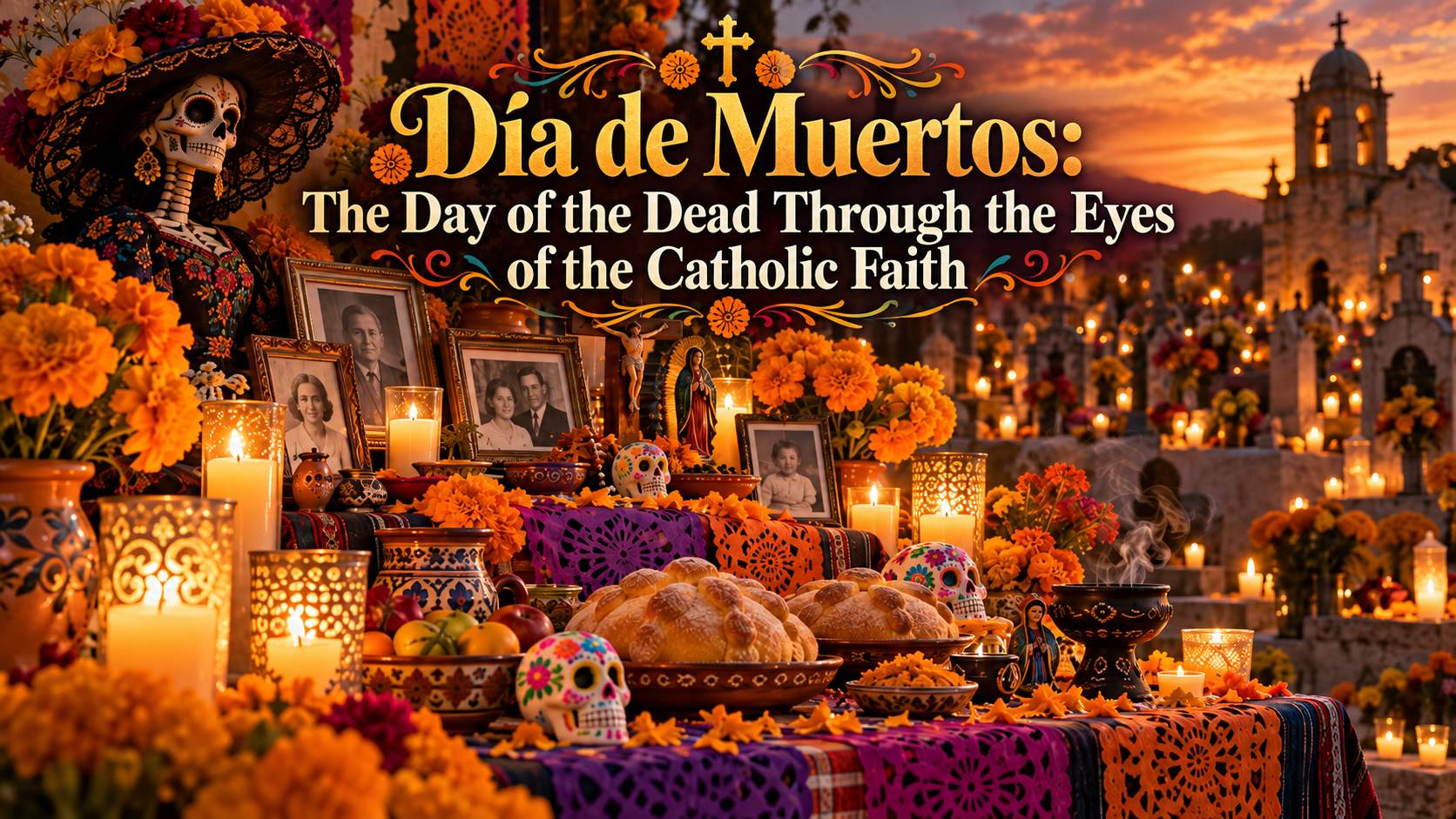
A Comprehensive Historical, Cultural, and Catholic Theological Examination of Death, Remembrance, the Communion of Saints, and the Hope of Eternal Life
Introduction: Remembering the Dead in the Light of Jesus Christ
Día de Muertos, or the Day of the Dead, is among Mexico’s most cherished cultural traditions. Observed principally on November 1 and 2, it is a time when families remember their deceased loved ones through prayer, flowers, candles, traditional foods, cemetery visits, and gatherings that unite generations.
For Catholics, however, the remembrance of the dead possesses a meaning far greater than nostalgia, cultural identity, or the preservation of family memories. It directs our hearts toward one of the central mysteries of the Christian faith: Jesus Christ has conquered death through His Passion, Death, and Resurrection, opening the gates of eternal life to those who belong to Him.
Our Lord declares:
“I am the resurrection and the life: he that believeth in me, although he be dead, shall live.”
— John 11:25, Douay-Rheims
These words establish the proper foundation for a Catholic understanding of Día de Muertos.
The Christian does not merely remember the dead as persons who have disappeared from earthly life. He prays for them, entrusts them to the infinite mercy of God, and hopes for the resurrection of the body and the life everlasting.
The Catholic Church teaches that the bonds of charity among the members of Christ’s Mystical Body are not destroyed by death. Through the Communion of Saints, the faithful on earth remain spiritually united with those undergoing purification and those already enjoying eternal happiness in heaven.
As the Catechism of the Catholic Church explains:
“From the very earliest days of the Christian religion, [the Church] has honored with great respect the memory of the dead.”
— Catechism of the Catholic Church, § 958
This belief gives Catholic remembrance its distinctly supernatural meaning.
Día de Muertos also reflects Mexico’s rich and complex history. Its development involved the encounter between Indigenous Mesoamerican societies and the Catholic faith introduced during the Spanish colonial period.
Across the centuries, Indigenous artistic expressions, traditional foods, local customs, and family practices became associated with the Catholic celebrations of All Saints’ Day and All Souls’ Day.
The resulting observance is culturally diverse. Some families emphasize prayer, Holy Mass, and cemetery visits. Others emphasize cultural remembrance, community festivities, and traditional offerings. Still others retain beliefs derived from non-Christian spiritual traditions.
An essential distinction must therefore be maintained: Día de Muertos is a cultural tradition, whereas All Saints’ Day and All Souls’ Day are Catholic liturgical observances established by the Church.
The two can be celebrated together, but they are not identical.
The Catholic Church does not require participation in Día de Muertos, nor does she endorse every belief or custom associated with it.
Nevertheless, Catholics may preserve and appreciate the celebration’s legitimate cultural traditions when these are understood in harmony with the Gospel.
Properly observed, Día de Muertos can become an occasion for family unity, gratitude, repentance, spiritual charity, and prayer for the faithful departed.
Its deepest Christian significance is not the supposed temporary return of deceased ancestors to their homes, but the hope that, through the mercy of God, the faithful departed may attain eternal life in Jesus Christ.
1. Historical Origins: Indigenous Traditions and the Catholic Calendar
Death and the afterlife in pre-Hispanic Mesoamerica
Long before the arrival of the Spanish in Mexico in AD 1519, Indigenous civilizations possessed elaborate religious beliefs concerning death, burial, ancestors, and the afterlife.
The Mexica, commonly known as the Aztecs, together with the Maya, Zapotec, Mixtec, Purépecha, and numerous other Indigenous peoples, developed distinctive ceremonies for honoring their dead.
Their practices could include burial offerings, incense, ritual meals, religious invocations, flowers, and objects associated with the deceased.
These customs reflected the belief that death did not simply erase the person’s significance within the family or community.
Among the ancient Mexica, the destiny of the dead was often understood in relation to the circumstances of their deaths.
Traditional Nahua accounts describe several destinations associated with the deceased:
- Mictlan: An underworld associated with many who died ordinary deaths.
- Tlalocan: A realm associated with the rain deity Tlaloc and particular forms of death involving water.
- The realm associated with the Sun: Connected with certain warriors and others whose deaths were understood to possess a special religious significance.
- Chichihualcuauhco: A place described in Nahua traditions in connection with infants who had died.
These beliefs formed part of religious systems substantially different from Christianity.
They must not be confused with Catholic doctrine concerning particular judgment, heaven, purgatory, hell, or the resurrection of the body.
Catholicism teaches that human beings are created by God, possess immortal spiritual souls, and are called to eternal communion with Him through Jesus Christ.
Their final destiny is not determined by the manner in which they physically die but by their relationship with God, His grace, and His judgment.
See Catechism of the Catholic Church, §§ 1021–1050.
Did Día de Muertos originate with the Aztecs?
The answer requires historical precision.
Ancient Mesoamerican peoples certainly possessed traditions of remembering the dead. Their religious and funerary customs contributed to the cultural environment from which modern Mexican observances developed.
However, it would be inaccurate to describe the present celebration of November 1 and 2 as an unchanged continuation of a single ancient Aztec festival.
Those calendar dates come from Catholic Christianity.
The observance of All Saints’ Day and the Commemoration of All the Faithful Departed had developed in Christian Europe centuries before Spanish missionaries reached Mexico.
Historical scholars have offered different interpretations of how Indigenous and European customs interacted.
Some emphasize the survival and adaptation of Indigenous traditions.
Others, including historian Elsa Malvido and archaeologist Víctor Joel Santos Ramírez, emphasize the medieval Catholic origins of the November commemorations and the importance of later colonial and national developments.
These interpretations challenge the popular assumption that modern Día de Muertos is simply a pre-Hispanic ceremony given a Catholic name.
The historical evidence supports a more complicated development involving Catholic observances, Indigenous customs, regional traditions, and subsequent cultural transformations.
From a Catholic perspective, historical honesty is important.
We need not deny the Indigenous contributions to Mexican culture. Neither should we overlook the unmistakable Catholic foundations of the November commemorations.
The Catholic feast days provided the liturgical setting, while Mexican communities developed distinctive cultural expressions of remembrance around them.
Historical references: Víctor Joel Santos Ramírez, El origen del Día de Muertos, Instituto Nacional de Antropología e Historia; Elsa Malvido’s historical studies concerning death and commemorative traditions in Mexico.
2. The Catholic Foundations: All Saints’ Day and All Souls’ Day
To appreciate the Christian significance of Día de Muertos, we must first understand the sacred observances celebrated by the Catholic Church.
These are not festivals centered on death itself.
They are celebrations of the holiness of God, the victory of Jesus Christ, the Communion of Saints, and the hope of eternal life.
October 31: The Eve of All Saints
October 31 is the eve of the Solemnity of All Saints.
The English expression All Hallows’ Eve, from which the word Halloween developed, refers to the evening before All Saints’ Day.
Within Catholic tradition, the approach of a great solemnity provides an opportunity to prepare spiritually for its celebration.
The Church invites the faithful to contemplate holiness, conversion, and eternal life.
In Mexico, some families begin arranging their memorial displays during the final days of October.
These preparations may be culturally meaningful, but they are distinct from the Church’s official liturgical celebration.
A Catholic family may use this time to examine its conscience, pray for deceased relatives, and prepare to participate in Holy Mass.
November 1: The Solemnity of All Saints
All Saints’ Day celebrates the glory of God revealed in all those who have attained heaven.
This includes the Blessed Virgin Mary, the Apostles, the martyrs, the canonized saints, and innumerable faithful souls whose holiness is known to God alone.
The saints are not merely historical figures whom Christians admire.
They are living members of the Church triumphant, united eternally with the Most Holy Trinity.
Sacred Scripture describes the heavenly multitude:
“After this I saw a great multitude, which no man could number, of all nations, and tribes, and peoples, and tongues, standing before the throne, and in sight of the Lamb.”
— Apocalypse 7:9, Douay-Rheims
All Saints’ Day reminds Catholics that heaven is the final fulfillment of the human vocation.
We were created not simply to live for a few decades on earth, but to know, love, and serve God and to enjoy eternal happiness with Him.
The saints demonstrate what God’s grace can accomplish in human lives.
For this reason, Catholics honor the saints and ask for their intercession, while worship and adoration belong to God alone.
See Catechism of the Catholic Church, §§ 956–957 and 1023–1029.
The remembrance of deceased children
In many Mexican communities, November 1 is also associated with the remembrance of deceased children, affectionately called angelitos, meaning “little angels.”
This expression conveys parental tenderness and love.
Nevertheless, Catholic theology makes an important distinction.
Human beings do not become angels after death.
Angels are purely spiritual creatures, while human beings are creatures composed of body and spiritual soul.
Those who die in Christ remain human persons and await the resurrection of the body.
The Church also entrusts children who die without Baptism to God’s mercy, with hope in His saving love.
See Catechism of the Catholic Church, §§ 328–330, 362–366, and 1261.
Thus, the remembrance of deceased children can be a beautiful occasion for Catholic families to pray, express their grief, and commend these little ones to the merciful Heart of Jesus.
November 2: The Commemoration of All the Faithful Departed
November 2 is especially important to a Catholic understanding of Día de Muertos.
On this day, the Church commemorates the faithful departed and offers prayers for their eternal rest.
The observance became particularly associated with St. Odilo, Abbot of Cluny, who established a commemoration of the faithful departed in the monasteries of his congregation around AD 998.
The practice spread throughout the Western Church.
Its theological meaning rests upon the ancient Christian practice of praying for those who have died.
Sacred Scripture teaches:
“It is therefore a holy and wholesome thought to pray for the dead, that they may be loosed from sins.”
— 2 Machabees 12:46, Douay-Rheims
This passage is a fundamental biblical witness to prayer for the dead.
The Church teaches that those who die in God’s grace and friendship, but who still require purification, undergo the final purification called purgatory.
Purgatory is not a second chance after death, nor is it a permanent destination separate from heaven.
It is the purification of those already assured of salvation.
See Catechism of the Catholic Church, §§ 1030–1032.
For this reason, Catholics offer prayers, works of charity, penance, and especially the Holy Sacrifice of the Mass for the faithful departed.
The Mass is the greatest prayer the Church can offer on their behalf because it makes sacramentally present the one sacrifice of Jesus Christ.
Flowers commemorate the deceased. Photographs preserve their memory. But Holy Mass and prayer offer spiritual assistance through the mercy of God.
This is the central Catholic distinction.
3. The Arrival of Catholic Christianity in Mexico
During the 16th century, Spanish missionaries brought the Catholic faith to the peoples of Mexico.
Franciscans, Dominicans, Augustinians, and other missionaries proclaimed the Gospel, administered the sacraments, taught Christian doctrine, and established churches and religious communities.
They introduced Catholic teachings concerning creation, sin, redemption, divine judgment, purgatory, heaven, hell, and the resurrection of the dead.
They also introduced the Church’s liturgical calendar, including the celebrations of November 1 and 2.
The encounter between Indigenous peoples and Spanish colonial society involved both genuine missionary efforts and painful historical realities.
Colonization also brought violence, coercion, cultural suppression, disease, and profound social disruption.
These realities must not be ignored or justified.
At the same time, Indigenous Christians contributed actively to the development of Mexican Catholic life.
They employed their languages, music, art, flowers, and local customs in forms of religious expression that developed across generations.
The Franciscan missionary Toribio de Benavente, known as Motolinía, described Indigenous Christians bringing offerings that included maize, cacao, food, and candles in connection with commemorations of the dead during the early colonial period.
Such accounts illustrate how local cultural practices became associated with Catholic observances.
Inculturation and the Catholic faith
The Church recognizes that the Gospel may be expressed through the legitimate traditions of different peoples.
This process is commonly called inculturation.
The purpose of inculturation is not to alter divine revelation or combine incompatible religions into a new faith.
Rather, it permits the authentic values of a culture to be illuminated, purified, and elevated by the Gospel.
The Second Vatican Council taught that the Church does not destroy what is good in the traditions of peoples, but seeks to order these things toward God.
See Ad Gentes, § 22, and Gaudium et Spes, § 58.
In the context of Día de Muertos, this means that Mexican Catholics may preserve flowers, foods, music, artistic expressions, and family customs without adopting beliefs contrary to Christianity.
A cultural practice does not become sinful merely because it has historical associations with a non-Christian society.
Its present meaning, intention, and religious significance must be considered.
Nevertheless, when a custom involves divination, spiritism, idolatry, or superstition, it cannot be incorporated into authentic Catholic devotion.
The Gospel must remain the measure by which every religious practice is judged.
4. The Ofrenda: A Memorial of Love and an Opportunity for Prayer
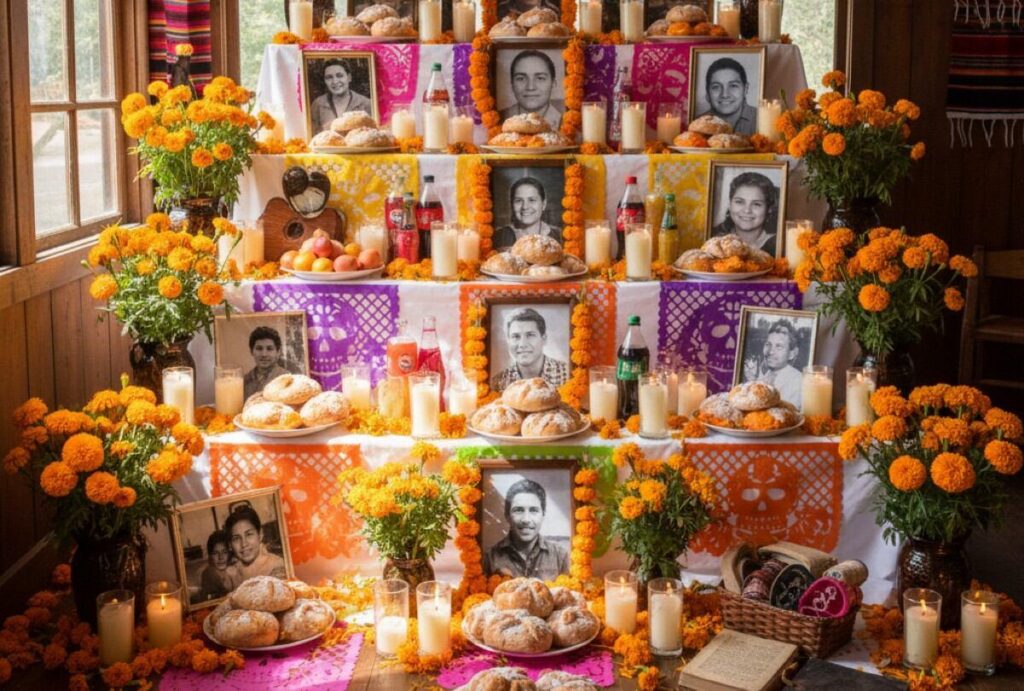
Perhaps the best-known feature of Día de Muertos is the ofrenda.
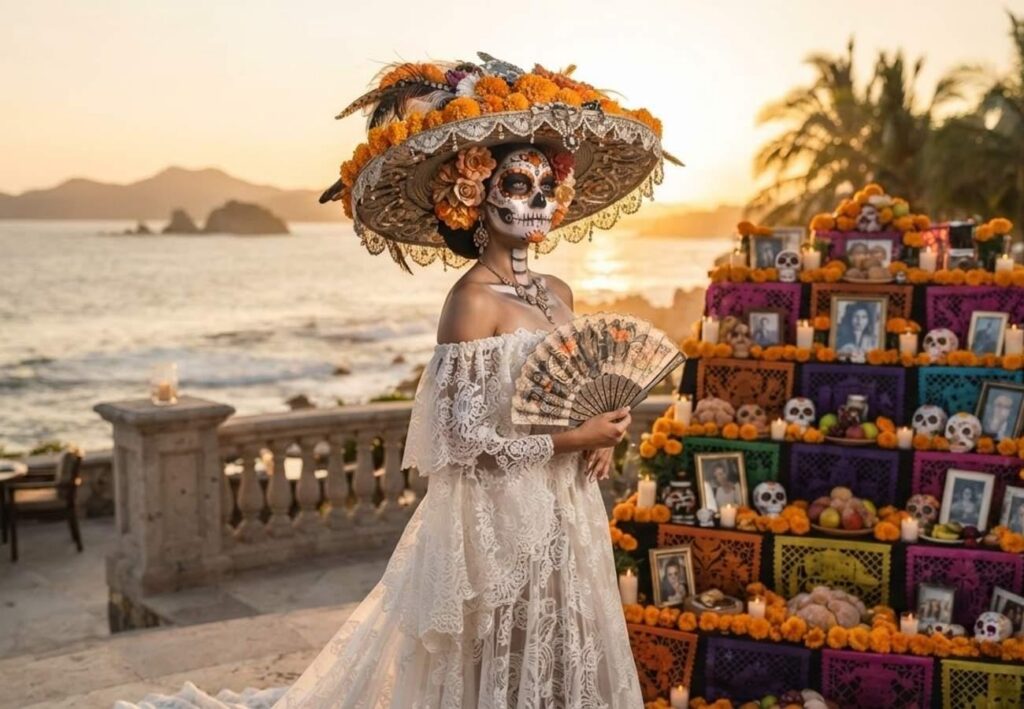
An ofrenda is a traditional memorial arrangement, often placed in the family home, that commemorates deceased relatives and friends.
It may contain photographs, candles, flowers, foods, religious images, and objects associated with those who have died.
Although the Spanish word ofrenda means “offering,” its significance varies among communities.
For some families, the arrangement is principally a cultural memorial.
For others, it expresses the traditional belief that deceased relatives temporarily return to visit the living.
For Catholic families, it can be understood as a place of remembrance and prayer, provided its religious meaning remains faithful to Christian doctrine.
Traditional symbols and their Catholic interpretation
| Element | Traditional significance | Catholic understanding |
|---|---|---|
| Photographs | Remember deceased relatives | Encourage gratitude and prayer for them |
| Cempasúchil flowers | Traditionally believed to guide returning souls | Express beauty, affection, and the fragility of earthly life |
| Candles | Light and guidance | Recall Christ, the Light of the World |
| Pan de muerto | Traditional bread associated with remembrance | Encourages family unity and gratitude |
| Water | Traditionally offered as refreshment for visiting souls | May serve as a cultural symbol; souls do not require earthly water |
| Favorite foods | Hospitality and family remembrance | Recall shared meals and personal memories |
| Papel picado | Festivity, movement, and the fragility of life | Can remind us that earthly life is passing |
| Sugar skulls | Mortality, humor, and cultural identity | May serve as reminders of death and the need for conversion |
| Incense or copal | Fragrance and traditional ritual purification | May recall prayer, without attributing magical powers to the substance |
| Crucifix | Christ’s Passion and Death | Directs the family toward redemption through Jesus Christ |
| Sacred images | Religious devotion | Encourage prayer and confidence in God’s mercy |
These are common interpretations rather than universal rules.
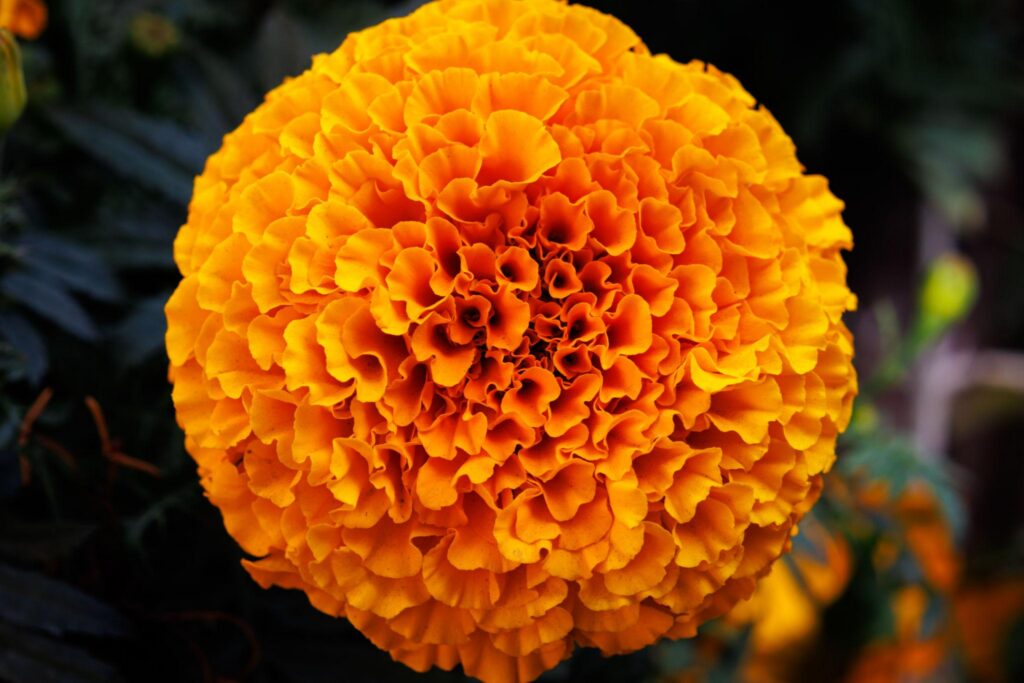
The cempasúchil flower
The brilliant orange cempasúchil, often called the Mexican marigold, has become one of the most recognizable symbols of Día de Muertos.
Traditional beliefs associate its vivid color and fragrance with guiding deceased souls toward their families.
Petals are sometimes arranged in pathways leading to the memorial display.
A Catholic may appreciate the flower’s natural beauty without believing that it possesses spiritual powers.
Flowers also hold a respected place in Catholic funerary customs.
They express tenderness, honor the dead, and remind us of the passing nature of earthly life.
As Sacred Scripture teaches:
“For all flesh is as grass, and all the glory thereof as the flower of grass. The grass is withered, and the flower thereof is fallen away.”
— 1 Peter 1:24, Douay-Rheims
Pan de muerto
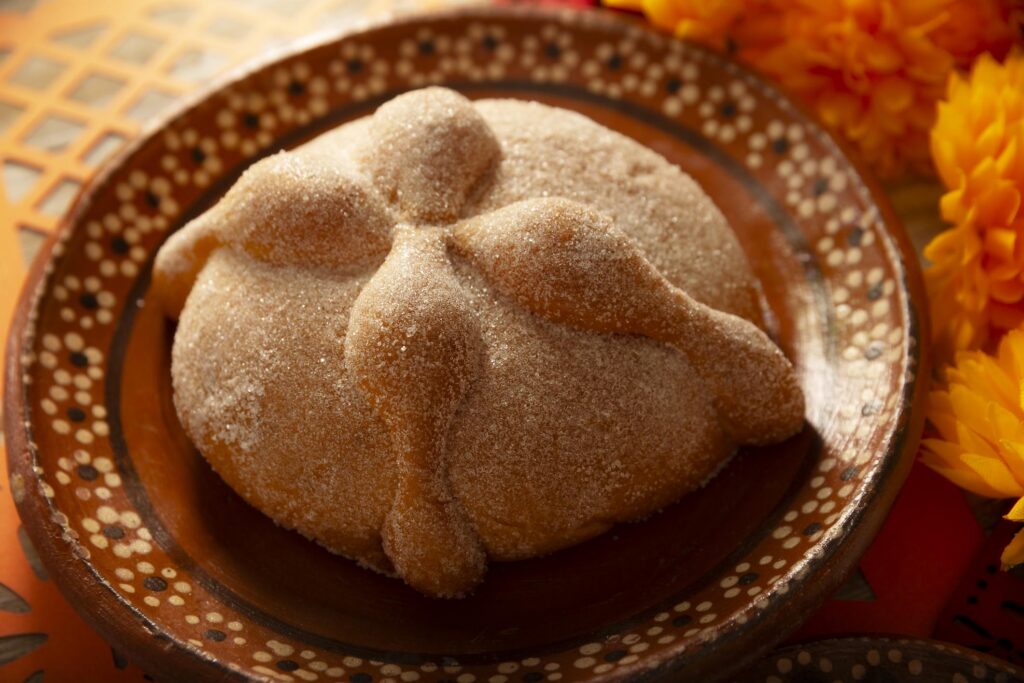
Pan de muerto, or bread of the dead, is another cherished tradition.
Many versions are round and decorated with dough shaped like bones, though forms and recipes differ among Mexican regions.
Families prepare and share this bread while remembering their deceased loved ones.
There is nothing inherently contrary to Catholic teaching in such a custom.
Sharing traditional food can strengthen family relationships and preserve memories across generations.
However, the bread should not be confused with the Holy Eucharist.
The Eucharist is the true Body, Blood, Soul, and Divinity of Jesus Christ, made present through the consecration at Holy Mass.
Traditional memorial bread has cultural significance, not sacramental power.
See Catechism of the Catholic Church, §§ 1373–1381.
What makes an ofrenda Catholic?
A distinctly Catholic memorial display should direct the hearts of the living toward God.
A crucifix may occupy a central place, reminding the family that salvation comes through Christ’s sacrifice.
An image of the Blessed Virgin Mary may recall her maternal intercession.
A candle can signify the light of faith.
Photographs may remind relatives to pray by name for those who have died.
The family may gather before the display to pray the Rosary, recite Psalm 129 (130), De Profundis, or offer the traditional prayer for eternal rest.
The distinction is essential:
A Catholic does not prepare an ofrenda to feed, summon, control, or spiritually satisfy deceased relatives. Rather, the display may serve as a visible reminder to entrust them to God.
A beautiful memorial can support Christian devotion, but it can never replace Holy Mass, the sacraments, or prayer.
5. Skulls, Skeletons, and the Christian Reminder of Death
Día de Muertos is famous for its colorful skulls, skeletons, and artistic portrayals of death.
Although these images may appear unusual to those unfamiliar with Mexican culture, reflecting upon mortality has a long history within Christianity.
Memento mori: Remember that you must die
The Latin expression memento mori means “remember that you must die.”
Christian spiritual writers and saints have often encouraged meditation upon death as a means of developing humility, repentance, and detachment from worldly vanities.
The purpose is not to glorify death.
Rather, it is to recognize the brevity of earthly life and prepare for eternity.
Sacred Scripture advises:
“In all thy works remember thy last end, and thou shalt never sin.”
— Ecclesiasticus 7:40, Douay-Rheims
This reflection is particularly important in a culture that frequently avoids speaking about death.
The Christian knows that wealth, status, physical beauty, and worldly accomplishments cannot prevent the end of earthly life.
Every person must eventually stand before God.
Christian art has therefore sometimes depicted skulls beside saints, penitents, and monks.
Such images symbolize the passing nature of earthly existence and the urgency of conversion.
A skull can be understood as a reminder that our time on earth is limited.
It must never become an object of worship.
La Catrina: A Mexican cultural symbol
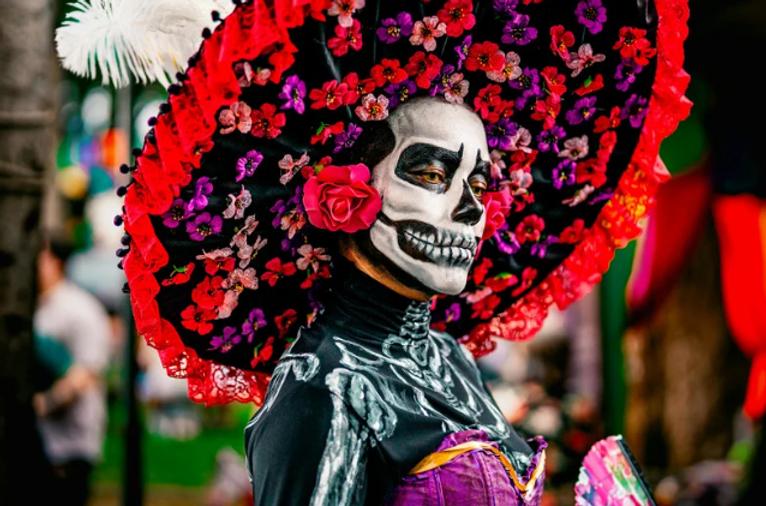
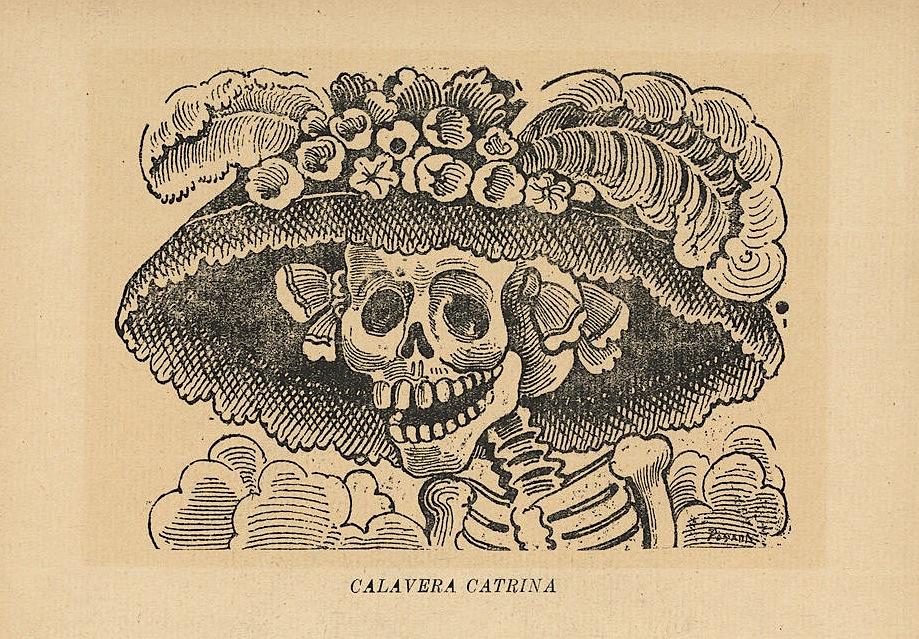
One of the most recognizable figures associated with Día de Muertos is La Catrina.
Her origins lie in the work of Mexican printmaker José Guadalupe Posada (AD 1852–1913).
Posada created La Calavera Garbancera, a satirical portrayal of a skeletal woman wearing an elaborate European-style hat.
The image criticized vanity, pretension, and the desire to imitate upper-class European fashions.
In AD 1947, Diego Rivera incorporated the figure into his mural Dream of a Sunday Afternoon in the Alameda Central.
Over time, La Catrina became a prominent symbol of Mexican cultural identity.
She now appears in artistic displays, costumes, paintings, public celebrations, and commercial imagery.
From a Catholic perspective, La Catrina is neither a saint nor a religious figure possessing supernatural authority.
She is a cultural and artistic creation.
Her use should be distinguished from Catholic devotion.
When interpreted as an artistic reminder that every earthly life eventually ends, skeletal imagery can encourage reflection upon mortality.
However, Catholics must avoid any practice that treats death itself as a deity, a spiritual power to be invoked, or an object of religious worship.
For Christians, death is not our savior. Jesus Christ is our Savior, and He has conquered death.
6. Regional Celebrations: Mexico’s Rich Catholic and Cultural Heritage
Día de Muertos is not observed identically throughout Mexico.
Its customs reflect the country’s diversity of peoples, languages, artistic traditions, and local histories.
This variety is important because no single regional practice should be presented as universally representative.
Michoacán: Noche de Ánimas
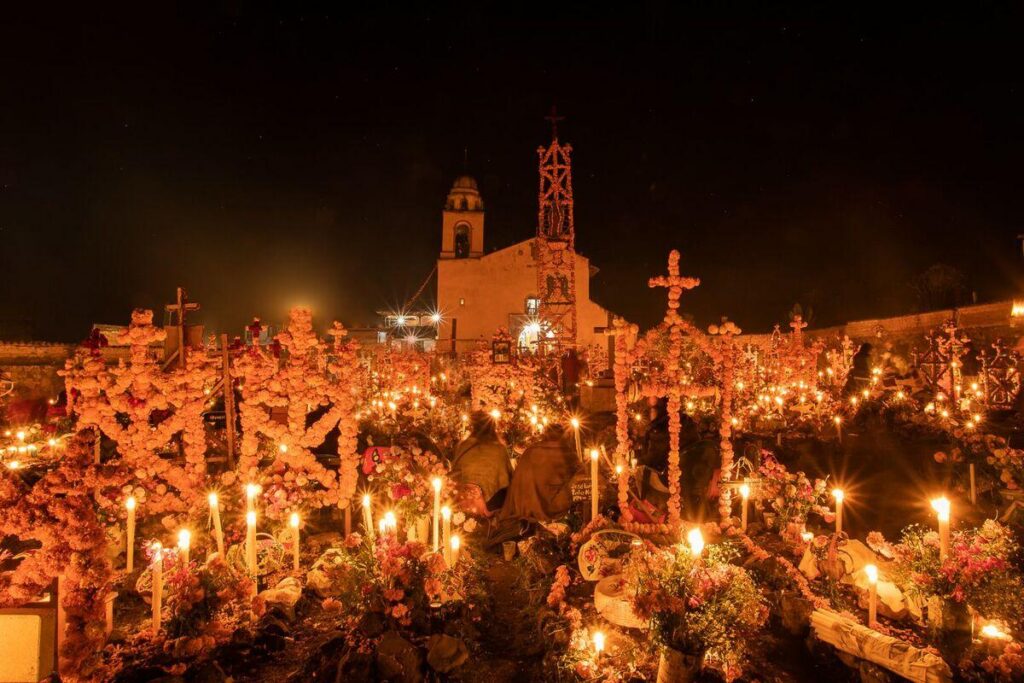
In the region surrounding Lake Pátzcuaro, especially among Purépecha communities, remembrance of the dead is closely associated with cemetery vigils and family gatherings.
Families decorate graves with candles and flowers, prepare traditional foods, and sometimes spend much of the night beside the resting places of deceased relatives.
The observance is often known as Noche de Ánimas, or the Night of Souls.
Within Catholic families, this occasion can become an expression of prayerful solidarity with the departed.
The candles symbolize hope, while the cemetery provides a setting for remembrance and intercession.
What matters most is not the number of candles or flowers placed upon a grave, but the prayers offered with faith and charity.
Oaxaca: Altars, cemeteries, and family remembrance
Oaxaca possesses a particularly rich variety of observances.
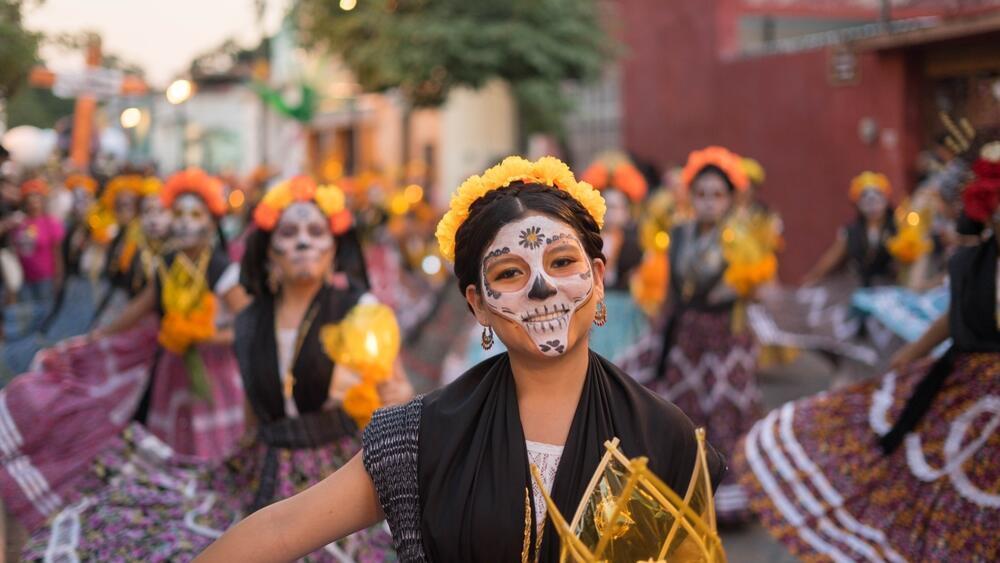
These may include decorated family altars, cemetery visits, traditional foods, music, flowers, and community processions.
Some communities organize comparsas, in which participants perform in costumes accompanied by music.
Zapotec and other Indigenous communities preserve distinctive local traditions.
Catholic families may participate in these festivities while centering their religious observance upon prayer, the Mass, and the hope of resurrection.
The joy of family gatherings need not contradict the solemnity of death.
Christian hope permits gratitude and even laughter amid genuine mourning.
The Huasteca: Xantolo
In the Huasteca region, Día de Muertos is commonly associated with the celebration known as Xantolo.
Among Nahua, Teenek, and other communities, the observance may include ceremonial arches, traditional dances, music, foods, flowers, and cemetery visits.
The celebration is closely connected with local identity and ancestral memory.
For Catholics, its cultural elements must be distinguished from any religious belief that attributes supernatural authority to ancestral spirits or treats ritual performances as a means of controlling them.
Authentic Christian devotion remains directed toward God.
Yucatán: Hanal Pixán
Among Yucatec Maya communities, the celebration is known as Hanal Pixán, commonly translated as “food of the souls.”
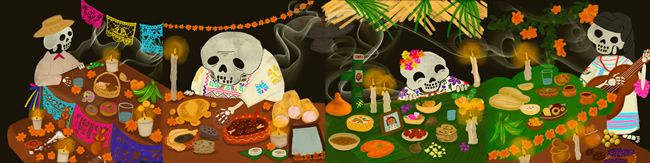
It emphasizes family remembrance and traditional meals, including regional dishes and specially prepared tamales.
Many families also incorporate Catholic prayers, Holy Mass, and visits to cemeteries.
As elsewhere, the presence of food in a memorial display does not by itself establish that a family believes deceased souls literally consume it.
For Catholic participants, its appropriate meaning is that of cultural remembrance and family affection.
Unity in faith amid cultural diversity
The Catholic Church is universal.
Her members belong to many nations and cultures, yet profess the same faith in Jesus Christ.
Mexican Catholic traditions may therefore possess distinctive artistic and cultural forms without altering the essential doctrines of Christianity.
The Church’s unity comes from Christ, not from uniformity in cultural expression.
See Second Vatican Council, Lumen Gentium, § 13.
7. The Communion of Saints: The True Spiritual Bond Between the Living and the Dead
One of the most beautiful doctrines of Catholic Christianity is the Communion of Saints.
It reveals that the Church is not merely an earthly institution composed of those presently living.
The Church is the Mystical Body of Jesus Christ.
The faithful who belong to Him remain united through His grace.
Catholic tradition distinguishes three conditions of the one Church.
The Church Militant
This refers to the faithful still living on earth, who struggle against sin, seek holiness, and persevere in the spiritual life.
They pray, receive the sacraments, perform works of charity, and strive for eternal salvation.
The Church Suffering
This traditional expression refers to the souls in purgatory.
These souls have died in God’s friendship and are assured of eternal salvation, but still require purification before entering the fullness of heavenly glory.
They are assisted by the prayers and suffrages of the faithful on earth.
The Church Triumphant
This refers to the saints in heaven.
They enjoy the Beatific Vision, seeing God face to face, and intercede for the faithful who remain on earth.
These three conditions are not three separate Churches.
They belong to the one Communion of Saints in Jesus Christ.
See Catechism of the Catholic Church, §§ 954–962; Second Vatican Council, Lumen Gentium, §§ 49–51.
Why do Catholics pray for the dead?
The Catholic Church has always regarded prayer for the faithful departed as an act of charity.
St. John Chrysostom encouraged Christians not to hesitate to assist those who had died through prayers offered on their behalf.
His teaching is cited in the Catechism of the Catholic Church, § 1032.
The reason is profoundly Christian.
If we love our relatives and friends while they are alive, we should not cease loving them after death.
We can no longer provide them with ordinary earthly assistance, but we can entrust them to the mercy of God.
Catholics therefore pray that those undergoing purification may enter the fullness of heavenly joy.
Spiritual communion is not communication with spirits
Here an important distinction must be made.
The Communion of Saints does not mean that deceased relatives must return to earth during a particular festival.
Nor does it require candles, flowers, food, or ritual objects to establish spiritual contact.
The bond of the faithful exists through Christ.
It does not depend upon attempts to summon the dead.
Catholics may ask the saints in heaven to intercede for them because the saints are alive in Christ.
That is fundamentally different from attempting to invoke unknown spirits, conduct séances, or obtain hidden knowledge from the deceased.
Christian communion with the saints is a gift of divine grace, not a form of spiritism.
This distinction safeguards both Catholic doctrine and the dignity of the dead.
8. Is Día de Muertos Compatible with Catholicism?
The answer is yes, provided it is celebrated in a manner consistent with Catholic faith and morals.
Día de Muertos is not inherently a single religious ceremony with one obligatory set of beliefs.
It includes cultural, familial, artistic, and religious practices that vary widely.
Some are entirely compatible with Catholicism.
Others require clarification or rejection.
Practices Catholics may embrace
Catholics may honor deceased relatives through respectful cultural customs, including:
- Visiting and decorating graves with flowers.
- Displaying photographs and treasured family memories.
- Preparing and sharing traditional foods.
- Lighting candles as expressions of prayer and remembrance.
- Gathering to tell stories about deceased loved ones.
- Teaching children about their ancestors and family history.
- Praying the Holy Rosary for the departed.
- Requesting Holy Masses for deceased relatives.
- Giving alms and performing works of mercy in their memory.
- Praying for the forgotten souls who have no one to pray for them.
These practices can express family affection and Christian charity.
The Church’s Directory on Popular Piety and the Liturgy, §§ 248–260, specifically discusses Christian remembrance of the dead and recognizes such expressions of popular devotion.
The Church particularly encourages the Holy Eucharist, prayer, and works of charity on behalf of the faithful departed.
Practices Catholics must reject
Certain practices are incompatible with Catholic doctrine, including:
- Attempting to summon deceased relatives or spirits.
- Conducting séances or using mediums to communicate with the dead.
- Practicing divination to receive messages from the deceased.
- Treating ancestors as deities or independent sources of supernatural power.
- Believing that particular offerings can compel spirits to perform favors.
- Believing that failing to provide food, flowers, or other objects will cause deceased relatives to punish the living.
- Participating in occult rituals or magical practices.
- Treating death itself as a supernatural being worthy of worship.
The Catechism teaches:
“All forms of divination are to be rejected.”
— Catechism of the Catholic Church, § 2116
The same paragraph explicitly rejects conjuring the dead and recourse to mediums.
The Church also condemns magical practices that seek to control supernatural powers.
See Catechism of the Catholic Church, §§ 2115–2117.
These prohibitions are not a rejection of Mexican culture.
They arise from the First Commandment and the obligation to worship God alone.
Must Catholics reject every traditional ofrenda?
No.
The moral meaning of a practice depends upon its actual nature, intention, and circumstances.
A Catholic who places flowers and a photograph beside a crucifix in memory of a deceased grandmother is not thereby practicing spiritism.
Likewise, preparing a relative’s favorite meal in affectionate remembrance does not constitute worship of the dead.
However, if the practice is undertaken with the belief that spirits must be summoned, fed, appeased, or controlled, it presents a different religious meaning.
The distinction must be made carefully and without unfairly accusing families of superstition merely because they preserve traditional customs.
A Catholic may cherish Mexican heritage while remaining completely faithful to the teachings of the Church.
The principle is simple: Honor the dead, pray for their souls, and worship God alone.
9. Día de Muertos and Halloween: Understanding the Difference
Día de Muertos and Halloween are often confused because they occur close together and sometimes share images of skulls, skeletons, and death.
However, their histories and traditional purposes differ.
Halloween is observed on October 31.
Its development involved the Christian observance of All Hallows’ Eve, European folk traditions, and later secular customs.
Modern Halloween frequently emphasizes costumes, entertainment, frightening imagery, and trick-or-treating.
Día de Muertos, by contrast, is primarily associated with November 1 and 2.
It developed in Mexico around the Church’s commemorations of All Saints and All Souls, together with regional customs and traditions of family remembrance.
The typical emphasis is upon deceased relatives, cemeteries, flowers, memorial displays, and family gatherings.
For Catholics, the proper focus during these days is not entertainment centered upon death, but prayerful remembrance and the hope of eternal life.
This does not mean that every costume, decorative skull, or festive gathering is sinful.
Rather, Catholics should exercise prudence and avoid anything that glorifies evil, trivializes the sacred, promotes occult practices, or contradicts Christian faith.
The Church’s liturgical celebrations remain distinct from the popular customs surrounding them.
10. Día de Muertos and Mexican National Identity
During the 19th and 20th centuries, Día de Muertos became increasingly important as an expression of Mexican cultural identity.
Mexico’s independence, social reforms, changes in cemetery practices, urbanization, and the development of modern national culture all influenced its evolution.
Following the Mexican Revolution, artists, intellectuals, and cultural organizations placed greater emphasis upon Indigenous heritage and popular traditions.
Images of skeletons, skulls, flowers, and traditional memorial displays became prominent symbols of Mexican identity.
Artists such as José Guadalupe Posada and Diego Rivera contributed to this visual tradition.
The historian Elsa Malvido examined how the modern presentation of Día de Muertos was shaped by historical circumstances, including postrevolutionary interpretations that sometimes emphasized national identity over Catholic devotion.
International recognition
In AD 2003, UNESCO proclaimed the Indigenous festivity dedicated to the dead a Masterpiece of the Oral and Intangible Heritage of Humanity.
In AD 2008, it was inscribed on the Representative List of the Intangible Cultural Heritage of Humanity.
This recognition acknowledged the cultural significance of Indigenous Mexican traditions of remembrance.
It did not constitute a theological judgment by the Catholic Church concerning every practice associated with the celebration.
Modern festivals and commercialization
The celebration has also become increasingly visible in films, tourism, public processions, fashion, and international cultural events.
Mexico City’s large annual Día de Muertos parade began in AD 2016, following the fictional parade portrayed in the opening sequence of the AD 2015 film Spectre.
This illustrates how modern entertainment can influence the public presentation of older cultural traditions.
The celebration’s growing popularity has created opportunities for cultural education and artistic expression.
At the same time, commercialization can obscure its religious and familial meaning.
The Church warns against exploiting death and the emotions of grieving families for commercial profit.
See Directory on Popular Piety and the Liturgy, § 259.
For Catholic families, a magnificent public display is far less important than sincere prayer, Christian charity, and faithful remembrance.
A humble candle offered with prayer may express more genuine devotion than an elaborate celebration emptied of spiritual meaning.
11. The Catholic Theology of Death, Judgment, Purgatory, Heaven, and Resurrection
To understand death from a Catholic perspective, we must look beyond cultural customs to the truths revealed by God.
The Church traditionally speaks of the Four Last Things:
Death, Judgment, Heaven, and Hell.
These truths remind Catholics that earthly life is a preparation for eternity.
Death: The end of our earthly pilgrimage
Death brings earthly life to its conclusion.
Catholic doctrine teaches that death entered human history in connection with sin.
Sacred Scripture declares:
“For the wages of sin is death. But the grace of God, life everlasting, in Christ Jesus our Lord.”
— Romans 6:23, Douay-Rheims
Death is not a good to be worshipped or an independent spiritual power.
It is an enemy that Jesus Christ has conquered.
The Christian response to death is therefore neither fascination with darkness nor hopeless despair.
It is repentance, faith, charity, and preparation for eternal life.
See Catechism of the Catholic Church, §§ 1005–1014.
Particular judgment: Our encounter with divine justice and mercy
Immediately after death, each human soul receives particular judgment.
God judges every person with perfect justice, mercy, and truth.
The soul receives its eternal recompense according to its faith and works, in relation to Christ and His grace.
See Catechism of the Catholic Church, §§ 1021–1022.
This teaching reminds us that earthly decisions have eternal significance.
Our final destiny is not determined by how often our descendants remember us or how elaborate our funerary customs may be.
It depends upon the saving grace of God and our response to Him.
Heaven: Eternal union with the Most Holy Trinity
Heaven is the ultimate goal of Christian life.
It is the state of perfect communion with God, the Blessed Virgin Mary, the angels, and all the saints.
Those who enter heaven experience the Beatific Vision: the direct vision of God as He is.
There is no suffering, death, separation, or sin.
See Catechism of the Catholic Church, §§ 1023–1029.
Purgatory: The final purification of the saved
Catholics believe that some souls who die in God’s friendship still require purification.
Purgatory is that final purification.
The souls in purgatory are not condemned.
They are destined for heaven.
Their purification prepares them to enter the perfect holiness of God’s presence.
The Council of Trent solemnly reaffirmed the existence of purgatory and the value of prayers offered for the faithful departed.
See Council of Trent, Session XXV, Decree Concerning Purgatory, AD 1563.
The Church’s practice of praying for the dead therefore reflects a profound act of charity.
When we request a Mass for a deceased relative, pray the Rosary, or offer works of mercy for that person’s intention, we entrust the departed to the merits of Jesus Christ.
Hell: The consequence of definitive separation from God
The Church also teaches the reality of hell.
Hell is the state of definitive self-exclusion from communion with God.
Those who die in mortal sin without repentance and without accepting God’s merciful love remain eternally separated from Him.
See Catechism of the Catholic Church, §§ 1033–1037.
For this reason, Catholics should not presume to know the eternal destiny of every deceased relative.
We may hope in God’s mercy, pray for the departed, and commend them to His judgment.
But Christian hope is not the same as automatically declaring that every deceased person has attained heaven.
The resurrection of the body
Catholic Christianity teaches something even greater than the survival of the immortal soul.
It proclaims the future resurrection of the body.
At the end of history, Christ will raise the dead.
The redeemed will enjoy eternal life in the fullness of their humanity, body and soul, glorified through the power of God.
St. Paul declares:
“Death is swallowed up in victory. O death, where is thy victory? O death, where is thy sting?”
— 1 Corinthians 15:54–55, Douay-Rheims
This is the ultimate triumph Christians await.
We do not hope merely that souls will make periodic visits to their former homes.
We await the glorious return of Jesus Christ, the resurrection of the dead, and the fulfillment of God’s eternal kingdom.
See Catechism of the Catholic Church, §§ 988–1019.
The greatest Christian hope is not a temporary reunion with the dead, but everlasting communion with God and all those saved in Jesus Christ.
12. How a Catholic Family Can Faithfully Celebrate Día de Muertos
A Catholic family can observe Día de Muertos in a beautiful and spiritually fruitful way.
The key is to make Jesus Christ, prayer, and the hope of eternal salvation the center of the observance.
First: Participate in Holy Mass
On November 1, Catholics should celebrate the Solemnity of All Saints, observing the obligation to attend Mass wherever applicable under Church law.
On November 2, participation in Holy Mass for the Commemoration of All the Faithful Departed is especially fitting.
Families may also request Mass intentions for deceased relatives.
The Eucharistic sacrifice is the greatest act of intercession offered by the Church for the faithful departed.
See Catechism of the Catholic Church, § 1032.
Second: Prepare a Christ-centered memorial display
A Catholic family may arrange an ofrenda with photographs, flowers, candles, and traditional foods.
A crucifix can serve as its central Christian symbol.
An image of Our Lady of Guadalupe, particularly meaningful within Mexican Catholic devotion, may also be included.
A Bible and Rosary can remind the family that prayer and God’s promises are more important than the decorative elements.
The display should encourage remembrance of the dead and trust in God’s mercy, not the invocation of spirits.
Third: Visit the cemetery
Families may gather at the graves of deceased relatives to clean and decorate them with flowers.
They can pray the Our Father, Hail Mary, Glory Be, and Eternal Rest prayer.
They may also recite the Rosary or Psalm 129 (130), De Profundis.
Cemetery visits are recognized expressions of Christian remembrance.
See Directory on Popular Piety and the Liturgy, § 260.
Fourth: Pray the Holy Rosary
The Rosary offers a beautiful opportunity to meditate upon the life, Passion, Death, and Resurrection of Jesus Christ.
A family may offer the Rosary for all deceased relatives, especially those who may be undergoing purification.
The Glorious Mysteries are particularly appropriate for reflecting upon Christ’s victory over death and the promise of eternal life.
Fifth: Share family stories and traditions
Children can be taught about their grandparents, great-grandparents, and other deceased relatives.
Families may share photographs, stories, and favorite recipes.
They may recall the virtues of loved ones and express gratitude for the sacrifices made by previous generations.
At the same time, remembrance should be truthful.
Catholics can acknowledge the imperfections and sins of those who have died while praying for God’s mercy upon them.
Sixth: Perform acts of charity
The family might donate food to the poor, support a parish ministry, assist someone grieving, or perform another work of mercy in memory of the deceased.
Such acts reflect the Christian understanding that love must lead to charity.
The Church specifically commends almsgiving and works of penance offered on behalf of the faithful departed.
See Catechism of the Catholic Church, § 1032.
Seventh: Pray for forgotten souls
Not every deceased person has family members who remember to pray for them.
Catholic families can therefore extend their prayers beyond their own relatives.
They may pray for the souls of the faithful departed who are forgotten, those who died alone, and those for whom no one offers prayers.
This widens family remembrance into a work of spiritual charity for the whole Church.
A traditional Catholic prayer for the faithful departed
English
Eternal rest grant unto them, O Lord, and let perpetual light shine upon them.
May the souls of the faithful departed, through the mercy of God, rest in peace.
Amen.
Español
Dales, Señor, el descanso eterno, y brille para ellos la luz perpetua.
Que las almas de todos los fieles difuntos, por la misericordia de Dios, descansen en paz.
Amén.
Latin
Requiem aeternam dona eis, Domine, et lux perpetua luceat eis.
Requiescant in pace.
Amen.
These words express the heart of Catholic remembrance.
We do not seek to summon the dead.
We ask God to grant them eternal rest, purification where necessary, and the everlasting light of His presence.
13. Common Misconceptions About Día de Muertos and Catholicism
Misconception 1: Día de Muertos is simply Mexican Halloween
This is historically incorrect.
Although the observances occur close together, Día de Muertos developed through distinctive Mexican traditions associated with the Catholic commemorations of November 1 and 2.
Its historical emphasis upon family remembrance and prayer differs from much of modern Halloween’s secular entertainment.
Misconception 2: Día de Muertos is entirely an ancient Aztec religious festival
This oversimplifies its history.
Ancient Indigenous customs contributed to the development of Mexican remembrance traditions, but the November dates and their Catholic religious significance come from the Church’s liturgical calendar.
The modern celebration emerged through centuries of historical change.
Misconception 3: Catholics are required to celebrate Día de Muertos
The Church does not require Catholics to observe Día de Muertos as a cultural festival.
She does, however, celebrate All Saints’ Day and All Souls’ Day within her liturgical calendar.
Catholics have the freedom to participate in legitimate cultural customs, provided these are consistent with the faith.
Misconception 4: Every ofrenda constitutes worship of the dead
This is also incorrect.
An ofrenda may be a cultural memorial rather than an act of religious worship.
The intention and meaning of the specific practices must be considered.
Nevertheless, Catholics must reject rituals involving spiritism, idolatry, divination, or superstition.
Misconception 5: Catholicism forbids all skulls and skeletons
Christian tradition has long employed images of mortality to encourage repentance and preparation for eternity.
Such imagery is not automatically sinful.
However, Catholics must distinguish artistic symbolism from occult practices or the worship of death.
Misconception 6: Deceased relatives become angels
This is not Catholic doctrine.
Angels and human beings are distinct creatures.
Human persons retain their identity after death and await the resurrection of the body.
Misconception 7: Every deceased relative is automatically in heaven
The Church does not teach that every person enters heaven immediately after death.
The reality of particular judgment and purgatory explains why Catholics pray for the departed.
We entrust those we love to God’s mercy without presuming to know what belongs to His judgment.
Misconception 8: The dead literally need food, water, or candles
Catholic doctrine does not teach that separated souls require material nourishment.
Food, water, candles, and flowers may possess cultural or devotional significance, but they do not sustain the souls of the departed.
The greatest assistance Catholics can offer the faithful departed is spiritual: especially the Holy Sacrifice of the Mass, prayer, and works of charity.
Misconception 9: Celebrating the dead means Christians should not mourn
Catholicism does not forbid sorrow over the death of loved ones.
Jesus Himself wept at the tomb of Lazarus.
See John 11:35.
Grief is a natural expression of love.
Christian hope does not eliminate sadness; it places sadness within the promise of eternal life.
Families may therefore share laughter, tears, stories, and prayers during Día de Muertos without contradicting the faith.
14. Conclusion: In Christ, Death Does Not Have the Final Word
Día de Muertos reflects the enduring human desire to remember those who have gone before us.
Its flowers speak of the beauty and passing nature of earthly life.
Its candles recall the human longing for light in the midst of darkness.
Its family photographs preserve the memory of those whose love shaped our lives.
Its traditional foods connect generations through shared experiences.
Its cemetery visits remind us that death is a reality every person must confront.
These customs can possess genuine human and cultural value.
Yet the Catholic faith calls us to something greater than remembrance alone.
We are not created merely to be remembered after death. We are created for eternal life with God.
The Church teaches that death is not the destruction of the human person.
The soul survives bodily death, and the body awaits its future resurrection.
Through Jesus Christ, eternal life has been opened to humanity.
The Christian therefore approaches death with reverence, repentance, charity, and hope.
We honor deceased relatives because they are persons made in the image and likeness of God.
We preserve family memories because gratitude and love are virtues.
We visit cemeteries because the human body deserves respect, even after death.
We pray for the faithful departed because charity does not cease when earthly life ends.
And we offer the Holy Sacrifice of the Mass because the redemption accomplished by Jesus Christ is the source of our salvation.
The Catholic meaning of these November commemorations is beautifully expressed in the Church’s teaching on the Communion of Saints.
Those who die in Christ are not separated from His love.
The faithful on earth can assist the souls undergoing purification through prayer, while the saints in heaven intercede before God.
This communion is not established by returning spirits, ritual offerings, or magical ceremonies.
It exists because Jesus Christ is the Head of His Mystical Body.
A faithful Catholic observance of Día de Muertos should therefore lead the family toward the essential truths of Christianity: the necessity of conversion, the mercy of God, the value of prayer for the dead, and the promise of the resurrection.
When these truths remain at the center, Mexican cultural remembrance can become an expression of authentic Christian hope.
The Church does not celebrate death as a deity or a power worthy of reverence.
She celebrates the Lord Jesus Christ, who conquered death and opened the way to eternal life.
As St. Paul proclaims:
“But thanks be to God, who hath given us the victory through our Lord Jesus Christ.”
— 1 Corinthians 15:57, Douay-Rheims
And the Book of the Apocalypse reveals the glorious promise awaiting the redeemed:
“And God shall wipe away all tears from their eyes: and death shall be no more.”
— Apocalypse 21:4, Douay-Rheims
For Catholics, this is the ultimate meaning of our remembrance.
We do not merely look backward toward the lives of those we have lost.
We look forward in hope toward the resurrection of the dead and the life of the world to come.
We pray that those whom we love may, through the infinite mercy of God, attain the eternal happiness of heaven.
And we strive to live faithfully so that we, too, may one day enter the joy of the Lord.
Día de Muertos, when lived in harmony with the Catholic faith, is therefore not a celebration of the power of death, but an occasion to proclaim the greater power of Jesus Christ, who is the Resurrection and the Life.
May the souls of all the faithful departed, through the mercy of God, rest in peace.
Amen.
Principal Catholic and Historical References
Sacred Scripture — Douay-Rheims Bible
- 2 Machabees 12:38–46 — Prayer and sacrifice for the dead.
- Ecclesiasticus 7:40 — Remembering our last end.
- John 11:1–44 — Jesus Christ, the Resurrection and the Life.
- Romans 6:23 — Sin, death, and eternal life.
- 1 Corinthians 15:12–58 — Christ’s Resurrection and the resurrection of the dead.
- 1 Peter 1:24–25 — The passing nature of earthly life.
- Apocalypse 7:9–17 — The heavenly multitude.
- Apocalypse 21:1–4 — The new heaven and new earth.
Catechism of the Catholic Church
- §§ 328–330 — The nature of angels.
- §§ 362–366 — The unity of body and soul.
- § 1261 — Children who die without Baptism.
- §§ 946–962 — The Communion of Saints.
- §§ 988–1019 — The resurrection of the body.
- §§ 1020–1022 — Death and particular judgment.
- §§ 1023–1029 — Heaven.
- §§ 1030–1032 — Purgatory and prayer for the dead.
- §§ 1033–1037 — Hell.
- §§ 1680–1690 — Christian funerals.
- §§ 2110–2117 — Idolatry, superstition, divination, and magic.
Magisterial Documents
Second Vatican Council
- Lumen Gentium, §§ 13, 49–51 — The universality of the Church and the Communion of Saints.
- Ad Gentes, § 22 — The Gospel and the cultural traditions of peoples.
- Gaudium et Spes, § 58 — The Church’s relationship with human cultures.
- Sacrosanctum Concilium, §§ 81–82 — Christian funeral rites and the Paschal Mystery.
Council of Trent
- Session XXV, Decree Concerning Purgatory, AD 1563.
Congregation for Divine Worship and the Discipline of the Sacraments
- Directory on Popular Piety and the Liturgy: Principles and Guidelines, AD 2001, especially §§ 248–260 concerning prayers for the deceased and popular customs.
Historical and Cultural References
- UNESCO, Indigenous Festivity Dedicated to the Dead, proclaimed in AD 2003 and inscribed on the Representative List of the Intangible Cultural Heritage of Humanity in AD 2008.
- Víctor Joel Santos Ramírez, El origen del Día de Muertos, Instituto Nacional de Antropología e Historia (INAH).
- Elsa Malvido, historical research concerning death, colonial funerary customs, and the modern development of Día de Muertos.
- Instituto Nacional de los Pueblos Indígenas (INPI), ethnographic materials concerning Indigenous remembrance traditions and regional observances.
- Smithsonian Institution, historical and cultural studies concerning Día de Muertos and Mexican American cultural expression.
Final Catholic Principle
Remember the dead with love. Honor their memory with gratitude. Pray for their souls with charity. Place your hope in Jesus Christ, who conquered death and promises eternal life to those who follow Him.