

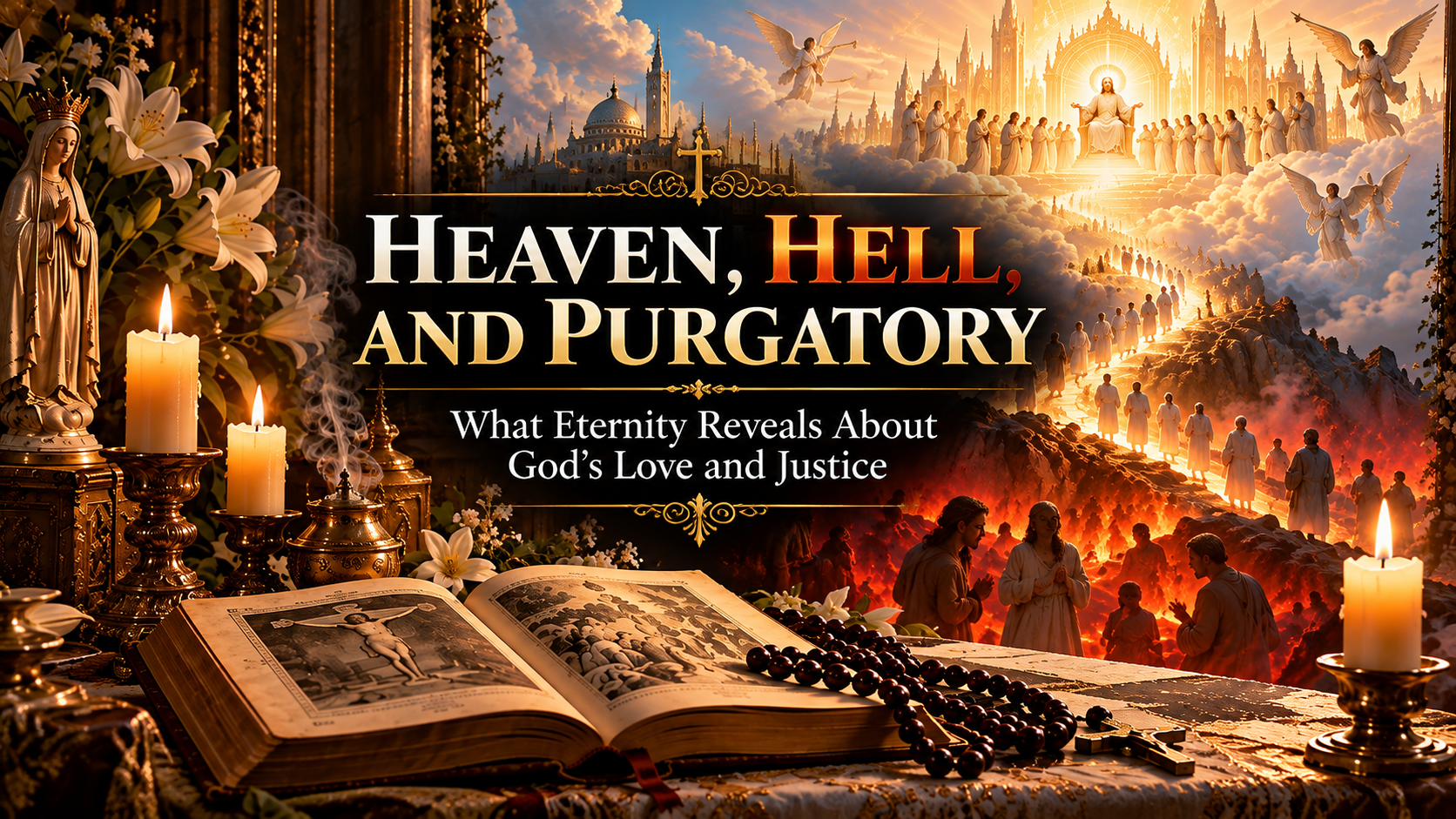
Remember Your Last End — Article 5 of 7
What does the Catholic Church really teach about our eternal destiny, and how do these truths illuminate the meaning of life today?
Scripture for Meditation: John 14:1–6; 1 Corinthians 2:9; Matthew 25:31–46; 2 Machabees 12:43–46; Revelation 21:1–5
Why eternity is more than a frightening question
When Christians speak of the Four Last Things—death, judgment, heaven, and hell—the subject can be presented as a list of threats. But these truths are not a collection of disconnected images. Together they reveal the seriousness of freedom, the perfection of God’s justice, the reality of His mercy, and the immeasurable good for which human beings were created.
The supplied edition of St. Alphonsus Liguori’s Preparation for Death lists considerations on heaven, mortal sin, mercy, and final perseverance in its table of contents. Those chapters are not included in the uploaded text. Accordingly, the detailed teaching of this article is taken from Sacred Scripture and the Catechism, not attributed to unseen passages of the saint.
The first question should not be “How frightening is eternity?” but “For whom was I created?” Christian teaching answers: we were made for communion with God. Heaven is the fulfillment of that calling. Hell reveals the dreadful possibility of a free and definitive refusal of that communion. Purgatory manifests the final purification of those who die in God’s friendship and are destined for heaven.
Each doctrine makes sense only when seen in relation to Jesus Christ.
Heaven is not simply an improved version of earth
Images of heaven often emphasize golden streets, bright clouds, gardens, or the reunion of loved ones. These images can awaken hope, but they must not obscure heaven’s essential reality.
The Catechism defines heaven as the ultimate end and fulfillment of the deepest human longings: the state of supreme, definitive happiness (CCC 1024). Those who die in God’s grace and friendship and are perfectly purified live forever with Christ (CCC 1023).
The deepest joy of heaven is the beatific vision: seeing God as He is. This does not make the saved equal to God or collapse the distinction between Creator and creature. It means that, by divine grace, the blessed are admitted to the direct contemplation of God’s own life.
Think of our search for truth. Every discovered truth awakens the desire to know more. Every genuine beauty seems to promise a fullness we cannot quite grasp. Every act of authentic love makes us aware of how limited and fragile earthly relationships can be. These longings point beyond themselves.
In heaven the soul is not simply distracted from sorrow by endlessly renewed pleasures. It is fulfilled by God Himself. The blessed live in communion with the Most Holy Trinity, the Blessed Virgin Mary, the angels, and all the saints (CCC 1024).
We should resist imagining heaven as passive boredom. Scripture’s images of worship and divine communion signify living fulfillment. The precise mode of heavenly life surpasses what we can presently imagine.
Why the resurrection of the body matters
Heaven is not the final abandonment of bodily existence. Catholic faith professes the resurrection of the body. At Christ’s return, God will raise the dead; the definitive renewal of creation belongs to His saving purpose (CCC 988–1019; 1042–1050).
This is essential because human persons are bodily and spiritual. Our bodies are not accidental containers. Through them we worship, serve, suffer, work, embrace, and perform acts of charity.
The Resurrection of Christ is the pledge of our own. As St. Paul insists in 1 Corinthians 15, Christian hope depends on the real Resurrection of Jesus.
We should not claim to know the exact physical appearance of glorified bodies or invent details beyond revelation. The Church teaches the truth of resurrection; she does not provide exhaustive descriptions of the transformed creation.
What we may affirm is profound enough: God does not abandon what He has made. In Christ, creation itself is destined for renewal.
Purgatory: purification for those already saved
Purgatory is often misunderstood as a third final destination between heaven and hell, or as a place where God grants a second chance to persons who have definitively rejected Him. Neither account is Catholic teaching.
The Catechism states that those who die in God’s grace and friendship but are still imperfectly purified undergo purification after death so as to achieve the holiness necessary to enter the joy of heaven (CCC 1030–1031).
Purgatory is for the saved. Its purification does not make Christ’s sacrifice inadequate. Every grace of salvation, including purification, flows from His merits.
Why is purification necessary? Because being reconciled to God and being perfectly free from every disordered attachment are not identical descriptions of the soul’s present condition. A believer can receive forgiveness and still struggle with habits, wounds, and attachments inconsistent with perfect holiness. God’s final purification brings the person wholly into the holiness of heaven.
The Church speaks of purifying fire in her tradition, but we should not treat every devotional image as a literal map. Neither Scripture nor the Catechism gives us measurements of purgatory’s duration or geography. We should be cautious about confidently describing experiences that revelation has not specified.
This teaching is hopeful: God completes the work of sanctification in those who die His friends.
Why Catholics pray for the dead
Because the Church believes in the communion of saints and the final purification of the saved, she offers prayer for the departed, especially the Holy Sacrifice of the Mass (CCC 1032).
Second Machabees 12:43–46 describes prayer and sacrifice for the dead in anticipation of the resurrection. This passage is part of the Catholic canon of Scripture and has long informed Catholic practice.
We cannot know the precise condition of particular departed persons. We pray not because we possess secret knowledge of their destiny but because charity can commend them to God’s mercy.
This practice also resists our culture’s tendency to forget the deceased as soon as public mourning concludes. Names may fade from conversation, but the Church continues to remember the dead before God.
A family can offer a Rosary for the departed, request a Mass intention, visit a cemetery reverently, and perform a work of mercy in a loved one’s memory. These are acts of living communion and hope.
Hell: the seriousness of freedom
The Church teaches that hell exists. The Catechism describes its principal punishment as eternal separation from God, in whom alone the human person can possess the life and happiness for which he was created (CCC 1035).
It also teaches that to die in mortal sin without repenting and accepting God’s merciful love means remaining separated from Him forever by one’s own free choice (CCC 1033).
This teaching cannot be reduced to a metaphor for earthly unhappiness. Jesus speaks with solemnity about judgment and eternal loss. We should neither erase His warnings nor turn them into spectacles designed to frighten the vulnerable.
A crucial safeguard is CCC 1037: God predestines no one to hell. For damnation, a willful turning away from God—a mortal sin—and persistence in it to the end are necessary.
The Church’s doctrine of mortal sin also requires grave matter, full knowledge, and deliberate consent (CCC 1857–1859). We cannot simply identify a visible bad act and conclude that we know another person’s eternal fate. Human freedom, knowledge, responsibility, repentance, and grace are more complex than outsiders can see.
Hell shows that love cannot be reduced to coercion. God takes our freedom seriously. Precisely because eternal communion with Him is our highest good, its definitive loss is dreadful.
Justice and mercy are not enemies
We sometimes imagine justice and mercy as opposed. Justice supposedly demands condemnation, while mercy asks God to ignore wrongdoing. This is too shallow.
God’s justice is the perfect truth of His holiness and governance. His mercy is not dishonesty about evil but the generous love by which He calls sinners to repentance and offers forgiveness through Jesus Christ.
The Cross reveals the seriousness of sin and the initiative of divine love. Christ died for us while we were sinners (Romans 5:8). His saving grace makes repentance possible. Yet salvation is not forced upon us against our freedom.
The right response to eternal realities is neither self-satisfaction nor panic. It is a life of faith, hope, and charity sustained by the sacraments, daily prayer, and genuine conversion.
Those prone to scrupulosity should avoid making private calculations about damnation. Trustful obedience to a prudent confessor is generally more fruitful than repeatedly seeking certainty where God calls us to hope.
Living today in the light of heaven
If heaven is union with God, then the Christian life cannot be organized around an entirely different ultimate purpose. Daily faithfulness is already training in the love that heaven perfects.
The person who receives the Eucharist with reverence is being drawn toward communion with Christ. The person who forgives by grace learns to prefer charity to vengeance. The person who serves the poor responds to the Lord who identifies Himself with those in need (Matthew 25:31–46).
And if purgatory teaches us that holiness must be complete, we should take sanctification seriously now. The appropriate response is not terror about unknown punishments, but a renewed desire to surrender sinful attachments to God’s grace.
If hell teaches us the seriousness of rejection, we should pray for conversion—our own and that of others—without presuming to judge souls.
Eternity should make Christians more loving, not merely more speculative.
The CatholicG33k Practice: Hope, purification, and mercy
During this week, read John 14:1–6 and Revelation 21:1–5. Reflect upon the desire for communion with God rather than attempting to construct a detailed picture of heaven.
Make one practical effort to detach from a disordered attachment. It might be resentment, vanity, dishonesty, or indulgence that weakens charity. Seek sacramental Confession when necessary.
Offer a decade of the Rosary or attend Mass for a deceased person. Pray for someone whose faith is weak or who has turned away from the Church. Perform one corporal work of mercy as an expression of your hope for eternal communion.
Finally, pray the Apostles’ Creed slowly, especially its profession of the resurrection of the body and life everlasting.
Questions for reflection
1. Do I imagine heaven mainly as receiving earthly pleasures, or as perfect communion with God?
2. How does knowing that purgatory is a purification of the saved correct common misunderstandings of Catholic teaching?
3. Does the reality of eternal freedom move me toward charity and conversion, or toward judging other people?
A prayer for eternal hope
Father, You made me for Yourself and call me to the joy of Your Kingdom. Turn my desires toward the good that does not pass away. Through Jesus Christ, free me from attachment to sin and teach me to welcome purification by Your grace. I entrust the faithful departed to Your mercy and ask that all who seek You may persevere in love. Keep me from presumption, despair, and harsh judgment of others. Fix my hope upon the Resurrection of Your Son and the life of the world to come. Amen.
Conclusion: Eternity changes the purpose of today
Heaven, hell, and purgatory are not themes for idle curiosity. Heaven reveals our destiny in God; hell warns of the dreadful possibility of rejecting Him; purgatory witnesses to the completion of His sanctifying mercy in those who die His friends.
The best way to take eternity seriously is to seek Christ faithfully today.
Sources and further reading
Primary spiritual context: St. Alphonsus Liguori, Preparation for Death: Prayers and Consolations for the Final Journey, ed. Norman J. Muckerman, C.Ss.R. (1998), editor’s Foreword and table of contents. The uploaded file does not contain the book’s listed chapters on heaven, mercy, or final perseverance. This article’s theological exposition is independently grounded in the sources below.
Sacred Scripture (Douay-Rheims): John 14:1–6; 1 Corinthians 15; Matthew 25:31–46; 2 Machabees 12:43–46; Romans 5:8; Revelation 21:1–5.
Catechism of the Catholic Church: CCC 988–1019 (resurrection); 1023–1029 (heaven); 1030–1032 (purgatory); 1033–1037 (hell); 1042–1050 (new creation); 1857–1859 (mortal sin).
Magisterium: Second Vatican Council, Lumen Gentium, 48–51; Gaudium et Spes, 18.
CatholicG33k — Faith. Truth. Reason.