

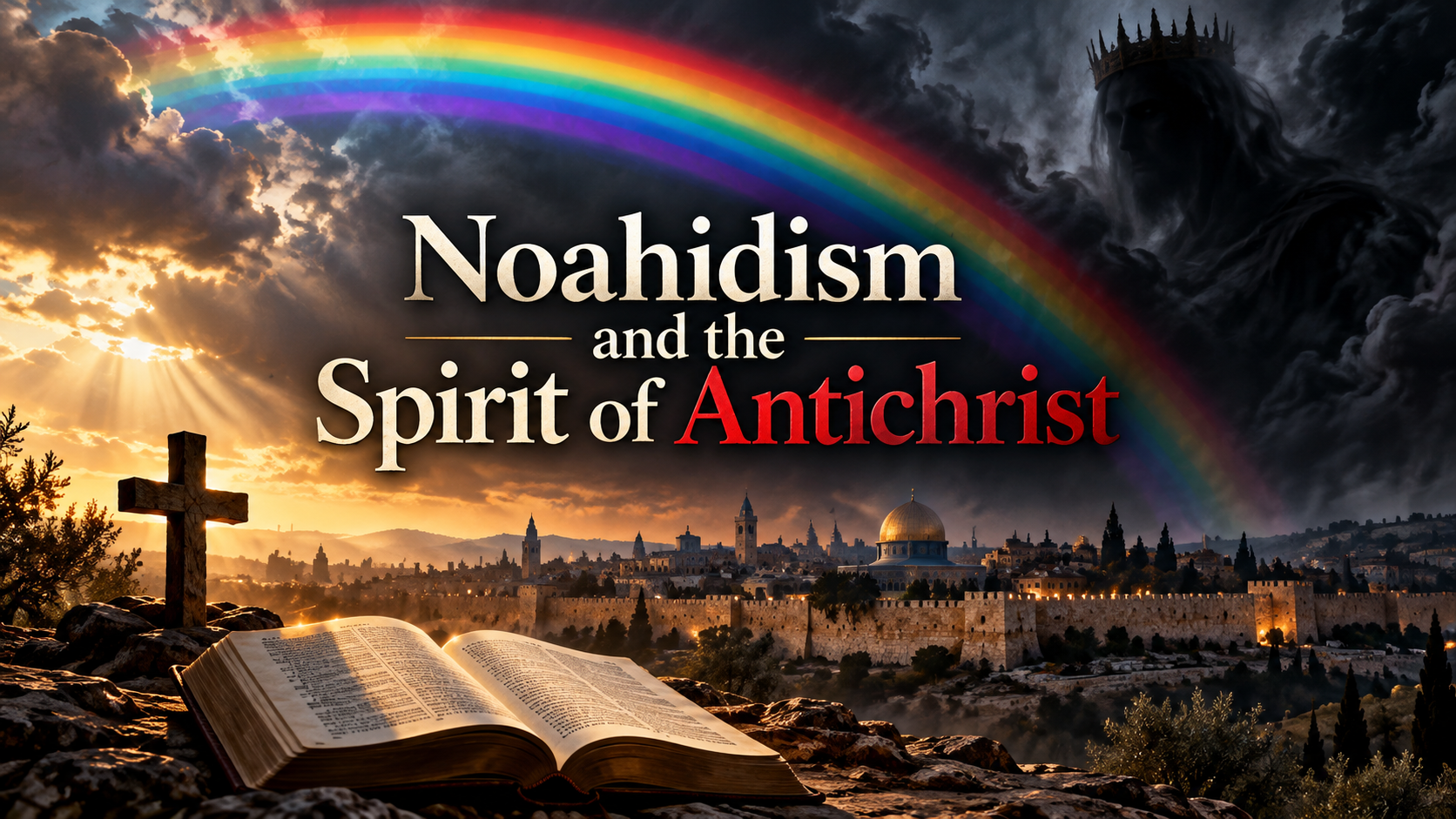
A Catholic Examination of the Emerging Global Noahide Movement, Its Religious Claims, and the Danger of a Universal Faith Without Jesus Christ
An examination in light of Sacred Scripture, Catholic Tradition, and the Magisterium
Introduction: Can Humanity Be United Under God While Rejecting His Son?
Throughout Christian history, the Church has encountered religious philosophies and movements promising to bring humanity into greater harmony through shared moral principles and belief in one God.
Some contain genuine moral truths. Others propose a spiritual path that conflicts with the fullness of divine revelation.
The modern Noahide movement presents a particularly important theological question.
Rooted in rabbinic Judaism, Noahidism proposes that non-Jews can live in a covenantal relationship with God by accepting and observing the Seven Laws of Noah without becoming Jewish or professing Christianity.
Its proponents envision a moral and spiritual framework capable of uniting people from many nations.
Yet Catholics must ask a question that reaches to the very heart of the Gospel:
Can a religious movement claiming to provide a divinely ordained path for the nations be accepted as sufficient when it does not acknowledge Jesus Christ as the incarnate Son of God, Messiah, and Redeemer?
Sacred Scripture offers a solemn warning:
“Who is a liar, but he who denieth that Jesus is the Christ? This is Antichrist, who denieth the Father, and the Son.”
— 1 John 2:22, Douay-Rheims
This verse provides the starting point for examining the Noahide movement’s theological relationship to what St. John calls Antichrist.
The argument must be made carefully. Rejecting the truth about Christ is an objective theological error. It does not follow that every adherent consciously intends to oppose Christ, participates in a conspiracy, or bears equal personal responsibility.
Nevertheless, Catholics cannot ignore the spiritual consequences of presenting religion without Christ as a complete path for humanity.
I. What Is Noahidism?
Noahidism is a modern religious movement based upon the rabbinic understanding of the covenant associated with Noah and his descendants.
Its central principles are commonly called the Seven Laws of Noah:
- Prohibition of idolatry.
- Prohibition of blasphemy.
- Prohibition of murder.
- Prohibition of prohibited sexual relations.
- Prohibition of theft.
- Prohibition of eating flesh taken from a living animal.
- Obligation to establish courts of justice.
These principles are developed within rabbinic tradition, particularly the Babylonian Talmud (Sanhedrin 56a–b) and Maimonides’ Mishneh Torah, Laws of Kings and Wars, chapters 8–9.
Several express genuine moral truths recognized by Catholic teaching.
The prohibition of murder, for example, agrees with the Fifth Commandment. The prohibition of theft agrees with the Seventh Commandment. The requirement to establish justice corresponds to obligations flowing from the natural moral law.
The difficulty is not that these principles are inherently evil.
The theological difficulty arises when observance of these principles is proposed as a sufficient religious path for humanity apart from the explicit confession of Jesus Christ and the New Covenant.
Maimonides teaches that a non-Jew who properly accepts and observes the Seven Commandments belongs among the righteous of the nations and merits a share in the world to come (Mishneh Torah, Laws of Kings and Wars 8:11).
That claim belongs to a Jewish theological framework. Catholic theology cannot accept it as an independent saving dispensation alongside the redemption accomplished by Jesus Christ.
For Catholics, salvation comes through Christ, even when God grants salvation to persons who, through no fault of their own, do not explicitly know Him.
The distinction is fundamental.
II. The Noahic Covenant Was Real, but It Was Not the Fullness of Revelation
The Catholic Church affirms that God established a covenant with Noah.
Genesis 9:8–17 describes God’s covenant with Noah, his descendants, and living creatures. Its visible sign is the rainbow.
The Catechism of the Catholic Church, paragraphs 56–58, recognizes this covenant as an authentic stage in the history of salvation.
However, divine revelation did not end with Noah.
God subsequently called Abraham, formed Israel, spoke through Moses and the prophets, and finally revealed Himself definitively through His Son.
The Epistle to the Hebrews states:
“God, who, at sundry times and in divers manners, spoke in times past to the fathers by the prophets, last of all, in these days hath spoken to us by his Son.”
— Hebrews 1:1–2, Douay-Rheims
The Church therefore understands the Noahic covenant within the larger unity of salvation history.
It prepares humanity for the ultimate revelation of God in Jesus Christ.
Indeed, the Catechism teaches that the covenant with Noah remains significant within the history of the nations, awaiting the universal proclamation of the Gospel (CCC 58).
Noah’s ark itself prefigures the salvation offered through Baptism (CCC 1219; 1 Peter 3:20–21).
Thus, from the Catholic perspective, a return to Noah that treats Christ as unnecessary reverses the proper direction of salvation history.
The Christian movement of salvation history is not from Christ back to Noah, but from Noah toward Christ.
A religious system can preserve elements of the ancient covenant while still failing to acknowledge the fullness toward which that covenant points.
III. The Fundamental Conflict: The Rejection of Jesus Christ
The defining doctrinal difference between Catholic Christianity and Noahidism concerns the identity of Jesus Christ.
Catholic Christianity proclaims that Jesus is the eternal Son of God, consubstantial with the Father, made man for the salvation of humanity.
He is not merely a prophet, teacher, or religious reformer.
He is God incarnate.
Jesus declares:
“I am the way, and the truth, and the life. No man cometh to the Father, but by me.”
— John 14:6, Douay-Rheims
St. Peter likewise proclaims:
“Neither is there salvation in any other. For there is no other name under heaven given to men, whereby we must be saved.”
— Acts 4:12, Douay-Rheims
These are not peripheral Christian assertions. They express the foundation of the Catholic faith.
Modern Noahidism, understood according to its rabbinic religious framework, does not profess that Jesus is the divine Messiah and Savior.
For that reason, its understanding of God’s relationship with humanity differs fundamentally from the Gospel.
The Congregation for the Doctrine of the Faith reaffirmed this teaching in Dominus Iesus (2000), particularly paragraphs 13–15 and 20.
The document rejects theories that undermine the uniqueness and universal saving significance of Jesus Christ.
Catholics therefore cannot affirm a separate religious economy that makes Christ unnecessary.
There may be moral truths within Noahidism.
There may be sincere religious devotion among Noahides.
Yet neither moral goodness nor sincere devotion eliminates the doctrinal contradiction between the Noahide framework and the Catholic confession of Christ.
IV. Why St. John’s Teaching About Antichrist Matters
The word Antichrist is frequently associated with a final figure who will oppose Christ before His glorious return.
Sacred Scripture, however, also describes a broader phenomenon.
St. John writes:
“Little children, it is the last hour: and as you have heard that Antichrist cometh, even now there are become many Antichrists.”
— 1 John 2:18, Douay-Rheims
He identifies denial of Jesus as the Christ as a defining characteristic of antichristic error (1 John 2:22–23; 4:3; 2 John 7).
We must distinguish three matters.
First, there is opposition to the truth about Christ.
A doctrine contradicting Christ’s identity or saving mission is objectively opposed to Christian revelation.
Second, there is the spirit of Antichrist.
In the Johannine writings, this language concerns false teaching about Jesus. In its immediate historical context, 1 John also addresses persons who had departed from the Christian community (1 John 2:19).
Consequently, one should not simply apply every biblical reference to Antichrist indiscriminately to all non-Christian believers.
Nevertheless, Christian theology may recognize an analogous antichristic tendency whenever a religious message actively replaces or contradicts the truth of the incarnate Son.
Third, there is the supreme deception associated with the final Antichrist.
The Catechism, paragraphs 675–677, describes the final religious trial facing the Church.
This deception offers humanity an apparent solution to its problems at the cost of abandoning divine truth.
These distinctions are important.
The Noahide movement’s rejection of Christian claims about Jesus creates a real doctrinal contradiction. Where Noahidism becomes a substitute for Christian faith, it can function as a movement away from Christ.
That is a defensible Catholic warning.
It is not, by itself, proof that the movement is the final Antichrist or that its members deliberately seek to advance an apocalyptic conspiracy.
V. A Global Noahide Movement Is Now Being Organized
The Noahide World Center, also known as Brit Olam, promotes the Seven Laws of Noah and provides religious instruction for non-Jewish communities.
Its announced First International Congress of Noahides is scheduled for Jerusalem on November 2–6, 2026.
According to the organization’s congress materials, participants are expected to help establish shared religious infrastructure, including:
- A founding charter and structured membership.
- A coordinated educational syllabus and religious publications.
- Regional councils.
- A financial and organizational foundation.
- An international Beit Din, or rabbinical court of religious guidance.
The organizers describe a reception at the residence of Israel’s president. Such a reception, if held as planned, would represent an important public recognition of the congress, but not a transfer of governmental authority.
The planned Beit Din is explicitly described as advisory, without criminal jurisdiction over nonparticipants.
These distinctions matter.
There is documented evidence of a serious organizational effort. There is no justification in the published congress program for claiming that its court will acquire worldwide legal authority or that Christians will be forcibly subjected to its decisions.
The theological question is different and more substantial.
What happens when a religious framework that does not confess Christ becomes an increasingly organized global spiritual alternative?
From a Catholic perspective, organizational growth can increase the reach of both genuine moral insights and theological error.
A coordinated international teaching structure may transmit the movement’s distinctive understanding of revelation to people who previously identified as Christians.
This concern is not purely hypothetical.
Religious scholar Rachel Z. Feldman has documented contemporary Noahide communities, including former Christians who adopted Noahide religious identities. Her research appears in Nova Religio (2018) and Messianic Zionism in the Digital Age (2024).
Such conversions require careful consideration by Catholic pastors and apologists.
The issue is not the ethnic or religious identity of Noahide teachers.
It is the abandonment of faith in Jesus Christ.
VI. The Prophetic Language of the Jerusalem Congress
One of the congress’s most significant theological features is its use of biblical prophecy.
Its promotional material invokes Zechariah’s prophecy concerning the nations joining themselves to the Lord and presents the Jerusalem gathering as a moment of historical religious fulfillment.
In the Douay-Rheims Bible, Zechariah 2:11 states:
“And many nations shall be joined to the Lord in that day, and they shall be my people.”
The congress materials, following another biblical numbering tradition, identify this passage as Zechariah 2:15.
The organizers proclaim that the anticipated day of gathering has arrived.
Catholics should examine that interpretation closely.
The Church reads the prophets in the light of Jesus Christ.
The gathering of the nations cannot be separated from the Messiah through whom the Father reconciles humanity.
St. Paul teaches that Christ has broken down the dividing wall between Jew and Gentile, making one people through His Cross (Ephesians 2:11–22).
The unity of the nations is therefore not merely political, geographical, or ethical.
Its deepest foundation is Christ Himself.
There is a significant difference between welcoming people from many nations into a religious congress and fulfilling the divine promise of humanity’s reconciliation in the Messiah.
The former is an observable organizational event.
The latter is a theological reality revealed through Christ and ultimately perfected by God.
A Catholic cannot accept a definitive interpretation of messianic prophecy that bypasses the Messiah whom the Church confesses.
This concern becomes especially relevant to the Catechism’s warning against attempts to present a historical movement as the realization of humanity’s ultimate messianic hope (CCC 676).
Still, the precise deception described by the Catechism should not be identified with the Noahide congress without further evidence. The congress’s prophetic language invites theological criticism; it does not establish an apocalyptic identity.
VII. Natural Moral Law Cannot Replace Supernatural Grace
A central difficulty with presenting the Seven Noahide Laws as a sufficient spiritual program concerns the difference between moral law and saving grace.
Catholic theology distinguishes the natural moral law, knowable through human reason, from the supernatural grace of redemption.
Human beings can understand many fundamental moral duties through reason.
For example, murder is wrong because it violates the dignity of human life. Theft is wrong because it violates justice.
The Catechism explains the natural moral law in paragraphs 1954–1960.
St. Thomas Aquinas likewise teaches that natural law is humanity’s participation in the eternal law (Summa Theologiae, I–II, q. 91, a. 2).
Yet knowledge of morality is not identical to salvation.
Because humanity is wounded by sin, we need more than instructions about what is right.
We need reconciliation with God, forgiveness of sins, sanctifying grace, and the supernatural life made possible through Jesus Christ.
The New Law is not merely a better list of commandments.
It is the grace of the Holy Spirit given through Christ (CCC 1965–1966; Summa Theologiae, I–II, q. 106, a. 1).
A person may observe moral commandments and still lack the fullness of explicit Christian faith.
Therefore, any religious system that treats observance of a limited universal moral code as a complete substitute for Christ’s redemptive work conflicts with Catholic soteriology—the Church’s doctrine of salvation.
Morality tells humanity how to act. Jesus Christ does what no moral code can accomplish on its own: He redeems fallen humanity and communicates divine life.
VIII. Did the Apostles Establish a Noahide Alternative for Gentiles?
Some discussions of the Seven Noahide Laws appeal to Acts 15 and the Council of Jerusalem.
The apostles decided that Gentile converts to Christ did not need to accept the entire Mosaic Law.
They also instructed Gentile believers to abstain from certain practices, including idolatrous pollution and sexual immorality (Acts 15:19–29).
There are similarities between some of these instructions and moral concerns addressed within the Noahide tradition.
But the Council of Jerusalem did not establish a non-Christian religion for Gentiles.
The entire discussion presupposed faith in Jesus Christ.
St. Peter declared:
“But by the grace of the Lord Jesus Christ, we believe to be saved, in like manner as they also.”
— Acts 15:11, Douay-Rheims
The issue was whether Gentile Christians needed to become observant Jews under the Mosaic Law, not whether they could replace faith in Christ with another religious covenant.
The answer of the apostles preserved the universality of salvation through Jesus.
The Catholic Church therefore cannot interpret Acts 15 as authorization for a separate, Christless religious path.
IX. The Genuine Danger: A Religious Unity That Leaves Christ Behind
The aspiration toward peace among nations is not evil.
Justice, charity, honesty, and respect for human life are indispensable to a good society.
The danger arises when religious unity is sought by making the defining truth of Christianity optional or unnecessary.
A religious vision might invite humanity to acknowledge one Creator, establish common ethical standards, and recognize shared spiritual responsibilities.
Those goals can contain substantial moral value.
But from the standpoint of Catholic revelation, they are not sufficient to constitute the fullness of communion with God.
Jesus Christ is not an optional addition to a universal moral religion.
He is the mediator of the New Covenant.
The Epistle to Timothy declares:
“For there is one God, and one mediator of God and men, the man Christ Jesus.”
— 1 Timothy 2:5, Douay-Rheims
A global religion that knowingly presents a complete path to divine fulfillment while excluding Christ raises a profound theological concern.
Where such a system leads baptized Christians to abandon their profession of Jesus as Lord, it becomes an instrument of apostasy from the Christian faith.
This is the strongest sense in which Catholic theologians may identify an antichristic tendency: a religious promise of truth or salvation that displaces the unique mediation of Christ.
Yet theological resemblance must not be confused with proof of an organized plan to bring about the final Antichrist.
The Catechism’s description of the final deception is more specific than merely the existence of a growing non-Christian religion.
X. The Catholic Church’s Teaching on the Jewish People Must Also Be Respected
An authentic Catholic defense of Christ must never become hostility toward the Jewish people.
Jesus Christ was born of the Jewish people.
The Blessed Virgin Mary, the apostles, and the earliest disciples belonged to Israel.
The Old Testament is the inspired Word of God and an indispensable part of the Christian Scriptures.
The Second Vatican Council’s declaration Nostra Aetate, paragraph 4, explicitly rejects antisemitism and the portrayal of the Jewish people as rejected or cursed by God.
The Catechism likewise recognizes the enduring and unique relationship between the Church and the Jewish people (CCC 839–840).
Consequently, it would be wrong to claim that Jews collectively constitute Antichrist, that Judaism is inherently a secret conspiracy, or that every Noahide participant knowingly serves evil.
Catholic doctrine permits a firm and uncompromising rejection of teachings incompatible with the Gospel.
It does not permit hatred or unjust accusations against the people who hold those teachings.
Furthermore, the Church teaches that persons who, through no fault of their own, do not know Christ and His Church may nevertheless attain salvation through God’s grace (CCC 846–848).
This does not create an independent source of salvation apart from Christ. It acknowledges that the saving grace of Christ can operate in ways known fully to God.
The Catholic response must therefore combine doctrinal clarity with justice and charity.
XI. How Catholics Should Respond
Catholics should neither dismiss the theological significance of Noahidism nor sensationalize it.
The appropriate response begins with a renewed confession of Jesus Christ.
Catholic families, educators, priests, and apologists should explain the relationship between the Old and New Covenants, the divinity of Christ, the necessity of grace, and the nature of salvation.
Particular care should be given to Christians attracted to Noahidism because of questions about the Trinity, biblical interpretation, the history of the Church, or Jewish religious tradition.
These questions deserve serious theological answers.
Catholic apologetics should also examine the religious claims made by contemporary Noahide organizations, distinguish authentic moral truths from incompatible doctrines, and challenge claims of messianic fulfillment that exclude Jesus Christ.
Such engagement must be truthful, peaceful, and free from religious prejudice.
Above all, the Church must proclaim the risen Christ rather than allow fear of an imagined conspiracy to obscure the Gospel.
Conclusion: The World Does Not Need a Saviorless Covenant
The modern Noahide movement presents Catholics with a genuine doctrinal challenge.
It promotes belief in the Creator and several authentic moral principles, while offering non-Jews a religious identity and path grounded in rabbinic teaching rather than faith in Jesus Christ.
Its increasing international organization deserves careful attention, particularly when Christians abandon their profession of Christ to embrace that path.
The Catholic Church can recognize the good found within its moral teachings without accepting its religious claims as a sufficient alternative to the Gospel.
St. John’s warning about the denial of the Son provides a serious theological lens through which to examine any doctrine that leads people away from Christ.
The Catechism’s teaching on Antichrist further reminds Catholics that apparent spiritual solutions can become deceptive when they demand abandonment of revealed truth.
Nevertheless, responsible Catholic theology must distinguish antichristic doctrinal tendencies from claims about the final Antichrist, and must not attribute hidden intentions or collective guilt without evidence.
The central issue is not Jerusalem, a rabbinical council, an international congress, or the ethnic identity of those involved.
It is Jesus Christ.
Humanity cannot attain its ultimate supernatural destiny through an ethical code alone.
It needs the Redeemer.
The Church’s answer to every proposal for a universal religious order without Christ must remain the same: the true unity and salvation of humanity are found in Jesus Christ, crucified and risen.
The Christian mission is not to spread fear, but to announce that salvation has already entered human history in the person of the incarnate Son of God.
Principal References
Sacred Scripture — Douay-Rheims Bible
- Genesis 9:8–17; Zechariah 2:10–11.
- John 14:6; Acts 4:12; 15:7–29.
- Ephesians 2:11–22; 1 Timothy 2:5.
- Hebrews 1:1–2; 1 Peter 3:20–21.
- 1 John 2:18–23; 4:1–3; 2 John 7.
Catholic Magisterium
- Catechism of the Catholic Church, §§56–58, 674–677, 839–848, 1219, 1954–1960, 1965–1967.
- Second Vatican Council, Nostra Aetate (1965), §4.
- Congregation for the Doctrine of the Faith, Dominus Iesus (2000), §§13–15, 20.
- Second Vatican Council, Lumen Gentium (1964), §16.
Theological and Historical Sources
- St. Thomas Aquinas, Summa Theologiae, I–II, q. 91, a. 2; q. 106, a. 1; q. 107, a. 1.
- Babylonian Talmud, Sanhedrin 56a–b.
- Maimonides, Mishneh Torah, Laws of Kings and Wars, 8:11 and 9:1.
- Rachel Z. Feldman, “The Children of Noah: Has Messianic Zionism Created a New World Religion?” Nova Religio, 22, no. 1 (2018), pp. 115–128.
- Rachel Z. Feldman, Messianic Zionism in the Digital Age: Jews, Noahides, and the Third Temple Imaginary (Rutgers University Press, 2024).
Contemporary Movement Sources
- Brit Olam–Noahide World Center, What Is a Noahide?
- Brit Olam–Noahide World Center, The Seven Laws of Noah.
- Brit Olam–Noahide World Center, First International Congress of Noahides, announced for November 2–6, 2026.
Research and congress information reviewed October 23, 2026. Planned events and proposed organizational structures are distinguished from completed events.